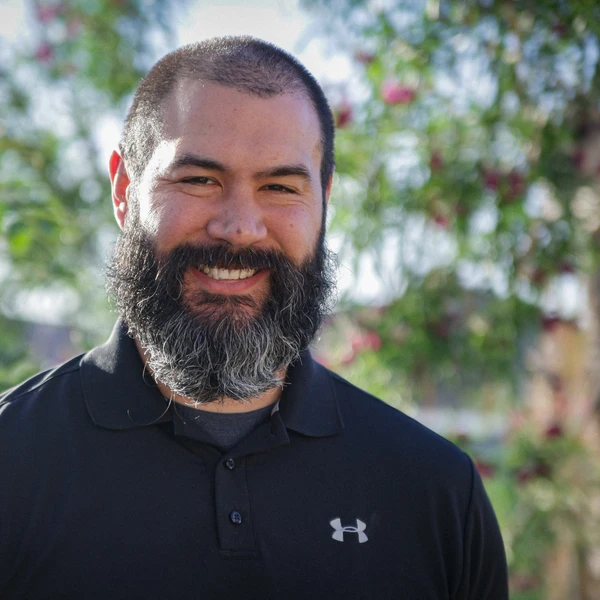
The Gospel of Matthew, Jesus calls out to ordinary fishermen with a profound invitation, "Follow me, and I will make you fishers of men." This call was not to a life of comfort or prestige, but to a life of pulling people out of turbulent, dangerous waters and into the safety of a loving community. For the past several years, I have tried to echo that call in the West Valley of Arizona. At 6-foot-4, weighing 250 pounds, and wearing a full beard, I am often told I look more like a bouncer, a soldier, than a pastor or counselor. Yet, God has given me this specific physical presence to use as a shelter. In the Title 1 schools where I serve as an Area Director for Young Life, a youth outreach and mentorship ministry, my size and soft and humorous demeanor has allowed me to become a "gentle giant" a safe harbor for marginalized and at-risk teenagers navigating environments filled with chaos.
Rather than in a clinical classroom, my most profound education in mental health occurred in the trenches of my own community. Serving on the front lines, I witness daily the adolescent mental health crisis ravaging this generation. For years, my ministry was purely relational and spiritual. I connected with youth experiencing deep poverty, severe anxiety, and complex trauma. As a mentor, I simply showed up, shared a cup of coffee, and used a Socratic approach to hear their fears and doubts, believing that every person deserves to be valued as God created them. But in 2023, our local school board voted to eliminate licensed social workers and campus mental health counselors due to budget constraints, shattering our community’s safety net. With these campus triage units dismantled overnight, the crisis landed directly on my shoulders. I found myself in living rooms late at night, intervening in suicide attempts, and sitting with victims of severe abuse. Holding onto drowning teenagers in these deep waters brought a heartbreaking realization, empathy without clinical training is fundamentally incomplete. While I could offer a compassionate ear and the love of Christ, I lacked the professional psychological methodology necessary to triage their profound trauma.
Sitting with an actively suicidal teenager brought a profound realization, faith demands not just action, but thorough preparation and rigorous equipping. This fundamentally transformed my spiritual perspective on service. While God calls us to stand in the gap, He also requires that we gather the necessary tools to construct a resilient bridge. I came to see that spiritual, emotional, and mental well-being are deeply interconnected, treating a youth's spiritual hopelessness is so difficult without also addressing the psychological and physiological trauma that alters their brain. My faith has transitioned from a solely pastoral model to a deeply integrated perspective. I firmly believe that clinical competence and spiritual truth act as complementary lifelines rather than opposing forces. To follow Christ's example of healing the entire person and truly become "fishers of men" today, we must be prepared to confront the intricate psychological bounds of mental illness, trauma, and addiction that pull our youth into darkness.
This shift in my convictions demanded a profound transformation in my relationships, starting with my own family. Answering this calling meant completely redirecting my life. For fourteen years, I enjoyed a successful corporate management career, leading 135 employees and providing stable security for my wife and four children. However, witnessing the urgent mental health crisis in my community made it impossible to stay in that comfortable corporate world. I made the frightening decision to resign, trading a stable salary of only a $250 monthly stipend in full-time vocational ministry,a transition requiring immense, shared sacrifice from my wife and children. We face severe financial and logistical pressure as a "triple tuition" household, with my wife, my daughter, and myself all enrolled in university simultaneously. Yet, this struggle has only deepened our family ties and solidified our shared principles. My children are witnessing us carry on a legacy inherited from my father. As a Latino farm worker, my father's path was transformed in the 1960s when a Christian mentor invested in him, enabling him to become a high school teacher. He taught me that when you cross the bridge of opportunity, you do not pull it up behind you; you widen it. By sacrificing our family's comfort, we are modeling for my children that love for our neighbors is defined by our willingness to sacrifice.
Driven by this crisis and anchored by my faith, I am currently pursuing a Bachelor of Science in Counseling and Applied Psychological Science at Arizona State University. My ultimate career aspiration is to become a Licensed Professional Counselor (LPC) and to subsequently pursue a Master of Divinity at Dallas Theological Seminary. I intend to use this combined education to establish a nonprofit, community-based counseling center in the West Valley. This clinic will serve as a sanctuary where clinical excellence intersects with genuine, faith-driven accessibility, ensuring that no student or family is ever turned away due to an inability to pay. We will meet adolescents in their darkest moments, whether they are battling severe depression, trauma, or the co-occurring substance abuse that so often accompanies deep pain, and we will offer them a comprehensive path to healing.
The legacy of Dima Kapelkin reminds us that a life lived for Jesus and for others is a life beautifully spent. We are surrounded by a generation adrift in a turbulent sea of mental illness and isolation. They need compassionate professionals willing to wade into the deep, messy waters to pull them out. I am dedicating the rest of my professional and personal life to being that advocate, combining the unconditional love of Christ with the rigorous clinical tools necessary to heal broken minds. Receiving the Fishers of Men-tal Health Scholarship would be a profound blessing for my family, easing the heavy burden of our triple-tuition reality, and empowering me to cast a wider net of hope, healing, and restoration for the youth who desperately need it.