user profile avatar

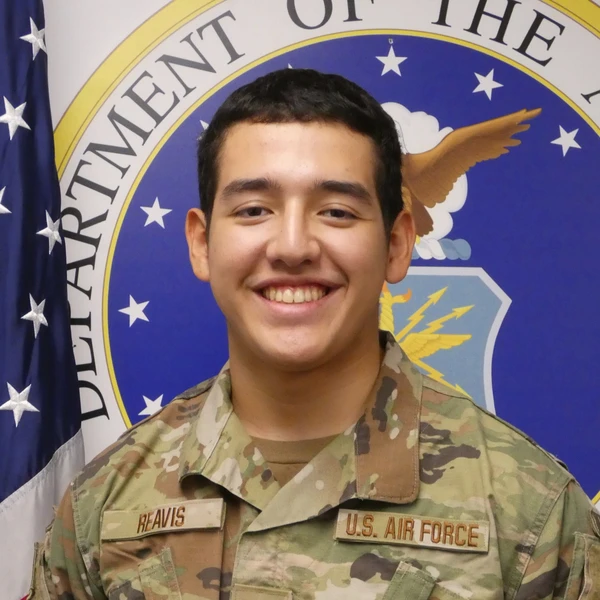
Joseph Reavis

1x

Finalist

1x

Winner

Bio

I am a first-generation college student and third-year Chemistry undergraduate at the University of Southern California, pursuing a B.S. with an emphasis in Nanoscience. I carry my education without family financial support, working part-time while averaging 19 units per semester, conducting undergraduate research in the Takahashi Group on quantum and classical chemical systems, and serving as a cadet officer in Air Force ROTC — where I have held the roles of Wing Superintendent and Training Officer, responsible for the training and development of over 100 cadets. Outside of those commitments, I tutor algebra, chemistry, and English to underserved high school students across Los Angeles through USC Med-COR, and compete as a triathlete and combat sports athlete. My goal is to commission as an Air Force officer, fly search-and-rescue missions, and return to my community in Las Vegas to open free tutoring, college prep, and youth aviation programs for students who grew up the way I did. Everything I am building is in service of that.

Education

University of Southern California

Bachelor's degree program
2023 - 2027
  • Majors:
    • Nanotechnology
    • Chemistry
  • GPA:
    3.5

Rancho High School

High School
2019 - 2023
  • GPA:
    3.9

Miscellaneous

  • Desired degree level:

    Master's degree program

  • Graduate schools of interest:

    • Georgetown University
    • Johns Hopkins University
  • Transfer schools of interest:

  • Majors of interest:

    • International Relations and National Security Studies
    • Intelligence, Command Control and Information Operations
  • Not planning to go to medical school
  • Career

    • Dream career field:

      • Aviation & Aerospace
    • Dream career goals:

      Finish an eventful and fulfilling career in the United States Air Force as a search-and-rescue pilot. Afterwards, return to my community in Las Vegas and introduce underserved youth to opportunities in aviation and flight.

    • Wing Superintendent

      AFROTC Detachment 060
      2024 – 20251 year
    • Training Officer

      AFROTC Detachment 060
      2025 – 20261 year
    • Learning Facilitator

      USC Med-COR
      2023 – 20252 years
    • Recreational Assistant

      Clark County Parks and Recreation
      2022 – 20253 years

    Sports

    Wrestling

    Club
    2024 – 20251 year

    Triathlon

    Club
    2024 – Present2 years

    Research

    • Chemistry

      USC — Research Assistant
      2024 – Present

    Arts

    • Jazz Band

      Music
      2022 – 2023
    • Marching Band

      Music
      2021 – 2023

    Public services

    • Volunteering

      Airmen of Troy — Assistant
      2023 – Present
    • Volunteering

      Pi Kappa Phi — Volunteer
      2025 – Present

    Future Interests

    Advocacy

    Volunteering

    Philanthropy

    Entrepreneurship

    Bick First Generation Scholarship
    "First-generation student" is a term that means something different to everyone. To me, its definition began with a single image: at 12 years old, watching my mother struggle to fill out a form written in a language she did not understand. I stood beside her, watching her reread the English words as if one more read over would make it click. At that moment, I understood my education would not just be mine. It would be the answer to every form she couldn't read, and every door she couldn't open on her own. I am the proud son of a Mexican immigrant, raised in Las Vegas, Nevada, in a household where college was a fantasy dream without a roadmap. Neither of my parents attended college, and neither could guide me through a system they'd never been part of. No one was around to explain a syllabus, how FAFSA worked, or how to apply for housing. I learned by doing, failing, and refusing to let confusion become an excuse to stop. Because of my efforts, I currently study chemistry with an emphasis in nanoscience as a third-year undergraduate at the University of Southern California. Between nearly 40 hours of class time and about 20 hours of work weekly to cover what financial aid does not, there is little room for rest. Every late night studying after a shift, every assignment finished on a break, has carried the same weight my mother carried filling out that form years ago. Alongside my coursework, I tutor for USC's Med-COR program, teaching algebra, chemistry, and English to high school students across greater Los Angeles. I've worked with over 100 students, mentoring them not just in these subjects but through the college application process, showing each one that higher education is within reach. I also serve as a cadet in Air Force ROTC, working toward a commission as an officer. My ultimate goal is to fly the CV-22 Osprey as a search and rescue pilot, conducting personnel recovery for service members who cannot get themselves home. Both pursuits come from the same place: knowing what it costs to navigate something alone, and wanting to be the one who steps in when there is no one else. Where I am now is not the result of a single decision. It has been a string of small efforts, repeated daily, until they built into something bigger than myself. This scholarship would not change my determination, but would help close the gap for my tuition, reduce my working hours, and allow me to focus on the degree I've spent so much energy and time earning. It would mean finishing this degree the way my parents deserve to see it finished: without compromise. Being a first-generation student is by no means easy, but I would not have it any other way. I intend to make sure the sacrifices and work of my parents will never be in vain, one degree, one commission, and one rescue at a time.
    Sloane Stephens Doc & Glo Scholarship
    When I was twelve, I watched my mother fill out a form she couldn't fully read, in a language she was still learning, alone. No one had told her there was help available. That image has never left me. I learned early that opportunities are not evenly distributed; many families in my neighborhood navigate poverty, language barriers and the absence of connections that open doors for other kids. I was one of those kids. No one in my immediate family had gone to college, no one knew what a STEM pipeline looked like, let alone how to apply to a college. I figured it out anyway, and now I am a third-year Chemistry student with an emphasis in Nanoscience at the University of Southern California. But the version of me that made it to USC is not who this essay is about. This essay is about the two people who made the journey worth it, my younger brothers, and the community of kids in Las Vegas who deserve the same chance I fought to find. My brothers are my clearest mirror and my loudest motivation. Every resource I lacked, every mentor I needed, every moment I almost quit, I saw the same conditions waiting for them as they got older. The last thing I wanted was for them to have to fight as hard as I did simply to access what should be foundational and universal. That desire to clear a path for them has grown into something larger: a responsibility to every child in our community who is navigating the same invisible ceilings. That responsibility has already taken concrete shape today. Through the organized mentoring and tutoring program USC Med-COR, I have helped over 120 children in the Greater LA area in subjects like algebra, chemistry and English, all while advising and counseling them in the process of getting into college. I got to work directly with students who, like me, are first-generation and under-resourced. Watching a student grasp something they wrote off as “not for them” cannot be overstated. That feeling is a confirmation that the gap between these kids and their potential is nothing more than a matter of access. My long-term vision extends that principle into the sky, literally. After I graduate, I intend to establish a youth aviation program for underserved children in the Las Vegas area. This program would introduce young people to flight experiences, ground school fundamentals, and direct contact with working aviators who can serve as proof that these careers are attainable. Aviation sits at the intersection of science, mathematics, discipline and most importantly, wonder, all while the diversity of the field remains narrow. That is a problem my background is uniquely positioned to address. My degree in Chemistry and Nanoscience is not incidental to this vision. It gives me scientific credibility, research fluency, and the technical foundation to speak the language of aerospace with authority. When I stand in front of a child from a neighborhood like mine and say that this path is open to them, I want to be proof of that path. Sloane Stephens built her foundation on the belief that underserved youth deserve access to the spaces where greatness is cultivated. That belief resonates with me precisely because I grew up on the outside of those spaces. This scholarship would directly support my ability to remain focused on both my academic work at USC and the community-building I am committed to carrying out in Las Vegas. The two are inseparable. My education is not a finish line. It is the infrastructure for everything I intend to build.
    Patriots Path Scholarship
    Winner
    My name is Joseph Reavis. I am a third-year undergraduate at the University of Southern California pursuing a Bachelor of Science in Chemistry with an emphasis in Nanoscience (current 3.52 GPA), and a cadet in the USC Air Force ROTC detachment. The choice to pursue a career in the military was not born from family tradition or circumstance, but rather an idea that I could never ignore: I cannot ask someone to do something I am unwilling to do myself. That guiding principle has shaped every decision I have made in and out of uniform. Within ROTC, I have served as Wing Superintendent, coordinating performance and training feedback for a GMC corps of over 60 cadets, and later as a Training Officer, responsible for designing and executing weekly training plans for a Wing of more than 100 cadets. These positions reach beyond organizational competence, and demand that I earn trust, communicate clearly and hold myself to a higher standard than the standard I set for others. I welcome that accountability, and it is the reason I chose this path. As a cadet, I had the incredible opportunity to attend AM-490 “Freefall” at the United States Air Force Academy, a program that concentrates everything I’ve learned in ROTC into real, high-stakes execution; the margin for hesitation is zero when one is standing in the door of an aircraft 5000 feet in the air. The program sharpened something in me that training alone cannot replicate: the ability to act with precision when the consequences are real. It is the kind of readiness I intend to bring into every leadership role I hold as a commissioned officer. Outside of ROTC, I have forged physical and mental discipline through combat and endurance sports. I trained for two years with USC Mixed Martial Arts and the Wrestling team, disciplines that demand composure when the conditions are worst and everyone wants to go home. Now, I train individually as a triathlete, teaching me a different kind of toughness; one that is built in the long hours on my own where no one is holding me accountable but myself. These endeavors serve not just to make me a better athlete, but also to make me more effective as a leader, and help myself and others to keep going when it would be easier to stop. My work in academics is equally important to me. I conduct quantum mechanics and systems research in the Takahashi Group at USC. The work demands rigorous thinking, tolerance for ambiguity and the willingness to be wrong in the pursuit of something correct. I believe these qualities are directly relevant to military development, as the Air Force increasingly operates at the crossroads of advanced science and national security. I intend to bring a technical foundation and an unmatched sense of responsibility to that space. To me, service is not a detour from a fulfilling life, but rather the whole point of it. I think about the cadets and Airmen I have worked with, the ones who showed up uncertain and left sharper, more intelligent and more capable. That is the kind of work I want to spend my life doing, because nothing else I have done has felt nearly as worthwhile. The support of this organization would allow me to stay fully committed to that: to finish a demanding degree, commission as an officer, and begin repaying what this country has made possible for me.
    RonranGlee Literary Scholarship
    Selected Passage: “Of things, some are in our power, and others are not. In our power are opinion, motivation, desire, aversion, and, in a word, whatever is of our own doing. Not in our power are our body, our reputation, office, and, in a word, whatever is not of our own doing. The things in our power are by nature free, unhindered, and unimpeded; the things not in our power are weak, slavish, can be hindered, and are not our own.” — Epictetus, Discourses, Book I, Chapter 1 Thesis: In the opening passage of Discourses, many may mistake Epictetus to simply sort the world into two categories; this is not the case. He establishes a radical redistribution of human identity. His underlying argument is that most people have built their sense of self on territory they do not and cannot ever own. His deeper claim, hidden by his succinct division, is that greatness is not a matter of talent or fortune but of where a person chooses to invest their efforts. It is important to understand this fundamental ideal: the boundary Epictetus draws is not between the powerful and the powerless; it is between those who waste themselves pursuing what cannot be controlled, and those who master what always could be. Like the work of many of Epictetus contemporaries, the passage opens with a literary choice which is so succinct it can be mistaken for simplicity: “Of things, some are in our power, and others are not.” Here, what is often overlooked is that Epictetus is not making a simple observation about the world around him, but rather diagnosing a fatal flaw in human error. There is no weakness or laziness, it is the misallocation of one’s will. We know that Epictetus wrote as a slave, a man who possessed no bodily autonomy, no personhood, and no control over where he lived or what he was made to do. Thus, he is the most qualified to comment on what truly constitutes the jurisdiction of oneself. He concludes that the self, properly understood, cannot be chained, because the self (the willing, judging and desiring part) exists in a domain where no external force can enter. No one can say their will, judgement or desire is truly owned or exercised by anyone other than themselves. The following “opinion, motivation, desire, aversion” are also deceptively mundane. These are not abstract philosophical faculties, but the cogs of daily life. One should pause on Epictetus' description of these utilities: free, unhindered, and unimpeded. “Unhindered” should not be taken to mean easy or natural. It means that no external force has jurisdiction over them and cannot “hinder” them. When Epictetus then pivots to what is “not in our power” and names the body among things that are “weak” and “slavish,” he is not dismissing physical existence. Rather, he is making a comment on people who organize their identity around the body, including its appearance and performance, place themselves in permanent servitude to conditions that are not under their command. Inevitably, the body will fail, age, be judged or injured. Therefore to stake one’s sense of worth in this outer domain is, in Epictetus’ opinion, to choose slavery. What most interpretations of Discourses miss is the implicit theorization on human potential. If matters of opinion and desire are entirely in our power and by nature are “free and unimpeded,” then the ceiling of human development is located not in talent or inheritance, which are externally commanded, but in the quality of a person’s will. This is perhaps the most profound idea in the passage, and it’s not even mentioned by word. Epictetus is not saying that everyone will achieve the same outcomes, but that every person has unconstrained access to the internal capacity that produces mastery. The amateur and the champion both have full, unhindered jurisdiction over their motivation. The question then becomes what each of them does with it. I came to understand these ideas not through direct reading of the philosophy, but through a mat. When I first walked into my first Brazilian jiu-jitsu class, I was outclassed completely, even by people who were much smaller or slower than me. Too much time in practice separated me and my opponents to win any matches. Every instinct and prior assumption told me that what separated us was an innate quality or characteristic that I was just not born with, whether it be natural athleticism, muscle fiber types, or a certain aptitude I didn’t possess. I believed, as most beginners do, that the gap between us was a feature of my circumstance rather than a consequence of accumulated will. If Epictetus could witness my conclusion, he would immediately identify that belief as my central error. I had placed my source of their excellence in the category of things “not in our power”, where it in fact lived in the category of things that are. They had simply applied their motivation and desire to the same hours I had been given, for longer and more completely. Over countless rolls and hours in the sport, I eventually stood across from those same people as an equal. Nothing physical had changed as I was still the same size relative to those initial opponents; in other words, my body was not categorically different from the one that walked into the first class. What had changed was where I directed my will, towards training, study, and droning repetition that most people abandon. It is through Epictetus’ framework that makes this mechanism visible: the gap between amateur and champion is not located in the domain of things outside our power. It lives entirely in the domain of things within it. The implication is one that most people resist because it is simultaneously liberating yet demanding. No one is incapable of greatness, which means that falling short of it is always, in some measure, a choice. For the average reader, this is the passage’s most uncomfortable edge. Epictetus offers no comfort to the one who believes the world has dealt them a bad hand. He does not deny that the body suffers, that reputation can be damaged, or that faculties can be revoked, in fact he acknowledges all of that explicitly. But by classifying those things as “weak” and “slavish,” he is not demeaning the person who suffers them, but demeaning the attachment to them. To define oneself by outcomes, wins and losses and the external opinions of oneself is a futile effort, is to build a house on ground someone else owns. The demand Epictetus makes is to relocate the self entirely: to identify not with results but with the quality of effort, not with achievement but with the discipline that makes achievement possible. This is what it means, in his framework, to be free. To map this passage past philosophy and onto the practical texture of daily life, we can see that the division translates into a choice every person makes. Most people spend their energy in the domain they cannot control while underinvesting in the domain they own completely. Epictetus is not asking for passivity or indifference to results. He is asking for a reorientation of effort toward what is “free, unhindered, and unimpeded,” which is precisely the internal work that produces everything worth having. Neither talent nor time are the variables. The only variable Epictetus identifies is where a person chooses to apply the will they already, always, fully possess. Epictetus wrote this as a man who owned nothing. That is not incidental to its meaning, but the proof of it. He had tested the boundary between what is ours and what isn’t, under conditions most people will never face, and he emerged with a conclusion that holds for everyone. The inner life is sovereign. Everything built from that ground is real. Everything built outside of it is borrowed.