Hobbies and interests
Accounting
Business And Entrepreneurship
African American Studies
Artificial Intelligence
Advocacy And Activism
Marketing
Reading
Action
Academic
Anthropology
Business
I read books multiple times per month
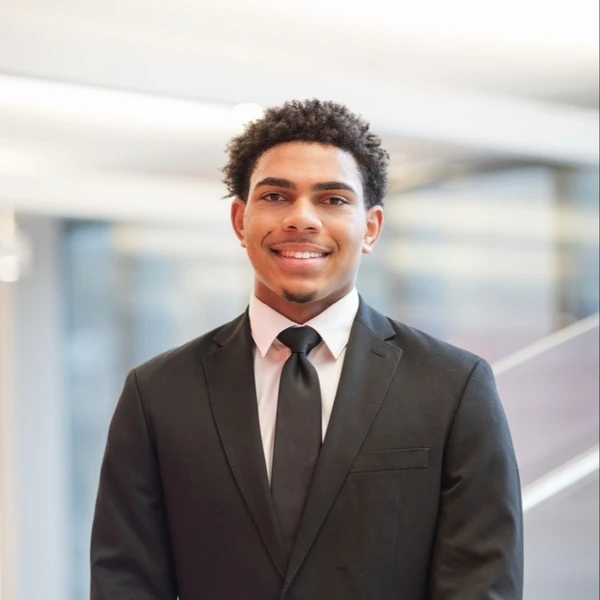
Jordan Tolliver
1x
FinalistJordan Tolliver
1x
FinalistBio
Hey there! My name is Jordan. I am from Atlanta, Georgia, and I am a student with an eagerness to learn. I am concentrating in AI for Business and Entrepreneurship & Innovation at the University of Pennsylvania’s Wharton School of Business. I have a strong interest in AI and the intersectionality it has with business. I am on the board of the Black Wharton Undergraduate Association at UPenn.
I have goals to be a change-maker one day. I enjoy thinking of ways in which I can break down barriers for others and pragmatically affect change.
Education
University of Pennsylvania
Bachelor's degree programMajors:
- Entrepreneurial and Small Business Operations
- Finance and Financial Management Services
- Economics
Miscellaneous
Desired degree level:
Master's degree program
Graduate schools of interest:
- Stanford University
Transfer schools of interest:
Majors of interest:
Career
Dream career field:
- Management Consulting
Dream career goals:
Sports
Tennis
Varsity2021 – 20243 years
Football
Varsity2021 – 20232 years
Research
Computer and Information Sciences, General
Sprayberry STEM Academy — Single researcher2023 – 2024
Champions Of A New Path Scholarship
I don't think I "deserve" this scholarship more than anyone else competing for it — most applicants are working hard against real financial pressure, and that's not a competition I want to win by comparison. What I can offer is a specific, evidence-backed reason to bet on the return: I've already shown I can take an idea from nothing to something measurable, on a timeline most people don't get in undergrad.
In August 2025, I co-founded CultivatED, an AI-powered SAT prep platform built for students the traditional system tends to overlook. I wasn't hired to build it and nobody handed me a playbook — I recruited and now lead a ten-person cross-functional team of Penn students across engineering, marketing, and go-to-market, built the diagnostic engine with Google Gemini, and pitched Wharton alumni donors and the Office of the President of UPenn to fund it. The pilot cohort posted a 110-point average SAT gain in two weeks with 90% retention, and we've since signed confirmed institutional partnerships with Atlanta Public Schools and a Detroit charter network. That's not a hypothetical plan for what I might accomplish with more support — it's a track record of doing more with less, already in motion.
What gives me an edge specifically is the combination I bring to it: I'm not just the "vision" person or just the "spreadsheet" person. I'm studying Economics with concentrations in Finance and AI for Business and a Statistics minor at Wharton, so I can build the financial model, run the regression, and pitch the investor in the same meeting. I paired that with a Business Innovation internship at Eagle Enterprises doing competitive benchmarking and M&A due diligence, and I currently lead a 6-person consulting team through Black Wharton Consulting advising a real company on expansion strategy. Most 20-year-olds have one or two of those reps. I've been deliberately stacking all of them at once, because I think the gap between "good idea" and "funded, working company" is almost entirely execution, and execution is a skill you build through reps, not talent you're born with.
The most concrete reason to invest in me, though, is that I've already proven I reinvest what I'm given. Every dollar and every hour of mentorship I've received — from teachers, from Wharton, from the people who backed CultivatED early — has come back out the other side as a partnership, a mentoring session, or a student's SAT score. A scholarship here isn't charity into a void. It's capital into someone with a documented habit of turning support into compounding results for other people, not just for himself.
J&Y Law Yahouda Yahoudai Service Scholarship
Most of the service work I've done doesn't look like a single dramatic moment — it looks like showing up for the same people, consistently, until something changes. That's been true whether I was mentoring a first-year at Wharton or building a company meant to serve students who never asked to be part of an "achievement gap."
The clearest example is CultivatED, the AI-powered SAT prep platform I co-founded in 2025. It exists because standardized test prep is one of the more quietly unequal parts of the college process — students with resources get personalized tutors, and students without them get a $30 book and good luck. We built CultivatED specifically for the second group: an adaptive diagnostic engine that personalizes content based on each student's actual learning history, not a generic curriculum. It's now running in 12 schools across the U.S. and Africa, with a pilot cohort that posted a 110-point average SAT gain in two weeks and 90% retention. Beyond the product itself, I've spent a lot of time in the rooms where this kind of access gets decided — pitching Wharton alumni donors and nonprofit education executives to fund the work, and negotiating the partnerships with Atlanta Public Schools and a Detroit charter network that let us actually reach students instead of staying a nice idea on a slide deck.
Closer to home, I mentor first-year students as a Wharton 1010 Teaching Assistant, running 1:1 coaching sessions and guiding student teams through the program's Innovation Challenge. I know what it's like to walk into a room at eighteen and feel like you don't belong there — I've been that student — so a lot of what I try to give first-years isn't just academic help, it's the reassurance that the uncertainty is normal and survivable. I've done similar work as a STEP (Successful Transition & Empowerment Program) mentor and as a Co-Head Peer Mentor for the Africana Summer Institute, both aimed at helping incoming students land on their feet.
I also serve as a Board Member and Freshman Liaison for the Black Wharton Undergraduate Association, where I redesigned our engagement strategy and grew membership retention by 55% by adding outcomes-driven, entrepreneurship-focused programming instead of one-off social events. And through Black Wharton Consulting, I lead a 6-person team advising a Philadelphia-based retail company on its expansion strategy — pro bono work that gives a local business access to the kind of strategic thinking it couldn't otherwise afford.
None of this feels especially heroic day to day. It's mentoring sessions, partnership emails, and board meetings. But I've come to believe that's what most real community impact actually looks like — not a single grand gesture, but a habit of showing up for the people around you and building systems that keep showing up even when you're not in the room. That's the standard I try to hold myself to, at CultivatED and everywhere else.
Bright Lights Scholarship
My plan for the future has three parts: build proof, earn a seat, then use that seat to change who else gets one.
The "build proof" part is already underway. I co-founded CultivatED in 2025, an AI-powered SAT prep platform for students the traditional system tends to overlook. We designed the diagnostic engine to correlate a student's prior learning experience with the content we serve them next, and our pilot cohort posted a 110-point average SAT gain in two weeks with 90% retention. We've since signed confirmed partnerships with Atlanta Public Schools and a Detroit charter network launching this fall. I didn't start CultivatED because I had it all figured out — I started it because I got tired of watching talented students lose ground simply because their zip code didn't come with the same test-prep resources as the next one over, and I wanted proof, not just a theory, that the gap could close.
The "earn a seat" part is what my time at Wharton is for. I'm studying Economics with concentrations in Finance and AI for Business, and I plan to spend a few years after graduation inside a private equity or venture firm that takes both returns and inclusion seriously — learning how institutional capital actually gets allocated, and who it tends to skip. Eventually, I want to run my own fund focused on undervalued markets and underestimated founders, using the same thesis that drives CultivatED but applied at a much larger scale.
The "change who gets a seat" part is the actual point. I lead a 6-person team through Black Wharton Consulting, I mentor first-years as a Wharton 1010 TA, and I sit on the board of the Black Wharton Undergraduate Association, where I helped redesign our engagement strategy and grew membership retention by 55%. None of that is separate from the career plan — it's the same plan, just running at a smaller scale right now. I'm trying to build the habit of pulling people up as I go, not waiting until I've "made it" to start.
None of this is free, and I'm not pretending it is. Wharton runs close to $90,000 a year, and even with my family's support and what I contribute myself, I'm on track for roughly $300,000 in private loans by graduation if I don't close that gap. This scholarship wouldn't fund the whole plan, but it directly funds the part of it I control least well — tuition — which frees up more of my own time and energy for the parts I can actually build: CultivatED's next partnership, the next student I mentor, the next case competition my team enters. Every dollar that doesn't have to come from a loan is a dollar I don't have to spend the next decade paying off instead of reinvesting in the work.
Hines Scholarship
For most of my childhood, I associated "college" with a specific kind of room — the kind where I was often the only Black student, and where I had to decide, over and over, whether that fact would shrink me or sharpen me. By the time I got to Wharton, I'd already made my choice. I don't walk into a room hoping to be allowed a seat at the table. I walk in prepared to bring my own.
Going to college, for me, was never just about the degree. It's the mechanism by which I get access to rooms — venture pitches, boardrooms, alumni networks — that weren't built with someone like me in mind, and then the leverage to widen the door behind me. I grew up watching what a gap in access actually costs a community: schools with fewer resources, counselors stretched too thin to walk every student through the financial aid maze, kids with real talent and no clear map to use it. Wharton didn't hand me a fix for that. It handed me the tools — finance, statistics, AI — and the credibility to make people with capital actually listen when I say the fix is possible.
I'm using both right now. I co-founded CultivatED, an AI-powered SAT prep platform built specifically for students the mainstream system tends to overlook, many of them Black students in schools like the one I came up in. Our pilot cohort posted a 110-point average SAT gain in two weeks with 90% retention, and we've since built confirmed partnerships with Atlanta Public Schools and a Detroit charter network. None of that happens without what I'm learning in the classroom — how to model a business, read a financial statement, build something that survives contact with real institutions instead of just sounding good in a pitch deck.
What I'm trying to accomplish goes beyond CultivatED, though. I want to spend my career proving that access and excellence aren't in tension — that you can build things that are both rigorous and generous, both profitable and genuinely useful to the people who need them most. Long-term, I want to move into venture or private equity and eventually run my own fund focused on the founders and markets that get overlooked, because I've watched firsthand how much talent goes unfunded simply because it didn't come from a familiar zip code or a familiar name.
College, for me, is the bridge between where I started and the rooms I need to be in to actually build that. Every partnership CultivatED signs, every case competition my consulting team wins, every finance concept I learn well enough to teach it to a first-year student as a TA — it's all rehearsal for the same goal: making sure the next kid who feels like the only one in the room doesn't have to bring the table by himself.
Learner Math Lover Scholarship
While most of my friends found comfort in a book, I found it in times tables. There was something satisfying, even as a kid, about a problem with an answer that didn't move depending on who was arguing about it. Math was the one subject where being right wasn't a matter of opinion or persuasion — it was just true, and I could prove it.
What's kept me in love with it since is less the certainty and more what you can build with it. I minored in Statistics at Wharton not because it was required, but because regression, hypothesis testing, and A/B testing turned out to be the actual language of the questions I care about most: does this intervention work, for whom, and how do we know? That question sits at the center of CultivatED, the AI-powered SAT prep platform I co-founded. Underneath the product is an adaptive diagnostic engine that correlates a student's prior learning experience with the content we serve them next — which is really just statistics doing the work of noticing that two students who look identical on paper often need completely different help. When our pilot cohort posted a 110-point average SAT gain in two weeks, that wasn't a lucky story we got to tell. It was a number we could defend, because we'd built the model to be honest with us before it had to be honest with anyone else.
That's the part of math I love most: it doesn't let you get away with a good story that isn't also a true one. In a field like education, where good intentions are common and rigorous evidence is rare, I've come to see math less as an academic subject and more as an accountability system — the thing that keeps me asking "does this actually work" instead of just "does this sound like it should." I don't think I'll ever stop finding that useful.
Barbara Cain Literary Scholarship
For most of my adolescence, I had a mild disdain for reading — not the act of it, but its status. I was a film kid. It seemed strange to me that a book was always treated as the more serious cousin of a movie, and for a while I was stubborn about that opinion. Then, in ninth grade, I was assigned To Kill a Mockingbird — a book I already thought I knew, because I'd watched the film half a dozen times during quarantine. I figured I'd skim it out of obligation.
I didn't skim it. I got hooked — not on the plot, since I already knew how it ended, but on how much more the book was doing underneath the plot. The film gave me Atticus's closing argument. The book gave me the slow, uncomfortable accumulation of a town's willful blindness, page by page, in a way a two-hour runtime never could. It was the first time I understood that a story could indict an entire way of seeing people without ever raising its voice.
That distinction — between what a town believes about someone and what's actually true — turned out to be the lesson I needed most, just outside the context of 1930s Alabama. I grew up moving between a Black neighborhood in South Fulton and a mostly white suburb in Marietta, and I spent a lot of my childhood on the receiving end of assumptions people had already made before they knew anything real about me. Harper Lee's Maycomb is a town full of people who never let facts interrupt what they'd already decided about Tom Robinson or Boo Radley. Reading it at fourteen was the first time I saw that pattern named clearly on a page, and it gave me language for something I'd been living without knowing how to describe.
That's ultimately what changed my relationship with books: I stopped treating reading as a lesser form of entertainment and started treating it as a rehearsal space for empathy — a place to practice understanding people you'll never meet, which turns out to be useful training for understanding the people you will. It's part of why I've spent the last few years building CultivatED, an AI-powered test-prep platform for students the education system tends to overlook. A lot of that work is really just applied reading comprehension — trying to understand a student's specific barriers instead of assuming what "the average student" needs, the same way Mockingbird refused to let its town's assumptions stand in for the truth about Tom Robinson.
I don't know that I'll ever be the kind of reader who finishes a book a week. But I know that one book, read at exactly the right moment, rewired how I evaluate people and assumptions — including my own. That's the standard I hold books to now: not how many I get through, but whether they change how closely I look at what I thought I already understood.
Sloane Stephens Doc & Glo Scholarship
I used to think resilience meant holding everything together. Showing up with a smile. Saying "I'm fine" even when you're not. But I've since learned that real resilience is sometimes messy — it cries in the bathroom during midterms, it pauses, it grieves, and somehow, it still keeps moving.
Last fall, I lost my grandmother to cancer. She wasn't just my rock — she was the blueprint. My second mother. The woman who taught me that purpose is bigger than pride, and that no matter how chaotic the world feels, you can always offer someone warmth — through a meal, a story, or a small act of kindness. I carry her voice with me: "Do what you came to do, baby, and do it with heart." That voice echoed in my head the first time I stepped into a pitch competition room as the founder of my startup CultivatED. I was 18, wide-eyed, and the only Black student in the room. But I walked in anyway — because my grandmother didn't raise me to shrink. She raised me to serve. CultivatED is my way of doing that. It's an EdTech platform that uses AI to personalize test prep for underserved students — especially Black youth — using culturally responsive learning tools. It's education that sees students for who they are, not just who they're expected to be.
My passion for educational equity didn't start in a classroom. It started on long car rides with my grandmother, where she'd point out schools in disrepair and say, "These kids deserve better." It deepened when I joined the National Black MBA Association's case competition in high school and saw how access could change everything. It came full circle when I founded CultivatED, blending my love for innovation with the soul of my community.
But chasing dreams isn't always poetic. Some days it looks like imposter syndrome at 2 a.m. Other days it's rejections, restarts, and the guilt of trying to carry grief and ambition at the same time. And yet — here I am. Still moving. Still creating. Still believing in something better.
That's why Sloane Stephens' story speaks to me so deeply. Competing at the highest levels while staying rooted in community and family? That's the balance I hope to live. I see my own dreams reflected in hers — not because I'm on a tennis court, but because I'm in a fight of my own. To make space. To build access. To uplift those coming behind me.
This scholarship wouldn't just support my education — it would honor a legacy I hold sacred. The legacy of my grandmother, who believed education could change everything. The legacy of Sloane's Doc & Glo — resilience, kindness, and self-belief stitched into every fiber. And the legacy I'm building, one student, one story, one startup at a time.
So here I am, doing what I came to do. And yes, I'm doing it with heart.
Joe Gilroy "Plan Your Work, Work Your Plan" Scholarship
My plan has three phases: finish building the foundation at Wharton, prove I can operate at the highest level of finance, then use both to build something of my own.
Phase one runs through May 2028, when I graduate from the Wharton School with a B.S. in Economics, concentrating in Finance and AI for Business, with a Statistics minor. I'm currently maintaining a 3.52 GPA while running CultivatED, the AI-powered test-prep platform I co-founded, which has grown to serve students across 12 schools in the U.S. and Africa and secured partnerships with Atlanta Public Schools and a Detroit charter network. Financially, this phase costs roughly $90,000 a year. I'm covering $20,000 of that myself, my family contributes $70,000 a year, and I'm on track to need close to $300,000 in private loans by graduation if I don't close that gap with scholarships and paid work — exactly why I'm applying here.
Phase two is the two to four years immediately after graduation. My goal is to join a private equity or venture capital firm with a real track record of investing in both innovation and inclusion. I'm building toward this now: a Business Innovation internship at Eagle Enterprises doing competitive benchmarking and M&A due diligence; leading a 6-person consulting team through Black Wharton Consulting; and TAing Wharton's intro business course. Each is a deliberate rep for the analytical and people-management muscles that role requires.
Phase three is the goal underneath all of it: launching my own investment vehicle, likely within seven to ten years of graduating, focused on underestimated founders and undervalued markets — the same thesis that drives CultivatED, applied at fund scale. I don't expect to raise that fund straight out of undergrad. The plan is to earn the credibility and pattern-recognition that only comes from institutional finance first, then use that position to redirect capital toward the people and problems I care about.
None of these phases work in isolation — the internships fund the loans, the loans buy the Wharton credential, the credential opens the PE/VC door, and that door eventually lets me build the fund. Scholarships like this one shrink the loan number in phase one, the leverage point for everything after it. Every dollar of scholarship support I receive is a dollar I can redirect from debt repayment into the next CultivatED partnership or the next student I mentor, which is ultimately the return I'm most trying to compound.
Arthur and Elana Panos Scholarship
Last fall, I lost my grandmother to cancer. She wasn't just my rock — she was the blueprint, my second mother, the woman who taught me that purpose is bigger than pride. I carry her voice with me still: "Do what you came to do, baby, and do it with heart." When she died, I didn't have a tidy theological answer for why. What I had instead was the faith she'd spent twenty years building into me — not as a set of rules, but as a trust that showing up with heart matters even when, maybe especially when, you don't understand the plan.
That faith is what got me into a pitch competition room at eighteen, the only Black student in it, founding a company with no idea if it would work. I didn't walk in because I was confident. I walked in because my grandmother didn't raise me to shrink, and because I believe I was given the specific mix of skills, community, and stubbornness I have for a reason bigger than my own comfort. CultivatED — the AI-powered SAT prep platform I co-founded — exists because I kept believing that, even when the early version barely worked, even when funding was scarce, even when I was a sophomore trying to convince Atlanta Public Schools to trust a 19-year-old's product. Faith, for me, has never been passive. It's been the thing that let me keep building when the spreadsheet said I shouldn't.
I don't separate my faith from how I try to run a company. I think a lot about stewardship — the idea that whatever influence or resources you're given, you're accountable for what you do with them. That shapes how I think about CultivatED's mission: we built it specifically for students the mainstream system overlooks, because I believe access to opportunity shouldn't depend on which zip code you're born into, and because I was given far more access than that mattered to me not to waste. It shapes how I try to lead the ten-person team behind it, too — trying to be someone people can trust to tell them the truth, credit them fairly, and not cut corners just because no one would catch it.
Going forward, I think faith will keep functioning less like a comfort and more like a discipline in my career — the thing that keeps ambition honest. It's easy in venture-backed spaces to let growth-at-all-costs become the only metric that matters. I want to be the founder, and eventually the investor, who asks a different question first: who does this actually serve, and am I building it with integrity or just building it fast? My grandmother spent her life proving that generosity and excellence aren't in tension — that you can serve people and still demand excellence from yourself. That's the standard I'm trying to hold myself to, one pitch, one partnership, one hard decision at a time. I don't think I'd have the nerve to keep doing this without believing there's a plan bigger than the next fundraising round.
Charles B. Brazelton Memorial Scholarship
I sleep with a light on. Not a dramatic one — usually just a lamp in the corner, sometimes my phone flashlight propped against a water bottle if I'm somewhere unfamiliar. I've tried to play it off over the years as a preference for "ambient lighting," but let's be honest: it's a nightlight for a twenty-year-old who runs a company by day.
I used to be embarrassed about it. In a dorm full of people who can fall asleep the second the lights go off, admitting you need a glow in the room to settle down feels like confessing something you should have outgrown around age seven. My roommate freshman year found out the hard way when he woke up at 2 a.m. to my desk lamp still on and asked, half-joking, if I was scared of the dark. I told him no, I just liked the "gentle illumination." He laughed. I laughed. But it stuck with me, because he wasn't wrong to notice — it is a little different, and for a while I treated it like something to manage quietly rather than something to just be honest about.
What changed my mind wasn't some big revelation. It was noticing how much energy I spent editing the small, harmless parts of myself so nobody would clock them as strange. I do this in bigger ways too — I talk too much, I ask too many questions, I've been called "too loud" more times than I can count. I used to think the fix was to take up less space: quieter voice, fewer questions, lights off like everyone else. But the truth is, the version of me that asks too many questions is also the version that cold-emails alumni until one says yes, that will introduce himself to a room of strangers and walk out with two new collaborators. The extrovert who can't sit in silence is the same person who's comfortable pitching a stranger on an idea for a startup built to help kids who look like the kid I used to be. The traits that make me a little odd at 2 a.m. are, more often than not, the same ones that make me useful at 2 p.m.
So now I don't apologize for the lamp. It's a small, slightly ridiculous thing, and it's mine. I've learned that the parts of us that don't fit neatly — the habits we picked up as kids and never quite grew out of — aren't always flaws to smooth over. Sometimes they're just proof that we're specific people and not smoothed-out averages of everyone else. I'd rather be the guy whose roommates remember the light thing than the guy who spent four years pretending to be exactly like everybody else in the room.
If you ever find yourself up at 2 a.m. wondering why the light's still on in my room, now you know. I'm probably just working — with the lamp on, obviously.
Neal Hartl Memorial Sales/Marketing Scholarship
Persuasion entered my life not through a textbook but through a jar of peach preserves.
At twelve I stood beside my grandmother’s folding table at the Marietta flea market, watching
her turn strangers into loyal customers armed with nothing more than a sunrise-colored smile
and a story about picking fruit at dawn.
She offered a free taste, asked where people were from, and—almost magically—made
them feel that buying a jar was less a transaction than a small partnership in a sweeter world.
I did not yet know the vocabulary of “value proposition” or “customer journey,” but I
memorized something more foundational: good sales is an act of generosity that starts with
curiosity about another human being.
That lesson has followed me to Wharton, where I co-founded CultivatED, an AI-powered
platform that personalizes SAT preparation for students the mainstream system overlooks.
Building a start-up is part engineering, part caffeinated endurance, yet the heartbeat is
marketing.
I spend more time turning algorithms into human-sized promises than writing code—
crafting a 15-second TikTok that swaps test anxiety for confidence, or an email sequence that
transforms “I’m not a good test taker” into “I just hit my target score.”
Each iteration reminds me that data points alone are inert until a story
animates them.
My decision to pursue a career in sales and marketing is therefore equal parts heritage and
hypothesis.
Heritage because I descend from storytellers who sustained our family by convincing
communities to believe in possibility—whether that meant peach preserves in Georgia or, a
generation earlier, fresh okra at a roadside stand in South Carolina.
Hypothesis because I have seen, both in the classroom and in the trenches of a fledgling
venture, how analytics and empathy can collide to solve problems at scale.
Marketing is where left-brain rigor courts right-brain imagination, where A/B tests meet
archetypes, and where purpose can be priced, packaged, and delivered to the people who need
it most.
Three forces keep my passion ignited:
1. The democratizing power of narrative.
A well-crafted message can reach a student in Lagos as easily as a recruiter on Wall
Street, redistributing opportunity at the speed of a share button.
2. The puzzle of behavior.
Every campaign is a living experiment in human psychology. Tweaking copy, color, or
timing and watching click-through rates behave like real-time vote tallies thrills the
scientist in me.
3. The moral imperative.
Technology without thoughtful marketing is potential unrealized. I want to be the
translator who ensures innovations—whether adaptive learning software or clean
energy—actually touch the people they are built for.
Ultimately, sales and marketing sit at the intersection of empathy and execution.
They force me to listen harder, think sharper, and act bolder.
They demand resilience—every “no” a data point, every pivot a fresh hypothesis—and grant
the privilege of turning abstract value into tangible change.
One of my grandmother’s empty jars still sits on my desk.
It reminds me that even the most sophisticated strategy begins with a simple invitation:
Come, taste what I’ve made for you.
My career in sales and marketing is my way of extending that invitation—this time, to the
world.
Sloane Stephens Doc & Glo Scholarship
I used to think resilience meant holding everything together. Showing up with a smile. Saying "I'm fine" even when you’re not. But I’ve since learned that real resilience is sometimes messy—it cries in the bathroom during midterms, it pauses, it grieves, and somehow, it still keeps moving.
Last fall, I lost my grandmother to cancer. She wasn’t just my rock—she was the blueprint. My second mother. The woman who taught me that purpose is bigger than pride, and that no matter how chaotic the world feels, you can always offer someone warmth—through a meal, a story, or a small act of kindness. I carry her voice with me: “Do what you came to do, baby, and do it with heart.”
That voice echoed in my head the first time I stepped into a pitch competition room as the founder of my startup CultivatED. I was 18, wide-eyed, and the only Black student in the room. But I walked in anyway—because my grandmother didn’t raise me to shrink. She raised me to serve. CultivatED is my way of doing that. It’s an EdTech platform that uses AI to personalize test prep for underserved students—especially Black youth—using culturally responsive learning tools. It’s education that sees students for who they are, not just who they’re expected to be.
My passion for educational equity didn’t start in a classroom. It started on long car rides with my grandmother, where she’d point out schools in disrepair and say, “These kids deserve better.” It deepened when I joined the National Black MBA Association’s case competition in high school and saw how access could change everything. It came full circle when I founded CultivatED, blending my love for innovation with the soul of my community.
But chasing dreams isn’t always poetic. Some days it looks like imposter syndrome at 2 a.m. Other days it’s rejections, restarts, and the guilt of trying to carry grief and ambition at the same time. And yet—here I am. Still moving. Still creating. Still believing in something better.
That’s why Sloane Stephens’ story speaks to me so deeply. Competing at the highest levels while staying rooted in community and family? That’s the balance I hope to live. I see my own dreams reflected in hers—not because I’m on a tennis court, but because I’m in a fight of my own. To make space. To build access. To uplift those coming behind me.
This scholarship wouldn’t just support my education—it would honor a legacy I hold sacred. The legacy of my grandmother, who believed education could change everything. The legacy of Sloane’s Doc & Glo—resilience, kindness, and self-belief stitched into every fiber. And the legacy I’m building, one student, one story, one startup at a time.
So here I am, doing what I came to do. And yes, I’m doing it with heart.
Edward Dorsey, Jr. and Audrey Dorsey Memorial Scholarship
I don’t believe the business world needs more Black excellence. We’ve always had that. What it needs now is more Black ownership—of ideas, of institutions, of capital, and of narrative. I plan to use my education to help make that happen.
At Wharton, I’ve studied finance, entrepreneurship, and AI not just as academic disciplines, but as tools—tools that can dismantle the barriers Black communities have long faced in accessing generational wealth, startup capital, and leadership pipelines. But theory alone doesn’t build bridges. Lived experience, community context, and cultural fluency are what allow theory to become transformation. That’s where I come in.
As the founder of CultivatED, an EdTech startup aimed at creating culturally responsive, AI-driven test prep for underserved students, I’m building more than just a company—I’m building a pipeline. One that equips Black students with not only the academic skills to succeed in business, but the confidence to redefine it on their own terms. Education becomes the foundation, but ownership is the goal.
Too often, Black ambition is framed as exceptional when it should be expected. Through my work, I want to normalize the presence of Black students in venture capital meetings, on IPO stages, and in the rooms where algorithms are being built and budgets are being decided. I want to create learning systems that don’t ask Black students to mold themselves to outdated corporate norms—but instead ask, “What kind of world would you build if you were in charge?”
And I want them to be in charge.
To that end, I plan to expand CultivatED to include financial literacy and entrepreneurship modules specifically tailored to Black students, using case studies from our own communities—stories of resilience, innovation, and legacy. I’ll use my business education not to teach kids how to get a seat at someone else’s table, but how to build their own table, send out the invitations, and cook the meal from scratch.
But my education isn’t just about what I build—it’s also about what I question. I plan to enter the venture capital world not just as a participant, but as a critic and a reformer. I want to ask why less than 2% of VC funding goes to Black founders—and what structural redesigns we need to change that. I want to advocate for equity not as charity, but as strategy. Because when Black entrepreneurs thrive, entire ecosystems benefit—from job creation to community reinvestment to new markets born from overlooked brilliance.
Ultimately, I see business not just as a vehicle for profit, but as a platform for justice. My education at Wharton is not the end goal—it’s the launchpad. And I intend to use it to clear a path, build a bridge, and then turn around and pull as many others up with me as I can.
Because progress isn’t progress if we arrive alone.
FLIK Hospitality Group’s Entrepreneurial Council Scholarship
In the next five years, I plan to make a difference in the environment with something less dramatic, less obvious: learning. Learning—especially when it is tailored and culturally relevant—can be a powerful force for climate awareness and action, I'm sure. And with my own career as a founder of CultivatED, a bespoke EdTech system for marginalized learners, I plan to show it.
I'm from the South, and I saw environmental injustice not on cable television, but in my own community: treeless blocks sweltering in heat islands, schools with broken air conditioning, asthmatic children walking along highways to attend class. These weren't mistakes. They were choices—historic redlining, disinvestment, and decades of complacency. And I came to understand that as we teach students how to find the area of a triangle or break down a poem, we don't so frequently teach them how to read the world around them. I want to change that.
That's why CultivatED is evolving into something more than a site for test prep. We're embedding environmental literacy into our modules of learning—not as an afterthought, but as a paradigm. Math problems based on real air quality readings. Reading selections derived from climate policy rhetoric. Wellness journaling prompts that ask students to reflect on how their physical environment impacts their mental well-being. The idea is simple: if we want students to care, we need to show them how their world is already caring about them.
Awareness, however, does not collect tuition. That’s why I’m designing a Green Micro-Scholarship Fund, which will reward students with small financial grants for completing climate-focused learning modules. A student who completes a course on sustainable urban design might earn a scholarship toward their college fund. It’s a fusion of finance and purpose: a system where educational effort toward environmental awareness is directly tied to opportunity. For students who have been left behind for years, that message—that knowledge can literally change their world—is compelling.
I'm also exploring the possibility of using machine learning to identify patterns of environmental distress in school settings. For example, we can mine patterns in student performance against indoor air quality or temperature fluctuations and offer schools real-time advice on low-cost, environmentally friendly interventions. This introduces wellness into the equation—not as a broad catch-all, but as a necessary precursor to any true environmental benefit.
What most excites me is not just the scale, but the intimacy of this work. It's in the aha moment of comprehension from a student who now knows why her community floods every spring. It's in the sense of accomplishment of a junior high school student who receives a scholarship for writing an essay on solar power in Ghana. It's because I think climate action isn't reserved for scientists or politicians—it's for students too. Especially those who've been told their voices don't matter.
Over the next five years, I hope to amplify thousands of those voices. Because the climate crisis doesn't just require new technology—it requires new storytellers. And I think some of the most powerful ones are in under-resourced classrooms, waiting to be amplified.
Fund the Future Scholarship
1.) I’m currently an undergraduate at the University of Pennsylvania’s Wharton School, concentrating in Entrepreneurship & Innovation with a planned graduation date of 2028. While some people collect stamps or sneakers, I seem to collect experiences in mission-driven business. I’ve interned as a nonprofit consultant under Black Wharton Consulting, where I worked with Bungee Brand USA to develop a product expansion strategy targeting emerging consumer trends. Prior to that, I helped ideate a culturally grounded academic enrichment academy under ITSMF—an initiative that married my passion for education access with structural change. I’m also the founder of CultivatED, an EdTech startup that uses machine learning to deliver personalized standardized test prep to students traditionally left behind by the system. My goal? Make the phrase “achievement gap” obsolete. The journey’s been a learning lab of its own—complete with pitch decks, user testing, and the occasional existential crisis about server costs.
2.) In the short term, I plan to join a private equity or venture capital firm with a strong track record of investing in both innovation and inclusion. I’m drawn to firms that don’t just chase returns, but also interrogate who gets access to capital, who defines “value,” and who gets left out of the room. Longer term, I want to launch my own fund—an alternative investment vehicle focused on undervalued markets and underestimated founders. The excitement I feel toward alternative investments stems from their very nature: they are complex, dynamic, and often deeply contrarian. Alternative investing is where vision meets rigor—and it rewards those who can challenge orthodoxy with precision. It’s a sandbox for systems thinkers and dreamers alike, and I proudly consider myself both.
3.) To ensure funding access for asset managers of all identities, we need more than just goodwill—we need infrastructure. First, LPs should commit to anchored capital in diverse emerging managers, not as a quota but as a competitive advantage. Many of these managers bring differentiated sourcing strategies and nuanced insights into high-growth, overlooked markets. We also need co-investment syndicates that provide capital alongside technical assistance, creating scaffolding that allows diverse GPs to not just raise funds, but raise performance. I’d also push for public-facing transparency dashboards that report capital allocation demographics—because sunlight is the best disinfectant, especially when bias hides in plain sight. And perhaps most importantly, we need a cultural shift in how we define risk. Homogeneity might feel familiar—but familiarity is not the same as security.
4.) If I could shadow any investor for a year, it would be Mitch Kapor. He embodies the kind of values-led investing I aspire to practice—grounded in racial equity, future-of-work innovation, and ecosystem building. His early support of companies like Bloc and Bitwise showed a commitment not only to betting on ideas, but on people and communities often ignored by traditional investors. I’d want to understand his approach to due diligence, how he navigates conversations with skeptical LPs, and how he balances financial discipline with social mission. Just as importantly, I’d want to see how he empowers founders post-check. Writing a check is one thing; building a company alongside someone is entirely another.
5.) If finance weren’t in the picture (and let’s pretend Excel never existed), I’d be building culturally rooted educational institutions—maybe a modern-day version of the Freedom Schools. I’ve always believed that education is the foundation of all upward mobility. I’m guided by values of access, equity, and storytelling—three things that thread through every project I touch. Whether that means creating digital platforms that personalize learning, or curating oral histories of Black entrepreneurship, I’m passionate about democratizing knowledge. In some ways, it’s not all that different from finance—just a different kind of capital being invested: social, cultural, and intellectual.
At the end of the day, whether I’m working through a term sheet, a community pitch, or a product-market fit dilemma, my north star is the same: expanding opportunity and equity through systems-level change. Alternative investments just happen to be my favorite tool for doing it.