Hobbies and interests
3D Modeling
Bible Study
Chemistry
Coding And Computer Science
Engineering
Landscaping
Robotics
Reading
Academic
Adult Fiction
Classics
Christianity
Short Stories
I read books multiple times per week
Jonathan Serb
1x
Finalist
Jonathan Serb
1x
FinalistBio
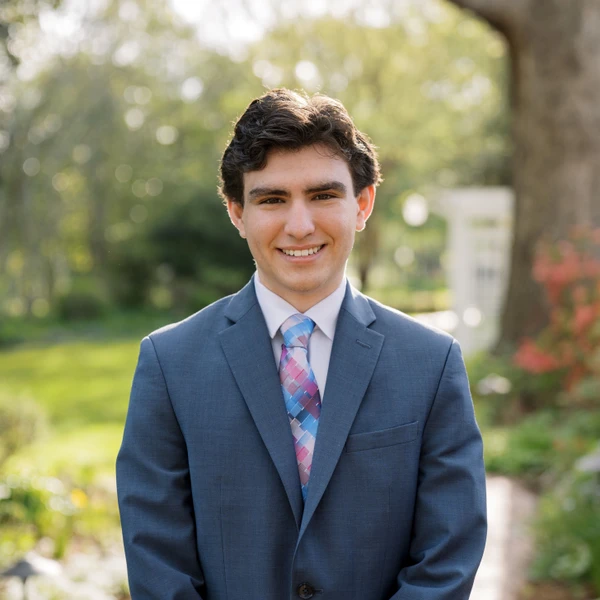
In a dusty garage, I watched a friend throw up his hands at a tangle of gears and belts, calling engineering "one Rube Goldberg machine after another." Where he saw frustration, I saw a puzzle I couldn't wait to solve, and I realized then that I wasn't chasing engineering for a paycheck or a family legacy, but because I genuinely love it. That love shows up in the details: this season, I designed a take-back-half feed-forward bang-bang control algorithm for my FTC robotics team's flywheels, cutting scoring time to .75 seconds and helping us place 18th in North Carolina. I've also spent time mentoring interns and working CNC and EDM processes at a machine shop, learning how the designs engineers create come to life. Now, pursuing a double major in Computer Engineering and Chemistry with a concentration in synthetic chemistry, I'm building toward a career solving problems most people aren't paying attention to yet.
Education
Homeschooled
High SchoolMiscellaneous
Desired degree level:
Bachelor's degree program
Majors of interest:
- Computer Engineering
- Chemistry
Career
Dream career field:
- Technology
Dream career goals:
At a Mid-Sized Machine Shop my Roles Included: Model and Technical Drawing Creation in Solidworks, Support for Machining Operations, and Quality Control for Safety-Critical Aerospace and Medical Parts with over 380 Hours of Total Work Experience
Accu-Tool2026 – 2026
Research
Veterinary Biomedical and Clinical Sciences
North Carolina State University — Dissection support and specimen preservation2025 – 2026
Public services
Volunteering
Homeschool Academic Resource Center — Assisting and Leading Chemistry Labs and Biology Labs and Dissections for Classes of 30 to 40 Students2023 – 2026
Future Interests
Volunteering
Philanthropy
Entrepreneurship
Charles B. Brazelton Memorial Scholarship
“No, Jonathan, you don’t need it!” my friend exclaimed as I jumped out of the car, ran to the edge of the road, and retrieved the rough, damp, and slightly smelly piece of plastic I had spied moments before.
I am a scavenger. But instead of searching through the trash, I keep my eyes peeled every time I go for a drive. That piece of plastic I picked up at a stoplight with my friend in the passenger seat? I used that as the material to create a critical part in the Rube Goldberg machine my team at Wake Tech Community College was constructing. Aside from simply keeping my local streets clean, my roadside discoveries have spurred my interest in anything from tanning animal skins as my great grandfather did, to vending soda cans out of a salvaged cooler. Everyone dismisses my streetside saves as garbage, but I see useful and exciting possibilities.
This contrarian mindset turned a routine dental issue into my first real experiment. At the age of thirteen, I joined the ranks of teens with braces when an orthodontist glued wires to my teeth. By the time I got them off, I was not only two years older, but also in need of a gum graft. The shifting of teeth had thinned my gum tissue to the point where the roots of my lower front teeth were exposed. My family was informed that receded gum tissue does not grow back and that our only option was to allow a periodontist to surgically transfer tissue from the roof of my mouth to the bottom of my teeth. We sat with quiet, stunned faces digesting what we had just heard. We thought braces would just be a brief, harmless phase. Now, I was facing a surgery we’d already heard horror stories about from friends.
As a result, I had a conversation with my parents and they allowed me to postpone the surgery and attempt to regrow my gums naturally. After talking to my science teacher, Ms. Grose, and researching online, I decided on a nightly treatment of topically applying sour vitamin C, sticky vitamin A, and powdery serrapeptase (an enzyme that breaks down proteins) to the affected area. The gritty mixture tasted horrible, but I stayed consistent. After a predetermined time of three weeks, my gum line remained the same. I was devastated. I had failed and would need the surgery after all. This outcome made me feel stupid for doubting what my orthodontist said and reminded me how important it is to objectively evaluate data.
If I hadn’t admitted defeat, I would have thin gums to this day. The graft was successful and the tales of woe I once feared never happened. Yet, I realized that my experiment was not in vain. Since I was young, I have battled recurring canker sores. I used to painfully wait for them to mend on their own, but during my experiments, I noticed that serrapeptase seemed to speed up healing for me. Excitingly, I couldn't find this treatment documented anywhere!
I discovered that questioning the status quo could lead to new treatments in surprising ways, and in doing so, I found something I truly love. I don't care if that makes most people view me as paranoid, nerdy, or just outright weird, that's just who I am.
So was my friend right? Maybe. Maybe I don’t need that warped piece of plastic, or those PVC pipes I picked up afterwards. But then again, maybe my next drive will uncover more than “junk.” Maybe it will reveal the next idea worth challenging.
Arthur and Elana Panos Scholarship
"It is men of desperate fortunes on one hand, or of aspiring, superior fortunes on the other, who go abroad upon adventures, to rise by enterprise, and make themselves famous in undertakings of a nature out of the common road." The father of Robinson Crusoe warned his son one side was too low for him, the other too high. Similar wisdom can be found within the Bible.
Throughout Ecclesiastes, the pursuit of earthly goods is vanity, chasing after the wind. In 1 Thessalonians 4:11-12, Paul instructs Christians to "aspire to live quietly, and to mind your own affairs, and to work with your hands...so that you may walk properly before outsiders and be dependent on no one." Reading this, I realized I was not aligning my desires with God's plan.
If I were the captain of my life, it might be easy to say where I see myself in ten years. But I am not the master of my decisions. I have put my yes on the table for God, choosing to trust His wisdom for my life. Right now, my one desire is to be married and train up my children to have a greater impact for God's kingdom than I will. Whether that life holds poverty, adventure, or Defoe's middle ground, I have no preconceptions, but know I must provide for my family.
At present, I believe that provision will take the form of founding and leading a startup, serving as both technical lead and guide for a small team: solving problems while cultivating the people solving them. This appeals to me not merely as preference, but as an extension of how God made me. During a Rube Goldberg competition at Wake Tech Community College, I discovered how deeply I enjoy leading a small group toward a shared solution under pressure, growing in integrity and meekness just as much as skill, creating relationships central to carrying out the Great Commission. Such a life, ten years out, would reflect responsibility and restraint: work ordered so it does not consume what it is meant to support, Sundays set apart, days begun early so I return home sooner to teach and raise my children.
Through First Tech Challenge robotics, I learned to navigate conflict while meeting engineering deadlines. Through dual enrollment, I discovered learning is valuable for its own sake, which is why I am graduating with an associate's degree I didn't need but wanted. My parents' upbringing in communist Romania and immigration to the U.S. impressed on me the importance of truth, hard work, and consistency, an understanding I intend to pass on to my children.
To move toward this future, I plan to join a Toastmasters club, build relationships beyond my field, and pursue internships and mentorship. But none of this can stand alone. Without daily prayer and time in Scripture, my ambitions would become self-directed rather than rightly ordered. Dependence on God grows the discipline and humility necessary for leadership and fatherhood alike.
Solomon writes in Proverbs 27:1, "Do not boast about tomorrow, for you do not know what a day may bring." Any vision I have set forth is not a declaration of what will be, but what I am presently being led to pursue. My responsibility is not to determine the outcome, but to be faithful in preparation, diligent in action, and steadfast in trust. If given the opportunity to lead, build, and provide, I will do so understanding these are gifts, not guarantees, seeking not to boast in tomorrow, but to walk rightly in what has been given today.
Treye Knorr Memorial Scholarship
“Why didn’t you raise your hand?” I once asked my father.
He told me that in communist Romania, questions could cost you. Teachers did not welcome curiosity; they enforced ideology. Faith was mocked. State doctrine was repeated until memorized. He learned early that silence was safer than inquiry.
When my parents immigrated to the United States, they chose to homeschool their children, not because education was unimportant, but because it mattered too much to outsource. They wanted my brother and I to ask questions freely.
In fifth grade, we toured a private school. An administrator explained that even if I had already completed the math curriculum, I would need to stay with my grade. At that point I was already working two years ahead. That afternoon, as we drove home, I understood what my parents had given me: room to grow.
Homeschooling did not make learning easier; it made it mine. By high school, my parents stepped back almost entirely. I scheduled my own coursework, built my own study plans, and sought out mentors when I hit obstacles. That independence carried me through calculus, linear algebra, and now differential equations. It allowed me to take in-person engineering courses at a local community college while still in high school and to graduate with a 4.0 GPA, a 35 ACT, and an associate degree in engineering.
But freedom without purpose drifts. Mine found direction in service.
At twelve, I began leading kindergarteners in the AWANA program. Years later, when the youth group activities conflicted with the program, most teens chose to leave. I nearly did too—until Andrew’s mother stopped me. Her autistic son had dreaded attending club because he struggled with verse memorization. So, over several weeks, we broke each passage into rhythm and motion. We sang syllables. We turned words into patterns. Slowly, frustration turned into confidence. He began asking to come. After hearing the tremendous impact I had unknowingly made in Andrew's young life, I made a stark connection: discipline is valuable, but it is incomplete unless used for someone else.
Homeschooling placed me in unusual rooms—community college classrooms with older students, robotics meetings where I now lead fifteen teammates, conversations with retirees who mentor me between rounds of AWANA games. I prefer discussions about faith, responsibility, and the weight of opportunity over whatever trend is circulating each week. As the son of immigrants who sacrificed familiarity for freedom, I feel accountable for what I build with that freedom.
Education, to me, is not information transfer. It is stewardship. It is the responsibility to cultivate what you have been given and multiply it for others.
I plan to double major in computer engineering and synthetic chemistry with the hope of solving real problems which are invisible to most people. But the deeper goal remains the same as the one my parents held when they chose to homeschool: ask freely, work diligently, and use what I learn to serve.
That is why I have chosen to attend Grove City College. Every time I have visited this institution, I have met student after student who not only asks questions, but also listens to my answers. The professors are keen on learning about each student as an individual, not as a grade. This scholarship would not only help me further my education, it would become part of why I raise my hand when others won't.