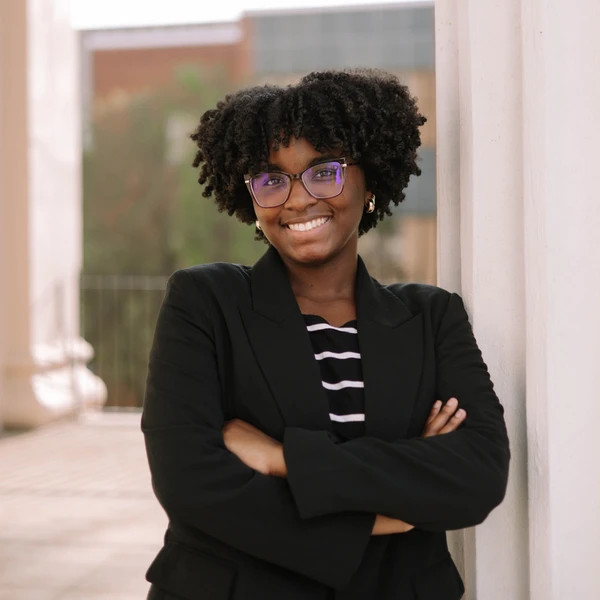
Raleigh, NC
Age
25
Gender
Female
Ethnicity
Black/African
Hobbies and interests
Anime
Music
Crocheting
Movies And Film
Board Games And Puzzles
Crafting
Reading
Reading
Adult Fiction
Science Fiction
Romance
Fantasy
I read books multiple times per month
US CITIZENSHIP
US Citizen
J'nea Wiggins
2x
NomineeJ'nea Wiggins
2x
NomineeBio
I am a senior Biomedical Engineering student at the University of South Carolina, where I focus on the intersection of medical technology innovation and healthcare equity. As a candidate for Graduation with Leadership Distinction in Research, I have spent my undergraduate career developing a strong technical foundation in laboratory protocols, including Drosophila genetics research.
My work is driven by a commitment to improving the patient experience. This is reflected in my senior design project, where I spent a year focused on the mechanical redesign of clinical instrumentation to prioritize patient comfort. Beyond the lab, my experiences as a camp counselor for individuals with physical and mental disabilities have shaped my holistic approach to care. Combined with my minor in Medical Humanities and Culture, these experiences have prepared me for a future career in pediatrics, family medicine, or gynecology, where I hope to implement preventative care strategies in underserved communities.
Outside of academics, I enjoy collecting plants and playing The Legend of Zelda on my Nintendo Switch. I also enjoy reading, and my favorite book is Fourth Wing. I am an avid K-pop listener, it has been my most-played music genre since 2015, and my favorite group is EXO.
Education
North Carolina State University at Raleigh
Master's degree programMajors:
- Physiology, Pathology and Related Sciences
University of South Carolina-Columbia
Bachelor's degree programMajors:
- Biomedical/Medical Engineering
Wake Technical Community College
Associate's degree programMajors:
- Engineering Science
Miscellaneous
Desired degree level:
Doctoral degree program (PhD, MD, JD, etc.)
Graduate schools of interest:
Transfer schools of interest:
Majors of interest:
Career
Dream career field:
Medicine
Dream career goals:
Research Assistant
University of South Carolina2023 – 20263 yearsCabin Councilor
South Carolina Department of Health2025 – 2025Recreational Assistant
Town of Knightdale2018 – 20246 yearsSenate Page
North Carolina Senate2016 – 20182 years
Sports
Daniels Middle School Track and Feild
Varsity2014 – 20151 year
Volleyball
Varsity2014 – 20195 years
Awards
- Most Improved
Research
Cell/Cellular Biology and Anatomical Sciences
University of South Carolina — Research Assistant2023 – 2026
Arts
Enloe High School Concert Band
Music2015 – 2017Daniels Middle School
Music2012 – 2015
Public services
Volunteering
Lexington Medical Center — Emergency Department and Surgical Floor Volunteer2025 – Present- National Honors Society — National Honors Student2018 – 2019
Volunteering
North Carolina Senate — Senate Page2018 – 2018
Future Interests
Advocacy
Politics
Volunteering
Philanthropy
Ethel Hayes Destigmatization of Mental Health Scholarship
Growing up with a family member who has Schizophrenia can shape nearly every part of a person’s life. It changes the way you see responsibility, relationships, stability, and even yourself. Watching my aunt struggle exposed me to both the fragility and resilience of people in ways many others do not experience firsthand. Her story has deeply impacted my family and is one of the main reasons I am pursuing a career in medicine.
As a child, I did not fully understand mental illness. I only understood that there were periods when my aunt seemed like herself and other times when she became distant from the people around her. She often went on and off her medication, and each time it happened, the effects spread far beyond her alone. Important family events were missed, relationships became strained, and moments that should have brought everyone together were overshadowed by uncertainty and worry. Birthdays, holidays, and celebrations sometimes became reminders of her absence rather than moments of joy. Watching this happen repeatedly created frustration and sadness within my family because we loved her deeply but often did not know how to help her.
When I was younger, my understanding of the situation was limited. I thought the solution was simple: if my aunt struggled to stay on her medication and her illness caused instability, then placing her in a mental hospital long-term seemed like the easiest answer. At the time, I believed that if she remained in a controlled environment, everyone would suffer less. As I matured, however, I realized how incomplete and inhumane that perspective was. I began to understand that mental illness is far more complicated than simply telling someone to “take their medicine.” Treatment is not always straightforward, especially for someone living with schizophrenia. There are emotional, psychological, and social barriers that can make accepting treatment incredibly difficult, even when someone knows they need help.
Over time, I learned to see my aunt not simply as someone defined by her illness, but as a person struggling with something that affected every part of her life. I started recognizing the humanity behind her actions instead of viewing her solely through the frustration her illness caused my family. This shift in perspective changed the way I view people in general. It taught me that behavior is often connected to pain, fear, or illness rather than simply “good” or “bad” choices. It also taught me the importance of empathy and patience, especially when dealing with struggles that may not be visible to others.
Living close to serious mental illness also changed my understanding of relationships. Mental illness affects not only the individual but everyone around them. My family experienced stress, uncertainty, and emotional exhaustion, yet we also experienced resilience and compassion. There were moments when supporting my aunt felt overwhelming, but there were also moments that revealed the strength of family and the importance of continuing to care for someone even when the situation is difficult. Through these experiences, I learned that support systems are essential. People struggling with mental illness often need more than medication alone; they need understanding, stability, and people willing to stand beside them during difficult periods.
At the same time, witnessing my aunt’s struggles exposed me to the stigma surrounding mental illness. I saw how quickly people judged behaviors they did not understand and how easily families affected by mental illness could feel isolated. Many people assume that treatment is simple or that recovery depends entirely on willpower, but my experiences showed me that mental health is far more complex. I became more aware of the invisible battles many people carry every day and how important compassion is in helping them feel seen and valued rather than dismissed or judged.
These experiences shaped not only my understanding of the world, but also my goals for the future. My aunt’s story became one of the main reasons I decided to pursue a career in medicine. Watching her navigate a healthcare system that sometimes focused more on controlling symptoms than understanding the patient made me realize how important patient experience truly is. I began to understand that healing comes not only from medication or treatment plans, but also from trust, communication, and empathy. Patients are more likely to engage in their care when they feel respected, heard, and understood.
My aunt has made me deeply interested in the human side of medicine. I believe meaningful healthcare begins with listening. Patients are not simply diagnoses or symptoms; they are individuals shaped by experiences, fears, relationships, and challenges that may not always be visible during a clinical encounter. My experiences taught me that compassion can have a profound impact on a patient’s willingness to seek help and continue treatment. Even small acts of understanding can make patients feel less alone during vulnerable moments in their lives.
I also recognize that medicine requires balancing science with humanity. Physicians must understand diseases and treatments, but they must also understand people. Watching my aunt struggle helped me realize how easy it can be for patients to feel reduced to their illness, especially in mental healthcare. I want to become the kind of physician who sees patients as whole people rather than simply conditions to manage. I want my future patients to feel comfortable sharing their concerns and know they are being treated with dignity and compassion.
Although my aunt’s illness brought many challenges into my life, it also shaped me into a more understanding and empathetic person. It taught me to look beyond surface-level judgments and recognize the complexity of people’s struggles. Most importantly, it inspired me to pursue medicine with the goal of providing care that values not only treatment, but also humanity. I want to become a physician who listens carefully, builds trust, and treats patients with empathy rather than judgment. My aunt’s story continues to influence the way I see the world and the kind of doctor I hope to become.