Hobbies and interests
Singing
Photography and Photo Editing
Aerospace
Astronomy
Aviation
Biking And Cycling
Bowling
Food And Eating
Harmonica
Motorsports
Music
Origami
Walking
Church
Architecture
Artificial Intelligence
Choir
Bible Study
Coding And Computer Science
Computer Science
Engineering
Flying And Aviation
Guitar
Piano
Geography
Indonesian
Information Technology (IT)
Spanish
Karaoke
Legos
Machine Learning
Mental Health
Research
Running
YouTube
Studying
Reading
Science Fiction
Academic
Christianity
Historical
History
Science
Thriller
Realistic Fiction
Drama
I read books multiple times per month
Justin Effendi
6x
NomineeJustin Effendi
6x
NomineeBio
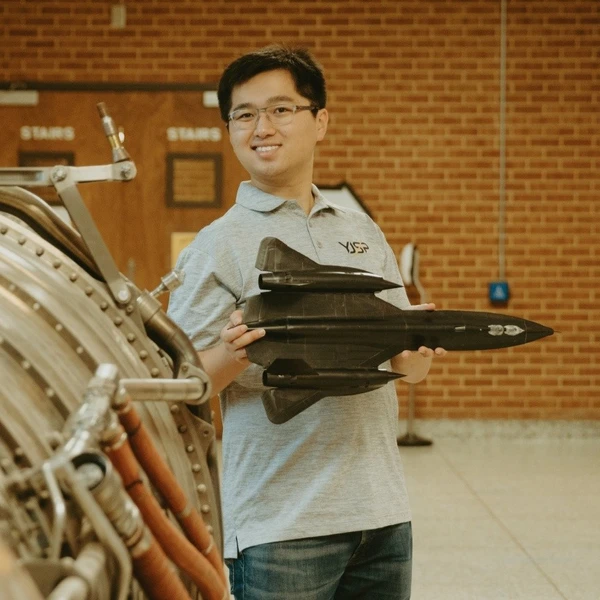
In the next few years, I want to be an engineer working in the space industry, helping create software systems or simulations that will help expand our presence in space and aid manned space exploration. I have always been passionate about space and space exploration since I watched the last space shuttle launch when I was 10.
I am a resilient, caring, and bubbly person. I refuse any setback, whether it's not "fitting in" as a person on the autism spectrum or mental health struggles, to define my life or bring it down. I have failed and fallen many times, but I always get back up and take on more challenges. I also love surprising my friends with heartfelt gifts, as their support and love mean a lot to me (not to mention seeing their reactions always makes me smile wide).
Education
Georgia Institute of Technology-Main Campus
Master's degree programMajors:
- Aerospace, Aeronautical, and Astronautical/Space Engineering
Georgia Institute of Technology-Main Campus
Bachelor's degree programMajors:
- Computer Science
Minors:
- Aerospace, Aeronautical, and Astronautical/Space Engineering
Centennial High School
High SchoolMiscellaneous
Desired degree level:
Master's degree program
Graduate schools of interest:
Transfer schools of interest:
Majors of interest:
- Computer Science
- Aerospace, Aeronautical, and Astronautical/Space Engineering
- Mechanical Engineering
Career
Dream career field:
Defense & Space
Dream career goals:
Lead Spaceflight Engineer
Resident Assistant - Freshman Dorms
Georgia Tech Department of Housing2021 – 20232 yearsApplication Development Intern
L3Harris Technologies2023 – 2023Full Stack Engineering Intern
Fidelity Investments2021 – 2021Software Engineering Intern
The Aerospace Corporation2022 – 2022
Research
Aerospace, Aeronautical, and Astronautical/Space Engineering
Georgia Tech School of Aerospace Engineering — Research Assistant2022 – Present
Arts
Georgia Tech Chorale
Music2019 – 2020Self-starting business
Photography2021 – PresentGeorgia Tech Glee Club
Singing2020 – 2023
Public services
Volunteering
National Spanish Honors Society — I helped volunteer at my local elementary school (Esther Jackson Elementary School) for a day and read aloud for the kids.2018 – 2019Volunteering
Georgia Tech Aerospace Outreach Program — I served as a tour guide for some elementary school groups, gave directions during events, and set up stations during outreach events.2021 – 2022
Future Interests
Philanthropy
Student Life Photography Scholarship
Learner Math Lover Scholarship
As long as I can remember, I have always loved math. From algebra to statistics, from trigonometry to calculus, the puzzle-like nature of mathematics was dopamine to my brain. The applications mathematics can be used to solve, especially in aerospace engineering and space exploration, made me fall head over heels for it. I concluded that my love for math would never stop, or that's what I thought.
When I began my first semester of undergrad, I signed up for a honors discrete math class at the last minute. It was a decision I quickly regretted. On day one, the class began with mathematical induction and lemmas, terms foreign to me. Until now, the extent of my "experience" with proofs was geometry proofs in 9th grade. I religiously attended TA office hours like never before, only to score a 5% on a homework assignment on set theory that I spent over 10 hours on. By the semester's end, I salvaged a B in that class solely because of a very generous curve.
"I love math, but I HATE proofs," I reasoned. For over a year, I winced at the sight of mathematical proofs. Then, I soon realized I did not truly love mathematics. I loved the application of mathematics to real-world problems. It made complete sense. From a young age, I learned mathematics was an asset in my toolbox I could use to solve problems. After all, I was studying computer science and aerospace engineering at my school. Problem-solving is just the name of the game.
However, my disdain for mathematical proofs soon faded. During my aerodynamics class, I began approximating the solutions to the Navier-Stokes Equations using order of magnitude estimations based on boundary layer properties. In my machine learning class, we worked our way from fundamental linear algebra principles to techniques on image compression and data reduction. Before I knew it, I saw the "why" of how math works. There are proofs and derivations to how equations and algorithms work. Indeed, everything in mathematics ticks in tune because of logic and reason.
This epiphany changed my perspective on mathematics forever. I used to love mathematics because of what it could do. However, I now love math because of what it is. It's a universal language of logic that proves its tenets, explains the world, and solves our problems. At last, I have discovered the heart and beauty of mathematics.
Learner.com Algebra Scholarship
As long as I can remember, I have always loved math. For most of my youth, math was my favorite subject. As I climbed from algebra to statistics, from trigonometry to calculus, the puzzle-like nature of mathematics was dopamine to my brain. The problems - the applications - mathematics can be used to solve, especially in aerospace engineering and space exploration, made me fall head over heels for it. I concluded that my love for math would only grow and can never stop, or that's what I thought.
When I began my first semester of undergrad, I signed up for a honors discrete math class for my computer science degree at the last minute. All of the "regular" discrete math classes filled up during orientation the month prior, and anyways, this should not be harder than an honors class in high school. That's how I rationalized the decision in my mind.
As it turned out, my assumptions were very wrong. On day one, the class began with mathematical induction and lemmas, terms foreign to my mind. The closest thing I've done to a mathematical proof before this was geometry proofs in 9th grade, which pale compared to what I was doing in that class. I religiously attended TA office hours like never before, but to no avail, as I scored a 5% on a homework assignment on set theory that I spent over 10 hours on. By the semester's end, I salvaged a B in that class solely because of a very generous curve.
"I love math, but I HATE proofs," I reasoned. For over a year, I winced at the sight of mathematical proofs. However, after introspection, I realized I did not truly love mathematics. I loved the application of mathematics to real-world problems. It made complete sense. From a young age, my teachers and parents taught me mathematics was an asset in my toolbox I could use to solve problems. After all, I was studying computer science and aerospace engineering at my school. Problem-solving is just the name of the game.
However, my disdain for mathematical proofs did not last long. While learning about various 2D and 3D fluid flow equations in my aerodynamics class, I began approximating the solutions to the Navier-Stokes Equations using order of magnitude estimations based on the properties of boundary layers. In my machine learning class, we worked our way from singular value decomposition and other fundamental linear algebra principles to techniques on image compression and data reduction. I realized everything from efficient dynamic programming algorithms to rocket propulsion equations derived from mathematical reasoning, sometimes combined with physical laws and other external concepts.
Before I knew it, I was madly in love with mathematics and stronger than ever. I saw the "why" of how math works. There are proofs and derivations to how equations and algorithms in the real world work correctly. Even the properties of arithmetic I learned as a child have mathematical proofs showing they work, something I would have taken for granted a few years ago. After all, arithmetic doesn't just "work." There's structured reasoning and logic as to why everything in mathematics works, even in mathematical problem-solving.
This epiphany changed my perspective on mathematics forever. I used to love mathematics because of what it could do. However, I now love math because of who it is. It's a universal language of logic that proves its tenets without any doubt. Its value comes from being an objective, accurate means to explain our world and solve its problems. At last, I have discovered the heart and beauty of mathematics.
Rivera-Gulley First-Gen Scholarship Award
When I was ten, my parents brought me to the Florida coast to watch the last Space Shuttle launch, the last time humans launched from American soil for nearly a decade. I can still vividly recall the distant, orange glow of the shuttle fading into the clouds and the subsequent chest-vibrating roar. I was captivated by the shuttle’s mission to help construct the International Space Station. Unbeknownst to me, this experience gave birth to my passion for space travel and exploration.
Going into middle school, I started exploring the topic of aerospace engineering, quickly discovering how much I loved the subject. I started watching Star Trek for the first time, falling in love with the storyline of the U.S.S. Enterprise exploring strange new worlds. I did everything from reading encyclopedias about planes and how they worked to sketching various concepts for aircraft and defining their specifications. Before starting eighth grade, I knew that designing aircraft and spacecraft was my calling.
By the time my senior year of high school came, I knew I wanted to partake in the mission of space travel and exploration, and Georgia Tech was the best post-secondary home for me to hone this passion. I originally planned to major in aerospace engineering, as it seemed the most direct path toward a career designing spacecraft and aircraft. However, by doing more research, I learned how integral different facets of computer science were in the aerospace industry. As I delved into computer science’s use in the aerospace industry, I saw examples like specialized algorithms giving autonomy to aerospace systems such as rocket boosters. When my first year of college began, I decided to major in computer science and a minor in aerospace engineering, choosing concentrations within my major that directly apply to the aerospace industry.
Majoring in computer science and minoring in aerospace engineering at Georgia Tech, I have been able to take a unique set of classes few other people take at the same time. For instance, one semester, I found myself taking computer networking, spaceflight operations, and aerospace dynamics at the same time. I have also been able to partake in extracurricular activities. From liquid propellant sloshing research to my collegiate liquid-propellant rocketry club to internships modeling and simulating missile trajectories, these opportunities have enhanced my problem-solving skills and synthesized what I learned in school in a way no other activity could provide. Attending Georgia Tech and extracting the most from every opportunity at this school is helping me integrate my computer science knowledge into several aerospace applications, advancing my journey into the spaceflight industry.
After graduation, I plan to work as a flight software engineer or an aerospace engineer. As an engineer, I look forward to using my skills to help develop, innovate, and improve spacecraft systems, simulations, or mission planning. Down the road, I could see myself either working as a project lead for a spacecraft project or delving further into spacecraft-related research. I am also considering pursuing a master’s degree in aerospace engineering at Georgia Tech to land myself in more impactful roles within the spacecraft industry. Down the road, I might even apply for the astronaut program to reach my dream of traveling to space and exploring other worlds. Whatever direction my career takes, I know that my future work will advance the progress of human spaceflight and exploration of the universe.
Disney Super Fan Scholarship
From the enchanting stories that have captured our hearts to the captivating characters that have become a part of our lives, Disney has always held a special place in my heart. However, it was the movie "Cars," released in 2006, that ignited a passion within me, leading me down an unexpected and thrilling path. As I reflect on my favorite thing about Disney, it is undoubtedly the magical ability of their stories to inspire and shape our interests. The unforgettable journey of Lightning McQueen and his friends in "Cars" captivated my imagination and steered me toward the exciting world of NASCAR.
Disney possesses an unparalleled ability to create captivating narratives that resonate with people of all ages. Through the magical world of "Cars," Disney transported me to a universe where animated vehicles possessed life and personality. The endearing characters, such as Lightning McQueen, Mater, and Sally, etched themselves into my memory, leaving an indelible mark. The story's message of perseverance, friendship, and embracing one's roots struck a chord deep within my soul, sparking an immense admiration for Disney's storytelling prowess.
As Lightning McQueen embarked on his journey from a self-centered rookie to a disciplined and compassionate racer, my fascination with the film began to transcend beyond the screen. I found myself drawn to the world of racing, particularly NASCAR. The exciting races depicted in "Cars" awoke a dormant curiosity, urging me to explore this fast-paced sport further. The movie introduced me to the world of NASCAR and instilled a sense of excitement and admiration for the skill, strategy, and dedication that define the sport.
Fueled by my newfound passion, I actively sought opportunities to delve deeper into the world of NASCAR. I began watching races on TV and online regularly, absorbing the thrill and intensity that accompanied each event. I even attended my first race with my parents at Atlanta Motor Speedway in October 2008. The speed, the rumble of the engines, and the nail-biting competition electrified my senses, creating an inexplicable connection. Inspired by the perseverance and determination of the drivers, I began to understand the values of grit, teamwork, and resilience, which transcended the confines of racing.
Over the years, my love of NASCAR, and motorsports as a whole, grew immensely. My passion for NASCAR was reignited during my last few years in college, especially with the advent of the next-generation car in 2022. Encouraged by my stronger love of the sport, I attended multiple races in-person in the last two years. The opportunity to witness the intense competition first-hand, taking photos as the sound of 40 stock cars reverberates in my chest, solidified my love for NASCAR. These experiences not only deepened my understanding and appreciation for the sport but also strengthened my personal growth, fostering a spirit of adventure, exploration, and a willingness to step out of my comfort zone.
In the enchanting world of Disney, where dreams come true and imagination knows no bounds, "Cars" was the catalyst that sparked an extraordinary journey for me. What began as a captivating movie transformed into a lifelong passion for NASCAR, encapsulating the essence of what Disney means to me. Disney's ability to inspire, entertain, and transport us to extraordinary realms is an invaluable gift that continues to shape our interests and enrich our lives. Through the magic of "Cars," Disney illuminated a path I never expected to traverse, and I am eternally grateful for that.