
Hobbies and interests
Acting And Theater
Dance
Advocacy And Activism
Art
Cosplay
Costume Design
Playwriting
Reading
History
Horror
Classics
I read books multiple times per month
Jessica Caldwell
1x
Finalist
Jessica Caldwell
1x
FinalistBio
I believe that rhetoric is the most important field of English. Having the ability to critically approach and analyze any information is crucial in an age of misinformation.
Education
North Carolina State University at Raleigh
Master's degree programMajors:
- Rhetoric and Composition/Writing Studies
University of Colorado Colorado Springs
Bachelor's degree programMajors:
- Rhetoric and Composition/Writing Studies
Pikes Peak State College
Associate's degree programMajors:
- English Language and Literature, General
Colorado Early Colleges Colorado Springs
High SchoolMiscellaneous
Desired degree level:
Doctoral degree program (PhD, MD, JD, etc.)
Graduate schools of interest:
Transfer schools of interest:
Majors of interest:
- Rhetoric and Composition/Writing Studies
- English Language and Literature, General
Career
Dream career field:
Higher Education
Dream career goals:
Scare actor
Hellscream Haunted House2022 – 20253 years
Sports
Dancing
2025 – Present1 year
Research
Rhetoric and Composition/Writing Studies
Writer2025 – 2025
Arts
Pikes Peak State College
Theatre2020 – 2022
Public services
Volunteering
FAGS/Bitesize Events Denver — Entertainer2025 – 2025
Future Interests
Advocacy
Politics
Volunteering
Justin Burnell Memorial Scholarship
As a transsexual man from a conservative household, I have had an uphill fight in order to exist as myself. I was only 16 when I accepted that I was transgender, and to be someone that my family believed was incorrect, inappropriate, dangerous- it felt like every day I was risking living as myself, I was risking destroying our family. But every day I lived as the person they wanted, the less I wanted to live.
As I grew up, I learned how to validate myself without being put directly in harm's way, but the changes were becoming more and more obvious to my parents. Cutting my hair, wearing masculine clothing, this was a version of myself that they began to accept because it wasn’t “as bad” as it could be. I noticed the relief in them when I told them I’d found a boyfriend. Unbeknownst to them, he is also transgender. They believed that my having a boyfriend promised that I was not the queer they’d been afraid of raising, and it meant we never addressed my identity out loud.
Instead of doing it socially, I learned to explore my identity through the written word. I found my community online, where texting was the only way to connect to one another. Queerness became de-mystified the more I exchanged messages with other queer people, and eventually it became a subject I wanted to explore beyond my social circle. I never got my drivers license, my family monitored what we watched on television, so that meant I had only one way to do it- through reading and writing.
The subject of representation is not a new conversation. But what really connected me to queer media were the writers behind them. People like Rebecca Sugar, who modeled the character Garnet’s relationship off of their own. Hans Christian Anderson, who put his pain as a gay man into the body of a mermaid girl that turns into sea foam. Maia Kobabe, whose lived experiences were considered so egregious by the government that it has been banned and censored more than any other American queer book. Or even Alex Hirsch, whose refusal to back down on including gay characters in his show directly resulted in leaving the largest animation company in the world. I became fascinated by the idea of being queer while writing. There is an art to it that I still have yet to fully understand, even though I have been writing for as long as I can remember.
It is cathartic. You can put your pain and joys all out on a page as infallible as a broken hard drive or page being put through a washing machine. It is never a-political. Just by having queerness be addressed, you have taken a stand against the ‘standard’ expectations. It is creative. They say that we’re running out of stories, but millions have yet to be told just because they are not straight or cisgender.
Even when my writing is not centered around queerness, it is still ‘queer writing’ because I myself am a queer writer. Maybe one day one of my plays will be published and a transgender actor will get their first visible role, or a student will stumble across a boring article I’ve published on rhetoric only to realize I am a trans academic just like them. What motivates me to keep writing is the fact that no matter what, I will always be that queer writer, and nothing can change that even if I am censored.
Bulkthreads.com's "Let's Aim Higher" Scholarship
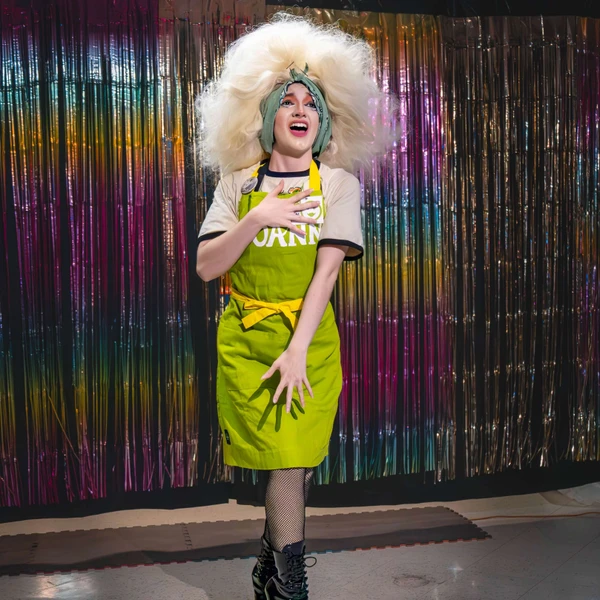
My goal is to build a community where drag artists of all kinds feel like their art is valued and seen. RuPaul’s Drag Race has done amazing things for the drag community, but it has also directly caused harm to the areas that it fails to represent. Many people do not know that drag is not just cisgender, gay men “dressing as women”. It is a multi-faceted community with a wide range of art that it would be impossible to list all types here. Because of this lack of visibility, I constantly witness the difference in how non-standard performers are valued by audience members and casting producers.
Even in the most progressive areas, drag shows are often only seen as a “spectacle”. The idea of going to watch “a man in a dress” is what draws a lot of people in, often leading to disappointment when that is not what they see. Because they cannot separate drag from this basic definition, I see how less skilled performers are tipped over the more skilled ones simply because they see the spectacle. This perception is what often causes casting performers to not even give non-standard performers a chance, which eliminates the opportunities for that wider community to be exposed to other forms of the art, which continues the cycle.
That is not to say that there are not extremely talented cis gay performers, but instead to say that they are not the only ones who exist. By not allowing these other talented artists to showcase their work, the community loses out on large aspects of its own culture during a time where solidarity among marginalized people is more important than ever. I have also witnessed first-hand how exposure to these alternate forms of art have opened the eyes of individuals outside of our community, and changed their perceptions on the LGBT+ community for the better. This includes my own father, who just three years ago would never have considered setting foot in a gay bar let alone attending a drag show. But now, he has seen me (someone who he considers to be a cis woman), performing in drag that he only expects from a gay man, become friends with a beefy nonbinary lesbian who only performs to Frank Sinatra songs, and become teary eyed while watching a Black transgender woman cutting up her abusive ex-wife’s wedding dress. By seeing the wider community that all is considered to be under the umbrella of “drag”, the LGBT+ community has become de-mystified in a way that has forced him to change his more bigoted views and become a more accepting person.
I aim to build this community by increasing the visibility of these non-standard performers- which means casting them on stages to put them directly in the spotlight. Not just large stages- any stages. In gay bars, in coffee shops, in dive shows, in pageants, and national competitions, we need to expand the definition of what is allowed to be seen as drag.
Wicked Fan Scholarship
Wicked, at its heart, has always been about existing despite the impossible odds. The message of learning how to exist despite your own government telling you you should not, and encouraging all to resist even when it is hard, hits incredibly close to home as a transgender drag artist. My government actively believes me to be a danger to society, when I simply wish to exist and live as everyone else does. I may not have chosen the fate I now walk, but I must embrace it in order to ensure a better future for my peers and those like me. I will not be cowed into silence because of the threat of censorship or fines, my identity is not a threat.
Not only that, but Elphaba's allyship with the animals should be followed by all human rights activists. Elphaba may be a human, but she still sees their struggles and decides to use her status as a human to voice the rights owed to them. I believe that this is the responsibility of all white able bodied LGBT+ individuals. We cannot have our rights without every marginalized person having rights. If we turn our eyes away from the struggles of other communities, People of Color, women, disabled individuals, we are hypocritical. Advocacy for LGBT+ rights means advocating for all human rights, and only through solidarity will we find a safer tomorrow.
Sabrina Carpenter Superfan Scholarship
As a transgender drag artist, my career has been significantly impacted by Sabrina's stage persona. Her music as well as her aesthetics have inspired many of my performances, and her allyship to the LGBT community inspires me to feel safe in the world of femininity. Additionally, my relationship with gender and sexuality has greatly improved ever since I have become a fan of her music. To have such an open and positive relationship with attraction to men while being kink and sex positive has been intrinsic in my healing journey, as I am having to navigate learning how to express my sexuality as a gay transgender man. To see someone who is unafraid of what she wants inspires me greatly, and I have never felt that her messages of "enjoy your love life, because it belongs to you" has helped me reclaim my sexuality and truly embrace the idea that it belongs to me, and nobody else. I can choose to share it with others, but no matter what I am myself and I belong to nobody. Her most recent impact has been her performance on The Muppet Show. As a life time fan of The Muppets, to see her continuing to be herself on such a prestigious stage makes me so proud to be a fan of both. She did not have to hide who she was to be on the show, and the show respected her persona enough to accurately portray it without sanitizing it to be more profitable.