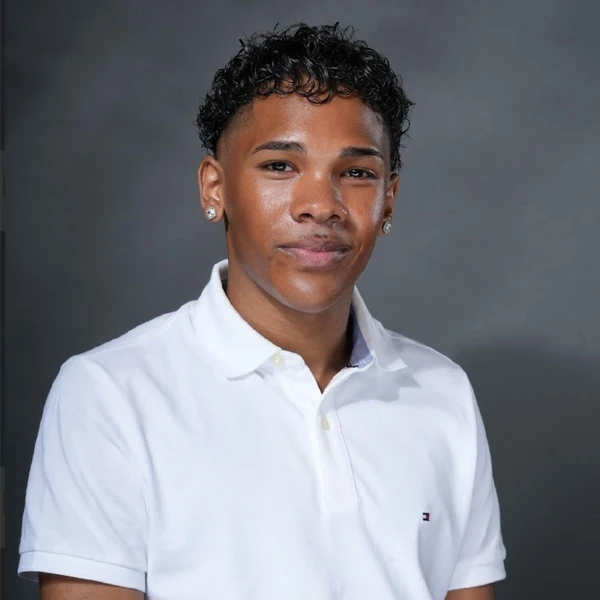
user profile avatar

Jeshua Jimenez

1x

Finalist

Bio

Jeshua Daniel Jimenez is a high-achieving student at Fordham University, double majoring in Political Science and International Relations on a Pre-Law track. He has a strong background in advocacy, having served on Bronx Borough President Vanessa L. Gibson's Bronx Youth Council, participated in Defying Legal Gravity to deepen his legal knowledge, and was involved in YVote as a youth activist where he spread awareness on civic engagement and the importance of voting during election season. In high school, he demonstrated leadership in the Student Leadership Team, National Honor Society, and other student organizations. Now in college, Jeshua is an active member of the Model United Nations team as a crisis delegate and current treasurer. He also works at Lincoln Square Legal Services, gaining hands-on legal experience in research, case preparation, and client interaction. He aspires to serve as a criminal defense lawyer and work towards fixing the unjust legal system in the United States.

Education

Fordham University

Bachelor's degree program
2024 - 2028
  • Majors:
    • International/Globalization Studies
    • Political Science and Government
    • Law

Miscellaneous

  • Desired degree level:

    Doctoral degree program (PhD, MD, JD, etc.)

  • Graduate schools of interest:

  • Transfer schools of interest:

  • Majors of interest:

  • Not planning to go to medical school
  • Career

    • Dream career field:

      Government Administration

    • Dream career goals:

    • Campaign Fellow

      Office of the Brooklyn Borough President
      2026 – Present5 months
    • Legal Empowerment Scholar & Alumni Panelist

      Defying Legal Gravity
      2023 – 20252 years
    • Youth Fellow

      Zellnor for NYC Fellowship
      2025 – 2025
    • Student Secretary

      Lincoln Square Legal Services, Inc.
      2025 – Present1 year

    Arts

    • Fordham High School for the Arts

      Acting
      Oedipus Rex, Romeo & Juliet, Once On This Island, The Crucible, Hereditary, The Joker, Marriage Story, Clue
      2020 – 2024

    Public services

    • Volunteering

      Defying Legal Gravity — DLG Volunteer
      2023 – 2024
    • Advocacy

      YVote — Youth Activist
      2023 – 2024
    Star Farm Scholarship for LGBTQ+ Students
    I am studying Political Science and International Studies at Fordham University on a pre-law track, with the goal of becoming a public defender and policymaker. I chose this path because I have spent my entire life watching systems fail the people I love, and I want to spend my career building something better. But before I could fight for anyone else, I had to learn how to fight for myself. I grew up hearing the word "maricón." In Dominican culture, it gets thrown around casually; at the television, across the dinner table, between relatives who do not pause to consider who might be sitting in the room absorbing it. I was that person in the room. I heard it from people who loved me, people who would have said they would do anything for me, people who did not yet know that the word they were using so carelessly was a word for me. That is what it means to grow up gay and Dominican. You learn very early that love can be real and conditional at the same time. In Latino spaces, queerness is often treated as something to be silent about, not acknowledged, not celebrated, and not welcomed at the family table without conditions. I grew up watching friends get pushed out of their homes for who they were. I loved my culture deeply and felt, at times, that my culture could not fully love me back. What made it harder was that queer spaces did not always feel like home either. I was too Dominican for some rooms and too queer for others, existing in a gap between identities that neither fully claimed me. That tension did not break me. It clarified me. Being gay and Afro-Latino taught me what it means to live in multiple worlds simultaneously, to find belonging where it is not automatically offered. Those are skills I bring into every room where I advocate for people who have also been told they do not belong. I do see myself as someone who gives back to the LGBTQ+ community. I am building toward a legal and policy career that centers the most marginalized, including queer people of color who face compounded systems of exclusion. I am working toward a future where queer Dominicans do not have to choose between their cultural identity and their full selves; by being visible, staying in these spaces, and refusing to disappear. Financially, this scholarship would make a direct difference. I am a low-income, first-generation college student whose mother works two jobs as a single parent to support three children in the Bronx. Last year, my family nearly faced eviction. I contribute income from my own part-time job to help keep our household stable. Every dollar I do not spend on tuition is a dollar that does not force me to choose between survival and the future I am building. The Star Farm Scholarship would not just support my education. It would support the version of me trying to make sure that the next gay Dominican kid from the Bronx does not have to fight as hard just to be seen. That is the community I came from. That is the community I am going back to. And I intend to make sure it is more whole when I arrive than it was when I left.
    New Jersey New York First Generation Scholarship
    When my father left Santo Domingo, he left everything he knew. The language, the streets, the people who loved him. He came to America with nothing but the belief that his children deserved something more than what poverty had given him. He built a life in the Bronx as a superintendent, raised four kids, and never finished his own education past the sixth grade. He never got to be a college graduate. That distinction will belong to me. Being a first-generation college graduate will mean that the sacrifice ends here. Not in the sense that struggle disappears, but in the sense that a new baseline is set. My brothers did not pursue higher education. I carry the weight of that too; the awareness that this path is fragile, that it requires fight, and that it is not guaranteed to anyone who looks like me or comes from where I come from. When I walk across that stage, I will not just be receiving a degree. I will be closing a chapter that my father opened when he stepped off a plane into a country that did not welcome him, and proving that his gamble was worth it. But a degree alone is not what shapes a person. It is what you do with the time around it. My extracurricular life has been the education I could not get in a classroom. At Lincoln Square Legal Services, I have sat across from clients facing eviction, helped prepare legal documents, and watched what it looks like when someone fights for a person the system has already written off. That work has humbled me and sharpened me in equal measure. It has shown me that public service is not abstract. It is a specific person in a specific crisis who needs someone present and capable. Through Defying Legal Gravity's Legal Empowerment Fellowship, I was given access to first-year law school curriculum as a high schooler and returned as an alumni panelist at their 2025 Legal Empowerment Conference, co-moderating a panel alongside nonprofit directors who had spent years building organizations across New York City. That experience taught me that leadership is not about seniority. It is about showing up and being willing to use whatever you have learned in service of others. Canvassing Brooklyn neighborhoods as a Campaign Fellow for Antonio Reynoso's congressional campaign taught me how to meet people where they are; how to have conversations about power and participation with people who have been told their voices do not matter. Y-Vote taught me that civic engagement is an act of resistance for communities like mine. Model UN taught me diplomacy, the art of holding your position while genuinely listening to someone who disagrees. Each of these experiences has built something in me that no tuition payment can purchase: clarity of purpose. I know why I am in school. I know who I am doing it for. I know what I want to build when I am done. Being a first-generation college graduate will mean that education is no longer foreign territory in my family. It will mean that when my siblings have children, those children will grow up knowing that college is not someone else's world. It will mean that the Bronx kid whose father collected coins in a wooden money bank to survive is now a lawyer, a policymaker, a person with the tools to fight for everyone who never got that chance. That is what this degree will mean to me. Not a credential. A continuation.
    First Generation Scholarship For Underprivileged Students
    Nobody in my family had ever gone to college before me. Not my father, who dropped out of school in the sixth grade in Santo Domingo to care for his sick mother because they could not afford healthcare. Not my mother, who works two jobs as a single parent to keep three kids housed in the Bronx. Not my older brothers, who did not pursue higher education despite everything my father sacrificed to give them that chance. When I enrolled at Fordham University, I was stepping into territory my family had never mapped. That is what it means to be first-generation. It is not just the financial burden, though that is real. It is the absence of a roadmap. It is not knowing the unspoken rules, not having a parent who can tell you how to talk to a professor, navigate financial aid, or build a resume. It is carrying the weight of everyone who came before you while trying to figure out a world they never got to enter. I have felt all of that. And I have refused to let it stop me. Today I carry a 3.5 GPA at Fordham while working at Lincoln Square Legal Services, serving as a Campaign Fellow for a congressional campaign, and engaging in civic work across New York City. I am a Harvard Law Future-L Scholar. I have sat on panels at Fordham Law School alongside seasoned nonprofit directors. None of that came with a guide. It came from stubbornness, community, and the belief that my background was not a barrier; it was a qualification. The most meaningful way I am working to inspire other first-generation students is through Defying Legal Gravity. DLG is a legal empowerment organization whose fellows are overwhelmingly first-generation students from communities like mine. I was one of them. I sat in weekly workshops at Fordham Law as a high schooler, learning Civil Procedure, Constitutional Law, and Criminal Law alongside peers who had never imagined themselves in a law school classroom. That program changed what I thought was possible for someone like me. When DLG invited me back as an alumni panelist for their 2025 Legal Empowerment Conference, I understood what that moment meant. The high school students in that room were watching someone who looked like them, came from where they came from, and had made it through. I was not there to perform success. I was there to make the path feel real and reachable. That is how I plan to inspire first-generation students: not through abstraction, but through presence. By showing up in the spaces where they are, being honest about how hard it has been, and refusing to pretend that the obstacles are not real. The obstacles are real. So is the possibility of moving through them. First-generation students do not need to be told that college is worth it. Most of us already know that and it is why we are here despite everything working against us. What we need is proof that people like us can survive it, thrive in it, and come back to hold the door open. That is what I am committed to doing, not just as a future lawyer and policymaker, but right now, in every room I enter and every student I meet who is walking the same road I walked. My father gave everything he had so I could have a chance he never got. I intend to make sure that chance does not end with me.