user profile avatar

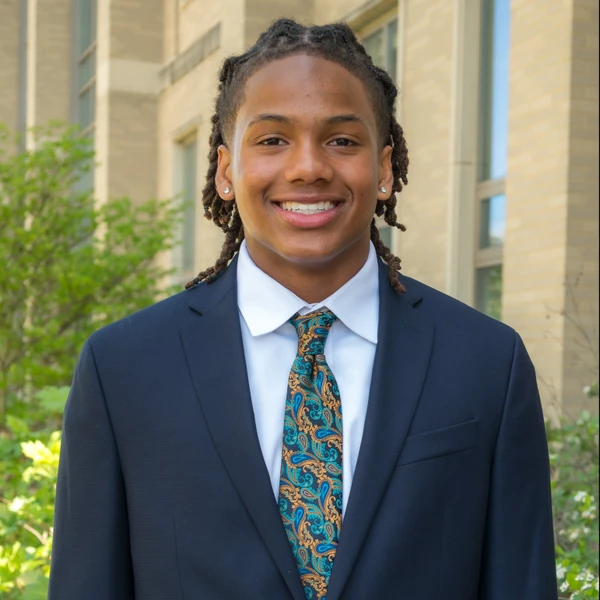
Jeremiah Thornton

1x

Finalist

1x

Winner

Bio

My name is Jeremiah Thornton, and I’m a recent graduate of Walnut Hills High School. I’m passionate about serving my community through engineering, mentorship, and mental health advocacy. Throughout high school, I took on leadership roles as a peer tutor, student-athlete, and ambassador with organizations like Forever Kings and 1N5. These experiences helped me see the power of positive influence—especially for young men who look like me. I’ll be studying Aerospace Engineering at the University of Cincinnati with a goal to design airport infrastructure that’s sustainable, inclusive, and future-focused. I want my work to create opportunity and safety for others. I live by Jeremiah 29:11, and I believe every step I take is part of a bigger purpose.

Education

University of Cincinnati-Main Campus

Bachelor's degree program
2025 - 2029
  • Majors:
    • Engineering, General
    • Aerospace, Aeronautical, and Astronautical/Space Engineering
  • Minors:
    • Mathematics

Walnut Hills High School

High School
2019 - 2025

Miscellaneous

  • Desired degree level:

    Bachelor's degree program

  • Graduate schools of interest:

  • Transfer schools of interest:

  • Majors of interest:

  • Not planning to go to medical school
  • Career

    • Dream career field:

      Aviation & Aerospace

    • Dream career goals:

      Aerospace Engineer or Technician

    • Supply Chain Intern

      The Hillman Group
      2025 – 2025

    Sports

    Baseball

    Varsity
    2022 – 20253 years

    Awards

    • Second-Team All Conference

    Arts

    • Walnut Hills Vocal Ensemble

      Music
      2023 – 2024

    Public services

    • Volunteering

      Every Nation Cincinnati — Served as a greeter, offering assistant, security member, and parking lot attendant to help ensure smooth church services and a positive experience for all attendees.
      2021 – Present
    Anderson Engineering Scholarship
    Walking into my second semester classes for the first time, I was struck by a recurring observation: the profound lack of minority representation, specifically Black students, in the room. This wasn't just a statistic to me; it was a call to action. I realized that my pursuit of an Aerospace Engineering degree at the University of Cincinnati is fueled by a dual passion: a drive to innovate within the aerospace industry and an ambition to prove to the next generation of minority students that the sky is not a ceiling, but a starting point. My ambition is rooted in the belief that engineering is a gateway to service. While I am motivated by the technical challenge of designing complex systems, my ultimate goal is to become a leader who contributes to both global innovation and the development of a more inclusive professional community. This drive has manifested in my academic performance. Maintaining a 3.86 GPA while navigating a rigorous course load including Intro to Aerospace Design, Multivariable Calculus & Linear Algebra, and Aerospace Computing requires a level of discipline that I take pride in. These courses have served as the forge where my professional identity is being shaped. Outside of the classroom, I have made intentional, strong connections with sought out mentors who have broadened my understanding of college and pursuing engineering. As a proud Darwin T. Turner Scholar, I was provided with a senior mentor, Tim Alade, who instilled in me the importance of remaining well-rounded & well-involved in college, even pushing me to stay involved with the National Society of Black Engineers (NSBE) Chapter at UC. Through NSBE conferences and other events, I connected with experienced engineers who have become trusted mentors. I am still learning from Johannes Ebba and Tony Mathis, both engineers affiliated with GE Aerospace, who taught me how engineers operate daily and encouraged me to persevere through hard times. There were times when I questioned if this degree was what I really wanted to do, yet engineers from my church community helped to reinforce the importance of staying grounded, understanding my purpose, and proactively pursuing every opportunity. This past year has been essential in providing me with hands-on-engineering experience through competitions, student organizations, and project-based coursework. The summer before my first college semester, I competed in the Junior Engineering Technical Society National Competition in Nashville, where my team designed and proposed climate change solutions and built bridges that met specific load requirements. At the University of Cincinnati, I joined the NSBE chapter and Bearcats Racing Team, where I learned how to contribute to collaborative engineering teams. In my Intro to Aerospace Design class, my partner and I created a wooden glider instruction manual and then built another team’s glider. In Intro to Systems Engineering, I used MATLAB to simulate dynamic systems, evaluate stability, and predict performance. Central to my development is the University of Cincinnati’s mandatory co-op engineering program. I am currently in the process of securing my first rotation for the Fall of 2026. My search for this position is not just a degree requirement; it is a vital step in my journey to apply my technical skills to industry challenges. I view the co-op program as the bridge between my current academic success and my future as a professional engineer. Receiving this scholarship would provide the necessary support to continue my journey. My commitment to engineering is fueled by more than just personal success, rather driven by the desire to use innovation and leadership to strengthen communities and create lasting solutions for a better world.
    Anderson Engineering Scholarship
    Winner
    When I walked into AP Physics 1 on the first day of junior year, the familiar feeling of being “the only one” settled in. Once again, I was one of just two Black students, and the only Black male, in the room. That moment crystallized why engineering isn’t just a career choice for me, it’s a mission. I want to build bridges, literal and figurative, so that the next generation of students who look like me sees possibility, not isolation, in advanced STEM spaces. I’ve always gravitated toward problems that demand both creativity and rigor. Whether it’s solving for a difficult integral in Calculus BC or toying with a circuit in AP Physics C, I relish the rhythm of engineering: imagine, test, refine, repeat. At Walnut Hills High School, ranked in Ohio’s top five percent, I sought out every challenging STEM course available, earning college credit in Foundations of Engineering Design Thinking I & II. Those classes gave me my first taste of university-level teamwork. Working with my team through challenging projects showed me that the best solutions emerge when diverse perspectives collide and collaborate. Being underrepresented has sharpened my ability to thrive in diverse teams and deepened my commitment to representation. Many of my peers growing up were steered toward sports or music, rarely encouraged to explore aerospace dynamics or structural analysis. My parents insisted that education is “the passport to the future,” a sentiment Malcolm X captures perfectly. Their conviction propelled me toward opportunities that would expand my horizons and, in turn, those of others coming after me. One such opportunity was the University of Dayton’s 2024 Summer Engineering Program. Over three days, I rotated through hands-on labs in civil, chemical, and technical engineering. In each session, I connected theory to results: optimizing truss designs, analyzing reaction yields, coding microcontroller inputs. I left without a favorite discipline but with absolute clarity that engineering’s breadth is what excites me. Aerospace engineering, where math, physics, and innovation intersect at 30,000 feet, is where I belong. Mentorship has been a compass on this journey. At scholarship events, I heard GE executive Tony Mathis describe “failing forward” and engineer Johannes Ebba explain how to navigate both vertically and laterally inside a company. Construction leaders Anthony Chambliss and Stan Williams modeled servant-leadership on job sites, while church mentors reminded me to keep purpose at the center of every pursuit. Their guidance fuels my determination to give back. During senior year, I visited five local elementary schools to share my story so, younger students, especially underrepresented ones, could picture themselves in a lab coat as easily as in a jersey. Next fall I will enter the University of Cincinnati’s acclaimed co-op program, alternating aerospace coursework with full-time industry rotations. The model fits my learning philosophy: theory refined by practice, classroom concepts grounded in real-world relevance. My experience in Design Thinking I & II felt like a miniature co-op, where I dealt with tight deadlines, unfamiliar problems, and a team depending on me to deliver. I’m eager to scale that experience with projects that push me to code more efficiently, model airflow more precisely, and design safer, more sustainable aircraft. Engineering is more than my passion, it’s my platform. Through it, I will innovate for the communities I love, mentor those who follow, and embody the representation that once felt so scarce. I’m preparing today, passport in hand, to help shape a tomorrow where every student, regardless of race, can walk into a calculus classroom or wind-tunnel lab and know they belong.