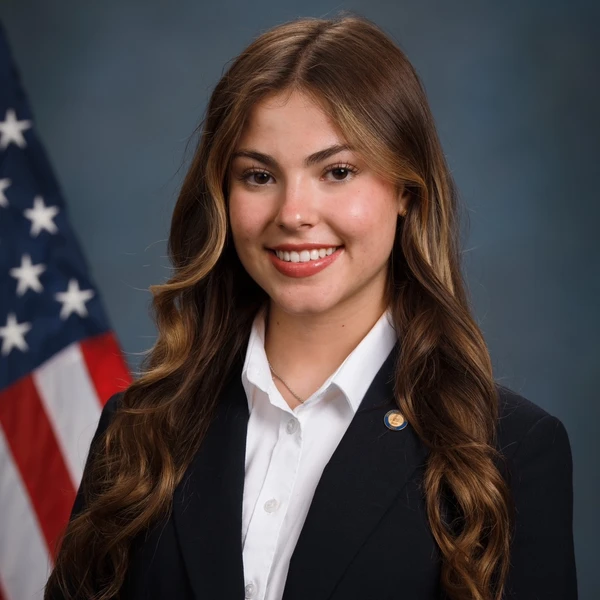
Williston, ND
Gender
Female
Hobbies and interests
Cello
Student Council or Student Government
Volunteering
Reading
Academic
I read books multiple times per week
Jayla Roberts
1x
FinalistJayla Roberts
1x
FinalistBio
Hello, I am from a small town in North Dakota. I attend Williston High School. At school I am a class rep and lead celloist.
I was blessed to spend my second semester of Junior year in Washington D.C. with 30 other students from across the country. I was a Senate page and worked on the Senate floor every day. We had a very rigorous schedule starting with school at 6:00 before readying the Senate Chamber. We worked until the Senate adjourned (sometimes going overnight and working 24-hour days). Being in the program inspired me to set my horizons high and I am now looking to attend a challenging university.
Education
US Senate Page School
High SchoolWilliston State College
Associate's degree programWilliston High School
High SchoolMiscellaneous
Desired degree level:
Bachelor's degree program
Graduate schools of interest:
Transfer schools of interest:
Majors of interest:
- Biochemical Engineering
- Biological and Biomedical Sciences, Other
- Chemical Engineering
- Biopsychology
- Political Science and Government
- Data Science
Test scores:
31
ACT
Career
Dream career field:
Computer Software
Dream career goals:
Data Analyst
Senate Page
United States Senate2025 – 2025
Sports
Track & Field
Junior Varsity2022 – 20242 years
Archery
Club2021 – 20243 years
Arts
Williston High School Orchestra
Music2022 – PresentHarmonic Music World
Music2023 – Present
Public services
Advocacy
Women in Leadership — Founder2025 – PresentVolunteering
Mondak Animal Rescue — Dog Walker2024 – PresentVolunteering
D.C. Central Kitchen — Vegetable cutter.2025 – 2025
Future Interests
Advocacy
Politics
Volunteering
Valerie Rabb Academic Scholarship
I am a cellist who mentors eleven younger musicians, a shift lead at a coffee shop where I train new employees, and a student council representative who organized fundraising dances that brought together over 600 students. I founded the Women in Leadership Club at my school after realizing rural girls lack the same leadership development opportunities as their urban peers. I spent six months as a United States Senate Page, working twelve hour days on the Senate floor while earning High Honors at the Page School. I have worked over 2,000 hours across four jobs during high school. I am from Williston, North Dakota, a town small enough that everyone knows everyone, which means both that community matters deeply and that leaving feels complicated.
My plan is to become a data analyst working in government. I excel in math and science, but I do not want to work in isolation. My time as a Senate Page showed me how policy decisions get made and how data informs choices that affect millions of people. Analysts answer questions that matter. Should rural hospitals receive additional funding to prevent closures? Are workforce development programs actually improving employment outcomes? Which interventions reduce food insecurity most effectively? These problems require technical skills and a commitment to serving people. I could pursue engineering and likely earn a higher salary, but that path does not align with what drives me. I want to use my analytical abilities in service of work that improves lives.
The adversity I have faced is not dramatic, but it has shaped me. The first challenge was leaving home for the Senate Page program during my junior year. I grew up in a community where the expectation was to stay close, to follow a predictable path. Choosing to move 1,000 miles away felt like a betrayal of that expectation. When I got to Washington D.C., the homesickness was crushing. I was exhausted all the time. My feet ached from standing all day on the Senate floor. I felt out of place in academic discussions with classmates who seemed more prepared than I was. Most nights, I called my mom crying and considered booking a flight home. But I stayed. I pushed through because something in me refused to settle for the easier path. By the end of the semester, I had earned High Honors and gained clarity about what I wanted to do with my life.
The second challenge has been financial. I have worked consistently since I was old enough to be employed because I need the income to support myself. Every shift I worked was a shift I was not studying or participating in activities that would strengthen my future. I made those trade offs willingly, but I understand their cost. Balancing work and school requires constant recalibration of priorities. Some weeks I choose sleep over studying. Some weeks I choose volunteer work over an extra shift, even though I need the money. Those decisions have taught me discipline, but they have also taught me that access to opportunity should not depend on how many hours you can work while still succeeding academically.
I plan to attend the University of Minnesota Twin Cities, where I will major in data science and minor in public policy. After graduation, I will pursue a master's degree while returning to Capitol Hill for an internship. I want to be someone who translates complex data into policy recommendations that help people. That is the difference I hope to make.
Ava Wood Stupendous Love Scholarship
"Boldly, Unapologetically Me"
Growing up in Williston, I had a path laid out. Find someone in high school, get married, stay close to home. It was comfortable. It was expected. It was what everyone did. During my junior year, I applied to be a United States Senate Page. When I was accepted, people asked why I would leave. Why would I move 1,000 miles away to work twelve hour days when I could stay home where everything was familiar? I didn't have a perfect answer. I just knew I needed to go.
Those six months were harder than I expected. I cried on the phone to my mom most nights. My feet ached from standing all day. I felt out of place in discussions with classmates who seemed more polished and prepared than I was. But I stayed. I pushed through the homesickness and the exhaustion because something in me refused to settle for the easier path. I watched senators debate policy that would affect millions of lives. I stood in the Capitol rotunda at three in the morning and let myself marvel at where I was. Choosing to leave Williston didn't mean rejecting home. It meant trusting that I could be more than what was expected. That choice changed everything about what I believe I am capable of.
"Creating Connection":
When I returned from Washington D.C., a conversation with my roommate stuck with me. She had mentioned her Women in Leadership club back in Chicago, and when I told her we didn't have anything like that at Williston High School, she was bewildered. I realized she was right. There was no dedicated space for girls to develop leadership skills through practice and support. Three months later, I founded the Women in Leadership Club. Thirty girls showed up to the first meeting. I had secured a local coffee shop sponsor and organized monthly workshops on impromptu speaking and teamwork. We practice the skills that intimidate us most. We give each other honest feedback. We create space to make mistakes without judgment.
The club has done more than I anticipated. Girls who never raised their hands in class now volunteer to give presentations. Friendships have formed across grade levels that wouldn't have existed otherwise. The workshops gave me confidence to enter the American Legion Oratorical Contest, where I won at the state level. Creating this space taught me that inclusion isn't passive. It requires actively building something that didn't exist before and inviting people in.
Foundation 4 Change Scholarship
I asked my friend to drive like a normal person. We were heading home from school, and he had been drifting around corners for the past few minutes. I was annoyed more than scared. It felt reckless but not dangerous, the kind of thing teenage boys do to show off. He laughed and straightened out the wheel. Seconds later, we were hit from the side by an armored bank vehicle at an unprotected intersection. The impact was sudden and violent. Metal crunched. Glass shattered. My body slammed against the seatbelt. For a moment, everything went still. Then the panic set in. We checked ourselves. We checked each other. Somehow, miraculously, everyone was okay. But in that moment between impact and relief, I understood something I had only known abstractly before. One decision can change everything. One moment of distraction or impairment can turn an ordinary drive into tragedy.
That crash was not caused by alcohol. It was caused by speed and bad timing. But the lesson applies. When you get behind the wheel impaired, you are making a choice that affects more than just yourself. You are deciding that your convenience matters more than the safety of everyone else on the road. You are gambling with lives, and the odds are worse than most people think. According to the National Highway Traffic Safety Administration, someone dies in a drunk driving crash every 39 minutes in the United States. That is 37 people per day. Those are not just statistics. They are parents driving home from work. They are college students heading to class. They are kids in the backseat who trusted the adults to get them home safely.
The consequences of drunk driving extend far beyond the immediate crash. If you survive, you face legal penalties that include jail time, fines reaching tens of thousands of dollars, and a criminal record that follows you for life. You lose your license. You lose your freedom. You lose job opportunities because many employers will not hire someone with a DUI conviction. But the legal consequences pale compared to the emotional ones. Imagine living with the knowledge that your decision to drive drunk killed someone. Imagine carrying that weight every single day. Imagine facing the family of the person you killed and trying to explain why you thought it was okay to get behind the wheel.
The ripple effects touch everyone. Families lose loved ones. Communities lose teachers, doctors, students, friends. Emergency responders show up to scenes they will never forget. The societal cost of drunk driving in the United States exceeds 44 billion dollars annually when you factor in medical expenses, legal costs, property damage, and lost productivity. That number does not account for the emotional trauma or the lives cut short.
So what do we do about it? The solutions are not complicated. They just require us to prioritize safety over convenience. First, plan ahead. If you know you are going to drink, decide before you start how you are getting home. Designate a sober driver. Call a rideshare. Take public transportation. Stay where you are. Apps like Uber and Lyft have made it easier than ever to get home safely. Many communities offer free or discounted rides on holidays when drinking is more common. Use them.
Second, speak up. If you see someone about to drive drunk, say something. I know it feels awkward. I know you do not want to be the person who ruins the vibe. But discomfort is temporary. Death is permanent. Take their keys. Offer them a ride. Call them a car. When I asked my friend to drive like a normal person, I was trying to avoid a crash that had nothing to do with alcohol. But the principle is the same. If something feels unsafe, you have a responsibility to speak up, even when it is hard.
Third, change the culture. We need to stop treating drunk driving like a minor mistake. It is not funny. It is not cool. It is a choice that kills. Schools should bring in speakers who have lost loved ones to drunk driving or who have survived crashes themselves. Hearing those stories makes the danger real in a way that statistics cannot. Communities should organize awareness campaigns that make it clear driving drunk is unacceptable. We should celebrate designated drivers the same way we celebrate people who volunteer. Make it the norm to plan for safe transportation, not the exception.
In Williston, I think we could do more. Our town is small enough that everyone knows everyone, which means word spreads fast. We could partner with local restaurants and bars to offer discounted rideshare codes on weekends. We could organize a pledge campaign where students commit to never driving drunk and to always intervening if they see someone about to make that choice. We could work with law enforcement to host educational sessions about the real consequences of DUIs. We could create a peer led program where students share their own stories about close calls or losses, making the issue feel immediate rather than abstract.
On a larger scale, ignition interlock devices should be required for all offenders. Some companies are developing cars with built in sensors that detect impairment and prevent the vehicle from being driven. We should invest in those technologies and make them standard.
I was lucky. My friend was lucky. The people in that armored vehicle were lucky. We walked away from a crash that could have been much worse. But luck is not a strategy. Luck runs out. The only real solution is making better choices before we get behind the wheel. Drinking and driving is not an accident. It is a decision. And every single one of us has the power to decide differently.
Matthew E. Minor Memorial Scholarship
As a first-generation college student from a rural town in North Dakota, the path to higher education has always felt both exciting and uncertain. Financial need plays a large role in that uncertainty. My family has worked hard to support me, but college costs—from tuition to textbooks—present a real challenge. I’ve taken initiative by working as a gymnastics coach while remaining highly involved in academics, music, and leadership roles. Still, outside financial support is essential to making my college dreams a reality.
My high school experience has been full of diverse commitments that have shaped who I am and how I give back. I served as a U.S. Senate Page in Washington, D.C., living away from home for six months without a phone and working closely with 30 other students from across the country. It was one of the most eye-opening experiences of my life. Before the program, I planned to stay in-state for college, but being around students from Alaska to New York showed me how far I could go if I stepped outside my comfort zone.
Beyond the Page Program, I’ve taken on leadership roles such as Class Representative and a member of both Student Council and the Prom Committee. I am a proud member of the National Honor Society and Tri-M Music Honor Society. Music is another major part of my identity—I’ve studied cello for years and currently serve as lead cellist in the Harmonic Creative World Music Ensemble, a community-based orchestral group outside of school.
I also work as a gymnastics coach for children, and it’s there that I’ve learned how important it is to create safe spaces for youth. Many of the children I coach come to the gym to build confidence and friendships in a supportive environment. I take my role seriously—not only teaching physical skills but modeling empathy, inclusion, and respectful communication. When it comes to bullying or harmful online behavior, I talk openly with young athletes about safety and boundaries. I remind them that their voices matter and that seeking help is always a brave and right choice. Creating a culture of respect and encouragement—online and off—is something I’m passionate about carrying with me into adulthood.
Receiving a scholarship like this would have a lasting impact on my educational journey. It would ease the financial strain on my family, allow me to focus more fully on academics, and help me pursue a degree in STEM—an area I grew to love through AP Chemistry and Biology. This support would not only help cover the rising costs of college but also affirm that hard work, community involvement, and resilience matter. I am eager to continue my education, give back to others, and inspire the next generation to do the same.
I Can and I Will Scholarship
There was a time when I couldn’t get out of bed—not because I was tired, but because everything felt unbearably heavy. It started around middle school, though I didn’t have the language for what I was experiencing. I just knew something was off. I would laugh at school, do my assignments, go to practice, and then come home and feel like I was collapsing into myself. I remember one afternoon sitting on my bedroom floor for hours, staring at the same spot on the wall, completely numb, hoping that if I stayed still long enough, the emptiness would fade.
In my household, mental health wasn’t something we talked about. We were raised to “tough it out” and “stay strong,” but that only made me feel more isolated. I started to believe that something was wrong with me because I couldn’t just snap out of it. I kept everything inside until one night I broke down in front of a close friend. I expected judgment. Instead, I was met with compassion. That one conversation shifted my world—I realized I didn’t have to carry everything alone, and that someone cared enough to sit with me in my silence.
Since then, I’ve been learning to treat myself with the same kindness I’ve always extended to others. It hasn’t been easy, and it’s far from over, but I’ve come to see my struggles not as weaknesses, but as signs of strength. Living with mental health challenges has taught me resilience—not the flashy kind, but the quiet kind. The kind that shows up in getting out of bed even when it’s hard, in asking for help, in choosing to keep going even when my mind tells me otherwise.
It’s also changed the way I see people. I now believe that everyone is fighting battles we can’t always see. I’ve become more empathetic, more present, and more grounded. I’ve learned to celebrate small victories and to give myself grace when things aren’t perfect. That grace, I’ve learned, is not a luxury—it’s a necessity.
These experiences have deeply influenced how I approach life. I’m more motivated than ever—not just to succeed, but to grow. To become someone who leads with compassion, who values honesty, and who shows up authentically, even when it’s difficult. I don’t take stability for granted. Every good day feels like something I’ve earned, and every challenge feels like something I can face.
Mental health shaped me, but it didn’t break me. It built me—patiently, quietly, powerfully—into someone I’m proud to be becoming.
David Foster Memorial Scholarship
"I pledge that I have neither given nor received any help on this assignment"
Signed, Jayla Roberts.
This pledge was required on every etymology assignment in Mrs. Owens' class. When I first entered her classroom, I thought the whole idea was, frankly, stupid. Did she really believe that students with unlimited access to the internet and each other would be held back by a single sentence. It is so easy to ask, "What did you get for number six?" or snap a quick picture of the back page to send to a friend. It felt naive, idealistic even. Integrity felt like a concept teachers liked to throw around to sound noble, and realistically everyone was guilty of getting a 'little' help from peers. Especially those who were academically inclined, after all, they wanted the best grade possible and if that meant a bit of searched so be it.
Nonetheless, Mrs. Owens insisted. Every assignment must be pledged. And she talked to us about what it meant. What did it mean to sign your name to something? Who we were when no one was watching or governing? She never accused or hovered over our shoulders to make sure we weren't cheating. Instead, she trusted us like we were already the people she believed we could become. People who valued their own work, took pride in honesty, and who understood that integrity wasn't about a grade but about character. There were times when I was tempted to cut corners, after all it would be easy, but I felt a moral principle governing the way I went about my schoolwork.
That trust changed me. I stated to care more about learning than about just finishing I caught myself rereading questions instead of googling them. I stopped asking friends for answers and started asking them to study. Little by little, I realized that the pledge was not just about schoolwork, but rather who I wanted to be.
Mrs. Owens taught me that integrity is worth more than a perfect score. To learn that shortcuts might get you to the finish line faster, but they won't make you proud of how of how you go there. Because of Mrs. Owens I strive to do the right thing. Not because it is the easiest or most gratifying but because it is Who I want to be. She did not just change how I work. She changed who I am and who I want to work to be.