Hobbies and interests
Choir
Church
Community Service And Volunteering
Concerts
Drums
Education
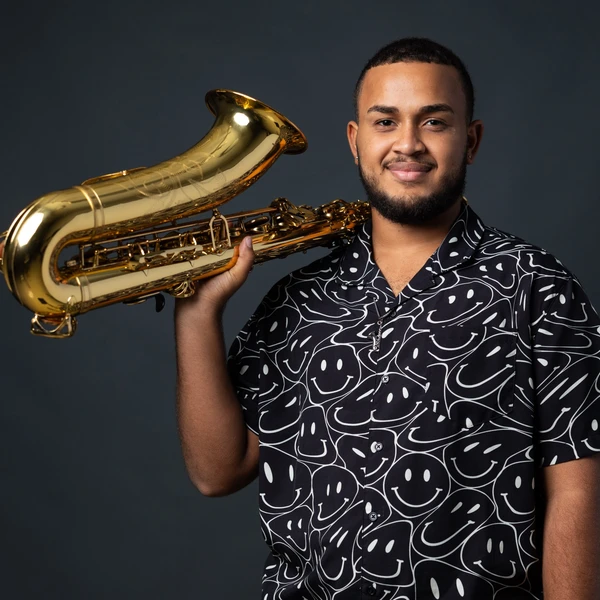
Saxophone
Music
US CITIZENSHIP
US Citizen
FIRST GENERATION STUDENT
Yes
Jay Cordero
1x
Finalist1x
WinnerJay Cordero
1x
Finalist1x
WinnerBio
I am a Puerto Rican first-generation college student studying Music Therapy at Carroll University in Wisconsin. I grew up in Dorado, Puerto Rico, where public school music programs had nearly disappeared. A free library program gave me my first saxophone lesson and changed everything.
I arrived in Wisconsin without mastering English and without family nearby. I figured it out anyway.
I volunteer for music therapy at the PR Children's Hospital and Genesee Lake School in Wisconsin. On campus, I participate in Marching Band, Jazz Ensemble, Wind Ensemble, and A Cappella, and organize Puerto Rican cultural workshops through the Latin American Student Organization.
My goal is to create a nonprofit offering free music classes and instruments to low-income youth. Education is not a privilege, it is a right worth crossing oceans for.
Education
Carroll University
Bachelor's degree programMajors:
- Rehabilitation and Therapeutic Professions, General
- Music
GPA:
3.3
JOSE SANTOS ALEGRIA
High SchoolGPA:
3.9
Miscellaneous
Desired degree level:
Master's degree program
Graduate schools of interest:
Transfer schools of interest:
Majors of interest:
- Music
- Community Organization and Advocacy
- Rehabilitation and Therapeutic Professions, General
- Mental and Social Health Services and Allied Professions
- Special Education and Teaching
Career
Dream career field:
Music
Dream career goals:
music therapist
Music teacher's assistant
Carroll University2024 – Present2 yearsvolunteer
Jane Stern Community Library2024 – 2024
Arts
Municipal Band of Dorado Puerto Rico
Music2025 – 2025Getsemani church
Music2017 – Present
Public services
Volunteering
The Jane Stern Dorado Community Library — Music teacher Music Teacher's Assistant2024 – 2024Volunteering
Revival-JSA Dorado High School — Musician2023 – 2024Volunteering
Latin American Student Organization — Cultural Support2024 – PresentVolunteering
Music Therapy Pioneers Organization — member2024 – PresentVolunteering
Genesee Lake School — vol2025 – PresentVolunteering
Getsemani church youth group - Juventud Guerrera — member2017 – PresentVolunteering
Pediatric Hospital Foundation in Puerto Rico — music therapy assistant2025 – Present
Future Interests
Advocacy
Volunteering
Philanthropy
Entrepreneurship
James B. McCleary Music Scholarship
I grew up in Dorado, Puerto Rico, in a low-income family where private music lessons were an impossible luxury. Public schools on the island had nearly stopped offering music programs, and my mother tried for years to find me access to one without success. For a long time, music was something I admired from a distance a closed door I didn't know how to open.
Everything changed at 16, when I discovered a free program at the Jane Stern Community Library in Dorado. I started with drums, then guitar, and finally the saxophone. My own classmates told me it was too hard, that I wouldn't make it. Two months later, I auditioned for a competitive music boarding program and was accepted. I was selected two consecutive years for the Berklee Puerto Rico program, completing it with an A average. Music didn't just give me an instrument it gave me confidence, identity, and direction.
But the moment that truly transformed my relationship with music was volunteering at that same library with a special young woman who needed extra attention. I earned her trust. At first, her mother had to sit beside her for her to play. The mother began waiting outside. The day I watched her perform alone in front of a full audience, with a smile I will never forget, I understood that music hadn't just changed my life it could change the lives of others too. That moment led me to switch my major from Music Performance to Music Therapy.
Music taught me that rejections are not the end. When I didn't pass the audition for the PR Conservatory of Music, that devastating blow became a redirection. I moved to Carroll University in Wisconsin without mastering English, without family nearby, in a completely different climate and culture. Music was the thread that kept me connected to my Puerto Rican identity through all that change. On campus I perform in Marching Band, Pep Band, Jazz Ensemble, Wind Ensemble, 70's band, Jazz Combo and PIOnissimo Acappella. Through the Latin American Student Organization and Music Therapy Pioneers I organize bomba and plena workshops because music is also culture, memory, and resilience.
Today I volunteer music therapy at the Puerto Rico Children's Hospital and at Genesee Lake School in Wisconsin, where I have watched young people with neurodevelopmental disorders transform the moment music begins to play. That is priceless.
My financial need is real and profound. My mother is my only source of support, and she has been unable to work for five years due to medical conditions that prevent her from doing so. She has never stopped believing in me, but her physical limitations make every semester a financial struggle. My biological father abandoned me when I was two years old and has never contributed to my education or my wellbeing. I have made it this far without the safety net that many students take for granted without a father, without stable family income, and far from home. Every scholarship I receive is not just financial help it is the difference between continuing my studies or having to leave them behind.
Music saved me from resignation, gave me purpose, and showed me the way. My goal is to create a nonprofit foundation offering free music classes and instruments to low-income youth so that no child has to wait to discover what music can do for their life.
Because music doesn't just open doors. It rebuilds identities, transforms, and saves lives.
Robert F. Lawson Fund for Careers that Care
My story begins before my earliest memory. My mother would put headphones on her belly during her pregnancy, filling me with music before I saw the world. When I was one year old, my grandmother made me make maracas out of recycled kitchen items. Those instruments taught me a truth that would define my life: music is not just sound, it is language, it is healing, it is hope.
My name is Jay N. Cordero Olivo, I am 19 years old, and I am in my second year of Music Therapy at Carroll University in Wisconsin. I consider myself cheerful, passionate, and deeply committed to service. But my path to music therapy was forged through the revelation that my greatest gift was using music to transform lives.
I grew up in Puerto Rico when most public schools eliminated music programs, and there were no facilities offering free classes. I had to wait until I was 15 to access free classes at my local library. When I was finally able to take lessons and decided to study saxophone after learning drums and guitar, many discouraged me. My mother was my anchor. "Forget what other people say," she told me. "I'm the one who's going to sacrifice to take you to lessons." Her words gave me the courage to pursue my passion.
The moment that changed my life came when I was volunteering as a music teacher at the same library. The administrators warned me about a student with special needs. For four months, I worked patiently with her. I was always very attentive and careful with her. "You just have to practice," I told her.
I witnessed a transformation that still moves me. Her mother, who initially sat next to her daughter during every class, gradually moved away until she was waiting outside the classroom. On the day of the final performance, my student played her entire set with the beginner band. I was conducting the group, and I saw the concentration on her face and the confidence in her hands. Today she tells me, "With you, I feel safe." Seeing the result showed me that my true calling was music therapy. I understood that my gift was to use music to heal and empower.
Leaving Puerto Rico to study in Wisconsin has been a huge sacrifice. I arrived without mastering English, without family nearby, facing financial difficulties that persist. I have experienced racism. But music keeps me grounded. I am currently involved in more than seven music organizations at university. I volunteer at a school specializing in autism in Wisconsin, and when I return to my island, I work at the Pediatric Hospital Foundation and with non-profit organizations.
My plan to positively impact the world is clear: to create or work for a nonprofit organization that offers music therapy and free music education to children in low-income communities. I want no child to have to wait until age 15 to access music lessons. I want to create safe spaces where young people can discover their potential.
Music saved me when I needed it most. It gave me a voice, purpose, and hope. Now it's my turn to be that bridge for others, to prove that access to music can transform not only individual lives, but entire communities. This is my commitment, my mission, my life.
Priscilla Shireen Luke Scholarship
Giving back is not something I plan to do in the future; it is something I live every day. It is my way of honoring those who opened doors for me when I did not have the means to open them myself.
Currently, I give back through constant volunteering. At Carroll University, I actively participate in more than seven music-related organizations. I regularly volunteer at a specialized autism school in Wisconsin, where I use music to help students with special needs express themselves and build confidence in ways that words sometimes cannot achieve.
When I return to Puerto Rico during breaks, my commitment intensifies. I volunteer with multiple nonprofit organizations—the same ones that once gave me access to music education when the public system failed me. I work at the pediatric hospital in Puerto Rico, bringing music to children facing illness. Seeing how a simple song can transform pain into a smile reminds me why I do what I do.
I also offer workshops on Puerto Rican music and culture at the university, keeping my culture alive while building bridges of cultural understanding.
But my greatest way of giving back comes from my direct work teaching music as a volunteer. I continue the work that began with that young student who changed my life. Every time I see a student discover their voice through music, I know I am making the difference that others made for me.
My vision for positively impacting the world in the future is clear. Once I complete my Music Therapy degree and obtain my certification, I plan to create or work for a nonprofit organization dedicated to providing music therapy and free music education to children from low-income communities.
My organization will integrate three components: free music education so no child has to wait until age 15 like I did; music therapy services to address the mental health crisis in marginalized communities; and after-school programs that offer safe spaces where young people can develop their talents.
I will focus especially on Puerto Rico, where the elimination of music programs in public schools has created a devastating void. But my vision extends beyond that. I want to create a replicable model that can be implemented in any community where music is seen as a luxury instead of a necessity.
My impact will not be measured only by how many students I teach, but by how many lives I transform, how many voices I amplify. I want to create a chain of giving back where the young people I help eventually give back to others, creating a perpetual cycle of empowerment through music.
Giving back currently keeps me connected to my purpose. Planning how I will impact the world keeps me motivated through financial difficulties, racism, and the challenges of studying far from home. Every student I help today is an investment in the world I am building for tomorrow—a world where music is not a privilege, but a fundamental right accessible to all.
Music saved me. Now it is my turn to use music to save others, to prove that access to music can transform not only individual lives, but entire communities.
Sunni E. Fagan Memorial Music Scholarship
WinnerMusic is my first language, my first heartbeat. My mother would put headphones on her belly during pregnancy, filling me with sounds before I saw the world. When I was just a year old, all that fascinated me were sounds. My grandmother made me maracas out of water bottles and rice, and drums out of empty cans of my milk. Those instruments taught me that music lives everywhere.
But my passion deepened through pain. I grew up in Puerto Rico when music programs were eliminated from public schools. I had to wait until I was 15 to access free classes at my town's library. Those years of waiting taught me how poverty can silence voices before they have a chance to sing.
My passion became my purpose during my volunteer work as a music teacher's assistant in Puerto Rico. The administrators explained to me that we would have a student with special needs and warned me that I had to be extremely careful. The responsibility motivated me deeply.
My student's mother sat right next to her daughter throughout the entire class, watching her every move. I began with absolute patience. I always asked her permission, always asked her if she was okay. I made it clear to her that making mistakes was not a bad thing. "You just have to practice," I told her.
For four months, I witnessed a transformation that still brings tears to my eyes. I saw my student begin to trust herself. I constantly showed her that I trusted her. And something magical happened: her mother began to move away. First, to a chair further away. Then, to the corner of the classroom. Finally, she stayed outside the classroom.
The highlight came with the final performance. My student took the stage with the beginner band. I conducted the group, and from the podium I could see her play two complete songs in front of an audience. The concentration on her face, the confidence in her hands, the smile at the end, it was all evidence of a miracle.
Today, this young woman advanced to the intermediate level. When we see each other, she tells me, "I feel safe with you." That phrase changed my life. It showed me that my gift was not just playing music but using it to heal and transform lives. That's why I switched from Music Performance to Music Therapy.
Now I study at Carroll University, participating in more than seven music organizations. When I return to Puerto Rico, I volunteer with multiple organizations. Every experience at the autism school in Wisconsin and at the pediatric hospital in Puerto Rico confirms to me that I am where I am meant to be.
My plan to give back to young people is to create or work for a nonprofit organization that offers music therapy and free music education to low-income children. I am a product of organizations that believed in me when I had no means. Without them, my voice would have been silent. Now it's my turn to open those doors.I don't want any child to have to wait until they are 15 to access music education. I want to create safe spaces where young people can discover their potential, just as my student did with me.
Music saved me, gave me a voice and a purpose. It connected me to my true calling through a student who taught me that the greatest power of music is not in the notes we play, but in the lives we touch.
Neil Margeson Sound Scholarship
My passion for music began before my first breath. My mother filled her pregnancy with classical music, ocean sounds, and angelic melodies. When I was barely a year old, anything that made sound mesmerized me. My grandmother crafted maracas from water bottles filled with rice and drums from my empty formula cans. Those humble instruments introduced me to a truth that would define my life.
Growing up in Puerto Rico, most public schools had eliminated music programs, and no government facilities offered free classes. While students in the United States received music education as standard curriculum, I had nothing. I had to wait until I was 15 years old to finally access free music classes at my town's library. Those years of waiting taught me a painful lesson about inequality and how economic circumstances can silence voices before they have a chance to sing.
When I finally began lessons and decided to pursue saxophone after learning drums and guitar, friends and family told me I was making a mistake. My mother became my anchor. "Forget what others say. I'm the one who will sacrifice to take you to lessons." Her words gave me courage when I had none.
The sacrifices intensified when I left Puerto Rico to study Music Therapy at Carroll University in Wisconsin. I left my family, my language, my culture, arriving without mastering English and facing financial difficulties that persist today. I've encountered racism—reporting professors who denied me accommodations, hearing derogatory comments for speaking Spanish. There were moments when I questioned whether I could continue. But music kept going.
The moment that crystallized my purpose came during volunteer work as a music teacher assistant in Puerto Rico. I worked with a young student with special needs whom many doubted could learn piano. For four months, I showed her that every mistake was another chance to grow. Her mother, who initially sat beside her during every lesson, gradually moved until she waited confidently outside. When my student performed two songs with our beginners' band before an audience, I witnessed music's power to shatter limitations and create possibilities where others saw only obstacles.
That experience transformed my path. I switched from Music Performance to Music Therapy because I understood my gift wasn't just playing music, it was using music to heal and empower lives.
Today, I actively participated in more than seven music-related organizations at Carroll University. During breaks, I volunteer with multiple organizations in Puerto Rico, never forgetting communities that need music most
My future goals are clear. I will complete my Music Therapy degree and certification, then create or work for a nonprofit providing free music therapy and music education to children from low-income communities. I will ensure no child waits until age 15 to access music classes, that economic circumstances never silence another young person's voice.
Music saved my life. It gave me voice when I felt voiceless, purpose when I felt lost, hope when circumstances seemed insurmountable. It connected me to my grandmother's love, my mother's faith, and my calling through a student who taught me that music's greatest power isn't in the notes we play it's in the lives we touch.
Now it's my turn to be that bridge for others, to open doors that were closed to me for so long. I remember the frustration of waiting years for access to something that should have been freely available.
Through music and sound, I will create not just melodies, but possibilities transforming pain into healing, silence into voice, and dreams deferred into dreams realized. This is my promise, my mission, my life's work.
Corderius M. Webster Memorial Scholarship
My relationship with music began before I could even remember. My mother tells me that during her pregnancy she played classical music to me, with headphones on her belly. Those first vibrations, those first rhythms, became the language with which I learned to understand the world. When I turned one, or perhaps even earlier, all the toys that caught my attention were musical instruments. I was fascinated by playing with all kinds of things and listening to their different sounds. My grandmother, with her creativity, made me maracas out of plastic water bottles filled with rice. She also turned my empty milk cans into drums that I played with great joy. Those first handmade instruments were my introduction to something that would become the center of my life.
But my real inspiration to pursue music came from my mother. When I decided to play the saxophone, many of my friends discouraged me, and even several family members expressed doubts. But my mother looked me in the eyes and said something I will never forget: "Forget what other people say. I'm the one who's going to sacrifice to take you to lessons, so forget about the negative comments." Those words gave me the courage to pursue my passion without apology. I already played drums and guitar, but the saxophone became my voice, my way of expressing what words couldn't.
My inspiration also comes from the nonprofit organizations that gave me access to music education when Puerto Rico's public school system eliminated these programs from most schools. I am a product of those organizations that believed in my potential when resources were scarce. Without them, I would never have been able to develop my musical skills.
The defining moment that transformed my passion for music into a life mission came when I volunteered to help teach music. I met a very special young student. I worked patiently with her, showing her that making mistakes was not bad, that she just had to practice. Little by little, her confidence grew so much that her mother, who at first sat right next to her during classes, was eventually able to wait outside the classroom. On the day of the final performance, I watched my student play in front of an audience while I conducted the beginner band. That experience showed me the transformative power of music when combined with empathy. That's when I changed my major from Music Performance to Music Therapy.
I want to create or work for a nonprofit organization that offers music therapy and music education services to low-income children and youth, especially in communities where access to these services is limited. I want other children to not have to go through what I went through when I was younger, unable to afford music lessons.
My goal is to use music not only as art, but as a tool for healing, development, and empowerment. I want to create safe spaces where young people can discover their own potential through music, where they can feel valued and understood. Music saved me, gave me a voice, gave me purpose, opened doors for me. Now it is my turn to open those same doors for others, to be for them what those non-profit organizations were for me, to honor my mother's sacrifice by being the professional she believed I could be. Through my musical career, I will not only play notes; I will touch lives, transform communities, and create a future where music is a right, not a privilege.
Sgt. Albert Dono Ware Memorial Scholarship
The values of service, sacrifice, and courage embodied by Sgt. Albert Dono Ware resonate deeply with my experience as a young Afro-Puerto Rican studying Music Therapy at Carroll University in Wisconsin. These principles have defined my career path and continue to inspire my vision to serve communities of African descent.
Sacrifice has been a constant in my journey. I left Puerto Rico—my family, my language, my culture—to pursue my education without fully mastering English, without close relatives, and facing significant economic hardship. This personal sacrifice has taught me about the collective sacrifice that communities of African descent have historically had to make to access opportunities that should be universal rights.
Courage has been equally essential. In Wisconsin, I have faced racism that tested my resolve. I had to muster the courage to report two university professors for discriminatory behavior: one refused to provide me with reasonable accommodations as a student whose primary language is not English; the other refused to adequately explain the course material to me, ignoring the fact that I never had access to formal music classes in Puerto Rico, where these programs have been eliminated from most public schools. I have heard derogatory comments simply for speaking Spanish. Each experience has required courage to stand firm in my right to fully exist in these spaces and demand respect.
My vision for service focuses on addressing a devastating inequity: the lack of access to arts education and culturally competent mental health services in communities of African descent. In Puerto Rico, the elimination of music programs in public schools has disproportionately affected communities of African descent and low-income communities. Children lose access to a form of expression and healing that could transform their lives. I was one of the lucky ones who found nonprofit organizations that gave me access to music education when the public system failed me.
The most critical reforms I envision focus on three areas. First, we must ensure universal access to music education in public schools, particularly in communities with high populations of African descent. Music is a fundamental tool for cognitive, emotional, and social development. Second, we need to integrate music therapy services into schools, hospitals, and community centers that serve populations of African descent. Mental health in our communities is a silent crisis, and music therapy offers a culturally resonant approach that can break down barriers of stigma. Third, we must expand after-school programs that offer artistic activities, mentoring, and safe spaces. These programs keep young people away from violence, give them purpose, and show them possibilities beyond their immediate circumstances.
These reforms cannot be implemented from the top down. I firmly believe that nonprofit community organizations must lead this change. These organizations understand the specific needs of their communities and have the trust of residents. As someone who was a product of these organizations, I know that they have an unparalleled impact.
Key stakeholders should include nonprofit community organizations, school districts with resources to prioritize arts education, mental health institutions committed to cultural competence, philanthropic foundations, local government leaders, and—crucially—Afro-descendant communities themselves, especially young people, whose voices should guide any intervention. Churches and other religious institutions also play a vital role as spaces of trust.
My vision is to create or work for a nonprofit organization that integrates free music education, music therapy services, and after-school programming specifically designed to serve low-income children and youth of African descent. I want no black or African-descendant child to have to go through the lack of access, discrimination, and feeling of not belonging that I experienced.
Sgt. Ware's legacy reminds me that true service requires sacrifice and courage. It requires confronting unjust systems, reporting discrimination even when it is uncomfortable, and persevering when it is easier to give up. It requires the courage to imagine a different future and work tirelessly to make it a reality.
Every barrier I have overcome has prepared me not to be a victim, but to be an agent of change. I am studying Music Therapy as a calling to serve my community with the same courage that Sgt. Ware showed in serving his. His legacy inspires me to be bold in my vision, to not settle for small changes when systemic transformations are needed, and to remember that the most meaningful service is that which uplifts those who have been historically marginalized.
This scholarship would enable me to become the type of leader that communities of African descent need—someone who understands their struggles because I have lived them, who has the professional skills to create real change, and who is committed to the service, sacrifice, and courage that Sgt. Ware's legacy represents.