Chicago, IL
Hobbies and interests
Advocacy And Activism
Law
Public Policy
Community Service And Volunteering
Reading
Science Fiction
Historical
Education
Law
I read books multiple times per month
Jasmine Flores
3x
Nominee1x
Finalist
Jasmine Flores
3x
Nominee1x
FinalistBio
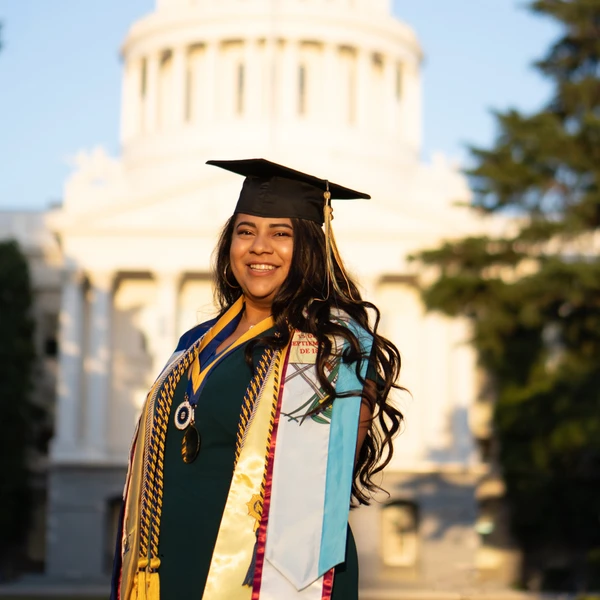
I am a first-generation law student at Northwestern Pritzker School of Law. As a Central American Latina raised in Compton, I grew up navigating systems that were rarely designed with my community in mind. These early experiences defined my mission: to be the first in my family to enter a courtroom not as a defendant, but as a fierce and informed advocate.
My education is more than a personal achievement; it is a tool for systemic change. I am committed to expanding access to justice and ensuring that the law serves as a shield for those it has historically overlooked.
My ultimate goal is to practice public interest law, specifically empowering disenfranchised youth to rewrite their own stories. By providing the representation and advocacy they deserve, I aim to prove that our beginnings do not have to dictate our endings.
Education
Northwestern University
Doctoral degree program (PhD, MD, JD, etc.)Majors:
- Law
California State University-Sacramento
Bachelor's degree programMajors:
- Political Science and Government
- Criminal Justice and Corrections, General
Miscellaneous
Desired degree level:
Doctoral degree program (PhD, MD, JD, etc.)
Graduate schools of interest:
Transfer schools of interest:
Majors of interest:
Career
Dream career field:
Law Practice
Dream career goals:
Open up a non-profit agency for justice involved youth
Law Intern
ACLU of Southern California2026 – Present6 monthsProgram Coordinator
Los Angeles Superior Court2023 – 20252 yearsSite Lead
GEAR UP - Bridge2020 – 20222 yearsJudicial Fellow
Los Angeles Superior Court2022 – 20231 yearProofreader
Office of Legislative Counsel2018 – 20213 years
Sports
Soccer
Intramural2012 – Present14 years
Research
Criminal Justice and Corrections, General
Judicial Fellowship — Judicial Researcher2022 – 2023
Public services
Advocacy
Street Law — Provide students with an interactive & engaging discussion to make laws accessible. Cover topics such as tenant rights, employment discrimination, & searches and seizures. Students become equipped to be civically engaged & informed citizens.2025 – PresentVolunteering
Greater Chicago Legal Clinic — Assist in completing documents for individuals to expunge or seal criminal records in Cook County2026 – PresentVolunteering
Illinois Free Legal Answers — Through legal research and memo drafting, I help increase access to advice and information about non-criminal legal matters for low-income residents.2026 – PresentVolunteering
Kappa Delta Chi — As the volunteer coordinator, I coordinated weekly and monthly volunteer opportunities. I acted as the primary liaison, managing volunteer databases, coordinated assignments for events, and ensured volunteers felt recognized and motivated.2018 – 2021Advocacy
CSUS College Democrats — Supported over ten local and state campaigns through weekly canvassing. Met weekly discuss campaigns, volunteerism, community outreach, fundraising and political activism.2017 – 2021
Future Interests
Advocacy
Politics
Volunteering
Philanthropy
Entrepreneurship
TRAM Purple Ribbon Scholarship
My first childhood memory should have been precious, but instead, it's me on top of my father, punching his head as he did the same to my mother. I grew up watching him get arrested for domestic violence, watching my mother absorb blow after blow, and not understanding until much later what that kind of violence does to a family long after the police leave.
I didn't understand it because no one named it. Not my teachers, who saw a "difficult" kid and never asked why. Not the doctors, who saw behavioral problems and never asked what caused them. Not even my own family, who were surviving their own version of the same thing and had no language for what any of us were carrying. It took twenty years and a diagnosis of complex PTSD in my sophomore year of college for everything to click. CPTSD comes from prolonged trauma, not a single event. Mine started in a home where intimate partner violence was the norm, and it shaped how I moved through the world for two decades before anyone gave it a name.
I share this because I think it's the piece of the intimate partner violence conversation that gets lost: the kids in the next room. IPV doesn't end with the person it's directed at. It moves into the children who witness it, who internalize it, who sometimes repeat it, and who show up in classrooms and courtrooms years later carrying a trauma no one has diagnosed. When I worked as a site lead for the Bridge Project in Sacramento, dismantling the school-to-prison pipeline, I saw that pattern constantly: kids labeled as behavior problems who were actually responding to violence at home. When I researched Teen Court recidivism rates as a Judicial Fellow at the LA Superior Court, I saw it again. The system was set up to punish the symptom and ignore the source.
That's the gap I want to close. I'm now a 2L at Northwestern Pritzker School of Law, and I'm interning with the ACLU of Southern California's Education Equity Project, where I work on how schools respond to trauma and crisis in children's lives. I've come to believe that ending intimate partner violence requires more than protecting the immediate victim. It requires building systems, schools, courts, and social services, that recognize the children in that house as victims too, and that intervene before a kid becomes a statistic instead of a case file.
With my legal education, I want to work on the policy side of that gap: pushing for trauma-informed protocols in schools, advocating for stronger legal protections for children exposed to domestic violence, and making sure family courts and education systems talk to each other instead of working in silos. I've lived what happens when those systems fail to connect. I know firsthand what it costs a kid to grow up unseen. I'm going to spend my career making sure fewer kids have to.
Max Bungard Memorial Scholarship
At 16, I stood by my mother's hospital bed, overwhelmed with guilt. I had been caught tagging on school property, a foolish decision that had lifelong effects. My mother had recently been diagnosed with diabetes, and her body could not take the stress. It sent her to the emergency room. Witnessing her pain, I realized the extent of the damage I was causing. I swore I would never hurt my mother, especially after watching her endure years of domestic abuse from my father. Though my actions did not directly harm her physically, they landed her in the same place he had sent her. Determined to break this cycle, I vowed to create a different future for my mother, my siblings, and myself, one filled with change, reform, and freedom.
What I have not always talked about is what was underneath the tagging. By then, I was using drugs and alcohol to cope with things I did not have words for yet: my father's addiction and the abuse he put my mother through, the instability at home, the pressure of growing up faster than I should have had to. I told myself I was fine because I was still going to school, still functioning. I did not see it as following my father's path, but that is exactly what it was. The night that sent my mother to the hospital was not separate from that pattern. It was part of it.
My decision to get sober started almost immediately after that night. Although I have never followed a formal program, my church, family, and community have been what has kept me sober for the past couple of years. Since is staying in therapy, which I have done consistently for five years, and staying focused on my goals and my family, sobriety has been the best. I think people sometimes expect recovery to follow one script. Mine did not. It looked like showing up to therapy even when I did not want to, and like reminding myself, on the harder days, exactly what I was working toward and who was counting on me.
Recovery did not erase that night. It gave me the chance to build something from it instead of being defined by it. I carried what I learned, that addiction can hide behind a functioning exterior, that the people struggling with it are still whole people, into the work I have chosen. I am now a law student focused on juvenile justice, work that exists because I know what it looks like when a family's hardest moment becomes a turning point instead of an ending. My father's addiction shaped my earliest understanding of what happens when no one intervenes in time. My own experience taught me what it takes to intervene anyway.
I do not share this story often, but I am not ashamed of it. Addiction is part of my story. It is not the whole of it, and it is not the end of it. I plan to spend my career being the intervention for someone else that I eventually had to become for myself.
Future Nonprofit Leaders Award
Growing up in Compton, CA, I watched my father cycle in and out of the criminal justice system. His struggles with addiction meant I spent my childhood learning how few second chances the system offers people who need them most. My family also had mixed immigration status, which taught me early on that a person's access to safety and opportunity often depends on paperwork they had no say in. As a kid, all I knew is that the adults who helped us, teachers, community organizers, our public defender, and counselors, were doing something different from the adults who processed us like case numbers. That distinction is why I want a career in the nonprofit sector. I want to be one of the people doing something different.
In college, I worked full time to pay for school, which taught me discipline, but it was the Panetta Congressional Internship that showed me what public interest work actually looks like day to day. I focused on Central American asylum policy under the Migrant Protection Protocols, reading case files that could have described my own relatives. Later, through the Bridge Project, I consulted on school-to-prison pipeline issues and stepped into a leadership role I did not expect to hold. I learned that the pipeline is not an abstraction. It is a set of specific decisions, a suspension policy, a missed IEP meeting, a school resource officer call, that nonprofit and legal advocates can actually change.
My time at the LA Superior Court as a Judicial Fellow sharpened that lesson. I researched restorative justice models through teen court and translated for Spanish-speaking families navigating a system that was never built with them in mind. Watching a parent understand her child's case for the first time, because someone finally spoke to her directly, showed me how much of justice work is simply making sure people are heard in a language and process they can access.
This summer, interning with the ACLU of Southern California's Education Equity Project, I have worked on protections for early childhood education providers facing immigration enforcement, and I drafted a policy analysis of one district's response to enforcement activity near schools. I have seen how a single memo or training session can give a teacher or a parent something concrete to act on when they are afraid. That is the kind of impact I want to keep making: not abstract, but specific enough that someone can use it the next day.
I am now a law student focused on juvenile justice and education equity, with plans to keep working at the intersection of the two. I hope to spend my career representing young people and families who, like mine, have had more contact with punitive systems than supportive ones. I want to write the memo that helps a school administrator make the right call, argue the case that keeps a kid in a classroom instead of a courtroom, and build the kind of trust with a community that lets people actually use the resources meant for them.
My father's story could have become mine. Instead, it became the reason I chose this work. I want my career to make sure that more young people get the version of the story where someone stepped in early enough to matter.