Hobbies and interests
Art
Baking
Clinical Psychology
Collecting
Comics
Criminal Justice
Criminology
Crocheting
Forensics
Human Rights
Law
Mock Trial
Psychology
Social Justice
Tattooing
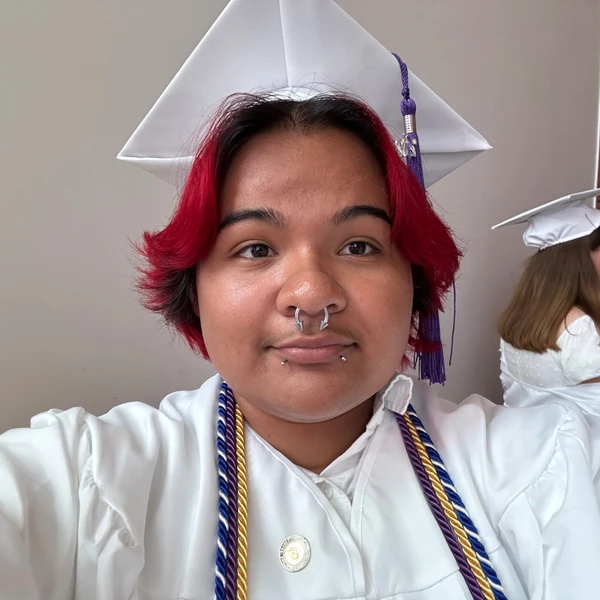
Quetzaly Escalante
1x
FinalistQuetzaly Escalante
1x
FinalistBio
I am a first generation college student who wants to help change how we view reformation and rehabilitation within our justice system. I believe compassion and community safety nets are what we truly need.
Education
University of California-Santa Cruz
Bachelor's degree programMajors:
- Psychology, General
Miscellaneous
Desired degree level:
Master's degree program
Graduate schools of interest:
Transfer schools of interest:
Majors of interest:
Career
Dream career field:
Civic & Social Organization
Dream career goals:
Data collection
Stray Cat Alliance2025 – Present1 year
Research
Psychology, General
AP research — Researcher2023 – 2024
Future Interests
Advocacy
Politics
Laurette Scholarship
Growing up I was very interested in bugs. I loved chasing dragonflies at recess and digging up isopods when I got the chance. As I got older and so did my peers I started noticing a rift between us. It felt like they always knew what to do, what was going on, and how to make friends. I thought I did too. Things are a lot easier when you’re a kid, but growing up didn’t allow for clumsy socializing and shut downs, you were expected to adapt faster than you could process.
For me, my autism affected a lot of my social life. I as unable to figure out the intricacies of socializing. Making friends became harder and harder, I was unable to branch out throughout middle school and once I had found my friends I was already comfortable and didn’t want to branch out from there. I was stuck in my own bubble, my own cocoon.
To deal with it all I turned to bugs again. In my mind bugs were easier to categorize, the people around me were caterpillars waiting to turn into butterflies, they knew what to do and could do it with ease. Me, on the other hand, knew what I wanted to do and wanted to be but I wasn’t able to do those things are easily or nicely as the others. I was a grub, a beetle grub. While others were developing and learning to soar, I was still digging and trying to figure out how to move from where I was.
However, as I made it to college, I was able to meet other bugs like me. The people I’ve met have made it easier for me to come out of my shell. They’ve helped me learn that there is no right way to socialize and that the things that might make it hard for me to make friends actually aren’t that difficult to deal with.
Phoenix Opportunity Award
My mom moved to the United States when she was 5 years old, she experienced more in her trip from southern Mexico to Los Angeles than most adults experience in their lifetime. She was brought here by her family to seize the opportunities that she couldn’t afford in Mexico. However at 21 my mom had me, leaving her with not much time or opportunity to actually build a career for herself. Despite this she never felt weighed down by having to raise me and later my brother, instead she has given me the strengths to seize the opportunities that she was brought here for.
Being a first generation student, there is so much expectation on your shoulders to make a career for yourself that your parents couldn’t, and just as I feel that too, what really drives me is the desire to uplift my mother and my community. My goal in going to a University is to pursue a psychology degree and use my knowledge gained from my time here to help reform the justice system we see today.
The Latino community has been targeted, among other racial minorities, in the criminal justice system. According to the Federal Bureau of Prisons, we make up 29.8% of the prison system in the US, nearly one third of the prison population are people that come from my community. Furthermore, prisons are notorious for their abuse of prisoners, lack of adequate healthcare, and overall do little to actually reform people who are thrown in prisons.
I believe there is more that we could do than simply wait for people to make mistakes and throw them in prison. I know that in order to fix a problem we must solve the source of it. Which means that we need to fund community safety nets, create programs that offer free or reduced food, allow for adequate mental health care as well as taking care of other basic needs like secure housing and affordable healthcare. I know to some this may seem outlandish but I am pursuing a higher education so that I may make goals like this a reality, for me, my mom, and my community.
Arnetha V. Bishop Memorial Scholarship
My goal for my career is to become a psychologist who has a deep understanding of the legal system and the ways in which it can improve its effectiveness for those with mental health conditions. I am very passionate about psychology and bettering people’s access to quality care no matter their circumstances. I’ve struggled with my own mental health in the past and understand that it is not always easy to get efficient and effective care in communities that have low income people and stigmatized views on mental health. I want to be able to contribute to the conversation of allowing BIPOC communities to become open to mental health care. Leaving mental conditions untreated can lead to bad outcomes in the future. I want to help create social programs that make mental health care accessible. Inexpensive, quality mental healthcare that will prevent consequences of untreated mental conditions.
Additionally I want to tackle a root issue within BIPOC communities, incarceration. Through my experience with mock trial I learned that I find the legal system fascinating. I later explored the drawbacks of the mental health services within prisons. Many inmates often have one or more mental health conditions that make prison much more difficult for them. Not just for the lack of proper treatment but the inhumane way that inmates are treated by prison guards as well as society at large. Often not having any way to get back on their feet post prison sentence and find themselves back in prisons. Even worse is knowing that black and brown communities make up a high percentage of the incarcerated population.
This cycle of neglect for inmate mental health and the blatant racism that our legal system is built on has made me passionate in finding alternatives to incarceration that can benefit those with mental health conditions. I have talked to firsthand change makers in this niche of legal practice who have created programs that can deter unhoused people from being incarcerated while still allowing them the ability to feel achievement that they can better their circumstances.
Just like her I want to become a change maker in the legal system. I want to create programs that deal with core issues in marginalized communities. Programs that will allow for easy access to efficient mental healthcare. I also want to continue to find ways to keep black and brown community members from being unjustly incarcerated by providing communities with the money and resources they need to thrive. Focusing on prevention rather than punishment is my goal. I know I have a lot of work if I want my goals to become fully realized but I am willing to work if it means that the communities that I care for will be able to get the healthcare they need.
Elijah's Helping Hand Scholarship Award
People are like caterpillars. As we grow we change and metamorphose into butterflies. We thrive and become another beautiful creature in the world. However, not all people become butterflies.
Growing up felt like an alienating experience. When I was little, making friends with other kids was easy and simple. We were caterpillars on a leaf eating as we pleased. However as time passed, people began transforming, the rift between us became more apparent. Gender roles and expression became more pronounced and so did my confusion. Caterpillars were simply caterpillars, but the metamorphosis of puberty started to create a chrysalis around me and my peers. I felt alone and different.
I knew there was something different about me. My colors weren’t as pronounced and the line between boy and girl was blurred in my mind. “I wasn’t like other caterpillars,” I told myself. There was no way I was as striking or appealing as they were.
As our transformation went on, there was simply no telling what I could be, the other chrysalis around me were green and neat. While mine was brown and rigid. I couldn’t figure out what was so different about me.
I bided time in my cocoon, feeling isolated from the rest of the caterpillars. They dangled from branches in tight groups, while I was stuck on the floor far far from them. They hung close together. As if sharing a secret I wasn’t let in on. Though in my cocoon I doubted I could understand it anyway. There was just something inherently different between me and the other caterpillars, a difference I couldn’t quite understand about myself yet. I continued to bide my time deep in thought of what made me unable to know the truth of myself.
Eventually we emerged from our cocoons. A swarm of beautiful butterflies of all colors flew past me. But when I tried to fly with them, I only found a tough exoskeleton and clear wings. I was a beetle.
I was not a boy or a girl. Growing up transgender is an uneasy experience. Time changes what we consider normal in a “boy” or “girl”, but that leaves a lot of people out from the crowd. I was often confused about myself and that inevitably made me question my place among my peers.
However, I most certainly found people like me, people who didn’t abide by their gender given to them. Free from social norms of gender identity. They were my beetles in a world of butterflies.