Hobbies and interests
Animals
Travel And Tourism
Movies And Film
Jada Lott
1x
Finalist
Jada Lott
1x
FinalistBio
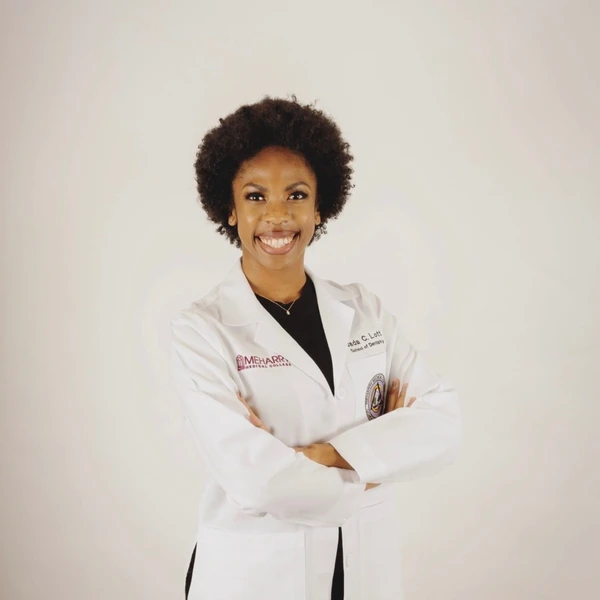
I'm a Memphis-raised, Nashville-based second-year dental student at Meharry Medical College, on track to earn my DMD in May 2028. Before dental school, I graduated Magna Cum Laude from Tennessee State University with a B.S. in Biology, where I spent three years as an NSF-funded TLSAMP researcher studying cardiovascular disease learning early on how to read a paper, run a protocol, and ask a real question.
That foundation carried me into the NIH MARC-U-RISE program, where I completed two years of mentored osteosarcoma research alongside clinicians and scientists at Vanderbilt University Medical Center. Research taught me to think like a problem-solver; chairside assisting at a private dental practice for a year and a half taught me why I wanted to be a dentist in the first place.
Beyond the lab and the clinic, I'm an advocate. As a Collegiate Councilman with The Education Trust, I contributed research and stakeholder engagement to statewide policy work on educational equity. At Meharry, I serve as a CEAL Health Advocate, organizing awareness campaigns and working directly with administration on student health needs.
My goal is to become a dentist who practices great care, clinically excellent, community-rooted, and committed to closing access gaps in oral health, especially for the patients and neighborhoods that raised me. I'm passionate about mentorship, research-informed practice, and proving that where you come from can be the very reason you're equipped to serve.
https://jadalott.com/
Education
Meharry Medical College
Doctoral degree program (PhD, MD, JD, etc.)Majors:
- Dentistry
Tennessee State University
Bachelor's degree programMajors:
- Biology, General
Miscellaneous
Desired degree level:
Doctoral degree program (PhD, MD, JD, etc.)
Graduate schools of interest:
Transfer schools of interest:
Majors of interest:
- Dentistry
Career
Dream career field:
- Dentistry
Dream career goals:
Dental Practice Ownership
Student Dental Assistant
Associated Dental Group2022 – 20242 years
Sports
Track & Field
Varsity2016 – 20204 years
Research
Biological and Biomedical Sciences, Other
TLSAMP / Tennessee State University — NSF-Funded Researcher2020 – 2023Biology, General
Vanderbilt University Medical Center — Researcher2022 – 2024Biology, General
NIH MARC-U-RISE (MVTCP) — Scholar / Researcher2022 – 2024
Public services
Advocacy
Meharry Medical College (CEAL) — Health Advocate2024 – PresentPublic Service (Politics)
The Education Trust — Collegiate Councilman2023 – 2024
Future Interests
Advocacy
Volunteering
Philanthropy
Entrepreneurship
Tawkify Meaningful Connections Scholarship
Option 3: Purpose and Connection
I have been thinking about this question a lot lately, maybe because Im in dental school and connection is so much of what the work actually is.
People think of dentistry as a technical field, and it is. But when you sit down in the chair across from someone who hasnt been to a dentist in six years because they were too scared or too broke to come sooner, the clinical skill is almost secondary in that first moment. What matters is whether the person in that chair feels like you actually see them. Connection is what makes the care possible.
The relationship that shaped how I think about this most was not a romantic one. It was the relationship I had with a mentor during my undergrad research years at Tennessee State University. She was a scientist who had grown up not far from where I grew up in Memphis. She didnt talk down to me and she didnt manage my expectations. She just expected things from me and then held that expectation with enough warmth that I felt like I had something real to live up to, rather than something impossible. I had never had a mentor like that before.
That relationship changed how I understand professional connection. It is not just networking or influence. Its about being seen with enough specificity that the other person actually believes in a version of you that you havent fully believed in yourself yet. She did that for me. I try to carry that into every interaction I have in a position of relative power, whether thats as a peer mentor, a student health advocate, or eventually as a dentist with a patient who walks in feeling vulnerable.
My long term goals are deeply tied to the relationships I hope to build. I want to open a dental practice in Memphis that serves people from the communities where I grew up. That goal is not possible without connection. Without trust built over time with patients who have every reason to distrust medical institutions. Without partnerships with community organizations that already have that trust. Without mentoring relationships with future dental providers who are willing to practice in places that need them.
I also think a lot about the relationship between dentists and the communities they serve, which tends to be extractive in places where people have the least. You come in, get what you need billed, and leave. That model is broken. I want to build something different: a practice as a community anchor, not just a service provider. That kind of relationship requires showing up consistently over years. It requires knowing your patients by name and knowing whats happening in their lives.
I dont think you can do meaningful work in healthcare without meaningful connection. The two are not separate things. The relationships I have built in my training, with mentors, with patients, with the students I have advocated alongside, are not just context for my career goals. They are the reason the goals exist in the first place.
Learner Math Lover Scholarship
I genuinely love math, and I say that as someone who spent years in a chemistry and biology lab where math was not optional. Math was the thing that told me whether my experiment actually worked or whether I just wanted it to.
I majored in Chemistry and Biology at Tennessee State University. Those are fields where you cannot fake the numbers. Stoichiometry does not care about your intuition. Concentration calculations do not bend to your preferred outcome. I spent two years doing NIH-funded research on osteosarcoma at Vanderbilt and three years working on cardiovascular research through the NSF-funded TLSAMP program. In both cases, data analysis was the backbone of everything. The question was never just what happened in the experiment. It was what the numbers actually said, and whether they said something worth knowing.
What I love about math is its honesty. It is one of the few places where the answer either checks out or it does not. When I was working through organic chemistry or calculating drug concentrations in pharmacology, the math was either right or it sent you back to find your mistake. That forced precision made me a better scientist and it is making me a better dental student now. Dentistry is full of math. Anesthesia dosing, bite force mechanics, reading a cephalometric analysis, understanding radiographic density. These all require quantitative thinking.
Math also has this quality where the more you understand it, the more you realize how connected everything is. Ratios show up in chemistry and they show up in music and they show up in architecture. That underlying pattern is something I find genuinely beautiful. It suggests that the world is organized in ways we can actually understand if we are willing to do the work.
I also think math gives people power. When you can read data, interpret statistics, and understand what a study is actually claiming, you are harder to mislead. That matters in healthcare especially. I want my future patients to understand what I am telling them about their oral health, and part of that is me being able to translate the numbers clearly. That starts with genuinely loving what math can do.
Ruthie Brown Scholarship
Every semester at Meharry Medical College, I owe $120,000 in tuition. I say "owe" because that is essentially what I'm doing. I signed my name on student loan promissory notes before I was even sure where I'd sleep once I got to Nashville. Four years of dental school means somewhere north of $400,000 in debt before I even factor in living expenses or the cost of dental instruments and lab fees. That number is not abstract to me. It sits in the back of my mind during every class, every clinic session, every late night studying for boards.
I grew up in Memphis and I went to Tennessee State University on scholarship. I came out of undergrad with minimal debt, which means I know what financial relief actually feels like. I used that time to build my research portfolio, to work as a dental assistant, to do the things that would make me a competitive applicant. I was deliberate. And I bring that same deliberateness to how I think about what comes after dental school.
My strategy for addressing my student loan debt is rooted in three things: scholarships, income-driven repayment, and my long-term practice plan.
First, scholarships. I apply aggressively because every dollar I earn through scholarships is a dollar I do not have to borrow. I am a Black woman in a healthcare field that has historically been inaccessible to people who look like me, and I am not ashamed to seek every resource available. I apply to scholarships funded by organizations that understand the financial barriers facing BIPOC students pursuing professional degrees. The reality is that health professional school debt falls disproportionately on students of color, and the legacy of that debt shapes the communities those graduates choose to serve.
Second, I plan to explore National Health Service Corps loan repayment options. My goal is to open a dental practice in Memphis, specifically in a community where access to dental care is limited. Memphis has some of the worst oral health outcomes in Tennessee, and they map almost perfectly onto neighborhoods that have been historically underfunded and underserved. If I practice in a designated Health Professional Shortage Area, I may qualify for NHSC loan repayment, which would significantly reduce my debt burden in exchange for serving in a community that genuinely needs me. That alignment between my values and my financial strategy is intentional.
Third, I'm building a practice model that emphasizes efficiency and volume without compromising quality of care. I want to offer sliding-scale fees and accept patients on Medicaid. The business model has to be sustainable for me to pay back what I owe while also giving back the way I intend to.
This debt is real and it is heavy. But it has not made me regret my choice. It has made me sharper about how I plan, more aggressive about scholarships, and more committed to building something in Memphis that serves the people who shaped me. I am not running from this debt. I am building a plan that makes it manageable and meaningful.
Olivia Rodrigo Fan Scholarship
There is a line in Olivia Rodrigo's "vampire" that stays with me every time I hear it. She sings about giving everything she had and watching it get used up, then wondering how she let that happen. As a dental student carrying over $120,000 in tuition debt every single year, there are nights when I ask myself a similar question. Not about a person, but about a system that asks so much from students like me and gives so little back.
I grew up in Memphis. I watched people in my community skip dental appointments not because they didn't care about their health but because they literally could not afford it. I watched teeth get pulled instead of saved. I watched people smile with their hands over their mouths. That image never left me, and it's the reason I am now sitting in dental school at Meharry Medical College in Nashville, grinding through the hardest years of my life.
"Good 4 U" is another song that lives rent free in my head. On the surface it sounds like a breakup song, but what I hear underneath it is someone watching another person move on without carrying the weight. There are moments when I see peers who came from different circumstances, whose paths just opened up a little easier, and I feel that same energy. But then I redirect it. I use it as fuel. I tell myself that the obstacles in my path are not the end of the story, they are the point of the story.
Growing up in a city with some of the highest rates of health disparities in the country made me serious about what I want to build. My research background, my years working chairside as a dental assistant, my work with the Education Trust pushing for educational equity, all of it is pointing toward one goal. I want to open a practice in Memphis that makes dental care accessible regardless of what somebody's insurance card looks like.
What Olivia Rodrigo captures so well, especially on the GUTS album, is the tension between who people expect you to be and who you actually are. "get him back!" is practically a thesis on that exact feeling. I know what its like to perform confidence when you feel uncertain. I know what its like to show up polished when inside you are running on empty. But I have also learned that the performance eventually becomes real. You fake it until it becomes you.
Olivia writes about growing pains with a kind of honesty that makes you feel less alone. That is what her music has meant to me through late nights in the clinic and early mornings in the lab. When everything feels heavy, there is something about hearing someone else name the feeling that makes it lighter. Her lyrics did not teach me to give up when things got hard. They taught me to feel it fully and keep moving anyway.
I am still in the thick of it. Dental school is relentless and the financial weight is real. But I carry Memphis with me everywhere I go, and I carry the vision of what I am building. That keeps me going on the days when even Olivia Rodrigo is not enough.
Love Island Fan Scholarship
My Love Island challenge is called "The Compatibility Checkup" and it takes the drama of the villa and adds a layer of actual honest self-examination.
Here is how it works. Each couple gets paired up and seated across from each other at what looks like a dentist chair setup, complete with the light, the tray table, and a doctor holding a clipboard. But instead of a dental exam, they are getting a Compatibility Checkup. The doctor asks each partner a series of diagnostic questions, one at a time, while the other partner sits in the chair and just has to listen without responding.
The questions are things like: What is one thing your partner does that you genuinely have not told them bothers you. What do you think they are most insecure about. What would you change about how you communicate. The partner in the chair cannot talk. They can only listen and react. The room sees everything on their face.
Round two is the Treatment Plan. Based on the answers from round one, each person has to propose one specific thing they will do differently in the next 48 hours. Not a general vibe shift. An actual behavioral change they can be held to. The producers track whether they follow through and the islanders vote at the end on which couple showed the most genuine effort.
The reason I like this challenge is that it gets past the surface. Love Island is entertaining because of the connection between people, but a lot of the drama comes from people not saying what they actually mean. This challenge forces everyone to say the thing and then actually do something about it. Which is basically the whole challenge of any real relationship, in or outside the villa.
Taylor Swift Fan Scholarship
I have been a Taylor Swift fan since I was in middle school in Memphis, which means I have essentially grown up alongside her discography. What strikes me most about her as a performer is not any single moment but the cumulative effect of watching someone build a career with that kind of sustained intentionality.
The performance that has stayed with me the longest is her Eras Tour set as a whole. The structure of it, taking each era of her work and treating it as its own distinct world with its own visual language and emotional register, is genuinely impressive. It is the kind of thing you do when you have spent years thinking about your own work rather than just producing it.
I am a second year dental student at Meharry Medical College. My life right now is a lot of long hours, a lot of delayed gratification, and a lot of trust that the work I am doing now will pay off in a way I can't fully see yet. Taylor Swift's career, the sustained focus, the willingness to reinvent, the refusal to be finished, is actually something I think about in that context. The Eras Tour is a performance about longevity. About having enough material, and enough faith in that material, to fill a three hour show about your own history.
For me, the most moving part of any Taylor Swift performance is the moment where you can see her clearly enjoying what she has built. She has earned the scale of what the Eras Tour was. Watching that has reminded me, more than once, that the long road is worth it.
Sabrina Carpenter Superfan Scholarship
I became a Sabrina Carpenter fan somewhere between my first biochemistry exam and my third all-nighter in the same week during undergrad. What I liked about her from early on was that she seemed genuinely unbothered by the pressure to be something she wasn't. That resonated.
I'm a dental student now at Meharry Medical College, which means a lot of my life runs on discipline, delayed gratification, and trying to stay grounded when the stakes feel high. Sabrina Carpenter's music has been part of that. Not in a way I would have necessarily predicted, but songs like Espresso ended up being the kind of thing I put on when I needed to just lighten up and remember that not everything has to be heavy.
What I appreciate about her career is that she has been consistent and she has grown. She has taken criticism, reinvented herself, and come out the other side more confident and more her own. That is a particular kind of strength that I think gets underestimated. The entertainment industry is brutal and she has navigated it with a lot of grace. Watching someone stay genuinely themselves while dealing with enormous amounts of external noise is something that I think about in my own life, even if the contexts are very different.
I grew up in Memphis and I am building a career in healthcare with the explicit goal of serving communities that are typically underserved. The road to that is long and there are a lot of moments where you have to just decide to keep going. Music matters in those moments. The ability to find something that makes you smile for three minutes before getting back to the typodont work is real. Sabrina Carpenter's music has done that for me more than once and I think that is worth saying.
Ethel Hayes Destigmatization of Mental Health Scholarship
Mental health shaped my path in healthcare in ways I did not fully understand until I was already deep into it.
Growing up in Memphis, I watched people around me carry enormous amounts of stress and grief without ever naming it as something that needed care. Families going without basic resources, including dental care and medical care, while also managing chronic stress and its downstream effects. The culture I grew up in, and many communities like it, treated toughness as a virtue and asking for help as a weakness. I internalized a lot of that.
When I got to college and then dental school, I started seeing those same dynamics play out in a new setting. Students who were clearly struggling, pushing through in silence because the culture of health professional programs rewards endurance and tends to pathologize vulnerability. I became a CEAL Health Advocate at Meharry Medical College in part because I could see what was not being said. I worked alongside administration to make sure mental health resources were visible, accessible, and actually reflected what students were experiencing. I organized health awareness campaigns and made myself available as a peer contact. A lot of students told me things they had not told anyone else, and I took that seriously.
The connection between mental health and oral health is one I think about constantly now as a dental student. Patients with depression or anxiety are more likely to avoid dental care for years, more likely to present in crisis, more likely to feel shame when they finally do show up. The mouth holds so much of what we do not say. Being a dentist who understands that is not just a nice thing. It is clinically necessary.
My own relationship with mental health has been one of learning to recognize when I am struggling and actually do something about it, rather than just continuing to push. That is still a work in progress. But the understanding I have gained from my own experience and from the people I have walked alongside in advocacy work has shaped the kind of provider and person I want to be. One who pays attention to the whole picture, and who takes seriously the things people are not always able to say out loud.
Women in Healthcare Scholarship
The honest answer is that I chose healthcare because of what I watched happen in my own neighborhood growing up in Memphis. I watched people delay care. Not because they didn't want it, but because the system made it hard to access, hard to afford, or hard to trust. I decided early that I wanted to be on the other side of that problem, not just observing it.
Dentistry specifically chose me when I started working as a student assistant at a private dental practice during undergrad. I spent a year and a half chairside, watching patients come in carrying years of avoided care. Some of them were embarrassed. Some were in significant pain they had been managing with over the counter medication because they couldn't afford to come sooner. That experience made it clear that dentistry isn't just about teeth. Its about access, trust, and what it means to be taken seriously by someone in a healthcare setting.
As a woman in healthcare, and specifically as a Black woman in dental school at Meharry Medical College, I think about my role in a particular way. Meharry was founded to train healthcare providers for underserved communities, and that mission is personal to me. Representation matters in healthcare not just symbolically but practically. Patients respond differently when they see someone who shares their background. They ask different questions. They come back. That is not a small thing.
My goal is to practice dentistry in Memphis in a way that puts access at the center. I want to build a practice with a sliding scale fee structure, serve pediatric patients, and eventually do mobile outreach in communities where getting to a dental office is itself a barrier. I also plan to transition into teaching at some point, because the pipeline matters as much as the practice. The next generation of Black women in dental medicine needs mentors who have navigated the same path and can help them stay in it.
The impact I want to have is not abstract. It is specific neighborhoods, specific patients, specific kids who have never been to a dentist and leave the appointment without fear. I have three years of NIH-funded research, two years as a campus health advocate, and a year of dental assisting experience behind me. All of it is preparation for the same thing: being the kind of provider and the kind of woman in healthcare that the communities I come from deserve to have.
Bulkthreads.com's "Let's Aim Higher" Scholarship
I want to build a dental practice in Memphis that does not require patients to choose between their oral health and their budget.
That is the short version. The longer version is this: I grew up watching people in my neighborhood put off dental care for years because the cost was too much or the access was too complicated. Cavities that became root canals. Pain that became infection. Problems that started small and grew because someone could not afford to address them when they were still manageable. I saw it enough that it stopped being invisible to me and became something I felt I had to do something about.
I am currently a second-year dental student at Meharry Medical College, on track to earn my DDS in May 2028. Meharry is one of the few HBCUs with a dental school, and it was the right choice for me precisely because of its mission rooted in service to underserved communities. That mission shaped how I think about what I am building toward.
The practice I want to open in Memphis will have a sliding scale fee structure from day one. It will prioritize pediatric and preventive care because those are the areas where early investment saves the most downstream harm. I want to do mobile outreach as well, bringing care directly into neighborhoods where the barriers to showing up at an office are too high. Eventually I want to bring on other dentists who share that orientation and build something that outlasts me.
Building this means building myself first. It means finishing dental school strong, passing boards, spending time as an associate dentist to refine my clinical skills and save startup capital, and learning the business side of practice ownership so I am not walking in unprepared. I take all of that seriously. I have been doing the groundwork since undergrad. Three years of NIH-funded cancer research taught me how to be rigorous. Two years as a community health advocate at Meharry taught me how to listen to what people actually need. A year and a half of chairside assisting in private practice taught me what the chair feels like from the patient side, and that is information I intend to carry into every appointment I ever run.
What I am building is specific, and it is mine. Not just a career. A place where the community I came from gets to walk in and know they are going to be taken care of, on their terms. That is worth building, and I intend to get it done.
Learner Mental Health Empowerment for Health Students Scholarship
Dental school is hard in ways people don't always talk about. The academic load is real, but what gets people is everything else. The financial pressure, the distance from home, the feeling that you have to constantly prove you belong somewhere that wasn't built for people who look like you. I say that as a second-year dental student at Meharry Medical College, and I say it as someone who spent a full year as a CEAL Health Advocate specifically because I saw what happens when those pressures go unaddressed.
Mental health matters to me as a student because I have watched it matter in ways that are hard to ignore. I have seen classmates withdraw during exam blocks and not come back the next semester. I have been in study groups where someone clearly needed more than a study break but didn't feel like they could say that out loud. The culture in health professional programs tends to reward toughness and treat vulnerability like a liability. I think that is backwards, and I've tried to do something about it wherever I could.
In my role as a CEAL Health Advocate at Meharry, I worked alongside college administration to advocate for health resources that actually reflected student needs. A big part of that was mental health. I helped organize health awareness campaigns on campus, facilitated conversations between students and health services staff, and served as a peer liaison so students had someone to go to who wasn't a faculty member or authority figure. Students opened up to me about things they hadn't said anywhere else, and I tried to make sure those concerns actually got to the right people in a way that protected those students.
I think advocacy looks different at different levels. At the individual level it looks like checking in, listening without trying to fix everything, and pointing people toward resources without making them feel broken for needing them. At the institutional level it looks like what I was doing at Meharry: showing up to meetings, raising issues that weren't being raised, and making sure the health support structures on campus were responsive and not just decorative.
As a future dentist, mental health advocacy is also part of how I think about patient care. Oral health and mental health are more connected than most people realize. Patients dealing with depression or anxiety often neglect their oral hygiene. The anxiety of sitting in a dental chair prevents a lot of people from coming in at all. I want to practice dentistry in a way that accounts for the whole person, not just the chief complaint. That starts with how I communicate, how I structure appointments, and how I treat patients who have been avoiding care for a long time.
Mental health is not separate from academic success or professional performance. Its woven into all of it. I got involved in advocacy because I believe that, and I plan to keep it at the center of the work I do, in school, in clinic, and eventually in my own practice in Memphis.
Charles B. Brazelton Memorial Scholarship
My awkward thing is that I ran track for four years in high school and never once enjoyed it. I was good at it. I showed up, I competed, I gave everything I had every single season. But the whole time, my actual dream was to be in a dental school somewhere and the idea that I was out on a track in the middle of a meet instead of studying for something that actually mattered to me felt genuinely bizarre. I ran because I could and because it was something I committed to. But I never stopped feeling like a slightly misplaced person standing at a starting block.
That feeling of being a little out of place, of caring deeply about something that wasn't where everyone around me was focused, has actually followed me in pretty useful ways. In high school, while my teammates were talking about college athletics, I was obsessing over oral health disparities in Memphis and trying to figure out how to get into a research lab. I was the kid at the science fair who brought a presentation on cardiovascular disease risk factors. Not exactly the thing that made me popular, but I found my people eventually.
I think the version of awkward that I carry now is a little different. I am a second year dental student who still thinks like a research scientist. When we do clinical work, I am the one asking about the biofilm composition and what the evidence says about the best debridement protocol, while most of my classmates are just trying to finish the procedure. My professors have called it a gift. My study group has called it exhausting. I think both things are true.
There is also this: I genuinely love teeth. Not in a weird way, in a way where I find the anatomy and biomechanics of the oral cavity deeply fascinating and could talk about occlusion for forty five minutes without noticing the time. When I tell people that, they usually give me a look. That look is something I have learned to be comfortable with. The people who ask follow up questions tend to become my closest friends.
What makes me stand out, I think, is that I am building something specific. I am not in dental school to have a stable career or move to a nice suburb. I am in dental school because I grew up in a neighborhood where dental care was not something families planned for. I want to change that for people who come from where I came from. That is a very particular kind of motivation, and it shapes everything. It shapes how I study, who I try to learn from, what I think about when I am doing a typodont exercise at midnight. It is the thing that keeps me going when the loans feel enormous and the boards feel far away.
I am the runner who never loved running, but showed up every time anyway. That is probably the most honest thing I can say about myself.
Joe Gilroy "Plan Your Work, Work Your Plan" Scholarship
My goal is specific: graduate from Meharry Medical College with my Doctor of Dental Surgery degree in May 2028, pass my board exams within a year of graduation, and open a dental practice in Memphis, Tennessee by 2031 that provides free and reduced-cost care to underserved patients. I have a plan to get there, and I've been working it since undergrad.
I'm currently a second-year dental student at Meharry, where tuition runs approximately $120,000 per year. My four years will total roughly $480,000 in dental school costs alone, which I am financing entirely through student loans. That number is real and it shapes how deliberately I approach every opportunity. Every scholarship, every research stipend, every dollar earned through assistantship work goes toward reducing the loan burden I'll carry into practice.
Between now and May 2028, my academic plan is straightforward: pass all coursework and clinical requirements on schedule, take Part 1 of the National Board Dental Examination during D2 year and Part 2 during D4, and graduate without any academic delays. I am currently on track with a strong performance record. I have the advantage of entering dental school with a chemistry degree from TSU and significant research experience, including two years as an NIH MARC-U-RISE scholar and three years of NSF-funded cardiovascular research. That background strengthens my ability to handle the science-heavy preclinical curriculum.
After graduation, my plan is to spend 12 to 18 months completing boards, applying for state licensure in Tennessee, and working as an associate dentist to build clinical skills and begin saving toward practice ownership. I estimate I'll need approximately $300,000 to $400,000 in startup capital for a small practice, which I plan to fund through a combination of SBA healthcare loans, personal savings during my associate years, and grant funding from community health programs. Memphis has federally qualified health center infrastructure I intend to study and potentially partner with to reduce operating costs in the early years.
The community care model I am building toward is not optional for me. It is the reason I chose dentistry over other health careers. I grew up watching people skip dental visits because they couldn't pay. That is a solvable problem if the person on the other side of the chair is willing to build a practice around access and not just profit. I am planning to be that person.
This scholarship would directly offset some of the loan burden I am carrying and allow me to put more toward savings during dental school. Every dollar I receive in scholarship funding during training is a dollar I do not owe when I open that Memphis practice. That math matters to me, and I take it seriously.
Women in STEM Scholarship
I didn't grow up thinking of myself as a STEM person. That language felt like it belonged to someone else, someone with better resources, a cleaner path. What I did have was curiosity about why people in my Memphis neighborhood went without basic care, including dental care, for years at a time. That question is what pulled me into science.
I started undergrad at Tennessee State University as a chemistry major, and spent three years on an NSF-funded research project studying cardiovascular disease through the TLSAMP program. I learned what it meant to sit with data and ask hard questions. I learned how to design a protocol, read primary literature, and defend findings. That foundation led me to the NIH MARC-U-RISE program, where I spent two years doing mentored osteosarcoma research alongside clinicians and scientists at Vanderbilt University Medical Center. Science stopped feeling like a subject and started feeling like a tool.
Dentistry is where that tool meets the people I care about most. I chose it because it sits at the intersection of science, health, and community. A lot of people think of the dentist as a routine thing, something you schedule twice a year. But growing up where I did, I know that for a lot of families, the dentist is something they put off because they cant afford it, or because there isn't one nearby that takes their insurance. That's not a personal failure. Its a systems problem, and I want to be part of fixing it.
As a woman in STEM, the work I'm doing now at Meharry Medical College is deliberate. I am one of a relatively small number of Black women in dental school nationally, and I think about what that means every time I walk into clinic or the lab. I serve as a CEAL Health Advocate at Meharry, working to improve the health resources available to students and making sure our voices are part of administrative decisions. I also contributed to educational equity research through The Education Trust, because I believe that the pipeline into STEM starts well before college, and we need policy that reflects that.
My goal after graduation is to open a dental practice in Memphis that serves patients who can't afford standard rates. I also want to teach. I want to be the kind of mentor that younger women in STEM don't always get to see, someone who looks like them, came from where they came from, and made it work anyway.
Being a woman in STEM is not just about representation, though that matters deeply. Its about what we bring to the problems. The research questions we ask are shaped by our experiences. The care we give our patients is informed by our understanding of what it means to be overlooked by a system. I chose STEM because science is one of the most powerful languages we have for changing how the world works. And I intend to use it.
Lotus Scholarship
Growing up in Memphis, financial struggle was something I understood early. My family didn't have much, and the idea of college, let alone dental school, felt like something other people did. But watching my community go without basic care, including dental care, made me more determined, not less.
That determination is what got me through a chemistry degree at Tennessee State University and into Meharry Medical College, one of the few HBCUs in the country with a dental school. I took on every research opportunity I could find, from NSF-funded cardiovascular work at TSU to two years as an NIH MARC-U-RISE scholar studying osteosarcoma at Vanderbilt. I knew I needed to outwork any disadvantage I came in with.
But its not just about me. I'm actively working toward building something bigger. I serve as a CEAL Health Advocate at Meharry, making sure student needs are heard at the administrative level. I contributed to education equity policy research through The Education Trust. And my long-term goal is to open a dental practice in Memphis that offers free and reduced-cost care to the community I came from.
I carry Memphis with me into every clinic room and every study session. The people back home deserve a dentist who understands what its like to put off care because of cost. I plan to be that dentist. This scholarship would help me stay focused on that goal, one less financial burden on a path I am fully committed to.
Michael Rudometkin Memorial Scholarship
Growing up in Memphis, I learned pretty early that the people around you shape who you become. I watched neighbors rely on each other when the system fell short, watched families go without basic things because access just wasn't there. That stuck with me. It's actually a big part of why I'm sitting in dental school right now, and why I can't imagine doing this work without giving back at the center of it.
I think selflessness, at its core, is about paying attention. Noticing what people need and showing up, even when its inconvenient or uncomfortable. At Meharry, I serve as a CEAL Health Advocate, a role where I work directly with the college administration to push for better health resources and support for students. A lot of what I do is just listening. Students come to me with concerns they don't always feel comfortable bringing to faculty, and my job is to make sure those concerns actually land somewhere they can be acted on. I organized health awareness campaigns and worked alongside other advocates to make sure our campus resources were reflecting the actual needs of the students using them.
Before dental school I also spent time chairside assisting at a private dental practice. Watching patients walk in scared, in pain, sometimes embarrassed about the state of their teeth, changed how I think about care. Dentistry isn't just clinical. There's a person in that chair who might not have had access to a dentist for years, maybe ever. I started thinking a lot about what it would mean to build a practice where cost was never the reason someone left without the care they needed.
That thinking led me to get involved with The Education Trust as a Collegiate Councilman, where I contributed to policy research and stakeholder engagement around educational equity in Tennessee. It taught me that selflessness doesn't always look like direct service. Sometimes it looks like staying in a room where difficult decisions are being made and making sure underrepresented voices are factored into the conversation.
My long term goal is to open a dental practice in Memphis that offers free and reduced-cost care to the community that raised me. I know what it's like to be from a neighborhood where going to the dentist is a luxury. I want to change that, starting in my own city. That vision is rooted in everything I've experienced as an advocate, a researcher, and a student of both science and community.
Michael Rudometkin's legacy resonates with me because he understood something I've been trying to live by: that what you build matters less than who you build it for. I'm working toward a career in dentistry not for the title or even the stability, but because I believe healthcare is something every person deserves access to regardless of their zip code or income. That belief has carried me through hard semesters, long nights in the lab, and every moment where I wondered if the path was worth it. It always is, when I remember who I'm doing it for.