
Hobbies and interests
Crocheting
Spending Time With Friends and Family
Exercise And Fitness
Shopping And Thrifting
Reading
Mystery
Thriller
I read books multiple times per month
Isabelle Cowan
1x
Finalist
Isabelle Cowan
1x
FinalistBio
Hello! My name is Isabelle. I am currently an incoming graduate student at Duke University studying nursing. I am passionate about human health and alleviating women's healthcare disparities. In my free time, I love seeing my friends, sewing & crocheting, and cuddling with my cat, Callie.
Duke University Master of Nursing '27
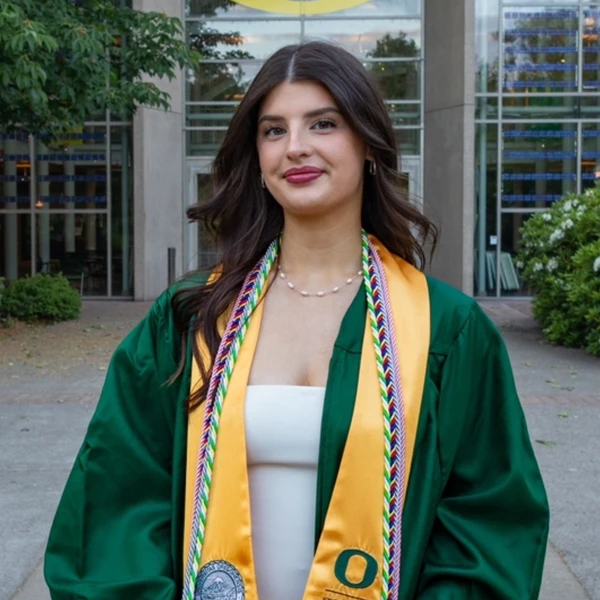
University of Oregon - BS Human Physiology, Chemistry Minor c/o 2025
Co-Founder of the Blossom Empowerment Project
Education
Duke University
Master's degree programMajors:
- Registered Nursing, Nursing Administration, Nursing Research and Clinical Nursing
University of Oregon
Bachelor's degree programMajors:
- Human Biology
Minors:
- Chemistry
Northern Arizona University
Bachelor's degree programMiscellaneous
Desired degree level:
Master's degree program
Graduate schools of interest:
- Duke University
Transfer schools of interest:
Majors of interest:
- Registered Nursing, Nursing Administration, Nursing Research and Clinical Nursing
Career
Dream career field:
- Nursing
Dream career goals:
Lifeguard
YMCA of Columbia-Willamette2018 – 20202 yearsHostess
Texas Roadhouse2022 – 2022Server
Red Robin2022 – 20231 yearBartender
Olive Garden2023 – 20241 yearCo-Manager
Kin Clothing Exchange2024 – Present2 yearsCardiac Rehabilitation Internship
PeaceHealth Riverbend2024 – 20251 yearOphthalmic Technician
Pacific ClearVision Institute2025 – Present1 year
Sports
Cheerleading
Varsity2017 – 20203 years
Figure Skating
Club2009 – 20178 years
Research
Medicine
Pacific ClearVision Institute — Investigator2025 – 2026
Arts
Kin Clothing Exchange
Jewelry2024 – Present
Public services
Volunteering
Volunteers in Medicine — Ophthalmic Technician2025 – Present
Future Interests
Advocacy
Volunteering
Philanthropy
Entrepreneurship
Tawkify Meaningful Connections Scholarship
The earliest memory I can remember is of my twin brother, Ryan, and I playing in our backyard while the summer sun was shining down on us. We always loved being outside and much of our childhood was spent playing with each other and our friends out on our street. In the years since, we've created countless more memories together and achieved milestones side by side.
I didn't always appreciate having a twin growing up. Looking back, I can recognize I was selfish for not enjoying sharing toys, friends, and birthdays each year. After spending eight years at the same small Catholic school, I felt like I was viewed less like my own person and more like half of a package deal. Even though I know it wasn't intentional, his shadow seemed to follow me in everything I did.
High school didn't make things easier on our relationship. We fought more than we got along and struggled to find common ground between our personalities. But no matter how far we drifted, we always circled back. We got our first jobs together, showed up to each other's sporting events, and walked across the stage together at our COVID drive-through graduation in the spring of 2020. Having him beside me as we reached those milestones was a gift I didn't fully recognize then, but I do now.
When we finally went our separate ways for college, me to Northern Arizona University and Ryan to the University of Oregon, I was caught off guard by how hard it was to be apart. Starting over somewhere new is difficult enough, but not having someone around who knew me completely, someone I could talk to about anything, was an adjustment I hadn't prepared for. Eventually I transferred to the University of Oregon for my junior year, and the three years we spent there brought us closer than we'd ever been. We ended up graduating at the same time, something I hadn't anticipated but am deeply grateful for.
Now that we're older and life is pulling us in different directions more than ever, I find myself grateful for all the years we spent figuring things out side by side. We've helped shape each other into the people we are today. Ryan has become an incredibly kind and intelligent person, who is thoughtful to those around him. He has helped me learn to not take everything so seriously and to be more present in the moment. We made each other better, not by intentionally trying to, but just by being honest and present with each other for so long.
As I write this, Ryan is driving to Los Angeles to begin the next chapter of his life. I'm sad knowing it may be a while before we see each other again, but I know he will continue to grow into the person he was always meant to be. That belief is what I'll carry into every relationship I build: that showing up consistently, even through conflict, is what makes something last.
Issa Foundation HealthCare Scholarship
"I can't see anything on the screen," the patient stated bluntly. She had come in presenting with intense headaches and a curtain veil effect across her vision. The vision in her right eye perceived only light, with her unable to make out even the giant letter "E" presented before her. As I spoke with her further, I learned that her substantial vision loss had occurred for nearly a month. She had delayed coming in because she was uninsured, afraid that the cost of care would be more than she could financially handle.
On further examination, she had a blood clot in the artery supplying her retina, a finding that also placed her at significant risk for stroke or heart attack. She was stunned, and relieved that she had finally come in. But I still remember what she said at the end of her visit: she wasn't sure how she could afford the care she now urgently needed.
That moment changed something in how I understood medicine. I had always understood that healthcare access was unequal and needed to be addressed. But sitting across from this patient made it visceral and undeniable. I always assumed if people were sick and concerned, they would just come in to receive care. What I learned through this patient is that many people don't, and that the barrier is often not a lack of concern for their own health, but a rational fear of financial devastation. That realization has shaped every clinical encounter I've had since.
In the year since graduating from the University of Oregon with a Bachelor's degree in Human Physiology, I have worked as an Ophthalmic Technician at Pacific ClearVision Institute, performing comprehensive ophthalmic testing, scribing for physicians, assisting in laser eye surgeries, and conducting Phase III clinical research visits for a keratoconus trial. Alongside that work, I volunteer once a month with Volunteers in Medicine, a community clinic offering free and low-cost care where I assist ophthalmologist Dr. Eric Niespodzany in providing free eye exams. These experiences have not just built my clinical skills; they have consistently brought me back to the same question my patient raised, how can I help make healthcare truly accessible?
That question is driving me toward a career as a women's health nurse practitioner, with a long-term goal of opening my own clinic offering comprehensive, accessible reproductive care and health education. As an incoming student in Duke University's Master of Nursing program, I know I will encounter more patients like her, people whose lives are at risk not because treatment doesn't exist, but because the cost of receiving it feels impossible. I want to be the kind of provider who meets patients where they are and understands that affordability is a clinical concern. Receiving this scholarship would allow me to graduate with less debt, and to build the kind of practice that doesn't ask patients to choose between their finances and their lives.
Christian Fitness Association General Scholarship
I remember my friend sitting next to me crying in pain as if it were yesterday. She had been home sick suffering from excruciating menstrual pain. Despite multiple doctor visits, she was told her heavy periods and pain were normal and that a heating pad and ibuprofen would suffice. Sitting beside her, it was painfully clear she was not okay.
Through her own research, my friend discovered that she likely had endometriosis, a condition that is frequently misdiagnosed and can take an average of 10 years to receive an official diagnosis. At the heart of this issue lies a healthcare system that often fails to take women’s pain seriously. Her experience, along with those of other women in my life, has inspired me to pursue a career in women’s health and education. In the short term, I hope to build a strong foundation as a RN, gaining experience before advancing to a NP role. My long-term goal is to start a women’s health clinic where I can provide comprehensive, accessible reproductive care and health education.
I used to think I wasn’t cut out to work in healthcare. In high school, I took anatomy & physiology, absolutely loved the class, and considered studying nursing in college to further my knowledge in a clinical setting. At the time, however, I doubted my ability to handle the rigor of a collegiate science degree and set that dream aside. When I began my studies at Northern Arizona University the following year as a marketing major, I felt unfulfilled and quickly realized it was not the right path for me. I took a leap, deciding I could do whatever I set my mind to, and transferred to the University of Oregon (UO) where I received my Bachelor of Science in Human Physiology. It brings me joy to know the younger me would be proud to see how far I’ve come.
One of my most impactful experiences at UO was teaching my peers as a Learning Assistant in Medical Terminology, Human Anatomy I, and Human Anatomy II Lab. I enjoy teaching others; it is gratifying to see students succeed and apply the knowledge I helped them learn. I also had the privilege of performing cadaver dissections of the thigh and the abdomen that students learned anatomy off of. These experiences allowed me to grow both academically and personally, strengthening my ability to communicate complex concepts and think critically. Teaching others has better prepared me to succeed at Duke University's Master of Nursing Program by strengthening my adaptability and deepening my understanding of effective learning strategies.
During my time at the University of Oregon, I co-founded the Blossom Empowerment Project, a student organization dedicated to raising money for menstrual products for unhoused people and promoting reproductive health education. When I started the organization, I had no idea how significant the need was for menstrual products in shelters, as donations of reproductive hygiene products are often overlooked. My goal for graduate school is to start a chapter of Blossom wherever I attend, continuing to raise awareness about reproductive health and access to menstrual products in underserved communities.
Currently, I work as an ophthalmic technician at Pacific ClearVision Institute (PCVI). My position entails performing comprehensive ophthalmic testing, scribing and shadowing doctors during eye examinations, assisting in laser eye surgeries, and conducting Phase III clinical research visits for a keratoconus trial. Through PCVI, I volunteer with Volunteers in Medicine, a community clinic offering free and low-cost healthcare. The organization’s mission aligns with my own goal of helping underserved populations. Once a month, I volunteer alongside ophthalmologist Dr. Eric Niespodzany to provide free eye exams. I have found this experience to be incredibly rewarding, and it continually reminds me why I want to pursue nursing by allowing me the opportunity to help serve others.
Nursing school will be one of the hardest and most rewarding things I ever do. I don’t want to just survive a program, I want to thrive in my education and leave feeling prepared for the work ahead of me. Receiving my acceptance to Duke University’s Master of Nursing program was truly one of the best moments of my life. I am beyond grateful to have received admission to one of the best nursing programs in the country and am elated to join this upcoming fall cohort. One of the biggest challenges I now face is finding the financial resources to fund my education. Receiving a scholarship would help me incur less student loan debt and better position me to serve individuals with limited access to healthcare. I want to provide low-cost, high-quality care as a nurse practitioner in community or women’s health settings, and minimizing my financial burden will allow me to pursue this goal more easily. A scholarship would give me the financial freedom to focus on my education and enter the workforce with a greater ability to serve where I am needed most.