Hobbies and interests
Acting And Theater
Singing
Reading
Drama
I read books multiple times per week
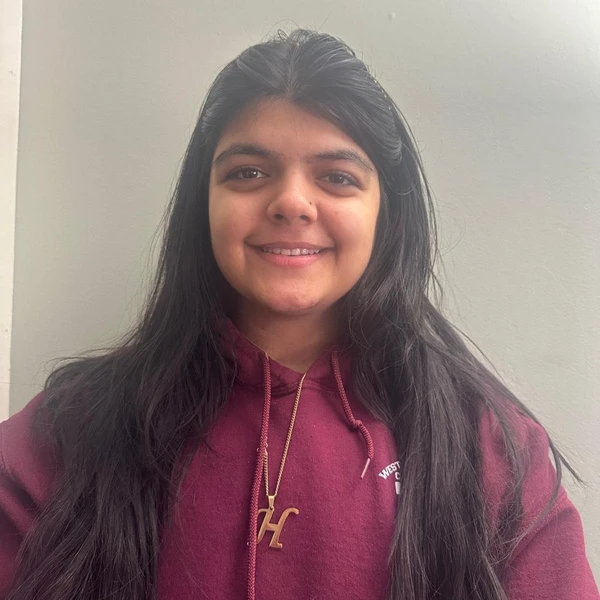
Himani Jamwal
1x
Finalist
Himani Jamwal
1x
FinalistBio
I am a passionate performer and storyteller from Weston, MA, graduating from Weston High School in 2026 with a 3.9 GPA. I have been accepted to the USC School of Dramatic Arts to pursue a B.A. in Dramatic Arts — a dream I have worked toward through years of dedication to theater, dance, and the arts. As an Indian-American student, I am driven by a desire to bring diverse voices and stories to the stage. I believe the arts have the power to foster empathy and connect communities. My goal is to become a professional actor and advocate for representation in storytelling. I am bold, earnest, and ready to make my mark.
Education
Weston High
High SchoolMiscellaneous
Desired degree level:
Bachelor's degree program
Majors of interest:
- Design and Applied Arts
Career
Dream career field:
Design
Dream career goals:
Research
Visual and Performing Arts, General
Weston High School Drama Department — Student Researcher and Performer2022 – 2026
Arts
Weston High School Drama Department
ActingA Midsummer Night's Dream2022 – Present
Public services
Volunteering
Weston Community Arts Program — Drama Workshop Volunteer2022 – Present
“I Matter” Scholarship
I remember the moment clearly. It was a Tuesday afternoon in October, and I was in the middle of rehearsal for our school's fall play when I noticed Maya sitting alone in the back of the auditorium, crying.
Maya was a sophomore who had just joined the drama program. She was quiet and had a hard time fitting in, and the other students mostly ignored her. I had seen her struggling in class, fumbling with her lines, but I had been too caught up in my own role to pay much attention. That day, though, something made me stop.
I walked over and sat next to her. She told me that she had just found out she didn't make the main cast, and she was thinking about quitting altogether. She said she felt like she didn't belong, like no matter how hard she tried, she would never be good enough. I recognized that feeling immediately, because I had felt it too, not that long ago.
When I first started doing theater, I was terrified. I grew up in a household where being on stage was not exactly encouraged, and I had to convince myself every single day that I deserved to be there. So when Maya said she felt invisible, I did not just feel sympathy. I felt it in my chest.
I told her the truth. I told her that I had been exactly where she was, that the first time I auditioned for anything, I cried in the parking lot after. I told her that the students who looked confident on stage had all been beginners once, that belonging was not something you had from the start but something you built over time.
Then I made her a deal. I said if she stayed in the program, I would work with her every week outside of regular rehearsal. We would run lines together, work on her physicality, talk through her character choices. She looked at me like I was offering her something she was not sure she deserved.
She stayed.
Over the next two months, we met almost every weekend. We sat in the park or in the school hallway and went over her scenes. I watched her grow more confident with each session. By the time the show opened, she was performing a supporting role with total conviction. The director even pulled her aside to tell her how much she had improved.
What surprised me most was how much it changed me too. Working with Maya made me understand my craft differently. I had to slow down and think about why each technique worked, not just how to do it. Teaching someone else pushed me to grow as a performer and as a person.
Helping Maya was not about being selfless. It was about recognizing that I had been given something valuable and that it was my responsibility to pass it on. Theater saved me in a lot of ways, gave me a voice when I did not know how to use one, showed me that my stories mattered. I wanted Maya to have that too.
She is still in the program today. And I am going to USC in the fall to study dramatic arts. I think about our Saturday rehearsals whenever I doubt myself, because they remind me that the best way to grow is to help someone else do the same.
Elijah's Helping Hand Scholarship Award
Mental health has shaped my life in ways I didn't fully understand until I was old enough to look back.
I moved seven times across three countries before graduating high school. Every time I relocated — Singapore to Canada, Canada to Massachusetts — I left behind friendships, routines, and any sense of normal. Most people move once and it's hard. I moved repeatedly, and each time I had to rebuild from zero. What I now recognize as anxiety and emotional exhaustion, I spent years just calling "adjusting." That framing made it seem temporary. But the weight of it stayed with me longer than any single move.
The hardest stretch was around sophomore year. I was newer to Weston, struggling academically for the first time, and aware that my family was navigating real financial pressure — my parents don't qualify for federal financial aid due to our visa status, and my sibling was also entering college that year. I didn't have words for how I was feeling, but I knew I wasn't okay, and I didn't feel like I could say that out loud. Mental health wasn't something that got talked about openly in my household or community. You were expected to push through.
Theater pulled me through that period more than anything else. It gave me somewhere to put everything I was carrying. I could step into a character and process feelings I hadn't figured out how to name yet. The community around it — the cast, the crew, the backstage conversations — gave me connection when I was otherwise isolated. I didn't think of it as mental health support at the time, but that's exactly what it was.
That experience directly led to building Mindle. During a Harvard entrepreneurship program, I designed a mental health app concept focused on young people who don't have easy access to traditional therapy. I was thinking specifically about students who look like me — from immigrant and BIPOC backgrounds, moving through systems that don't always have space for their struggles, without the language or resources to ask for help. Mindle was my attempt to lower that barrier.
The scholarship honoring Elijah matters to me because I understand what it means to struggle silently. I never reached a crisis point, but I've been close enough to darkness to know how real it is, and how invisible it can feel when you're inside it. I also understand that LGBTQIA+ students, students of color, and students navigating multiple identities carry additional weight that the people around them often can't see. Being part of communities that try to hold space for all of that — in theater, in design, in whatever work I do next — is something I take seriously.
I want to build a career at the intersection of storytelling and technology, in part because I believe both have the power to make people feel less alone. That belief came from personal experience. Mental health shaped my path here, and I intend to carry that forward.
Hines Scholarship
Going to college means getting to stop proving that my path is valid and actually start walking it.
I've spent most of high school explaining myself. Why theater? Why design? Why USC and not something more conventional? I've come from seven schools across Singapore, Canada, and the United States, and navigating so many different educational systems taught me early that ambition looks different depending on where you're standing. In South Asian immigrant families, college is often understood as a path to stability — law, medicine, engineering. Choosing to pursue dramatic arts and design at a prestigious school feels like a risk to people who care about me. But I've done the thinking, and I know what I'm building toward.
Going to college, for me, means going to USC's School of Dramatic Arts to study at the intersection of performance, design, and technology. That intersection is where I've always lived. I've been in 12+ theater productions and trained at Boston University's Summer Theatre Institute. I've designed app wireframes in Figma and built 3D architectural models through a UMass design program. I co-wrote and directed an original play with a cast and crew of seven. During a Harvard entrepreneurship program, I developed Mindle, a mental health app concept aimed at making support more accessible for young people who don't have the resources for traditional therapy. These things aren't separate hobbies — they're the same instinct applied to different materials. I want to build things that connect people and make them feel less alone.
What I'm trying to accomplish through my education is the ability to do that at a professional level. Specifically, I want to work in experiential design — the kind of creative work that lives at the edge of theater, tech, and human experience. I'm drawn to immersive storytelling, to using design as a tool for empathy, and to creating spaces where people feel genuinely seen. USC's program gives me the acting foundation while the BA structure lets me pursue design alongside it, which is exactly the combination I need.
Going to college also means something specific to me as a minority student whose family doesn't qualify for federal financial aid due to our visa status. My parents are supporting two kids in college simultaneously, without a safety net. College isn't a given in my situation — it's something we're making happen through hard work, scholarship applications, and a lot of stubborn belief that my education is worth fighting for. That makes every acceptance and every dollar of aid feel significant, not just for me but for my family.
I've grown up watching my parents navigate systems that weren't built with us in mind. I want to build things differently — to create work and tools and experiences that include people who are usually left out. That's what college is for. Not just credentials, but the space and structure to become someone who can actually do that work well.
Patricia Lindsey Jackson Foundation - Eva Mae Jackson Scholarship of Education
Faith, for me, isn't just something you practice in a religious building once a week. It's more like a quiet background belief that things are going to work out if you keep showing up — for yourself, for the people around you, and for whatever you're meant to do in the world. Growing up across three countries and seven schools, that kind of faith was the only constant I had.
My family is South Asian, and spirituality has always been woven into the texture of our lives. Not always in formal ways — but in the way my parents approached difficulty with patience, in the daily rituals that grounded us no matter what city we were in, and in the belief that hard work and good character would eventually be recognized. That quiet faith got passed down to me in small, daily ways, and it became my own.
What it gave me, practically, was resilience. Every time I moved — Singapore to Canada, Canada to Massachusetts — I had to start over. New school, new social rules, new everything. Faith was what made me walk into a theater audition in a country I'd lived in for three months and say yes even though I was terrified. I believe that when you do the thing that scares you, when you show up even without guarantees, something good usually comes from it. Theater became my whole community because I chose to believe that.
Faith has also shaped how I think about my future. I'm heading to USC to study dramatic arts, and I plan to work at the intersection of design, performance, and technology. That's not a traditional path. A lot of people in my life have raised their eyebrows at it. But I have a deep faith that the things I love — storytelling, design, building tools that help people — are worth pursuing seriously, not just as hobbies. When I created Mindle, a mental health app concept, during a Harvard entrepreneurship program, I was applying that same belief: that if I work on something that genuinely matters, and I do it with integrity, it can have an impact.
Beyond spirituality, the people who have pushed me toward higher education are my parents. They came to this country without a safety net, navigating visa status that means we don't qualify for federal financial aid, supporting two kids in college simultaneously. They never once made me feel like those constraints were my problem to carry. Instead, they just modeled what it looks like to keep going. That's faith in action to me — not blind optimism, but deliberate, persistent effort.
My teachers have also been a constant source of encouragement. My drama teachers especially have believed in my potential even when I wasn't sure of it myself. Receiving the METG Certificate for Acting and the Best Thespians Award told me that the things I was working on were real and worth continuing. Winning recognition from people you respect is its own kind of reinforcement — it deepens your faith in yourself.
I want to be the kind of person Patricia Lindsey Jackson and Eva Mae Jackson seemed to be: someone who uplifts others, leads with integrity, and stays committed to education even when it's hard. That's not a distant goal for me. It's how I try to move through every rehearsal, every design project, every classroom. Faith isn't something I keep separate from my work. It runs through all of it.
Instagram: @himani.jamwal
Peter and Nan Liubenov Student Scholarship
When I was fourteen, I moved from Singapore to Canada knowing no one. I didn't speak the local slang, I didn't know the social rules, and I definitely didn't know how to make friends in a new country for the fourth time. What saved me was theater. I walked into auditions nervous and walked out with a community. That experience taught me something I carry everywhere: belonging isn't automatic. Someone has to build it. I want to be that person.
I've attended seven schools across three countries, and every time I relocated, I watched the same thing happen. Students who were different — whether by background, language, or just personality — got pushed to the edges. Social norms decide who fits in and who doesn't, and those norms are often invisible until you're on the wrong side of them. Being a South Asian girl navigating mostly Western schools gave me a close-up view of how those invisible lines operate.
Right now, I try to be a positive force in the spaces I'm already in. In theater, I've been in 12+ productions, but more importantly, I've helped write and direct an original play called Tales from the Trail with a cast and crew of seven people, most of whom had never worked together before. Putting that production together meant creating an environment where everyone felt their ideas mattered, regardless of experience level. That's something I care about deeply: not just making work, but making it in a way that includes people.
I also built Mindle, a mental health app concept, during a Harvard entrepreneurship program. I designed it specifically because I noticed that mental health tools rarely reach people who don't already have access to expensive therapy or a strong support network. Social norms around mental health still make it hard for a lot of young people, especially in immigrant and BIPOC communities, to talk about what they're going through. Mindle was my attempt to design something that lowers that barrier. It's still a concept, but it showed me that design can either reinforce exclusion or challenge it, and I want to spend my career doing the latter.
That's the future I'm working toward. I'm heading to USC's School of Dramatic Arts to study at the intersection of performance and design. I want to use storytelling and technology together to build things that genuinely connect people, especially people who are used to being left out. Social norms are powerful, but they're also just stories we keep telling each other. The right kind of creative work can change the stories.
I'm a BIPOC student who has spent my whole life crossing borders, both geographical and cultural. I know what it costs to be an outsider, and I know what it means when someone decides to include you anyway. That's the kind of force I want to be in the world — not the loudest voice in the room, but the one making sure more voices get heard.
Tawkify Meaningful Connections Scholarship
Option 2: The Future of Human Connection
The most honest thing I can say about technology and human connection is that I've spent years watching them fail each other — and I'm still optimistic.
I grew up moving. Seven schools across Singapore, Canada, and the United States, which means I built and lost friendships on a loop. What I noticed, especially as social media became more central to everyone's lives, was a strange paradox: the tools that were supposed to keep us connected often made the loss of connection more visible, not less. You could watch the life of a friend you'd left behind on another continent unfold in your feed, and feel somehow lonelier for it. Proximity without intimacy. Contact without connection.
I don't think technology is the problem. I think design is.
Most social technology is optimized for engagement metrics — time on platform, number of interactions, breadth of reach. What it's almost never optimized for is the quality of the connection it produces. A post that gets five hundred likes might generate zero genuine relationships. A platform that connects you to three thousand people might leave you feeling like you know none of them. We've built tools that are extraordinarily good at creating the appearance of connection while quietly undermining the conditions that make real connection possible: attention, vulnerability, reciprocity, time.
I've been thinking about this problem through the lens of design for a while now. During a program at Harvard Ventures-TECH, I built Mindle, a mental health app prototype. The design process forced me to think carefully about what people actually need when they're struggling — and what I kept coming back to was this: people need to feel like someone is genuinely paying attention to them. Not algorithmically curated attention. Not a response generated in the interest of keeping them on the platform. Real attention.
Mindle was designed around low-friction, high-honesty interactions. Instead of asking users to rate their mood on a scale or select from a list of emotions (which tells you what to feel rather than asking what you feel), it uses open-ended prompts that create space for whatever is actually present. The goal was to replicate, as much as possible, the feeling of talking to someone who's actually listening.
I think the future of human connection requires us to design technology with that same intention. Not technology that maximizes contact, but technology that creates conditions for genuine exchange. A few principles I'd propose:
First, depth over breadth. The platforms that actually build community tend to be smaller, more specific, and more accountable than the mega-networks. Design should favor environments where you know the people you're talking to, even if it means fewer of them.
Second, asynchrony when it serves reflection. Real relationships aren't always real-time. Some of the most meaningful conversations happen over letters, emails, or messages that gave both people time to think. Technology can honor that rhythm rather than always pushing toward immediacy.
Third, intentional friction. Ease of interaction is not always a virtue. The things worth doing — maintaining a friendship across distance, having a difficult conversation, being honest about something hard — take effort. Design that removes all friction also removes some of the meaning.
I'm heading to USC's School of Dramatic Arts in the fall to study acting and design, and I carry both of those disciplines with me when I think about this question. Theater is one of the oldest technologies for human connection: strangers sitting in a dark room together, feeling something collectively, often feeling less alone. It works because it creates conditions for presence — actual, physical, undivided attention. That's the quality we should be designing toward, whether the medium is a stage or a screen.
Technology can preserve and strengthen human connection. But only if we're honest about what connection actually requires.
Forever90 Scholarship
Service, for me, isn't a category separate from the rest of my life. It's been built into how I move through the world — partly by necessity, and partly by choice.
Growing up moving between seven schools across Singapore, Canada, and the United States meant I spent a lot of time being new. And when you're perpetually new, you learn to pay attention to who else is on the outside. At every school, there were people who slipped through the cracks: students who didn't speak the dominant language well enough, kids whose family backgrounds didn't match the school's social assumptions, people who were talented but hadn't found a community that could hold them. I recognized them because I was often one of them.
My most concrete act of service came through theater. I wrote and directed an original play called Tales from the Trail, and I made a deliberate choice about my cast: I cast seven people who had never been on a stage before. Most people cast productions with performers who have experience — it's efficient. I did the opposite, because I believed the act of creating theater together was the point, not the product. We rehearsed for weeks. People who had never spoken publicly stood up and held a room. The play was the vehicle. The service was giving those seven people an experience of what it feels like to make something together and have it land.
I've also tried to serve through design. I built Mindle, a mental health app prototype, specifically for users who don't have access to traditional mental health resources. The design decisions — simplified onboarding, no jargon, multilingual accessibility — all came from thinking about who needs support the most and what barriers I could remove for them.
At USC's School of Dramatic Arts, I want to study acting and design, and I have a clear idea of how that education will serve others. Theater has always been a space where people who are excluded from other conversations can find representation. I want to create performances and experiences that tell the stories of communities that don't often see themselves on stage. And I want to build tools — digital, physical, theatrical — that lower the barriers to access.
Service isn't something I do separately from my creative work. It's the frame through which I understand why the work matters. You make something not just because it's meaningful to you but because it can be meaningful to someone else — someone who needed exactly that thing and had no other way to find it.
Richard Neumann Scholarship
The problem I set out to solve was simple to describe and hard to solve: most mental health apps are designed for people who already know they need help and know how to ask for it. I wanted to build something for everyone else.
I created Mindle during Harvard Ventures-TECH, an entrepreneurship and technology program. The concept started with a question I'd been sitting with for a while: what does a mental health tool look like if you design it for the person who has never been to therapy, doesn't have a therapist, doesn't know the language of wellness culture, and possibly doesn't even recognize that what they're feeling has a name?
Most existing apps — even good ones — assume a baseline. They have mood trackers that ask you to rate your day on a numerical scale, which presupposes that you've been trained to observe and quantify your internal states. They have journaling prompts that presuppose you're comfortable with introspection. Mindle was designed around the opposite assumption. I built the wireframes in Figma using a principle I'd borrowed from theater: design for the hardest case, and everyone else will be served too. The onboarding flow doesn't ask "how are you feeling?" — it asks what's been on your mind lately, which is a much lower-friction entry point. From there, the app gently offers structure without demanding it.
If I had the money and resources to take the project further, here's what I'd build next.
The core limitation of Mindle as a prototype is that it's still a solo-use tool. The next version would add a peer support layer — not a social network, but a structured, moderated space where users could opt into anonymous conversations with other users who've been through similar experiences. The matching algorithm would be based not on diagnosis but on situation: "I'm new to a city and don't know anyone" would match you with people who've navigated the same thing. "I'm managing anxiety around a big transition" connects you with people who've been through a comparable shift.
The reason I think peer support is the missing piece is that professional help, while valuable, isn't always accessible — and even when it is, people often need something in the hours between sessions. A structured, low-stakes peer layer could fill that gap without replacing professional care.
I'd also invest in language accessibility — the interface would be available in multiple languages from the start, because the users I'm designing for are often not native English speakers. This came directly from my own experience moving between countries and never quite having the right words for what I was feeling in any of them.
Problems worth solving aren't always the ones without existing solutions. Sometimes the most important work is redesigning what already exists to actually reach the people who need it most.
Justin Moeller Memorial Scholarship
My background is unusual for someone going into technology. I've attended seven schools across Singapore, Canada, and the United States — which means I spent my childhood being a perpetual newcomer, learning to read rooms quickly and adapt to different social systems. That experience shaped how I think about technology design in a way I couldn't have predicted.
I'm interested in the intersection of technology and human experience: specifically, how digital tools can be designed to serve people who are most often left out of the design process. I came to this interest through a combination of theater and software. I've been in twelve-plus theatrical productions over the years, and in that work I learned something about designing for emotional truth — about building experiences that feel real and accessible to audiences who come in with different backgrounds and needs. When I started working in technology, I found myself applying the same instincts.
The project I'm most proud of is Mindle, a mental health app prototype I built during Harvard Ventures-TECH, an entrepreneurship and technology program. I designed the user experience and wireframes in Figma, working from a central design principle: the user who needs this most is someone with no prior experience with mental health resources, no therapy vocabulary, and no existing support system. I designed for that user. The result was an interface focused on simplicity, low-friction entry points, and progressive disclosure — rather than assuming the user knew what they needed.
I've also worked in Rhino 3D for architectural modeling, completed AP Computer Science (where I developed practical programming skills), and built a design portfolio demonstrating UX and visual design work across digital and physical contexts.
What draws me to the technology field specifically is that it scales. Theater can reach hundreds of people at a time; a well-designed app can reach millions. I want to combine the empathic design instincts I've developed through performance with the reach that technology makes possible. My goal is to work at the intersection of experience design and technology — building tools and products that treat accessibility not as a feature but as a starting point.
As a South Asian woman going into a design-and-technology career, I'm aware that the field doesn't always reflect the diversity of the users it serves. I want to be part of changing that, not just by being present, but by doing work that models what it looks like to design with genuine care for who's on the other side of the screen.
RonranGlee Literary Scholarship
Paragraph selected from Aristotle's Poetics, Chapter VI:
"Tragedy, then, is an imitation of an action that is serious, complete, and of a certain magnitude; in language embellished with each kind of artistic ornament, the several kinds being found in separate parts of the play; in the form of action, not of narrative; through pity and fear effecting the proper purgation of these emotions."
Aristotle's definition of tragedy is not a description of what tragedy looks like — it is a theory of what tragedy does. The distinction matters. He is not cataloguing the formal properties of a play: the actors, the chorus, the stage. He is arguing that all of those formal elements exist in service of a single function: catharsis. The "proper purgation of these emotions" is not a byproduct of watching tragedy. It is its purpose. Tragedy exists to move through pity and fear toward something on the other side of them.
The word catharsis has accumulated several interpretations over the centuries. Some scholars understand it medically — purgation in the clinical sense, a clearing of emotional excess the way the body clears illness. Others read it more spiritually, as purification: the audience leaves not emptied but refined, their emotions having been processed into something higher and cleaner. What both readings agree on is this: the emotional experience of watching tragedy is not passive. Something is happening to the audience at the level of feeling, and that something is the point.
What I find most precise in Aristotle's formulation is his insistence on "pity and fear" as the specific pair. Not sorrow alone. Not dread alone. The two together, and the tension between them. Pity requires a certain distance — we pity those whose suffering is not our own. Fear closes that distance — we fear because we recognize that what happened to the tragic figure could happen to us. Aristotle is describing a kind of double consciousness in the audience: we watch with the safety of our seats and the vulnerability of our own lives at once. Tragedy works when it holds both simultaneously without collapsing either.
I have spent years performing in theater — twelve productions over the course of my school career, including one I wrote and directed myself — and I have come to understand Aristotle's description not as a theory I was taught but as something I verified through experience. The plays that land, that leave audiences changed, are not the ones that are sad or frightening in a simple sense. They are the ones that sustain that double consciousness Aristotle identifies. They make you feel for a character while also making you feel the proximity of their situation to your own.
There is a passage later in the Poetics where Aristotle argues that the poet's job is to depict not what happened, but what might happen — the probable or necessary outcomes of character and circumstance. This connects directly to his definition of catharsis. The reason pity and fear produce purgation is that the audience recognizes the action as real in the sense that matters: not historically factual, but humanly possible. We are not weeping for a fictional person. We are weeping for the version of ourselves that could be standing where they stand.
The phrase "of a certain magnitude" is easy to overlook in the definition, but I think it is doing significant work. Aristotle is not saying tragedy must be grand or operatic. He is saying the action must be large enough to carry the weight of what it is trying to do. Small actions in tragedy feel trivial; they cannot generate the pity and fear needed for catharsis. The magnitude is a calibration — the action must be serious and complete not for its own sake but because only actions of sufficient weight can produce the emotional transformation Aristotle is describing.
What I take from this, both as a theater practitioner and as a student, is that the arts have a specific kind of work to do in the world that other disciplines cannot replicate. Aristotle is not arguing that tragedy teaches moral lessons or depicts historical truth. He is arguing that it processes emotion — that it takes the rawest and most difficult feelings of human experience and, through the form of the play, moves an audience through and past them. The theater is a technology for emotional experience. This is why it has survived for thousands of years.
When I built Mindle, a mental health app prototype, I was thinking about a version of this same problem: how do you give someone without access to formal support a way to process what they are feeling? Aristotle's answer, applied to the digital age, might be: give them form. Give them structure within which their emotion can move. The cathartic function he identifies is not exclusive to theater. It is available anywhere that form meets genuine feeling. That, for me, is the underlying meaning of this passage: not a definition of tragedy, but a theory of how art heals.
Learner Mental Health Empowerment for Health Students Scholarship
Mental health is important to me because I've watched what happens when people don't have access to support early enough. Growing up moving between schools and countries, I was surrounded by peers navigating stress, loneliness, and anxiety — and I watched most of them do it without the language to name what they were experiencing, or any real resources to turn to. That gap between what people need and what's available isn't an abstract policy problem. I saw it up close.
My advocacy has been through design. During a program at Harvard Ventures-TECH, I developed Mindle, a mental health app prototype aimed specifically at accessibility. The idea came from a simple observation: most mental health apps are designed for people who already have some familiarity with therapy or wellness culture. They assume a baseline of vocabulary, self-awareness, and — implicitly — a certain level of income and comfort with seeking help. Mindle was designed around the opposite assumption: that the person who needs it most is the one with no prior experience, no therapist, and no idea where to start.
I built the wireframes in Figma, running the design process through a principle I'd developed in theater: design for the hardest case, and everyone else will be served too. In acting, you learn to find the emotional truth of a scene for the most difficult audience member in the room. In design, you build for the user with the most barriers, and in doing so you make something that works better for everyone.
At school, I've talked openly about mental health in ways that felt uncomfortable at first. I've brought it up in theater contexts — in post-show discussions, in conversations with cast members during long rehearsal nights — because those spaces already involve emotional openness. I've found that mental health conversations happen more naturally when they don't start with "mental health" as the topic. They start with honesty about a specific experience, and the broader subject follows.
I believe advocacy is most effective when it reduces the distance between the person who needs help and the person who can provide it. That's what I was trying to do with Mindle. It's what I try to do in my daily interactions. And it's what I want to do professionally — build experiences, products, and performances that make it easier for people to access care, connection, and the sense that what they're feeling is understandable.
Ethel Hayes Destigmatization of Mental Health Scholarship
When you move as often as I have — seven schools across Singapore, Canada, and the United States — you become an expert in a very specific kind of loneliness. It's not dramatic. Nobody around you knows it's happening. You sit in a new cafeteria, you learn the new hallways, you figure out what kind of humor works in this school versus the last one, and most of the time you do it completely alone.
I didn't have language for what this was for a long time. I just knew I was tired in a way that sleep didn't fix. I knew I was careful with people in a way that my classmates didn't seem to have to be. Every friendship I'd made before had eventually been cut off mid-sentence by a moving truck. So I stopped investing as deeply, and then I felt guilty for not investing, and then I felt isolated from the relationships I was actively maintaining. That loop — distance protecting you from loss, but also creating it — is something I think a lot of people experience, but rarely talk about.
What changed my understanding of it was theater. I joined productions at every school I attended partly because it was a fast way to find community, and I stayed because performing gave me something I didn't expect: a structured way to feel things safely. When you're playing a character going through grief or fear or joy, you're not suppressing it or projecting it randomly — you're channeling it with intention. Theater taught me that emotions are workable. That they have shape and logic. That you can sit inside a difficult feeling without being overwhelmed by it.
That understanding eventually led me to build something. During a program at Harvard, I developed Mindle — a mental health app prototype designed around accessibility. I built it thinking about the users who are most likely to be underserved: people who can't afford therapy, people who don't have the language yet to describe what they're going through, people like the version of me at fourteen in a new city who just needed something quiet and non-judgmental to help them think.
My experience with mental health has shaped my relationships by making me a careful and deliberate listener. People tell me things quickly — I think because I ask questions that come from genuine curiosity, not small talk. It has shaped my goals by pushing me toward the intersection of empathy and technology: I want to design experiences and tools that make people feel less alone.
And it has shaped my understanding of the world by teaching me that the things we most need to say out loud are the ones we've been taught to keep private. Destigmatization isn't about making mental health topics comfortable — it's about making honesty possible. I try to build toward that, in whatever form I can.
Love Island Fan Scholarship
My Love Island challenge is called "The Persona Switch," and it works like this: every islander is secretly assigned a personality type that's the opposite of how they normally present themselves. The loud, confident one has to spend the challenge being the quiet observer. The person who always deflects with humor has to be completely sincere. And so on.
Here's every aspect of how it would play out.
Before the challenge begins, the producers pull each islander aside and give them their assigned persona on a card. They're not allowed to tell anyone what their card says. They have one hour to embody this persona in a group activity — a shared dinner in the villa, with cameras everywhere.
The dinner itself is structured with conversation prompts dropped by a host every ten minutes. Questions like: "What's something you've never told anyone here?" or "Describe your ideal relationship in three words." These are designed to push people past their surface-level personas and force genuine answers — except the genuine answers now have to come from a character who isn't quite themselves.
At the end of the hour, the other islanders vote on who they think was performing the most convincingly. But here's the twist: there are two prizes. One goes to the islander who fooled the most people — the best actor. The other goes to the islander who, despite playing a persona, accidentally revealed something true about themselves in the process. The other islanders nominate for that second prize by explaining what they noticed.
Why I think this challenge would be great for the show: Love Island works best when the walls come down, but people are usually too self-protective to lower them voluntarily. This challenge creates permission to be different, and in doing so, it often reveals what people are actually hiding. The best performers in the villa are often the ones hiding the most — and this challenge makes that visible.
I love this idea because I do theater. I've been in twelve-plus productions and directed my own play. What I've learned from acting is that playing a character who isn't you almost always teaches you something about yourself. You find the edges of your own comfort zone by trying to escape it. I think the islanders would discover the same thing — and the audience would get some of the most honest television the show has ever aired.
The challenge would need minimal production value: a dinner table, some cards, some candles. The drama is entirely human.
Sabrina Carpenter Superfan Scholarship
I became a fan of Sabrina Carpenter the way a lot of people probably did — through "Espresso" playing on repeat in the summer and not being able to get it out of my head. But what actually kept me as a fan was watching interviews and realizing that she's someone who has figured out how to be completely herself across wildly different contexts.
I grew up doing theater. Twelve-plus productions, wrote and directed my own play, trained at Boston University's summer theater institute. I also design — I built a mental health app prototype, I work in Figma, I've done architectural modeling. For a long time I felt like these two sides of me were in tension, like I had to explain myself to people who only understood one or the other. What does theater have to do with design? What does acting have to do with apps?
Watching Sabrina Carpenter helped me articulate why they're not actually in conflict. She spent years as a Disney actress, then crossed into music, and rather than abandoning one thing for the other, she brought her acting instincts into her performance style. Her music videos are little short films. Her live performances have a theatrical quality — she doesn't just stand and sing, she inhabits a persona. And crucially, she doesn't treat any of it as less serious than the other thing. The acting is real. The music is real. The fashion and aesthetics she's developed around her brand are real.
I want to work at the intersection of design, technology, and performance. I'm heading to USC's School of Dramatic Arts in the fall, and I plan to double in acting and design. A lot of people ask me which one I'm really doing, like I have to pick. Sabrina's career has been useful evidence that you don't. That the best version of a creative life might actually be the one that refuses to collapse into a single lane.
The other thing I appreciate about her is that she's genuinely funny. A lot of artists in her position project an almost unbearable sincerity. She has that too, but she pairs it with wit — the "Please Please Please" rollout, her interviews, the way she handles attention with a kind of lightness. Growing up moving between seven schools in three countries, I learned early that humor was a way to make yourself legible to new people quickly. I recognize that quality in her.
I'm a fan because she's built something coherent from a lot of different things, and that feels like a template I can use.
Taylor Swift Fan Scholarship
The performance of Taylor's that I find most moving is the "All Too Well (Ten Minute Version)" live set from the Eras Tour. I've watched the filmed version more times than I can count, and every time, I end up a little emotional — not just because the song is devastating, but because of what Taylor does with the stage.
I grew up moving. Seven schools across three countries — Singapore, Canada, the United States. Every time I relocated, I left behind a version of myself I couldn't fully take with me. There were friendships, routines, a particular way I'd walk to school in the morning, that just disappeared. For a long time I didn't have language for that specific kind of loss — the loss of a place that no longer has you in it.
And then I watched Taylor sing "All Too Well" in an empty stage-set kitchen, in what felt like a totally private moment broadcast to thousands, and something clicked. The way she performs that song isn't about heartbreak in the conventional sense. It's about the specific grief of remembering something intensely while knowing the other person has probably forgotten. It's about how memory is uneven and unfair. I felt recognized.
What I love most is the theatrical restraint she uses. As someone who does theater, I spend a lot of time thinking about the difference between performing emotion and letting it live in your body. A lot of big arena performers overdo it — they hit every moment so hard that you can't feel anything. Taylor in that performance does the opposite. She underplays. She sits, she paces, she lets the lyrics carry the weight. The acting is the stillness.
There's a moment near the end — the shift from the low register to the almost-screamed "and I was never good at telling jokes, but the punchline goes" — where her whole body changes. If you watch her face, it's not theatrical grief. It's something more interior, more real. I've been in productions where I've tried to hit that quality and mostly failed. She makes it look inevitable.
I'm heading to USC's School of Dramatic Arts in the fall, where I want to study acting and design. I think about performance a lot — what makes something land, what makes an audience feel held. This performance is one of the clearest answers I've found. It moves me because it's honest, because it's restrained, and because it gave me words for something I'd been carrying for years.
Our Destiny Our Future Scholarship
I plan to make a positive impact by building things that make people feel less alone — and by making sure those things actually work for the people who need them most.
That might sound vague, so let me be specific about where it comes from.
I've moved seven times across three countries before turning sixteen. Singapore, Canada, the United States. Every move meant a new school, a new set of social rules I didn't understand yet, and the particular loneliness of being the person who doesn't quite know how anything works. What I learned from that experience — viscerally, not academically — is that belonging is not something people find automatically. It has to be built. And it usually has to be built by someone who knows what it feels like to be on the outside.
Theater became that place for me. Over more than twelve productions and five schools, I found that the stage is one of the rare spaces where being different is actually useful — where the things that made you feel out of place everywhere else become material you can work with. When I had the chance to write and direct my own short play, Tales from the Trail, I built the cast almost entirely from students who had never performed before. Not because I wanted the show to suffer, but because I had been that person — capable and creative, but convinced the opportunity wasn't for them. Getting seven first-time performers to opening night was, I think, the most genuinely useful thing I have done so far.
The same impulse drove me toward design. During the Harvard HUVTSP program, I built Mindle, a mental health app wireframed in Figma around one central question: what does this experience look like for someone who is having a genuinely hard day? Most apps are designed for the user who is already mostly okay. I wanted to build something for the user who isn't — with simplified navigation, reduced cognitive load, and an interface that doesn't punish someone for struggling. That's what I think positive impact actually looks like: not building for the best case, but building for the person who has the hardest time accessing what you've made.
I'm heading to USC's School of Dramatic Arts in the fall for a BA in Acting, with plans to also pursue design. My long-term goal is to work at the intersection of performance, technology, and experience design — creating spaces, products, and performances that actively include people who have historically been left out of those rooms.
The world doesn't need more things designed for people who already have access. It needs more things designed by people who remember what it felt like not to. That's the work I intend to do, and I plan to spend the rest of my education and career getting better at it.
STLF Memorial Pay It Forward Scholarship
The volunteering event I organized was a short theatrical performance called Tales from the Trail — a community production I wrote and directed for my school, designed specifically to give students who had never been onstage a chance to perform.
I'd been in theater for years, doing over twelve productions across seven schools and three countries. In that time, I noticed something consistent: the students who benefited most from theater — the shy ones, the new arrivals, the kids who seemed a little on the edges of things — were also the least likely to audition. The audition process itself filtered them out before they even got started.
So when I had the chance to create my own production, I made a deliberate choice to organize it as a service: a fully volunteer-run show with no auditions, where I actively recruited students who had never performed and had no reason to expect the experience was available to them.
I cast seven performers, almost all of them first-timers. I wrote the script, organized the rehearsal schedule, coordinated with teachers and staff for space and time, and ran every rehearsal myself. There was no stage manager, no assistant director — just me, the cast, and a commitment to making the performance work for everyone involved.
The act of service in this project was really about access. Theater had given me a community every time I arrived somewhere new, and I wanted to create that same experience for people who hadn't had it. Leadership through service, to me, means identifying something you've benefited from and actively working to extend that benefit to others — not just waiting for them to find it on their own.
On opening night, every performer completed the show. Several of them came up to me afterward and said it was the first time they had felt genuinely capable of something they hadn't expected to be good at. That response is what I think servant leadership looks like in practice: it's not about you being in front. It's about building conditions where other people can discover what they're capable of.
Going to USC's School of Dramatic Arts in the fall, I plan to continue this kind of work — using creative projects not just as personal expression, but as acts of service. The most powerful thing theater can do is make people feel like they belong. That's worth organizing for.
Mark Caldwell Memorial STEM/STEAM Scholarship
The hardship I know best is the kind that's invisible to everyone around you.
I moved seven times across three countries before I turned sixteen. Singapore. Canada. The United States. Each move meant a new school, a new social map I didn't have, and a new version of myself I had to figure out on the fly. The strategies I developed were mostly survival strategies: watch before you speak, learn the names of people who seem lonely, find the rooms where outsiders are welcome. For me, that room was always theater.
By the time I got to high school in Massachusetts, I had done over twelve productions and survived more first days of school than I could count. I had also carried something with me from every school: the specific knowledge of how it feels to walk into a room and not belong there.
When I had the opportunity to write and direct my own short play, Tales from the Trail, I made a decision that felt risky at the time. Instead of casting students with theater experience, I built my cast of seven almost entirely from people who had never performed before. People who, in various ways, were like the version of me who kept arriving at new schools — capable and creative, but not yet sure the space was for them.
The hardship in that process was real. Directing first-time performers while also being the playwright meant I was managing both the creative vision and the emotional environment of the rehearsal room, simultaneously. I had actors who froze during run-throughs. I had scheduling conflicts, rewrites, and a lead performer who nearly dropped out two weeks before opening night.
The strategies I used were ones I had been developing for years without knowing it. First: observation. I had spent years watching how people move and communicate in new environments, and I brought that same careful attention to understanding what each performer needed from the rehearsal process. Some people needed encouragement before every scene. Some needed structure and clear direction. Some needed me to back off and let them find it themselves.
Second: reframing. I told every performer that the nervousness they felt was not a problem to be solved — it was information about how much they cared. That reframe came from years of talking myself through first days at new schools, where anxiety wasn't something to eliminate but something to redirect.
Third: iteration. As both writer and director, I had the ability to revise the material around what the performers could do well. If a scene wasn't working for an actor, I asked whether the problem was the actor or the scene. Sometimes it was both. I rewrote.
On opening night, all seven performers completed the show. Several of them told me afterward it was the first time they had felt genuinely capable of something they hadn't expected to be able to do.
That was the achievement. Not just the show itself, but the realization that the particular kind of hardship I had experienced — being perpetually new, always arriving — had given me something I could give back to other people. The techniques I used to survive seven moves had become, without my planning it, exactly the skills I needed to build a space where seven other people could do something great for the first time.
Ultrafabrics Inc. Scholarship Award
My area of design is experience design — specifically, designing digital products and environments for people who are often left out of the design process entirely.
I came to this through an unusual path. I've been in theater for most of my life, doing over twelve productions across seven schools in three countries. What theater taught me about design is that the most important person in the room is the one who has never been there before — the audience member who doesn't know the conventions, the new cast member who's never been onstage, the user who opens your app during a moment of crisis and needs it to actually work for them right then.
During the Harvard HUVTSP program, I designed Mindle, a mental health app concept built around a principle I'd call design for the hardest case. I started with a question: what does this experience look like for someone who is having a genuinely difficult mental health day — low energy, low focus, low motivation? Most apps are designed for the user who is already mostly okay. I tried to build something for the user who isn't. Every design decision — simplified navigation, reduced cognitive load, calm visual language — came from that starting point. That's how I think about sustainability in design: not just environmental sustainability, but social sustainability. Building things that last for people, not just for the planet.
I've also worked in architectural modeling through UMass Amherst's Summer Design Academy, where I used Rhino 3D to develop structural concepts. That experience pushed me toward thinking about the long-term life of designed objects and spaces — who uses them decades from now, who maintains them, and how they age.
I'm heading to USC's School of Dramatic Arts in the fall, pursuing a BA in Acting with plans to double major in design. My goal is to work at the intersection of performance, technology, and experience design — creating spaces and products where the design actively serves people who have historically been underserved by it. Sustainability, for me, means building things that remain useful and humane over time, for the widest possible range of people. I plan to carry that principle through every project I take on.
Charles B. Brazelton Memorial Scholarship
My awkward thing is that I don't fully belong anywhere — and I never really have.
I've moved seven times across three countries before turning sixteen. Singapore. Canada. The United States. Different school systems, different social rules, different ways of saying things. And every time I landed somewhere new, I was slightly off. My references were wrong. My slang was from the last place. I'd make a joke that landed perfectly in Toronto and watch it die completely in Massachusetts.
There's a specific kind of awkwardness that comes from being perpetually new. You're always translating yourself. You learn the cultural codes of a place right around the time you're about to leave it. I became very good at reading rooms, watching how people interacted before I tried to join in, figuring out which version of me was closest to what this particular group would understand.
The weird part is, that skill — the translation skill — turned out to be the most useful thing I have.
In theater, being the person who has lived in multiple worlds is actually an advantage. I can play someone from a different background because I've spent years carefully observing how different people move and speak and carry themselves. I've done over twelve productions, and I wrote and directed my own short play called Tales from the Trail. When I was casting it, I looked for people who felt like outsiders — not because I wanted the show to suffer, but because I knew from experience that people who have spent time on the edges tend to pay closer attention. They notice things. They bring something to a room that people who always belonged never had to develop.
There's also the language thing. I've absorbed bits and pieces from everywhere I've lived, so when I talk, it's sometimes a little patchwork. I'll use a British expression I picked up from Canadian TV, then immediately follow it with something that is completely American high school. My friend once told me I sound like I was assembled from leftover parts. I think that's accurate, and I've stopped finding it embarrassing.
The same thing happened with my interests. I couldn't just be a theater kid or just be a design person or just be a tech person, because every place I lived introduced me to something new. I ended up doing a program at Harvard called HUVTSP, where I built a mental health app called Mindle — designing the user experience so that someone in a hard moment could actually use it, not just someone who already had everything together. I brought my theater background into it, my visual arts training, my experience of being somewhere unfamiliar and wishing things were clearer.
I'm heading to USC's School of Dramatic Arts in the fall for a BA in Acting. I want to eventually work at the intersection of design, technology, and performance — which is a weird combination, and I know that. But it's mine. It came from being assembled from leftover parts in seven different cities across three countries.
My awkward thing is that I've never had a single clear identity. But I think that's also the most interesting thing about me. It keeps me curious. It keeps me humble. And it made me a better artist, designer, and collaborator than I ever would have been if I'd just stayed in one place and belonged there completely.
Olivia Rodrigo Fan Scholarship
The first time I really heard "brutal" by Olivia Rodrigo, I was in a car on the way to yet another new school — my sixth in three different countries. I wasn't thinking about music. I was trying to memorize the layout of the building so I wouldn't look lost on my first day.
And then the song started, and it felt like someone had opened my journal.
I grew up moving constantly. Singapore. Canada. The United States. Seven schools before I turned sixteen. And the thing about moving that much is that you spend a lot of time being the new person — the one who doesn't know the inside jokes, the one who doesn't know which lunch table is safe, the one who smiles too much because she's trying so hard to seem like she's fine.
What Olivia captures in "brutal" is the specific kind of exhaustion that comes with being young and not having any of it figured out. The song is messy and loud and overwhelmed — and that was exactly how I felt. Not the polished version of a teenager finding herself. The chaotic, sometimes funny, often really lonely version.
The lyric that hit me hardest was about feeling like nothing you do is ever quite right. I had that exact feeling in every new city. My theater training from Singapore didn't match the style in Canada. My Canadian slang sounded strange in Massachusetts. My Massachusetts references confused people in the drama program. I kept arriving places with a slightly wrong version of myself, and having to figure out which parts to hide and which parts were worth keeping.
Theater was the one place that made me feel like the answer was: all of it. Every version of me that I'd collected across seven schools and three countries. In drama programs, the weird specific things about you aren't liabilities — they're material. I started doing over twelve productions. I wrote and directed my own short play, Tales from the Trail, and I cast it almost entirely with people who had never performed before, because I knew what it felt like to be told — implicitly, by every room you walk into — that you weren't the right fit.
But "brutal" also helped me understand something about ambition. Underneath all that chaos and self-doubt in the song, there's someone who cares deeply. Who wants things. Who is frustrated precisely because she knows there's more and she's not there yet.
I started the Harvard HUVTSP program and built a mental health app called Mindle — designing the user experience around people who are struggling, not people who already have everything together. I didn't design it for the best-case-scenario user. I designed it for the kid I used to be, sitting in a new cafeteria, trying to look like she had it figured out.
I'm heading to USC's School of Dramatic Arts in the fall for a BA in Acting. I want to build things — performances, spaces, experiences, products — that make people feel less alone. Olivia Rodrigo's work keeps reminding me that the goal isn't to never be confused or overwhelmed. It's to be honest about it anyway, and make something out of that honesty.
"Brutal" is that, compressed into three minutes. And it's what I'm trying to do, just stretched across a whole life.
Michael Rudometkin Memorial Scholarship
Selflessness, for me, has never been a grand gesture.
Growing up, I moved seven times across three countries before I turned sixteen. Singapore. Canada. The United States. Each move meant starting over: new school, new classrooms, new social hierarchies I didn't understand yet. I spent a lot of time being the kid who didn't quite belong, watching from the edges, figuring out how things worked before I could figure out where I fit.
What that taught me was how to see people who felt invisible.
In every school I entered, I noticed them — the kid eating alone at the corner table, the one who laughed too loud at their own jokes because no one else was laughing, the new student who flinched every time the teacher called on them. I recognized them because I had been them. And I started doing small things: sitting next to someone who looked like they needed it, learning a name I didn't have to learn, asking a question that gave someone else space to exist in the room.
Theater became the place where that instinct grew into something intentional.
I've been in over twelve productions, across multiple schools and three countries. And one of the things I love most about theater is that it creates community by design — it asks people to be vulnerable together, to trust each other with something real. I saw how powerful that could be for people who weren't used to being seen.
So when I had the chance to write and direct my own short play, Tales from the Trail, I made a deliberate choice. Instead of casting experienced performers, I built my cast of seven almost entirely from people who had never been onstage before. I wanted to give that experience to people who didn't think it was for them. I spent extra time in rehearsal with actors who were nervous, created space for people to go at their own pace, and structured the process so that by opening night, everyone felt like they belonged there.
They did.
That same instinct carried into my work in design and technology. During the Harvard HUVTSP program, I created Mindle, a mental health app concept built around one central question: what does this look like for someone who isn't already okay? I designed the UX with accessibility as a starting point, not an afterthought — making sure the interface didn't require the kind of focus or energy that depression or anxiety can take away. Selflessness in design, I've learned, means building something for the person who needs it most, not the person who needs it least.
None of this looks heroic from the outside. It's choosing to sit next to someone. It's spending extra rehearsal time with a nervous first-timer. It's asking, in a design process, whose experience isn't being centered.
But I think that's what selflessness actually is — not one large sacrifice, but hundreds of small choices to make the people around you feel like they matter.
I'm heading to USC's School of Dramatic Arts in the fall, pursuing a BA in Acting. I want to work at the intersection of theater, design, and technology — and I want to keep building spaces where people who felt like outsiders realize they were never really outside at all.
Michael Rudometkin left behind a legacy of showing up for people. That's the kind of legacy I want to build too.
Kay Sykes Arts Scholarship
Theater didn't feel like a choice, at first. It felt like survival.
I grew up moving constantly, seven schools across three countries before I was sixteen. Singapore, Canada, the United States. Every time we relocated, I lost my friend group, my sense of place, my sense of who I was. I was always the new kid, and I got very good at watching other people from the outside, trying to figure out how to belong.
Theater changed that. When I joined my school's drama program in ninth grade, I walked into a room where difference wasn't something to apologize for. The stage required you to use everything you had: your voice, your background, your emotions, your entire history. For the first time, the fact that I had lived in so many places felt like a gift instead of a burden. I had more to draw from. I had more stories.
What really drew me in was how theater works as a collective. You don't succeed alone. Every production depends on everyone showing up, doing their part, trusting the people next to them. I had spent years feeling like an outsider, and here was an art form that required community as a basic condition. You cannot do theater alone. That was the thing I needed to understand.
Over six years, I participated in more than twelve productions. I played roles that stretched me in ways I didn't expect. But the moment I remember most clearly is the one I created myself. In my junior year, I wrote and directed an original play called Tales from the Trail, drawing on real stories of displacement and belonging. I worked with a cast and crew of seven people, several of whom had never performed before. Watching them step onto a stage for the first time and realize they had something worth saying was one of the most important things I've done.
Theater also led me to design. I became fascinated with how space, light, and visual storytelling shape what an audience feels before a single word is spoken. That interest in how people experience environments pushed me toward work in UX design, including a mental health app called Mindle I built with a team through Harvard's HUVTSP program. The empathy I developed as a performer directly shaped how I thought about users.
Next fall, I'm heading to the USC School of Dramatic Arts, where I've been admitted to the BA program. I chose the BA specifically because it lets me combine theater with design and technology coursework. I want to build a career at the intersection of performance, storytelling, and human-centered design. Theater taught me to listen, to adapt, and to make things that connect people. I intend to keep doing that for the rest of my life.
I didn't choose theater. Theater chose me, at the exact moment I needed it most. And I've been choosing it back ever since.
Al Luna Memorial Design Scholarship
I am Himani Jamwal, an Indian-American high school senior from Weston, Massachusetts, and this fall I will begin a Bachelor of Arts in Dramatic Arts at the USC School of Dramatic Arts. Theater is not just what I do — it is how I understand the world, how I process belonging and difference, and how I plan to make a lasting impact.
Growing up between two cultural worlds — one rooted in the rich storytelling traditions of India, the other shaped by the American stages I fell in love with — I discovered that art is the most powerful tool we have for building empathy. A story performed well does not just entertain; it transforms the audience's understanding of lives unlike their own. That realization has guided every creative choice I have made.
At Weston High School, I have participated in productions that opened their doors to community matinee audiences — families and students from surrounding towns who might never afford a regular ticket. I have mentored younger students who felt they did not belong in the theater program, helping them find their voice and their place on stage. I have worked in every corner of production — performance, tech, backstage — because I believe in theater as a collective art form, not a spotlight for a chosen few.
My arts portfolio (himani.base44.app) reflects the range of my creative practice: performance documentation, creative projects, and the artistic identity I have been building with intention over the past several years. Everything in it points toward a single goal — to become both a performer and an institution-builder who creates spaces where underrepresented stories get told.
What draws me to this scholarship honoring Al Luna's legacy is the spirit behind it. Al Luna chose to leave a stable career to follow his true artistic passions, believing in the importance of creativity and education. I recognize that same pull in myself — the certainty that art is not a fallback or an indulgence, but a calling that demands courage and commitment. He encouraged everyone around him to pursue their dreams. I intend to do the same, especially for young South Asian women who rarely see themselves reflected on professional stages.
The impact I want to make is simple but immense: I want to build theater that belongs to everyone. Not only to those who can afford tickets, not only to those whose stories have historically been deemed "universal." Through performance and eventually through leadership in arts institutions, I will work to make the stage a genuinely inclusive space — one that heals, connects, and opens doors.
Art changed my life. I intend to spend my life changing lives through art.
Sunshine Legall Scholarship
Growing up as an Indian-American, I have always existed between two worlds — one rooted in centuries of storytelling and cultural tradition, the other shaped by the American theater landscape I fell in love with on stage. That intersection is not a contradiction; it is my greatest source of creative power and my clearest call to action.
My academic goal is to earn a Bachelor of Arts in Dramatic Arts from the USC School of Dramatic Arts, beginning in Fall 2026. Professionally, I aspire to become both a performer and a theater-maker — someone who not only acts but builds institutions that are genuinely inclusive. I want to create theater that reflects the full breadth of human experience, centering stories that have been systematically underrepresented: immigrant narratives, South Asian voices, stories of communities that rarely see themselves on a mainstage.
At Weston High School, theater has been more than a passion — it has been a form of community service. I have participated in productions that opened their doors to local families through community matinee performances, bringing live theater to audiences who might never otherwise experience it. For many students in our district and surrounding towns, ticket prices and transportation are real barriers. Those matinees mattered because they made art accessible, and I have seen firsthand how a single performance can shift a child's sense of what is possible for themselves.
Beyond the stage, I have worked to make our school arts program more welcoming to students who felt they did not belong in the drama room — younger students who were intimidated, peers who worried they were not "theater kids." I mentored classmates, helped run tech crew, and showed up to support productions I was not even cast in, because a thriving program lifts everyone.
What has inspired me most deeply, however, is the realization that representation is not just about visibility — it is about survival. When I look at the history of American theater and see how few South Asian women have led major productions, I do not feel discouraged. I feel urgency. I feel responsibility. I feel called.
My arts portfolio (himani.base44.app) reflects the range of work I have already undertaken: creative projects, performance documentation, and the artistic identity I have been building with intention. But more than any portfolio, what drives me is the knowledge that art has the power to build empathy across difference. Theater brings strangers into the same room, gives them the same experience, and asks them to feel together. In a fractured world, that is not entertainment — it is medicine.
I am applying to this scholarship because I believe ambition and service are not in tension. My goals are big: build sustainable, equity-centered theater institutions. But every day, I am already doing the smaller work — showing up, mentoring, performing, including. I will continue to give back as I grow, because the theater I want to make is not for a future version of me. It is for the communities that need it right now.
Maggie's Way- International Woman’s Scholarship
When I read about Maggie's story, I recognized something I had been struggling to name about my own.
Maggie moved to the United States alone, without a support system, to build a career in a field that demanded everything from her. She was determined, intellectually fearless, and unwilling to let her origin determine her ceiling. She found her place in this country not by becoming invisible, but by insisting on being fully herself.
I am an Indian-American woman with Permanent Resident status — someone who has built her life in the United States while carrying the weight of an identity that exists between two cultures. I did not move here alone the way Maggie did, but I have spent years learning what it means to occupy space in a country that is still figuring out where I belong.
For me, that reckoning happened on a stage. I am a high school senior at Weston High School in Massachusetts, and I have committed myself to theater — a field that, like engineering, rewards those who refuse to shrink. As an Indian-American woman, I am underrepresented in the performing arts. The stories told on stage rarely look like mine. The characters written do not often speak with my history behind them.
But like Maggie, I did not treat that gap as evidence that I didn't belong. I treated it as something to change.
At Weston High, I played Titania in our production of A Midsummer Night's Dream — a role that asked me to be commanding, unapologetic, and fully present in my body. I organized and participated in community matinee performances for elementary school students who had never seen live theater before, because I believe that representation matters and that access to the arts is not a luxury. I have also maintained a 3.9 weighted GPA, because like Maggie, I believe that boldness and rigor belong together.
This fall, I will attend the USC School of Dramatic Arts in Los Angeles. I am going not just to become a performer, but to understand how theater institutions work, how they sustain themselves, and how they can serve communities that are typically excluded from them. These are not abstract questions for me. They are the questions that will determine whether people like me can build careers in this country that are sustainable and meaningful.
Maggie was devoted to expertise — to becoming the very best at what she set her mind to. She was also brave in a way that most people never have to be: building a life in a foreign country from nothing. I carry a different version of that bravery. It is the bravery of an immigrant daughter who chose a road without a roadmap, in a country still learning to see her, in a field still learning to include her.
I think Maggie would recognize that kind of determination.
John F. Puffer, Sr. Smile Scholarship
The word "smile" has followed me through high school in ways I didn't anticipate. Not the casual kind — the kind that means something. The kind that holds a room.
At Weston High School, I have maintained a 3.9 weighted GPA while committing myself fully to the performing arts. I took on every academic challenge available to me — AP courses, honors classes, and a rigorous schedule I built deliberately, because I believe that artistic ambition and academic seriousness belong together. I wanted to be both, without apology, even when that felt like an unusual combination.
But the moments I am most proud of did not happen in classrooms. They happened on stages, in front of audiences who did not expect to see themselves reflected in the stories we told.
As a cast member in Weston High's production of A Midsummer Night's Dream, I played Titania — a role that asked me to take up space I had spent years shrinking from. I am an Indian-American woman in an arts world that does not always have a clear place for someone who looks like me. Theater became the place where I learned to stop shrinking. Playing Titania did not just train me as an actress; it changed how I understood what I was capable of.
That shift extended outward. Our theater program organized community matinee performances for elementary school students — some of whom had never seen live theater before. I helped bring those shows to life and stayed to watch what happened in the audience. I watched seven-year-olds see characters on a stage and recognize something of themselves. That moment of recognition became the center of my understanding of what theater is for.
The legacy I am building is not about myself alone. My parents came to this country from India, and while they supported my education without question, the arts were never a clear path in our family. Choosing to pursue theater professionally, and being admitted to the USC School of Dramatic Arts for fall 2026, represents something larger than a college decision. It is the possibility of a different kind of life than my family had imagined — one built around meaning and community, alongside ambition and discipline.
My goal is to become not just a performer, but someone who helps build institutions and programs that bring theater to communities that cannot always access it. I want to be a teaching artist, a producer, an advocate — someone who makes the arts more sustainable and more equitable. That is the legacy I am working toward: one that reaches back to the younger students who sat in our matinees and forward to communities I have not yet met.
John F. Puffer, Sr. made people feel seen. That is what I want to do. One performance, one student, one community at a time.
CollectaBees, LLC Golden Hive Gallery Art Scholarship
When people ask me why I chose theater, I usually joke that nobody warned me it was impractical. But the truth is, I chose it because it is the most practical thing I know.
I grew up in Weston, Massachusetts, a town with well-funded arts programs and a community that values creative education. But I also watched younger students — kids in less resourced towns nearby — who had no access to live performance, no drama programs, no space where they could stand up and be seen. The gap bothered me. It still does.
Theater, for me, is not just a performance. It is a system for building human connection, self-knowledge, and community resilience. And I plan to sustain my future through it — not only as an artist, but as someone who works to make sure the arts can sustain others too.
This fall, I will begin my studies at the USC School of Dramatic Arts in Los Angeles. My goal is not simply to train as an actress, though performance will always be at the center of my work. My broader aim is to understand how theater can function as a sustainable institution — how it can fund itself, grow its audience, and root itself in communities that have historically been excluded from the cultural conversation.
I have already started experimenting with this in small ways. During my junior and senior years at Weston High, I helped organize community matinee performances that brought in elementary school students who had never seen live theater before. Watching a seven-year-old recognize themselves in a character for the first time is not something I have found a substitute for. It is also not something that happens by accident — it requires planning, outreach, partnerships with schools, and careful thinking about what stories get told and for whom.
At USC, I want to learn more about the institutional side of this work. How does a small theater company build a subscriber base? How do arts organizations navigate public funding and private philanthropy? How do you create programs that serve communities without becoming extractive or paternalistic? These are not abstract questions for me. They are the questions that will determine whether the work I care about can actually survive.
My arts portfolio reflects the range of what I believe a working artist must be: not just a practitioner of a single discipline, but someone who can perform, teach, facilitate, organize, and advocate. I have trained in stage performance, worked with younger students as a teaching artist, and developed a growing body of creative work rooted in my identity as an Indian-American woman in the arts.
Los Angeles is a city built on the arts economy. It also has enormous inequality in arts access. I plan to spend my years at USC building the relationships, skills, and knowledge I need to contribute to both sides of that equation: working professionally as a performer while helping build sustainable pathways for young artists and underserved audiences who deserve a seat in the theater too.
Art has sustained me. I intend to spend my life returning that favor.
David Foster Memorial Scholarship
I almost didn't audition for the fall play.
It was the beginning of my sophomore year, and the posters for Weston High School's production of "A Midsummer Night's Dream" were going up everywhere. My parents had never been opposed to me doing theater, but they weren't exactly pushing me toward it either. And I had spent enough years quietly wanting things I wasn't sure I deserved to have to be cautious about them. So I almost let the audition deadline pass.
Then Ms. Rodriguez knocked on the door of my English class and asked if anyone was thinking of auditioning. She looked directly at me when she said it. I don't know how she knew — I had never spoken to her before — but she did.
Ms. Rodriguez taught drama at Weston High, and she had a reputation for transforming quiet students into people who filled rooms. I would learn soon enough why. Her rehearsal room wasn't a place where you were told to perform. It was a place where you were told to be true. On the first day of rehearsal, she gave us an instruction I still carry with me: "Your job is not to pretend. Your job is to mean it."
That note rewired how I understood everything.
I had spent a long time as a person who softened herself for other people's comfort. As an Indian-American girl in a predominantly white town, I had learned early that being "too much" — too loud, too emotional, too attached to my heritage — made people uncomfortable. I had gotten very good at shrinking. Ms. Rodriguez was the first teacher who asked me to do the opposite.
She cast me as Titania. I was terrified. Titania is not a character who apologizes for herself. She is commanding, fierce, and fully present. Every rehearsal, Ms. Rodriguez would pull me aside and say, "More. I need you to take up more space." At first it felt impossible. Then, slowly, it began to feel necessary.
By opening night, something in me had shifted. When I stepped onto that stage, I wasn't performing Titania's authority. I was borrowing it — and beginning to recognize that some of it was already mine.
Ms. Rodriguez never told me what to feel or who to be. She simply gave me a space where the full, complicated, Indian-American girl I had been muffling could come forward without apology. She taught me that theater isn't escapism. Done right, it is the most honest thing a person can do.
That lesson has shaped everything since. It's why I started organizing community matinee performances at my school, sharing the stage with younger students who also needed to see themselves reflected in art. It's why I'm heading to the USC School of Dramatic Arts this fall — not just to act, but to learn how to build the kinds of spaces Ms. Rodriguez built for me: places where people can show up fully, take up their rightful room, and mean it.
Big Picture Scholarship
The first time I watched "Bend It Like Beckham," I was twelve years old, sitting cross-legged on our living room couch while my mom cooked in the kitchen. I wasn't expecting much. It was just a movie about soccer. But by the time Jess ran onto that pitch in the final scene, I was crying—quietly, so my mother wouldn't notice—because I recognized something in her that I had been quietly carrying inside myself for years.
Jess Bhamra is Indian-British, the daughter of parents who love her deeply but have a clear vision of who she should become. She is supposed to learn to cook the perfect roti, marry a nice Indian boy, and build a life that mirrors everything her family sacrificed to give her. But Jess wants to play football. More than that, she needs to. It's not ambition—it's identity. And the movie doesn't pretend that her dreams and her family's love are simple things to balance.
I am Indian-American. I grew up in Weston, Massachusetts, a mostly white suburb where I was often the only brown girl in the room. Like Jess, I come from a family that poured everything into giving me opportunities—and like Jess, I found my passion somewhere my family hadn't originally mapped out. For me, it wasn't a football pitch. It was a stage.
From the moment I first performed in a school play at age eight, I knew theater was where I belonged. I felt the same electricity Jess must have felt with the ball at her feet—the sense that this was not just something I was doing, but something I was. But I also felt the quiet weight of knowing that pursuing a career in the arts meant stepping outside the comfortable professional trajectories that Indian families often envision for their children: medicine, law, engineering. When I told my family I wanted to study dramatic arts in college, the conversation that followed was loving and complicated all at once.
"Bend It Like Beckham" taught me that love and opposition can coexist in the same person, and that neither cancels out the other. Jess's parents aren't villains. They are immigrants who know exactly how fragile dreams can be, who watched their own aspirations bend to the realities of starting a new life in a country that didn't always welcome them. Their resistance comes from love—and so does Jess's refusal to stop.
What the movie gave me was permission to hold both truths at once. I could honor my family's sacrifices and still insist on my own path. I could be a proud daughter of the Indian diaspora and also someone who belonged on a stage. I didn't have to choose.
This fall, I will begin my studies at the USC School of Dramatic Arts. My parents will be there on move-in day, carrying boxes. They are proud of me. We worked through it together, the way Jess and her father ultimately did—not by pretending the tension wasn't real, but by choosing each other anyway.
A movie changed how I understood my own story. That is the biggest picture of all.
Valerie Rabb Academic Scholarship
My name is Himani Jamwal, and I am a senior at Weston High School in Weston, Massachusetts, graduating this spring with a 3.9 GPA. In the fall, I will pursue a Bachelor of Arts in Dramatic Arts at the USC School of Dramatic Arts — a program I have worked toward for as long as I can remember. Theater is not simply my passion; it is the lens through which I understand myself and the world around me.
I believe that storytelling has the power to transform lives. When a young person sees themselves reflected on stage — their culture, their struggles, their joy — something shifts inside them. They feel seen. That is the impact I intend to make through my career as a performer and, eventually, as a theater educator and advocate. I want to create spaces where stories that have long been overlooked find their rightful place in front of audiences who need them most. As an Indian-American woman entering a field where South Asian representation is still limited, I know what it means to look for yourself in a story and not find it. I am committed to changing that — both through the roles I pursue and the communities I serve.
During high school, I channeled this purpose into action. I organized free community matinee performances for students from under-resourced schools who rarely have access to live theater. I served as backstage coordinator, facilitator, and performer, helping bring hundreds of young people into a theatrical experience for the first time. I also volunteered weekly at an elementary school afterschool program, teaching basic acting techniques to children in grades three through five — many of whom had never set foot on a stage. Watching their confidence grow week by week reinforced my conviction that the arts are not a luxury; they are a lifeline.
The adversity I have faced has shaped this mission. Growing up as the daughter of Indian immigrants, I often felt caught between two identities — Indian enough at home, American enough at school, but rarely fully either in either space. The performing arts became the place where I did not have to choose. On stage, I was not the Indian girl; I was a storyteller. But I also recognized how rarely stories like mine were told, and how that absence sends a message to young South Asian kids that their experiences do not belong in the spotlight. I refused to accept that message.
I overcame the pressure to pursue a safer career path — medicine, engineering, law — because I knew that walking away from theater would mean walking away from the truest version of myself. That took courage, and it took the support of teachers and mentors who believed in my potential even when doubt crept in.
At USC, I plan to partner with Los Angeles nonprofit organizations to bring sustained theater programs to Title I schools. I want to spend my career proving that art belongs to everyone — and that telling diverse, honest stories makes all of us more human. Valerie Rabb dedicated her life to uplifting students and championing their futures. I am committed to doing the same through the work I do on and off the stage.
Chi Changemaker Scholarship
Access to live theater is not equally distributed. Students in well-funded districts like mine in Weston, Massachusetts, grow up with full-scale productions, professional directors, and community performances. Students just a few miles away, in schools where arts budgets have been cut, often never sit in an audience — let alone step onto a stage. That inequity became the problem I chose to address.
As a student leader in the Weston High School Drama Department, I helped organize free community matinee performances specifically for students from under-resourced schools who could not afford tickets. We coordinated transportation logistics, donated admission, and structured post-show discussions so that younger audience members could engage meaningfully with what they had witnessed. I personally served as backstage coordinator and discussion facilitator — ensuring that the experience was not just entertaining, but transformative.
I also volunteered with a local elementary school's afterschool arts program, teaching basic acting techniques and improvisation to students in grades three through five. Many had never experienced theater before. Watching them learn to project their voices, listen to scene partners, and inhabit characters different from themselves reinforced for me that arts access is a social justice issue — not an extracurricular luxury.
So far, these efforts have brought live theater to hundreds of students who would otherwise not have had access. I have seen firsthand how a single performance can shift a child's sense of possibility.
At the USC School of Dramatic Arts, where I will pursue my B.A. in Dramatic Arts beginning Fall 2026, I plan to expand this work significantly. I intend to partner with Los Angeles nonprofit organizations to bring sustained theater programs to Title I schools — not one-time events, but recurring workshops integrated into school schedules. I also plan to advocate publicly for arts funding in public education, using my platform as an emerging artist to amplify the voices of students who have been told the arts are not for them.
Every young person deserves to see themselves on a stage. I am committed to making that possible.
Carla M. Champagne Memorial Scholarship
Theater has always been more than a passion for me — it has been a vehicle for service. Growing up as an Indian-American student in Weston, Massachusetts, I discovered early that the stories we tell on stage have the power to build bridges, heal wounds, and spark belonging in communities that often feel invisible. That conviction has guided not just my artistic journey, but my commitment to volunteering.
Throughout my four years at Weston High School, I have dedicated hundreds of hours to community-focused theater work. As a member and later a student leader in the Weston High School Drama Department, I helped organize and perform in productions that were open to the entire community — including elderly residents from local assisted-living facilities, families with children on the autism spectrum, and students from neighboring under-resourced schools. We coordinated free matinee performances specifically for students who could not afford tickets, ensuring that the transformative experience of live theater was never gated behind financial barriers. I personally volunteered as a backstage guide and post-show discussion facilitator, helping younger audience members engage with the themes and characters they had just witnessed.
Beyond the stage, I volunteered with a local elementary school's afterschool arts program, teaching basic acting techniques and improvisation to students in grades three through five. Many of these children had never experienced theater before, and watching them grow in confidence — learning to project their voices, to listen to their scene partners, to inhabit characters different from themselves — reinforced for me how deeply the arts can serve social-emotional development. I learned that helping others does not always mean solving a crisis; sometimes it means giving someone a space to be fully themselves.
What I have learned from this work is profound: service and storytelling are inseparable. When I stand on a stage or sit across from a child learning their first monologue, I am not just performing — I am witnessing someone's capacity for empathy expand in real time. That is the greatest gift volunteering has given me.
At the USC School of Dramatic Arts, where I will pursue my B.A. in Dramatic Arts beginning Fall 2026, I intend to continue this work at a larger scale. I plan to partner with Los Angeles community organizations to bring theater workshops to underserved youth, and to use my platform as an emerging artist to advocate for arts funding in public schools. I believe representation in storytelling is an act of service — every time a young South Asian girl sees herself reflected on a stage, someone has volunteered their voice so she does not feel alone.
Volunteering has taught me that the most meaningful contributions we make are the ones that ask us to show up fully, again and again, for people we may never meet in any other context. I am committed to that work for the rest of my life.