Hobbies and interests
Dance
Advocacy And Activism
Anthropology
Biochemistry
Biotechnology
Research
Community Service And Volunteering
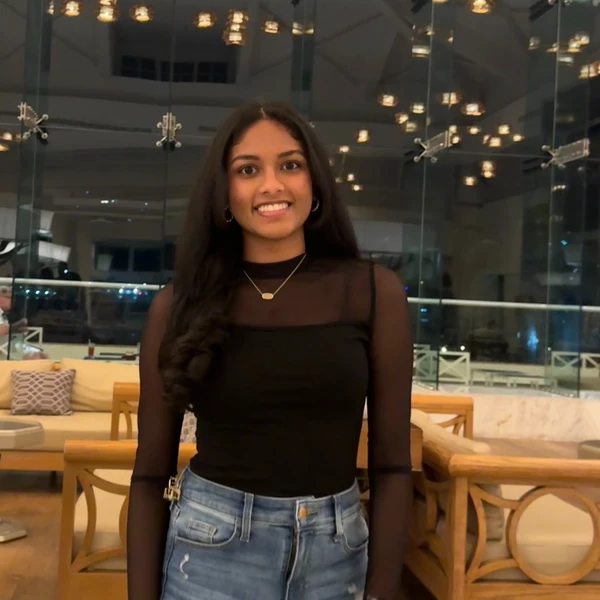
Hasini Kurmala
1x
FinalistHasini Kurmala
1x
FinalistBio
I am a driven high school student with a deep passion for medicine and community impact. My ultimate goal is to become a medical professional who not only provides care but also works to make healthcare more accessible and empathetic. I’m especially interested in how biology and patient-centered research can be used to improve lives and bridge gaps in medical understanding.
Through volunteering, internships, and health-focused projects, I’ve learned the importance of compassion, curiosity, and resilience. I’m passionate about helping others and turning my interest in science into meaningful service. I believe I’m a great candidate because I bring dedication and empathy to everything I do—whether I’m in a lab, a clinic, or my community.
Education
Independence High School (Ashburn)
High SchoolMiscellaneous
Desired degree level:
Bachelor's degree program
Majors of interest:
- Anthropology
- Biological and Biomedical Sciences, Other
- Biochemistry, Biophysics and Molecular Biology
- Biomedical/Medical Engineering
Career
Dream career field:
Medicine
Dream career goals:
Administrative Assistant
Curie Learning LLC – K-12 Academic Enrichment Center2024 – Present2 years
Research
Biomedical/Medical Engineering
Technology Student Association (TSA), Academies of Loudoun — Student Leader & Competitor2024 – 2025Microbiological Sciences and Immunology
George Mason University – Schar School of Policy and Government — Student Researcher under Dr. Fatah Kashanchi2025 – 2025Biomedical/Medical Engineering
Academies of Loudoun – Senior Research & Technology Program — Senior Researcher, Academy of Engineering and Technology2025 – Present
Public services
Volunteering
TruHealthNow – Primary & Urgent Care — Clinical Intern / Medical Assistant Trainee2024 – Present
Women in STEM and Community Service Scholarship
One of the issues that matters most to me is access to quality healthcare. It’s easy to take something as simple as a check-up or a prescription for granted, but for many people, even those small steps toward health can feel out of reach. Working in a primary and urgent care clinic has made me realize how uneven access to care can be, especially for people without stable income, transportation, or insurance. I’ve seen patients delay treatment because they couldn’t afford it, and others come in only after their symptoms had worsened. Those moments made me see healthcare not just as a science, but as a matter of equity.
That realization is what drives both my interest in bioengineering and my commitment to community service. I’ve always believed that the most meaningful progress happens when science meets empathy. In my research, I study how electric currents can break down bacterial biofilms that grow in hospital waste. It’s a project rooted in microbiology and engineering, but the goal behind it is simple—to make hospitals safer and prevent infections that put patients at risk. This work has shown me how technology and biology can combine to improve public health on a broader scale.
Outside the lab, I’ve worked with organizations that serve people experiencing homelessness. I’ve helped distribute meals and hygiene kits, but what stayed with me most were the conversations. Listening to people’s stories reminded me that stability and dignity start with small acts of care. That same belief guides how I see healthcare: it’s not just about medicine or devices, but about building trust and giving people back a sense of control in their lives.
My goal is to use my education to create technologies that make healthcare more accessible and efficient, especially in under-resourced communities. I want to work on systems that improve sanitation, reduce infection risks, and make early diagnosis possible in areas where resources are limited. More than anything, I want my work to reflect compassion.
Being a woman in STEM also motivates me to keep breaking barriers and helping others do the same. I hope to mentor young girls who are curious about science but might not see themselves represented in it. I want to show them that they don’t have to choose between compassion and innovation; they can bring both to the table. Whether through outreach programs, research collaborations, or direct patient care, I plan to keep using what I learn to make a difference where it matters most—in people’s lives.
For me, STEM is more than equations and experiments. It’s a way to turn curiosity into care, and care into change. Every discovery, every project, every hour spent learning is another step toward a world where health, stability, and opportunity are not privileges, but guarantees. That’s the kind of impact I want to make—one rooted in scientific innovation and a commitment to serve.