Hobbies and interests
Guitar
Singing
Mathematics
Science
Water Polo
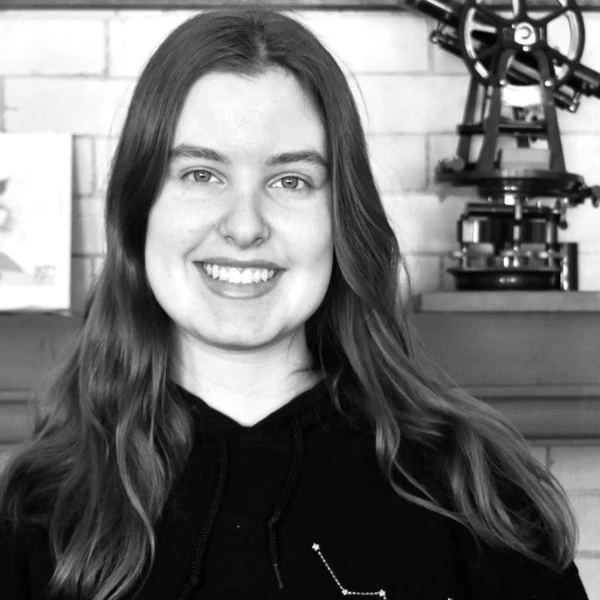
Grace Kachmarsky
1x
Finalist
Grace Kachmarsky
1x
FinalistBio
Astrophysics major at Wellesley College with 6" and 12" telescope certification at Whitin Observatory. Currently working to repair and program spectroscopy instrumentation for installation on 0.7 meter PlaneWave telescope to enable spectroscopy of galaxies, nebulae, and transients. Member of Wellesley Extragalactic Explorer Research Group conducting research and using astronomical Python Libraries to analyze galaxy and star cluster data from the Hubble and James Webb telescopes. Also conducting research with NASA PlaneWave Research Group observing TESS targets with 0.7 meter PlaneWave telescope.
Education
Wellesley College
Bachelor's degree programMajors:
- Astronomy and Astrophysics
La Salle High School
High SchoolMiscellaneous
Desired degree level:
Doctoral degree program (PhD, MD, JD, etc.)
Graduate schools of interest:
Transfer schools of interest:
Majors of interest:
- Astronomy and Astrophysics
Career
Dream career field:
Astrophysics
Dream career goals:
Student Election Worker
Los Angeles County2024 – 20251 yearStudent Researcher
Wellesley College Spectroscopy Research2025 – Present1 yearStudent Researcher
Wellesley Extragalactic Explorers2025 – Present1 yearWhitin Observatory Day and Night Lab Assistant
Wellesley College2026 – Present6 months
Sports
Water Polo
Varsity2021 – Present5 years
Awards
- 4-year Captain
- 2023-2024 MVP
- 2022-2023 Offensive Player of the Year
- 2021-2022 Rookie of the Year
Research
Physics and Astronomy
Wellesley College — Researcher2025 – PresentAstronomy and Astrophysics
Stanford and MIT Inspirit AI — Researcher2022 – 2023
Public services
Volunteering
Wellesley College A.S.T.R.O Club — First Year Representative2025 – Present
Future Interests
Advocacy
Volunteering
Philanthropy
Imm Astronomy Scholarship
I have the rare pleasure of remembering how my early thoughts made me feel. Sitting on my living room couch watching NOVA, the screen a swirl of enchanting colors evoking deep space, I felt each fingertip tingle as if sparks were about to appear. Since then I have been fascinated by space and the limitless possibilities of the universe and have been preparing to add my own questions to the exploration of tomorrow. My dream is to observe and theorize about our physical world as an astrophysicist, a field that still evokes those early sparks in my fingertips, causing me to dream and wonder.
I am passionate about everything to do with space and our relationship to the world we live in. I want to contribute to both observational and theoretical astrophysics research, potentially in high-energy astrophysics and cosmology. My astrophysics aspirations are fueled by my love of space and physics and inspired by my hometown of Pasadena’s rich astronomical history. My interests in astrophysics are broad, though I am currently most interested in researching black holes and dark matter, as well as the quasars powered by the accreting supermassive black holes at the centers of galaxies. I am also interested in Tidal Disruption Events and the recent JWST discovery of the Little Red Dots. I hope to participate in a wide range of research experiences that allow me to dive deeper into the topics that cause me to wonder. My dream is to work at NASA JPL one day and be a small part of the groundbreaking research happening there daily. In addition to research, I also hope to work in academia and teach the next generation of physicists and astronomers, sparking a passion for and love of space. I am also interested in space policy because astrophysics for me is not an individualistic pursuit, but rather a way to better understand and help our world as we face the future.
My choice to attend a women’s liberal arts college to pursue astrophysics has allowed me to continue to nurture my diverse interests and support other women pursuing space science. Collaboration has allowed me to become a more informed and innovative thinker. During high school I participated in the Inspirit AI program, where I collaborated with mentor Roochi Shah of Carnegie Mellon and an international cohort, training AI models to search imbalanced classes of data from the NASA Kepler space telescope to detect and characterize exoplanets. The experience culminated in a research symposium, where we presented our findings to faculty at Carnegie Mellon, Harvard, MIT, and Stanford. Through this experience, I learned how to solve a real-world problem with a diverse, multi-regional team of students. Currently, at Wellesley, my spectroscopy research team is focused on revitalizing a spectroscope to install on our 0.7-meter PlaneWave telescope to do spectroscopy of galaxies, nebulae, and transients such as supernovae. As this project is a continuation of research started by past students, I have learned the importance of keeping an updated record of findings and insights. There have also been lessons on the importance of small victories when participating in research. Collaboration was key in both research experiences, with various perspectives providing crucial insights and leading to findings. I am also a part of the Wellesley Extragalactic Explorers research group, using astronomical Python libraries for coding tasks and analyzing galaxy and star cluster data from Hubble and James Webb space telescopes. These research experiences have all sparked my passion and continue to excite me every day, advancing the astrophysics aspirations of my childhood.