Hobbies and interests
Horseback Riding
French
Music
Reading
Geography
History
Public Policy
Hiking And Backpacking
Reading
Historical
Adult Fiction
Biography
Novels
Mystery
Humanities
I read books daily
Grace Byma
1x
Finalist1x
Winner
Grace Byma
1x
Finalist1x
WinnerBio
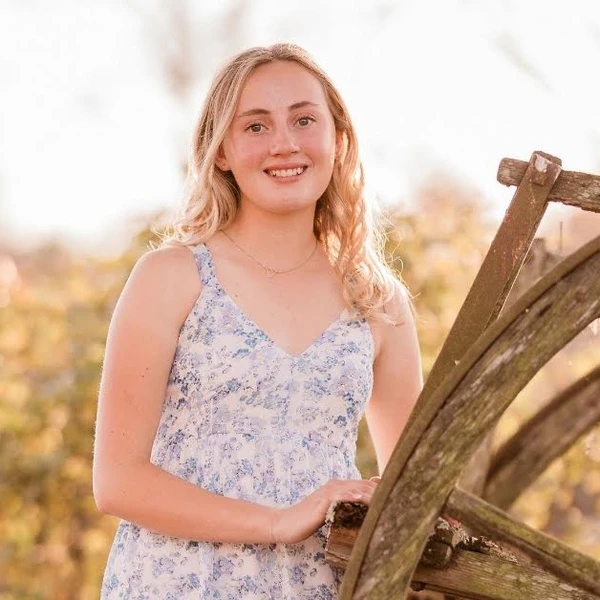
Hello! My name is Grace Byma, and I am a senior in high school attending East Carolina University in the fall of 2026. I have a strong interest in the geospatial intelligence field and plan to major in Geography, concentrating in Geographic Information Systems. From a young age, I have been fascinated by maps, constantly studying them. Growing up in a military family with both parents as veterans has also made me more attuned to global events and issues. Geography plays a crucial role in international affairs, as physical landscapes shape human cultures and, in turn, influence global relationships.
Outside of academics, I have been an avid equestrian for ten years. I have competed on an Interscholastic Equestrian Association (IEA) team throughout high school, where I have had the opportunity to attend horse shows throughout North Carolina and Virginia and serve as co-captain for the past two years. Over the past three years, I have also been retraining an off-the-track Thoroughbred alongside my trainer, developing him from a young racehorse into a promising hunter-jumper show prospect. From early morning rides to late-night barn chores, the equestrian sport has taught me the discipline and patience needed for college and my future career endeavors.
Through my studies in Geography and Geographic Information Systems, I hope to combine my interest in maps, global issues, and spatial analysis in aspirations to work for a federal agency or a defense contractor in the geospatial intelligence field.
Education
D H Conley High
High SchoolMiscellaneous
Desired degree level:
Bachelor's degree program
Majors of interest:
- Homeland Security
- Geological and Earth Sciences/Geosciences
- Geography and Cartography
Career
Dream career field:
Government Relations
Dream career goals:
Front of the House Team Member
Chick Fil A2026 – Present5 monthsHay worker
Calvary Stables2020 – 20244 years
Sports
Equestrian
Club2017 – 20269 years
Awards
- 2025–2026 IEA Team Co-Captain
- 2026 IEA Zone 3 Finals Team Rider
- 4th Place – Varsity Intermediate Fences, 2026 Region 9 Regionals
- 2024–2025 IEA Team Co-Captain
- 4th Place – Novice Fences, 2025 Region 9 Regionals
Arts
Eastern Youth Orchestra
Music2023 – 2024Greenville Piano Teachers Association Association
Music2017 – 2023
Public services
Volunteering
French National Honor Society — Volunteer Student Tecaher2024 – 2026
Future Interests
Advocacy
Politics
Volunteering
Philanthropy
Entrepreneurship
Ryan T. Herich Memorial Scholarship
A city does not just simply appear. In order for a civilization to thrive, access to water, cultivable land, an amiable climate, and a multitude of natural resources are required. Due to the gift of the Nile River, Ancient Egypt thrived. The river, a constant water source, flows north into the Mediterranean Sea, creating a fertile delta that allows for highly productive agriculture. Access to the Mediterranean also supported trade and communication with other civilizations. At the same time, the vast Sahara Desert to the west and the Eastern Desert provided natural protection from foreign invasion. Geography has been the fundamental force behind the rise of ancient civilizations for thousands of years and continues to shape the geopolitics of the modern world today.
My interest in geography is shaped by my family’s military background. Both my parents served four years in the Marine Corps and My dad served another sixteen years in the Navy Reserve as an intelligence officer. As a young kindergartener when my dad was deployed to Afghanistan. My mom hung a large world map in our living room and placed a thumbtack where my dad was located and another where our family was located. I constantly studied that map, originally to understand the distance separating my family, but over time I began to notice the significance of the places in between. From there, I was hooked. I filled my room with maps, collected postcards from friends traveling abroad, and explored atlases online. I am currently an admitted freshman at East Carolina University and plan to study Geography, concentrating in Geographic Information Systems. I aspire to work in the geospatial intelligence (GEOINT) field working for a federal agency or a defense contractor as a geospatial analyst.
Geographic location and terrain lays the foundation for a nation's culture, economy, military interests, and international relations. On the Arabian Peninsula, a combination of geological features and tectonic activity has created some of the world’s largest petroleum deposits. This has allowed Saudi Arabia to become one of the leading exporters of oil. Through this natural resource, Saudi Arabia has gained significant influence over global energy markets, generating enormous wealth and building strong international ties. While the geography of a country can provide great advantages, it can also impose deep constraints. A lack of warm water ports has driven Russia’s foreign policy and security concerns for the past few decades, leading to the annexation of Crimea in 2014 which allowed Russia to gain leverage over the Black Sea. These examples show that geography is not just historical but is still a relevant element in modern politics today.
Geography serves as the bridge between physical landscapes and how societies develop over time. By studying geography, we can better understand global events and conflicts. Beyond maps geography, is a way to analyze how the world functions, allowing for more informed decision making by stakeholders on a global scale.
Ben Brock Memorial Scholarship
WinnerGeography first sparked my interest as a young kindergartner when my dad was deployed to Afghanistan. My mom hung a large world map in our living room and placed a thumbtack where my dad was located and another thumbtack where we were located. I constantly studied the map, originally to understand the distance separating my family, but over time this led me to notice the significance in the places in between. From there, I was hooked; I filled my room with maps, collected postcards from friends traveling abroad, and explored a multitude of atlases online. I am currently an admitted freshman attending East Carolina University in the fall of 2026 and plan on studying Geography concentrated on Geographic Information Systems. I aspire to work in the geospatial intelligence (GEOINT) field as a geospatial analyst, a career that involves geography, map making, spatial analysis, and Intelligence gathering.
GEOINT is used across many government agencies, with the National Geospatial-Intelligence Agency serving as the primary agency in the GEOINT field. As a geospatial analyst at NGA, I would use satellite imagery and geographic data to identify physical features, patterns, and human activity in an area, turning that information into intelligence that supports national security and military operations. Geospatial analysts also work within the Central Intelligence Agency and Federal Bureau of Investigation; CIA geospatial analysts use geographic intelligence to assist with covert missions on the global stage, while FBI geospatial analysts focus on using geographic data to create maps that assist in domestic investigations.
I am connected to the military through my parents. My dad served four years in the Marine Corps and then went on to serve sixteen years in the Navy Reserve as an intelligence officer.
My mom also served four years in the Marine Corps and currently works for a U.S. Senator as a military and veteran liaison. My parents’ work in both the intelligence and public policy sectors has helped me understand the responsibility and sacrifice that is required to work within these careers. It has also allowed me to be more aware of national and international affairs.
Geography is always changing; the physical and built environments continue to shift, allowing human patterns and culture to evolve as well. Geospatial intelligence is used to continuously track these changes as they occur, analyzing patterns and understanding the impact to better interpret the world around us. From my early kindergarten days, I have always loved maps, and that passion has grown with me as I continue my education in college studying geography, focusing on geographic information systems. I am motivated to pursue a career in a field involving a subject that I am truly passionate about, while also doing meaningful work on a global scale.