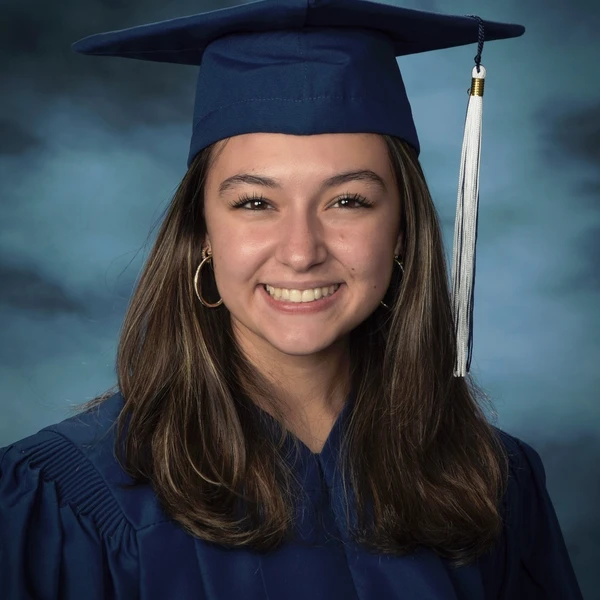
user profile avatar

Gabrielly Muller Melo

1x

Finalist

1x

Winner

Bio

Peanut butter and jelly with a side of coxinha. A sandwich packed for lunch at my rural Pennsylvania school, alongside a Brazilian chicken croquette tucked into foil by my mom. It was more than food, it was identity. The daughter of Brazilian immigrants, I grew up with one foot in American classrooms and the other in Brazilian kitchens where pão-de-queijo was always fresh, and samba played in the background. At seven, I played Susan in Miracle on 34th Street. By the age of eight, I was performing professionally. Behind the makeup was juvenile rheumatoid arthritis, chronic pain, eye damage risk, and frequent visits to the doctors. But Dr. Groh, my rheumatologist, treated me like a star, racing me down hallways, cheering me on. He didn’t just treat symptoms, he lifted spirits. That’s what I hope to do. Music gave me joy. Medicine gave me strength. Through performances, Fair Trade advocacy, and reforestation work in Ecuador, I’ve seen how healing takes many forms. My joints may ache, but my purpose has never been clearer: to be a doctor who treats the whole person with empathy, science, and maybe a song or two.

Education

Manheim Township High School

High School
2019 - 2026

Miscellaneous

  • Desired degree level:

    Bachelor's degree program

  • Majors of interest:

    • Neurobiology and Neurosciences
    • Human Biology
    • Medicine
    • Music
    • Genetics
    • Health/Medical Preparatory Programs
  • Planning to go to medical school
  • Career

    • Dream career field:

      Medicine

    • Dream career goals:

      Surgeon

      Sports

      Softball

      Club
      2024 – 20251 year

      Arts

      • Dutch Apple Theater

        Theatre
        2019 – 2019
      • American Music Theater

        Theatre
        2017 – 2023
      • Sight & Sound Theater

        Acting
        2016 – 2019

      Future Interests

      Advocacy

      Volunteering

      Minority Women in STEM Scholarship
      While everyone else was tearing open Lunchables at the cafeteria table, my lunchbox always had its own agenda. Inside was a little identity crisis in foil form: a PB&J for the American girl in me, and a coxinha made by my mom, seasoned with the tempero of my grandparents. By second grade, my lunch had already caused enough drama to start what my family still calls the “Microwave Battle.” My mom campaigned for the cafeteria to get a microwave so I could heat up what she considered “real food.” To her, sandwiches barely counted as lunch. For most families, this probably sounded excessive. For us, it was how arroz and feijão survived in the land of Lunchables. Not long after that, I found myself in another spotlight: center stage. At eight years old, I made my debut at Sight & Sound Theatres, performing in front of crowds of more than 2,000 people. From the audience, it probably looked magical. Backstage, however, was chaos in the best possible way. Think water buffalo stopping scenes mid-show, pet skunks wandering around backstage, and emergency cleanup after a camel accident. Glamorous? Not exactly. Memorable? Absolutely. For nearly a decade, theater became a huge part of my life. Between rehearsals, performances, choir, and school, I spent almost 800 hours a year performing. There were nights when I was doing math homework under dressing-room lights or finishing essays in the car after a show. The schedule could be exhausting, but theater taught me something I carry with me everywhere now: talent matters, but persistence matters more. Showing up tired, staying disciplined, and continuing even when things got difficult mattered just as much as what happened on stage. That lesson became even more important because I also grew up with Juvenile Rheumatoid Arthritis. Strangely, when I think back on those years, the memories that stand out most are not the painful ones. They are the traditions my mom created around them. After every appointment, she took me to Hershey's Chocolate World. I can still picture the singing cow on the chocolate ride and hear my mom laughing while I dramatically sang along. Those traditions did not erase the difficult parts, but they reframed them. I learned that resilience does not always have to look serious. Sometimes it sounds like laughter echoing through a hospital hallway. One person who shaped that perspective was my doctor, Dr. Groh. At every appointment, he would yelled, “Ready, set, go!” and sent me racing barefoot down the hallway tiles. At the time, I thought he was just being funny. Later, I realized he was observing my gait in the most natural way possible. Those hallway races were never just about medicine. They were about seeing the whole person behind the symptoms. The empathy and creativity he showed me inspired the little girl who dressed up as a doctor every year for career day. Even now, he is one of the reasons I dream of becoming a physician who listens carefully and treats patients like people before diagnoses. As I step into the next act of my life, I carry all of it with me: the music, the medicine, the PB&J, and the coxinhas. Just like my lunchbox once held two cultures side by side, I now hold multiple worlds within me: Brazilian roots and American experiences, persistence and performance, science and empathy. One day, I hope to become a doctor who listens deeply, advances equity, and helps patients feel seen in their own healing journeys. And honestly, I'll always be carring that lunchbox, no matter where I go.
      Stewart Family Legacy Scholarship
      The future isn't a passive outcome, but a landscape actively shaped by intellect and vision. At its core, this relies on science and leadership. Though distinct, these forces are deeply interconnected, collaboratively driving progress and building a more equitable, healthy, and sustainable future. My own journey exemplifies this. Science, for me, isn't just a textbook concept; it's profoundly personal. My experience with juvenile rheumatoid arthritis (JRA) since 18 months old made science tangible. It provided treatments allowing me to dance on professional stages. My pediatric rheumatologist, Dr. Groh, even turned physical therapy into a game, observing my gait with a clinician’s eye and a performer’s appreciation. This showed me how scientific inquiry impacts lives, pushing boundaries in human health. Without science, our efforts to build a better future would be guesswork. Yet, knowledge alone is inert without effective leadership. Leadership translates scientific understanding into actionable strategies, inspiring collective effort. My life, balancing demanding theater schedules with academics, taught me unparalleled discipline and time management. It was about showing up, collaborating, and delivering consistent performance. Founding my high school’s Fair Trade club, Toucan-You-Can, taught me to mobilize peers and educate our community. These experiences showed me leadership isn't just authority; it's fostering collaboration and building consensus. Visionary leaders discern scientific potential and mobilize resources to serve humanity. True power emerges when leadership and science converge. Scientific breakthroughs remain in labs without leadership to champion their ethical application. Conversely, leadership without scientific understanding risks decisions based on conjecture. My aspiration to be a doctor is rooted in this synergy: combining rigorous scientific knowledge with compassionate leadership. I envision treating the whole person, understanding their unique story, and actively advocating for health justice. It’s about being a healer who understands the systems and people involved, just as I learned to connect with audiences and advocate for fair trade. Ultimately, our future depends on integrating scientific discovery with principled leadership. It demands individuals adept at unraveling mysteries and skilled at uniting people, ensuring our collective journey is guided by intellect and empathy. My journey, from stage to hospital, from Brazilian kitchen to Fair Trade conference, shows these forces are lived realities empowering individuals to shape a better world. I am ready to bring my unique blend of scientific curiosity, empathetic leadership, and deep human understanding to contribute to a future where innovation serves humanity, and everyone thrives.
      Deborah Thomas Scholarship Award
      I plan to make a positive impact on the world by becoming the kind of doctor who treats people, not just problems, someone who listens not only with a stethoscope but with empathy, curiosity, and cultural understanding. My career goal is to enter medicine with a dual passion for science and humanity, healing both the body and spirit, especially for patients who feel unseen or underserved. This vision was born not only from living with juvenile rheumatoid arthritis (JRA), but also from a life spent navigating the beautiful intersection of the arts and health, culture and compassion. From a young age, I’ve lived between worlds: a Brazilian-American growing up in rural Pennsylvania, a professional performer juggling academics and rehearsals, a child managing a chronic illness while learning to find joy anyway. These experiences taught me that resilience is not about avoiding challenges, but meeting them head-on, with a song in your heart and a plan in your pocket. I’ve spent years learning how to show up in pain, how to adapt when the spotlight shifts, and how to keep going even when the path ahead looks uncertain. These lessons have shaped me into someone deeply empathetic, fiercely determined, and committed to creating positive change. As a future physician, I’m especially passionate about promoting holistic care and health justice. Living with JRA gave me a front-row seat to the healthcare system and made me realize how often emotional well-being is overlooked. I plan to advocate for a more integrated approach to medicine, one that acknowledges the full story of each patient. That includes cultural background, mental health, social factors, and more. I want to be the kind of doctor who doesn’t just ask, “Where does it hurt?” but also, “How are you really doing?” In addition, my advocacy through founding Toucan-You-Can, my school’s Fair Trade club, has sparked my commitment to addressing inequality on a systemic level. Whether it’s fighting child labor in global supply chains or addressing healthcare disparities in local communities, I want my future work to be rooted in justice and compassion. I believe in empowering people with knowledge, listening deeply, and showing up with both head and heart. At the same time, I’ll never stop being a performer at heart. Music and theater have taught me how to connect with others, to read a room, and to lead with joy. These skills translate beautifully into medicine, where communication, trust, and empathy are everything. Whether singing in a hospital ward to lift spirits, explaining a diagnosis in a way that truly resonates, or simply offering a smile at the right moment, I believe the arts will always be part of how I heal. My impact will be felt not just through the patients I treat, but through the communities I uplift, the systems I help improve, and the moments of human connection I create along the way. I plan to be a doctor who blends science with soul, and in doing so, makes the world a little more whole.
      "Most Gen Z Human Alive" Scholarship
      Lin-Manuel Miranda made the Founding Fathers rap, and suddenly, history had rhythm. For me, life’s always had music. I grew up balancing Brazilian Bossa Nova and Broadway scores, singing both “The Schuyler Sisters” and Tom Jobin in the kitchen while shaping brigadeiros with my mom. Long before I ever saw Hamilton live, I knew every beat, breath, and rhyme as if I’d written it myself. All the songs I lived it, in my own way: rewriting what it means to belong, to speak up, and to turn personal rhythm into public voice. I’m the Gen Z kid who writes songs in her Notes app at midnight, not for clout, but because music is how I process the world. The one who spends lunch singing Broadway harmonies with friends instead of scrolling. My camera roll is full of lyric snippets, concert clips, and blurry backstage moments that mean everything to me. I’m not chaotic, I’m quietly driven, with a melody always playing somewhere in the background. At five feet tall, I don’t always make the biggest entrance, but neither did Hamilton. Like him, I prove that presence isn’t about height, it’s about voice, passion, and purpose. I founded a Fair Trade club to advocate for global justice, not because it was trendy, but because I believe in dignity for all. I sing not to be the loudest in the room, but to make others feel seen. Hamilton taught us that legacy is about what you do with your voice. I use mine to write, sing, lead, and remind others they matter. If that’s not peak Gen Z, empathetic, expressive, and unapologetically original, I don’t know what is. I’m not throwing away my shot. I’m just singing it softly, until the whole room starts to listen.
      Byron and Michelle Johnson Scholarship
      I grew up in Lancaster County, Pennsylvania, a place best known for Amish buggies, cornfields, and the smell of soft pretzels wafting through Main Street. At first glance, it might seem like a quiet town where not much happens. But for me, it’s been the backdrop of a life filled with culture, purpose, and unexpected lessons that have shaped my deepest beliefs, closest relationships, and clearest career goals. Lancaster may not be a bustling metropolis, but it is a place where community matters. People wave when they pass you on the road. Local festivals like Taste of Lititz fill the streets with music, food, and neighbors catching up over lemonade. Growing up here taught me that service isn’t a special event, it’s a way of life. From a young age, I was encouraged to contribute, whether by volunteering at community events, tutoring younger students, or performing for senior citizens with my choir. As the daughter of Brazilian immigrants, I’ve often found myself navigating between cultures. In a school of 2,000 students, I was one of only three Brazilians. While this sometimes made me feel like an outsider, it also helped me develop empathy and pride in my roots. My home was full of Portuguese conversations, pots of feijoada, and debates about Brazilian politics. Meanwhile, school taught me how to listen, adapt, and educate others about who I was. This dual identity made me a bridge-builder, someone who’s comfortable in many worlds and sees diversity as a strength. One of the most defining experiences of my life came when I founded Toucan-You-Can, my school’s Fair Trade club. Inspired by what I’d learned at a national Fair Trade conference, I saw how local action could have global impact. We began educating our school and community about ethical consumption, sustainability, and labor justice. At the Taste of Lititz festival, we handed out Fair Trade banana desserts while teaching people how their shopping choices affect farmers around the world. Growing up in Pennsylvania gave me the platform to turn big ideas into tangible action—and it showed me that small towns can be powerful places for social change. Lancaster has also been the stage, literally, for another central part of my life: performing arts. From the age of eight, I worked as a professional singer, dancer, and actress at local theaters like Sight & Sound and American Music Theatre. Balancing performance schedules with schoolwork and a chronic illness (juvenile rheumatoid arthritis) taught me resilience, time management, and the power of storytelling. It also gave me a deep respect for those who use their voice, not just onstage, but in the world. These experiences have directly shaped my career goals. I plan to pursue a career in medicine with a focus on public health and global equity. Just as I once educated my town about Fair Trade bananas, I hope to educate patients and communities about health and access. I want to be a doctor who listens like a performer and advocates like a Fair Trade activist, someone who believes healing should be both personal and just. Growing up in Pennsylvania didn’t just shape who I am, it empowered me to believe that even in a small town, I could make a global impact.
      Mema and Papa Scholarship
      Winner
      From a young age, I discovered that being helpful isn’t just about offering a hand—it’s about offering hope. Whether I’m tutoring young girls in math, singing for seniors, or educating my peers about ethical consumerism, I’ve always believed that the small, consistent things we do for others can ripple out in big ways. In 2022, I attended the Fair Trade Federation Conference in California. That experience completely reshaped how I understood global justice, labor rights, and environmental responsibility. I learned how many everyday items from coffee to chocolate to bananas are connected to systems of exploitation. And I realized that students like me have the power to push for change, starting right in our schools. That’s when Toucan-You-Can was born. As founder and president of our Fair Trade club, I’ve led school-wide campaigns to raise awareness about the hidden costs of unethical consumption. Our club hosts events, collaborates with teachers, and is actively working to get our school certified as a Fair Trade School by 2025. At our town’s annual “Taste of Lititz” festival, we handed out Fair Trade banana desserts to hundreds of visitors. Most had never heard of Fair Trade, but after a short conversation—and a few delicious bites—they walked away seeing their grocery choices differently. That’s what helpfulness looks like to me: giving people the tools and knowledge to take action in their own lives. But if helpfulness is my why, perseverance has always been my how. I was diagnosed with juvenile rheumatoid arthritis when I was just 18 months old. While other kids were learning how to run, I was learning how to walk without pain. Even as I built a life onstage as a professional performer acting, singing, and dancing in theaters across Lancaster County, I was managing a condition that doesn’t care about stage lights or show schedules. There were days when I’d rehearse through aching joints or perform with a smile while my foot throbbed under my costume. But I never let my diagnosis define me. That same determination helped me grow Toucan-You-Can from an idea into a movement. When meetings were small or people seemed uninterested, I kept showing up. When the certification process seemed overwhelming, I kept pushing forward. And when I traveled to Ecuador in 2025 for a sustainability and service field experience, I was reminded why this work matters. I helped plant trees in the Amazon with Indigenous communities, deepening my understanding of the environmental stakes behind our consumer choices. It wasn’t the beginning of my journey, but it solidified the path I’m on. Whether through education, advocacy, or performance, I’ve committed myself to helping others, even when it’s hard, even when it hurts. Because the most lasting change is created not just by those who care, but by those who keep going.
      Rooted in Change Scholarship
      When people think about changing the world, they don't usually picture a banana. But to me, a banana, specifically, a Fair Trade banana, represents one of the most powerful tools we have to create environmental and social justice. In Ecuador, I was able to participate in a school sustainability field experience. I spent ten days deep in the Amazon rainforest working with Indigenous communities to restore the land through reforestation. We planted trees, listened to local leaders speak about ecological devastation, and saw up close how deforestation, pollution, and global consumption patterns threaten both the planet and its people. It was there, under the emerald canopy of the rainforest, that I began connecting the dots between my own life and global systems. Back in Pennsylvania, I founded Toucan-You-Can, a Fair Trade club at my high school. Our mission: to educate students and the wider community about ethical consumption, child labor, sustainability, and economic justice. At the heart of Fair Trade is the belief that no one should be exploited so someone else can enjoy cheap coffee, chocolate, or bananas. At our town's annual Taste of Lititz event, we set up a table offering samples of Fair Trade banana desserts, sweet, rich, and completely transformative. But our goal isn't just to delight taste buds. It's to educate. Every person who stops by learns about the difference a Fair Trade label makes: how choosing Fair Trade bananas means farmers are paid fairly, work under safe conditions, and follow environmentally sustainable practices like organic farming and crop rotation. We usually hand out over 300 samples and spark dozens of meaningful conversations. Some people are surprised to learn that banana plantations are often sites of pesticide overuse, worker exploitation, and even forced child labor. Others have never realized that their everyday purchases could directly support rainforest preservation and the well-being of farming families. One woman came back just to say, "I'll never look at a banana the same way again." Moments like that are why I believe environmental justice begins with education. And I'm not stopping there. I'm leading the charge to get our school certified as an official Fair Trade School by 2025. That means incorporating Fair Trade principles into our K–12 curriculum, from social studies to science, so that students grow up understanding their power as consumers. We're designing lesson plans, bringing in guest speakers, and expanding community partnerships. Because the sooner students see how their daily choices impact global ecosystems and economies, the more prepared they'll be to lead change. In college, I plan to major in pre-medicine with a concentration in global sustainability. I want to pursue a career at the intersection of medicine and environmental justice, where health isn't just about treating disease but about preventing it through clean air, fair labor, and sustainable systems. My dream is to become a physician who advocates for both people and the planet, especially in marginalized communities disproportionately affected by climate change and environmental degradation. What gives me hope is that real change often starts small. A student club. A banana dessert. A conversation across a folding table at a local festival. These may seem like tiny acts, but they're seeds. And when nurtured, seeds become forests. Just like the ones I helped plant in Ecuador.