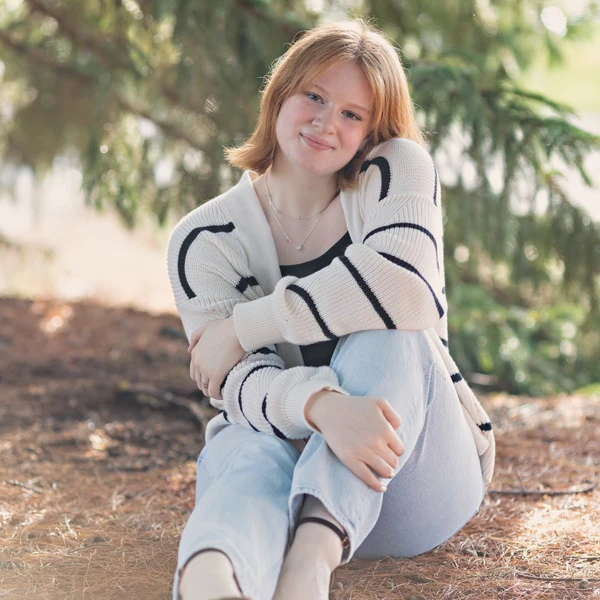
user profile avatar

Evelyn Anhalt

2x

Finalist

2x

Winner

Bio

Hi I'm Evelyn! I am an aspiring Museum Curator and am working towards my degree in Anthropology at the University of Iowa!

Education

University of Iowa

Bachelor's degree program
2025 - 2029
  • Majors:
    • Archeology
    • Anthropology
  • Minors:
    • Dance
    • Museology/Museum Studies

Miscellaneous

  • Desired degree level:

    Master's degree program

  • Graduate schools of interest:

  • Transfer schools of interest:

  • Majors of interest:

    • Anthropology
    • Archeology
  • Not planning to go to medical school
  • Career

    • Dream career field:

      • Museums and Institutions
    • Dream career goals:

      Museum Curation

    • Barista, barista trainer

      Starbucks
      2024 – Present2 years

    Sports

    Dancing

    Varsity
    2009 – 202516 years

    Awards

    • Individual judges awards
    • 1st place
    • 2nd place
    • 3rd place
    • runner-up
    • summer intensives
    • scholarships

    Research

    • Anthropology

      Iowa Historical Society — Observer
      2025 – 2025

    Arts

    • School of Classical Ballet and Dance

      Dance
      The Nutcracker, Peter Pan, Wizard of Oz, Snow White, Cinderella, Alice in Wonderland, Princess Mermaid, Beauty and the Beast, Recital, Intensive showcases
      2009 – 2025

    Future Interests

    Advocacy

    Politics

    Curated Stories: Redheads in the Humanities Scholarship
    Winner
    When I dyed my hair, I expected to miss the compliments. I didn't expect to miss the assumptions. This summer I did something I had spent years promising everyone I would never do: I dyed my hair brown. To most people, that likely doesn't sound remarkable. But anyone who knows me knows my natural strawberry-blonde hair has always been one of my defining features. Growing up, strangers would stop my family in grocery stores just to admire it. Hairdressers begged me never to dye it. "People would pay for this color," they’d often say. By the time I was twelve, I’d heard enough cautionary tales about women who dyed their red hair only to "lose it forever" that I firmly convinced myself changing it would mean giving up a part of who I was. This summer, however, I found myself asking a different question. My red hair has undeniably shaped my identity, but how much has it shaped everyone else's perception of me? So, I decided to conduct a small experiment. Armed with semi-permanent hair dye (as the fear of regret still lingers) and a healthy dose of curiosity, I temporarily traded my red hair for brown. I didn’t do it hoping for a new identity, but instead it was an excuse to conduct my own miniature ethnography. The differences were subtle, but still revealing. They confirmed something I had been suspecting for awhile, that my hair wasn't just part of my identity, but had become a part of everyone else's perception of me. At work, the daily comments about my hair disappeared. The kind compliments from elderly customers faded, but with them did the uncomfortable remarks from middle-aged men. Friends made fewer ginger jokes. Conversations that once began with my appearance simply… Well, they didn't. A close friend, when I asked how she would feel if I dyed my hair, replied that she needed time to prepare beforehand. She laughed that she couldn't imagine me as anything other than a ginger. I kept thinking about what she'd said. She wasn't reacting to a new hairstyle, she was reacting to the temporary loss of something she unconsciously considered an integral part of my identity. What surprised me the most wasn't that people treated me differently. It was how quickly they stopped seeing something that had always seemed impossible to ignore. I hadn't changed. My interests, personality, and values were exactly the same. Yet removing one visible characteristic quietly changed the story people seemed to tell themselves about me before I had even spoken a single word, and that realization reminded me why I was drawn to anthropology in the first place. Culture isn't only made through traditions, languages, or history. It's also built through the small assumptions we make every day, like the split-second impressions formed from appearance, education, accent, or background. Most people never have the opportunity to watch those assumptions change in real time, but this summer I did. As I pursue anthropology, I hope to keep asking questions that begin with ordinary moments and lead to deeper understanding. My summer experiment started with a box of drug store hair dye, but it became a bigger lesson in perception, identity, and the power of assumptions. Anthropology invites us to question the stories we inherit about other people, and sometimes even the stories we inherit about ourselves.
    Silver Maple Fund Legacy Scholarship
    Winner
    "So like, do the curtains match the drapes?" The first time someone asked me that, I was in the seventh grade. Vulgar? Most definitely. However honestly, it isn't the craziest thing I've ever heard uttered about my hair. Growing up, I took great pride in my red hair. My mother would tell me: 'Evelyn, you have the rarest hair in the world.' Old ladies in the supermarket would stop us to tell me they were envious. Hairdressers would make me promise to never dye it. 'People would kill for this color!' they'd exclaim. I don’t remember being made fun of or treated differently as a child, and being homeschooled up until my junior year of high school is probably a big reason for that. In our home, learning was curiosity-driven and personal. I was encouraged to ask questions, explore big ideas, and think for myself. My red hair, like my sometimes quirky interests or deep love for ballet, was simply one more thing that made me, me. However, one thing that became immediately apparent to me upon entering public school, is that being ginger makes you the first target for uncomfortable comments, and being homeschooled only adds fuel to the fire. "What do you mean you're homeschooled AND a ginger?! Did your parents hate you or what?" That's something a close friend once said to me. I think she meant it as a joke, but after hearing the same "joke" hundreds of times from almost everyone, it didn't really feel like one. At first, I laughed it off. I didn’t want to seem sensitive or dramatic. I became more cautious about what I shared, even joking about myself to blend in. But that didn’t feel right either. Even the well-meaning comments stung: “But you’re so normal for a homeschooler!” Which I suppose was meant to be a compliment, but it was also loaded with stereotypes. Why do these assumptions exist? What about having red hair makes someone a target for open ridicule? Why are homeschoolers seen as anti-social or sheltered, even when they’ve been socially engaged their whole lives? And why are these traits seen as inherently bad, instead of something to be understood, or even celebrated? These questions were more than just thoughts passing through my mind, they began to fuel a curiosity I had long wanted to explore. I became fascinated with discovering how people shape their identities and how outside pressure and judgement plays a role in it. How language and "harmless jokes" often reveal deeper biases. This is what led me to anthropology. My senior year I took AP Language and Composition, a class that is deeply structured around culture and the human experience. For our semester project, we were assigned an ethnography, where we observed a specific subculture. That assignment lit something up in me. I realized I didn’t just want to ask questions, I wanted to study the systems, histories, and patterns that inform how we relate to one another. I wanted to find out what creates culture. I plan to study anthropology because I’m drawn to the complexity of the human experience. My own journey, from being misunderstood to understanding others, has shown me how powerful, and sometimes painful, that shaping can be. But it’s also shown me the importance of looking closer. The things that once made me feel different have become the lens through which I see others more clearly. They’ve prepared me not just to study culture, but to contribute to it, with empathy, curiosity, and a genuine desire to make space for every person and every story.