Hobbies and interests
Dance
Fashion
Culinary Arts
Reading
Adult Fiction
Literary Fiction
Young Adult
Romance
I read books multiple times per month
Esther Edwards
1x
Finalist
Esther Edwards
1x
FinalistBio
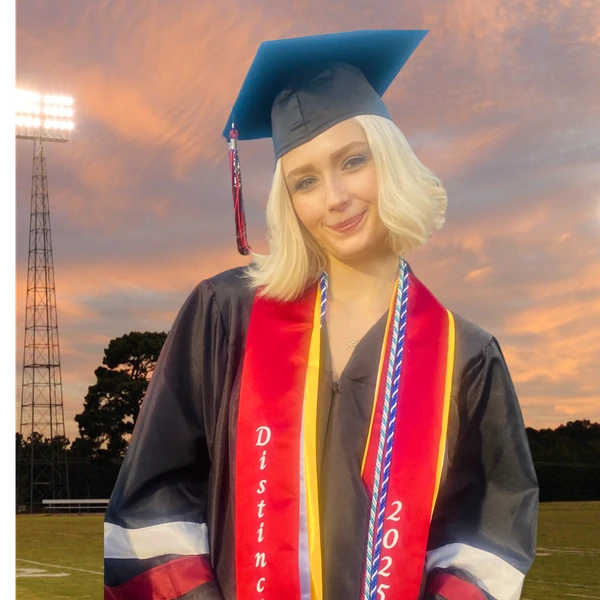
Esther Grace Edwards
A 2025 graduate of Tullahoma High School, Esther Edwards stood out as both a scholar and a student leader. She served as Senior Class Vice President, was crowned Homecoming Queen, and was voted “Friendliest” by her peers. She received the prestigious Faculty Award and the Student Council Award, and was named 2nd runner-up in the Miss Tullahoma pageant.
Passionate about inclusion and community impact, Esther led the initiative to transform the school’s outdated “smoker’s porch” into a welcoming outdoor classroom and greenhouse for students in the SPED program. She organized a bake sale fundraiser, secured donations from Sherwin Williams and local contractors, and coordinated the renovation effort—turning a forgotten corner of campus into a space for growth and learning.
Outside of school, Esther worked for a year as a chef at Emil’s Bistro, danced the role of Dewdrop in The Nutcracker, and volunteered with the Bedford County Community Outreach Partnership preparing grocery boxes for families in need. She also contributed to her local community college library by reorganizing its DVD collection.
Esther will attend Middle Tennessee State University in the fall, majoring in Nutrition and Dietetics. She is the recipient of the HOPE Scholarship, the MTSU True Blue Scholarship, and the Roddy Memorial Scholarship. She plans to pursue a career that blends science, service, and food as a tool for healing.
Education
Tullahoma High School
High SchoolMiscellaneous
Desired degree level:
Master's degree program
Majors of interest:
- Dietetics and Clinical Nutrition Services
Career
Dream career field:
Health, Wellness, and Fitness
Dream career goals:
Dietician
Chef
Emil’s Bistro2024 – 20251 year
Sports
Pickleball
Intramural2025 – Present1 year
Arts
Long School of Dance
DanceNutcracker, Peter Pan, Mama Mia, 12 Angry Jurors2021 – Present
Public services
Volunteering
Community Outreach Partnership — Packing grocery boxes2018 – Present
Ethel Hayes Destigmatization of Mental Health Scholarship
There was a time when I didn’t trust my own body, and that changes how you move through the world.
I was diagnosed with anorexia, and I’m in remission now, but that experience still shows up in how I think and how I relate to other people. It affected my goals, my relationships, and the way I understand what someone might be carrying even when they look fine on the outside.
During that time, everything felt off in a way that was hard to explain. I didn’t always have the language for it, so from the outside it probably looked like I was just being difficult or controlling. Inside, it felt like every decision was heavier than it should be. Something as simple as eating could take up an entire day’s worth of energy. That disconnect made me realize how easy it is to misunderstand someone when you’re only seeing their behavior and not what’s behind it.
That’s followed me into my relationships. I listen differently now. I notice pauses, shifts in tone, the things people circle around instead of saying directly. I’m more aware that people don’t always say what they mean the first time, or even the second. The people who helped me most were the ones who didn’t rush me or expect me to explain everything perfectly. They gave me room to figure things out without pressure. That’s something I try to give back in how I show up for others.
It also shaped what I want to do going forward. I’m interested in healthcare because I’ve seen what it feels like to be on the patient side of it, especially when things aren’t straightforward. Recovery isn’t clean or predictable. It can stall, move backward, or look fine on paper while still feeling difficult in real life. The people who made a difference for me paid attention to those in-between moments. They didn’t rely on assumptions or rush through conversations. That stuck with me.
Being neurodivergent adds another layer to all of this. I rely on routine more than most people, and sensory things can matter more than I expect them to. That can make certain situations harder to navigate, especially when expectations aren’t clear or flexible. It also means I notice when something feels off for someone else, even if they can’t explain it yet. Not everyone processes things the same way, and I’ve learned to leave space for that instead of expecting people to adjust immediately.
My understanding of the world has shifted in quieter ways. I don’t assume I know what’s going on with someone just because I can see part of it. I take things a little slower. I ask more questions. I try not to fill in the blanks too quickly.
Mental health is still something people avoid talking about openly, even when it affects so many lives. I want to be part of changing that, both in how I interact with people and in the work I choose to do. Through healthcare and involvement in professional spaces, I want to support more honest conversations and better understanding, especially for people who don’t fit neatly into expectations.
That experience didn’t give me a clean lesson or a simple takeaway. It changed how I pay attention, how I listen, and how I think about what people might need, even when they don’t say it out loud
Women in Healthcare Scholarship
I decided to pursue healthcare after seeing how much it matters to be truly understood when you’re vulnerable.
A few years ago, I was diagnosed with anorexia. I’m in remission now, but that experience stayed with me. It showed me how complicated healing can be and how much trust it takes to let someone help you. There were moments when I felt seen and supported, and those moments made a difference. There were also times when I felt misunderstood or reduced to a diagnosis, and that made everything harder. That contrast shaped how I think about healthcare and the kind of provider I want to become.
I’m drawn to healthcare because it allows me to be present for people during some of the hardest parts of their lives. That responsibility matters to me. I want patients to feel like they can be honest without being judged, and that they don’t have to explain themselves over and over just to be taken seriously. Clear communication, patience, and respect can change how someone experiences care, even before any treatment begins.
As a woman entering this field, I’m aware of how often women’s concerns are minimized or dismissed. I’ve heard too many stories of symptoms being brushed off or labeled too quickly. That’s something I want to challenge through how I practice. I want to listen closely, ask better questions, and make sure concerns are explored instead of overlooked. Patients should feel confident that their experiences matter and that their voice has weight in their own care.
My perspective is also shaped by being neurodivergent. I’ve learned that what seems straightforward to one person can feel overwhelming or complicated to someone else. That awareness affects how I approach communication and expectations. People process information differently, and care should reflect that. Taking an extra moment to adjust how something is explained or approached can make it more accessible and less stressful for a patient.
I’m also interested in contributing to healthcare beyond direct patient interaction. Through involvement in professional associations, I want to support continued research and advocacy, especially in areas that affect women and populations whose experiences are often underrepresented. Better research leads to better care, and that starts with asking more inclusive questions and paying attention to a wider range of patient experiences.
The difference I hope to make comes from how I show up over time. I want to be someone who listens carefully, explains things clearly, and notices when something doesn’t add up. I want patients to feel respected and comfortable speaking openly about their health. I also want to contribute to a field where women are heard, supported, and taken seriously, both as patients and as professionals.
Healthcare needs people who pay attention to details, patterns, and people. That’s the kind of work I want to do, and the kind of provider I’m working to become.
Thank you!
Amber D. Hudson Memorial Scholarship
The food on a patient’s plate can quietly shape the direction of their life. It doesn’t always feel dramatic in the moment, but over time, those daily choices add up in ways that can either support health or make existing conditions harder to manage. Research continues to show how strongly nutrition is connected to the prevention and progression of diseases like heart disease, diabetes, and autoimmune disorders. If I am awarded this scholarship, I want to help patients and their families understand how to use that knowledge in ways that actually work in real life.
One of the biggest challenges patients face is not a lack of information, but knowing what to do with it. There is so much conflicting advice that it becomes overwhelming, and people often give up before they start. I would focus on making nutrition feel more understandable and less intimidating. That means explaining how food affects the body in simple, clear ways and connecting those ideas to what patients are already experiencing—whether that’s fatigue, pain, blood sugar changes, or inflammation. When people can see the connection, they are more likely to stay engaged.
I would also approach nutrition with flexibility. Everyone’s life looks different, and a plan that works for one person may not work for another. Culture, finances, time, and access all shape what people are able to do. I would work with patients to find options that fit their routines instead of trying to force routines to change overnight. Sometimes that means starting small—adjusting one meal, finding a better option at the grocery store, or learning how to prepare a familiar food in a healthier way. Those small changes build confidence and lead to larger progress over time.
My own experience has also shown me that food isn’t always a simple choice. As someone who is neurodivergent, I’ve had to learn how things like texture, routine, and sensory comfort can affect what I’m able to eat. That perspective has made me more aware of how easily nutrition advice can overlook real barriers. Because of that, I would be intentional about listening first and helping patients work within what is realistic for them, rather than assuming a one-size-fits-all approach.
Families play an important role in making these changes possible. What happens at home—what food is available, how meals are prepared, and how support is given—can make a significant difference. I would include families in the conversation, helping them understand how they can support changes in ways that are practical and encouraging. When patients feel supported instead of isolated, they are more likely to stick with new habits.
I would also focus on helping patients build skills they can use every day. Understanding nutrition labels, recognizing how different foods affect their body, and learning how to make adjustments when life gets busy are all part of long-term success. These are tools patients can carry with them, rather than relying on a plan that only works under perfect conditions.
In addition to working directly with patients, I would advocate for continued research and education through professional associations. There is still so much to learn about how nutrition affects different populations, and it’s important that future research reflects a wider range of experiences. By staying involved in those conversations, I can help contribute to more inclusive and practical approaches to care.
Nutrition is one of the few tools people can use every single day to support their health. When patients and families understand how to use it in a way that fits their lives, it becomes something empowering instead of overwhelming.
Thank you!