Hobbies and interests
Anime
Artificial Intelligence
Basketball
Video Editing and Production
Church
Coding And Computer Science
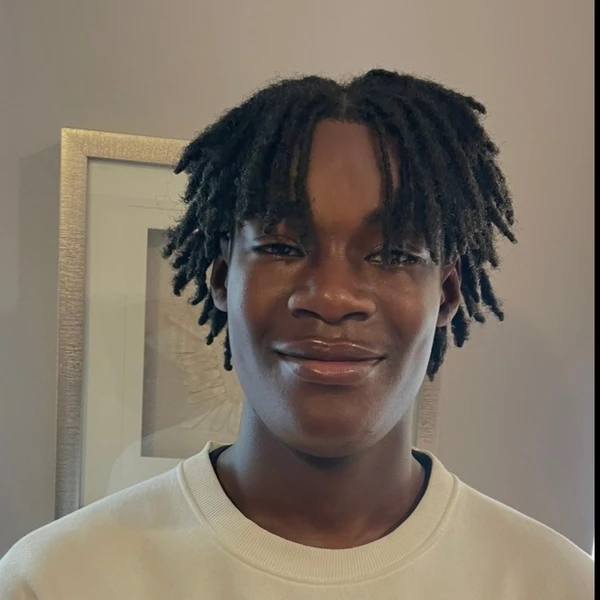
Eric Ameyaw
1x
Finalist
Eric Ameyaw
1x
FinalistBio
I am a 17-year-old born in Chicago and attending Lane Tech. In my free time, I enjoy playing pick-up basketball, playing video games with my friends, and watching movies, animated shows, and anime. I am also a minister of the word/lector at my local parish St.Grude. In the future, I hope to pursue a career as a software engineer specifically as a machine learning, python, or front-end developer.
Education
Lane Technical High School
High SchoolMiscellaneous
Desired degree level:
Bachelor's degree program
Majors of interest:
- Computer Science
- Data Science
- Information Science/Studies
Career
Dream career field:
Computer Software
Dream career goals:
machine learning developer,python developer, or front end developer
Sports
Basketball
Intramural2018 – 20213 years
Public services
Volunteering
St.Gertrude parish — Lector2023 – Present
Dr. Michal Lomask Memorial Scholarship
I launched my own web app before I ever felt like I truly knew how to code.
That sentence still surprises me when I say it out loud. I'm a first-generation college student from Chicago, the son of Ghanaian immigrants, raised in a household where college itself was the dream, let alone building a tech product. But somewhere between my junior and senior year of high school, I discovered that technology didn't require mastery to start. It required curiosity, stubbornness, and a willingness to fail in public.
So I got to work.
I had taken a CS class, but the real education came from building something real. I taught myself the rest: Next.js, TypeScript, Tailwind, and Supabase, not from a textbook but from debugging errors at midnight and Googling things I didn't have words for yet. I integrated Stripe for payments, connected to generative AI APIs, and eventually launched a live product, Glow Up AI, an AI-powered photo editing web app that real users can access today.
I didn't build it because someone told me to. I built it because I saw a problem, believed I could solve it, and refused to wait until I had "permission" to try.
That's what STEM means to me: it's not a major or a checklist. It's a way of thinking, a commitment to asking why, testing whether, and figuring out how. It's the mindset that said there has to be a better way and then actually built one.
But my passion for STEM runs deeper than code. It's personal in a way that's hard to separate from who I am. As a Ghanaian American, I grew up watching my parents navigate systems they didn't fully understand, healthcare forms, bureaucratic processes, financial institutions, often without the tools or language to advocate for themselves. I saw the gap between those who understood how systems work and those who didn't. That gap is largely technological. And it falls hardest on people who look like me.
STEM education is how I close that gap, not just for myself, but eventually for my community. I want to build products and systems that actually serve the people who've historically been left out of the room where technology gets designed. To do that well, I need the formal foundation: the algorithms, the data structures, the systems thinking that turns ambitious ideas into scalable, meaningful tools.
I'm heading to the University of Illinois Urbana-Champaign in the fall, pursuing a path toward Information Sciences. I'm not going to college to discover whether I like technology. I already know I do. I'm going to deepen and formalize what I've already started building.
Dr. Lomask's legacy, a life devoted to science, education, and opening doors for those who need it most, is exactly the kind of story that resonates with mine. I didn't have every resource. I didn't have a blueprint. But I had drive, and I used it. This scholarship would mean I can keep going without financial pressure forcing me to slow down.
I'm not waiting to make an impact. I already started. I just need the support to see it through.
Big Picture Scholarship
I was probably fourteen when I first watched Ex Machina, and honestly I just thought it was going to be another cool sci-fi movie. What I didn't expect was that it would completely shift the way I think about technology and what it means to build something intelligent.
The movie follows a programmer who gets invited to test an AI named Ava. On the surface it seems like a simple question: is she conscious? But the deeper the story goes, the more it becomes about something else entirely. Who has power? Who gets to decide what intelligence is worth? And what happens when the thing you built is smarter than you planned for?
At the time I was just starting to teach myself how to code. I had no formal training, no computer science class, just YouTube tutorials and a lot of trial and error. I was building small projects, figuring out how loops worked, why my code kept breaking. Watching Ex Machina while I was doing that felt almost like a warning I wasn't ready to understand yet.
A few years later, I built Glow Up AI, an AI-powered photo editing tool that has real paying users. I built almost the whole thing using AI tools myself. And somewhere in the middle of building it, I kept thinking back to that movie. Not because my app is anywhere near Ava, obviously. But because the questions the movie raised started to feel real in a way they didn't before.
When you actually build something that uses AI, you stop thinking of it as magic. You start thinking about what it's doing, who it affects, whether the decisions it makes are fair. My app edits photos. That sounds simple. But AI photo tools can reflect biases. They can alter the way people see themselves. They can be used in ways the creator never intended.
Ex Machina asked me to think about the creator's responsibility. Not just "can I build this" but "what happens after I build it." That shift matters. I think a lot of people who build things in tech never really ask those questions seriously until something goes wrong.
I'm heading to UIUC in the fall to study computer science. I want to keep building, keep shipping products, keep figuring out how AI can actually help people. But Ex Machina planted something in me that I don't want to lose. That voice in the back of my head that asks: who does this serve? What am I not seeing? What could go wrong?
The big picture, for me, is that building something real means caring about what you build, not just whether it works. That movie gave me that framework before I even knew I needed it.
Sunshine Legall Scholarship
My academic goal is straightforward: I want to study Computer Science at the University of Illinois Urbana-Champaign, where I am committed to attend this fall, and build a career that sits at the intersection of AI, software engineering, and entrepreneurship. I do not just want to work in tech. I want to create things in tech that actually serve people, especially people who look like me and come from where I come from.
I am a first-generation Ghanaian American from Chicago, and I am already doing that. In the past year I built Glow Up AI, an AI-powered photo editing platform that I coded almost entirely by myself, with real paying users. I am self-taught. No bootcamp, no coding school. Just a laptop, online resources, and a relentless need to figure things out. I document the whole journey on TikTok so that other young Black and brown kids can see someone who looks like them building something real.
Giving back to my community is not something I think about as a separate category from my life. It is just woven into who I am. I serve as a Minister of the Word and lector at my church. Every week I show up, I lead, and I serve my congregation. That work has made me more grounded, more accountable, and more aware that the people around me are counting on me. It also introduced me early to the idea that your skills and your time belong to more than just yourself.
The connection between those two things, building technology and serving community, is what inspires me to keep going. I grew up watching my parents work incredibly hard in a system that was not designed to help them get ahead. I watched them sacrifice so that I could have options they never had. That is not something I can just shrug off and walk away from once I get my degree.
My long-term goal is to build AI tools that are actually accessible to everyday people, not just enterprise clients with big budgets. I want to make the kind of technology that a small business owner in my neighborhood can use, that a student with no connections can benefit from. I want to be a bridge between cutting-edge tech and the communities that get left out of it.
This scholarship would make a real difference as I head into my first year at UIUC. It would ease the financial pressure on my family and let me keep building without having to stop. And it would mean a lot to be supported by someone who understands that access to opportunity is not equal, and that BIPOC students have something powerful to offer when given the chance.
Valerie Rabb Academic Scholarship
My name is Eric, and I am a first-generation Ghanaian American high school senior at Lane Tech College Prep in Chicago, committed to UIUC in the fall to study Computer Science. I have spent the last several years building a foundation I was not handed, and I plan to spend the rest of my life creating technology that genuinely helps people.
The adversity I have had to face is something that does not always get talked about, because it is invisible. Being the first person in your family to go to college means there is no one who has been there before. No one who can tell you how financial aid works, how to talk to a professor, how to evaluate a school. My parents came from Ghana and worked hard every day to build a stable life in Chicago. They gave me everything they could. But when it came to navigating the college process, I was largely on my own. That pressure was real, and there were times it was genuinely crushing.
What pulled me through was deciding to stop waiting for someone to teach me and just start figuring things out myself. I took that same mindset into coding. I am entirely self-taught. No bootcamp, no formal computer science class before senior year, just online resources and a lot of trial and error. That led me to build Glow Up AI, an AI-powered photo editing platform I created from scratch. It has real paying users and taught me more about product development, marketing, and problem solving than anything I have ever done in a classroom. I document the journey on TikTok to show other young people, especially first-gen kids, that it is possible to build something real from nothing.
Beyond tech, I serve my community through my church as a Minister of the Word and lector. Every week I show up and lead, which has taught me discipline, humility, and responsibility. It also reminded me that impact is not always about scale. Sometimes it is about being present and reliable for the people right in front of you.
My career goal is to build software that solves real problems for people who are often overlooked by the tech industry. I want to keep building AI tools that are actually useful and accessible, not just impressive. And I want to be one of the people who proves that kids from Chicago, from immigrant families, from first-gen households, have just as much to offer this industry as anyone else.
This scholarship would directly support my first year at UIUC, easing financial pressure on my family so I can focus fully on school and continue building. I am grateful for every opportunity that helps close the gap between where I started and where I am going.
Simon Strong Scholarship
The biggest adversity I have ever faced was not a single dramatic moment. It was quieter than that. It was the slow, steady weight of being the first person in my family to go to college, growing up in Chicago with immigrant parents who worked harder than anyone I know but could not always help me navigate a system they had never been part of themselves.
My parents came from Ghana. They built a life here from scratch. There was no roadmap for things like SAT prep, AP classes, financial aid, or how to even talk to a college counselor. I had to figure most of it out myself. And honestly, there were times that felt impossible. Junior year I remember sitting in front of my laptop at midnight trying to understand how to compare financial aid packages while my parents were asleep, because asking them would have only stressed them out more. That kind of loneliness hits different when you realize you are not just doing this for yourself.
What got me through it was building things. When I did not have answers, I went and found them. I taught myself how to code from online resources, zero formal instruction, just a laptop and stubbornness. That led me to create Glow Up AI, an AI photo editing platform I built from scratch that now has real paying users. Every time I got stuck, which was often, I had to problem solve alone. That process taught me more than any class I have taken. It taught me that I do not need everything handed to me. I just need the chance to try.
My church community also played a huge role. I serve as a Minister of the Word and lector, which means I show up every week and lead. That responsibility kept me grounded when school felt overwhelming. It reminded me that I had people depending on me, and that showing up even when things are hard is part of who I am.
The adversity of being first-gen shaped me in ways I am still discovering. It made me resourceful, self-reliant, and honest about what I do not know. I do not pretend to have it all figured out. But I have learned that not having a blueprint is not the same as not having a path. You just have to build the path yourself.
To anyone facing the same thing, I would say this: the system was not built with you in mind, but that does not mean you do not belong in it. Find one thing you are good at and go all the way with it. Connect with people who are ahead of you on the same road. And do not be ashamed of where you started. Where you start does not determine where you finish. I am living proof of that, and I am just getting started.
Kalia D. Davis Memorial Scholarship
My name is Eric, and I am a first-generation Ghanaian American high school senior at Lane Tech College Prep in Chicago. When I first read about Kalia D. Davis, a straight-A student, athlete, UIUC scholar, and community leader, I honestly felt like I was reading about a version of the person I am trying to become. I am also committed to UIUC in the fall, and like Kalia, I have had to learn that excellence is not something that just happens to you. It is something you choose every single day.
Growing up in Chicago as the son of Ghanaian immigrants, I knew from early on that no one was going to hand me anything. That reality pushed me to become self-reliant in ways most people my age are not. I taught myself how to code entirely outside of school, and over the past year I channeled that discipline into building Glow Up AI, an AI-powered photo editing platform with real paying users. There were plenty of nights I wanted to give up. The code would break, the answers were not in any textbook, and I was doing it all on my own. But I kept pushing because I believed in what I was building, and honestly, I believed in who I was becoming through the struggle. I now share that journey on TikTok to show other first-generation kids that they can do it too.
Service has always been a big part of who I am. I serve as a Minister of the Word and lector at my church, which means I show up every week to read scripture and help lead my congregation. That role has taught me humility, consistency, and what it actually means to be responsible to a community. Kalia served on the executive board of the Black Student Union and was preparing to enter the military. Our paths look different, but I recognize the same spirit: showing up for something larger than yourself.
My parents gave up so much to give me this shot. As the first in my family going to a four-year university, everything I have worked for carries more weight than just my own dreams. Every grade, every project, every late night meant something for my family and for every Black kid in Chicago who might one day see my story and think they can do it too.
This scholarship would take real pressure off my family as I head into my first year at UIUC and let me focus completely on my studies and my work in tech. But beyond the financial help, it means something deeper to me. Kalia stood for ambition, kindness, and relentless hard work. Those are the same values I try to live by every day. I do not just want to receive this scholarship. I want to earn it by continuing to build, serve, and give back in ways that would make her proud.
Her story is a reminder that you can be the hardest working person in the room and still be the one making everyone around you feel like they belong. That is exactly who I am working to be.
Ava Wood Stupendous Love Scholarship
Prompt 1: "Kindness in Action"
Growing up in a Ghanaian American household in Chicago, I watched my parents pour themselves into community without asking for recognition in return. That quiet generosity shaped how I move through the world.
During my junior year, a close friend was overwhelmed navigating the college application process. Her parents, like mine, had not gone through the American college system, and she had no one to walk her through deadlines, essays, or financial aid forms. I had been figuring it all out largely on my own too, but I had spent months piecing together information through research and outreach. So I became her resource.
We spent several evenings going through her list of schools, talking through what makes a strong personal statement, and breaking down the FAFSA step by step. I shared everything I had learned, not as a tutor but as a peer who understood exactly how disorienting the process felt without a guide. When she got into her first choice school, she called me before she called anyone else.
That moment reminded me that knowledge has more value when it is shared. Being first-generation does not just mean being the first in your family to go to college. It means carving a path that others can follow.
Prompt 2: "Boldly, Unapologetically Me"
At Lane Tech College Prep, there was an unspoken assumption about what serious students looked like. They joined traditional clubs, pursued established career paths, and stuck to what was predictable. Building a software product as a teenager, documenting it on social media, and calling yourself a founder was not part of that script.
When I started teaching myself to code and working on real projects outside of school, some people around me did not take it seriously. It did not fit the mold of what academic achievement was supposed to look like. I was not winning science competitions or landing research internships. I was building things because I genuinely loved it.
I kept going anyway. I recently launched Glow Up AI, an AI-powered photo-editing web application built almost entirely by me. I figured out everything from the user interface to the payment system. I also document my journey online, sharing what I learn with other young people trying to build outside of traditional pathways.
Choosing to be a builder when that was not what people expected of me was one of the best decisions I have made. It taught me that the most meaningful validation comes from doing work you believe in, not from fitting into someone else's definition of success.
Aserina Hill Memorial Scholarship
I am a senior at Lane Tech College Prep in Chicago, Illinois, preparing to be the first person in my family to attend a four-year university. This fall, I will be enrolling at the University of Illinois Urbana-Champaign, planning to study computer science.
Outside of academics, I have spent years serving as a Minister of the Word at my church, reading scripture during Mass for a congregation of hundreds. That role has shaped who I am in ways a classroom never could. It taught me that showing up for others is not a one-time act but a practice you build over time. It also gave me a comfort with public speaking and a sense of responsibility toward my community that I carry into everything I do.
My other passion is technology. I have spent the past several years teaching myself software development outside of school, driven by curiosity and a desire to build things that actually help people. I recently launched a web application of my own, which gave me real experience in design, development, and problem-solving under pressure. I document my journey as a self-taught young builder online, hoping to show other students from backgrounds like mine that this path is possible.
After UIUC, I plan to work in software engineering with a focus on AI and product development. My long-term goal is to use technology to make tools and opportunities more accessible to people who do not typically have access to them.
If I could start a charity, it would be called Code for the Community. Its mission would be to bring free, hands-on technology education to students in under-resourced neighborhoods across Chicago. I grew up knowing that the opportunities available to students often depend on their zip code. A student in one neighborhood might have access to coding bootcamps, mentors, and top-tier equipment, while a student a few miles away has none of that. That gap is something I have felt personally, and it is something I want to close.
The charity would serve middle and high school students in low-income communities who have shown an interest in technology but lack access to structured learning. Volunteers would lead weekly workshops covering web development, app building, and design. More experienced mentors would work one-on-one with students on personal projects, helping them build portfolios for college applications and job opportunities. The charity would also connect students with internships and scholarships to keep them moving forward after the program ended.
Aserina Hill's legacy of quietly giving so that others could reach their goals resonates deeply with me. She understood that access changes lives. Code for the Community would be my way of honoring that same belief. I am grateful for this opportunity, and I intend to pay it forward in everything I do.
John Woolley Memorial Scholarship
Growing up in Chicago as a first-generation college student, I learned early that if I wanted something, I would have to build it myself. That mindset has shaped everything about who I am.
I am currently a senior at Lane Tech College Prep, where I have maintained a 4.9 weighted GPA while teaching myself software development entirely outside of school. I am drawn to computer science not just as a field of study but as a creative tool. I think about how things are built, how they feel to use, and how they can be better. That curiosity has driven me to work on personal projects, including recently launching an AI-powered web app, and it is what I plan to bring with me to the University of Illinois Urbana-Champaign this fall.
What makes me unique is the combination of technical drive and a people-first mindset. I do not just want to write code. I want to build things that actually help people. Before I touch a keyboard, I think about the person on the other end of the screen. That instinct toward empathy and design is something I carry into everything I do.
Outside of technology, I serve my community as a Minister of the Word at my church, reading scripture during Mass for a congregation of hundreds. Public speaking, responsibility, and showing up consistently are not just resume items for me. They are habits I have built over years of service. That same discipline carries into my academic work and my ambitions.
This fall, I will be the first in my family to attend a four-year university. Getting here was not straightforward. Without parents who had been through the college process, I navigated applications, financial aid, and academic planning largely on my own. Every step required me to figure things out from scratch, and those experiences have made me more resourceful and more motivated than I might otherwise have been.
I am drawn to computer science because I believe software is one of the most powerful tools for changing lives. My goal is to build products that make professional and creative tools accessible to people who otherwise could not afford them. UIUC is where I plan to develop the technical foundation to make that vision real.
The scholarship funds would directly support my ability to attend UIUC without the weight of financial stress. Tuition, housing, and supplies add up quickly, and every dollar of support means more time I can dedicate to my studies and my growth rather than working just to stay enrolled.
I am not a typical applicant. I came into this process without a roadmap, and I built one anyway. I plan to keep doing exactly that.
Scorenavigator Financial Literacy Scholarship
The first time I got paid, I did not think about saving or investing. I thought about how quickly it could disappear. Watching money come in and then go right back out made me realize how easy it is to fall into a cycle where you are working but not actually building anything for yourself.
Growing up in a first-generation, lower-income household, financial conversations were not always direct, but their impact was clear. Every purchase had to be considered. There was an understanding that money mistakes could not easily be fixed. Because of that, I became aware early on that financial stability is not just about how much you earn, but how you manage what you have.
As I started working part-time, I began to take more control over my own finances. At first, I treated money casually, spending without much thought. Over time, I realized that mindset would not get me where I wanted to be. I started paying attention to where my money was going, learning how to budget, and thinking more intentionally about saving. Even small changes, like setting aside part of each paycheck, began to shift how I viewed money. It was no longer just something to spend, but something to build with.
At the same time, I recognized how little formal financial education I had received. Concepts like credit, investing, and long-term planning were not things I was taught in detail. I had to seek out that knowledge on my own, whether through online resources or by asking questions. That process showed me how important financial literacy is, especially for students who may not have access to guidance at home.
As a first-generation college student, financial decisions carry even more weight. College is one of the biggest investments I will make, and understanding how to manage that cost is critical. I have had to think carefully about tuition, scholarships, and minimizing debt. These decisions are not just about the next four years, but about setting myself up for long-term stability.
In the future, I plan to use financial education as a tool for independence and growth. I want to build strong habits early, including saving consistently, using credit responsibly, and making informed decisions about investments. My goal is not just to earn money, but to create stability for myself and eventually support my family.
Beyond my own future, I also want to share what I learn with others. Many young people fall into financial mistakes simply because they were never taught differently. I want to be someone who helps change that, whether through conversations with peers or by creating content that makes financial concepts easier to understand.
My experiences with money have shown me that financial literacy is not optional. It is essential. Learning how to manage money gives you control over your future, and that is something I am committed to building, one decision at a time.
Julius Quentin Jackson Scholarship
I learned early on that failure did not feel like an option. As a first-generation Ghanaian American, success was never just about me. It carried the weight of my parents’ sacrifices, the risks they took to build a life in a new country, and the expectations that came with those decisions. That pressure shaped how I approached everything, from school to my future.
Growing up, I often felt caught between two worlds. At home, I was raised with values rooted in discipline, respect, and perseverance. Outside, I was trying to find where I fit in among peers who did not always share or understand that background. There were moments where I felt out of place, unsure of which version of myself I was supposed to be. Over time, I learned that I did not have to choose. Instead, I began to see my background as something that gave me perspective and resilience.
One of the biggest challenges I have faced is navigating the path to college without a guide. My parents have always supported me, but they did not have the opportunity to attend college themselves. Because of that, much of the process has been unfamiliar. From researching schools to understanding financial aid, I have had to figure things out largely on my own. There is a constant pressure to make the right decisions, knowing that mistakes could have long-term consequences.
Financially, my family has had to be careful with every decision. College is not just a goal for me, it is a significant investment that comes with real uncertainty. The cost of tuition, housing, and other expenses creates stress, especially knowing that my parents have already sacrificed so much to provide opportunities for me. I do not take that lightly. It motivates me to work harder, but it also makes the financial burden feel very real.
These challenges have shaped me into someone who is driven, independent, and focused. I have learned how to seek out resources, ask questions, and stay disciplined even when the path is unclear. More importantly, I have developed a strong sense of responsibility, not just to succeed for myself, but to honor the sacrifices that made my opportunities possible.
This scholarship would help ease the financial pressure of pursuing higher education and allow me to focus on my goals without the constant weight of cost. I plan to study computer science and build a career that allows me to create meaningful solutions while also providing stability for my family.
My journey has not been defined by ease, but by persistence. The challenges I have faced have pushed me to grow, and they continue to drive me forward. I am committed to making the most of every opportunity, not only for myself, but for the people who made those opportunities possible.
Rev. Ethel K. Grinkley Memorial Scholarship
I still remember the first time I stepped up to the lectern. My hands were steady, but my voice carried more than just words. As a lector, I was not simply reading scripture. I was serving as a messenger, responsible for delivering something meaningful to a community that trusted me to speak with clarity and purpose. That moment changed how I understood faith. It was no longer something private. It became something I had to live out, consistently and publicly.
One idea has stayed with me as I have grown in my faith: love is something you practice, not just something you feel. Serving as a lector for the past three years has made that clear to me. Preparing readings each week taught me discipline, but more importantly, awareness. I began to notice how people listened, how certain messages resonated, and how words could bring comfort or reflection depending on how they were delivered. I realized that even something as simple as reading could impact someone’s day.
Outside of church, I try to carry that same mindset into my daily life. At my part-time job as a math and reading tutor, I work with students who often feel frustrated or unsure of themselves. I have learned that helping them is not just about explaining the material. It is about patience, encouragement, and making them feel capable. Seeing a student go from saying “I can’t do this” to solving a problem on their own is one of the most rewarding experiences I have had. In those moments, I see how small acts of support can build confidence and change how someone sees themselves.
As a first-generation college student, I understand that my journey carries responsibility. I plan to pursue computer science, focusing on user interface and user experience design. I am drawn to this field because it requires both technical skill and empathy. Good design is not just about appearance. It is about understanding people and creating tools that are accessible and meaningful.
In the future, I want to build platforms that help people learn, connect, and access opportunities they might not otherwise have. Whether that means creating educational tools or designing systems that are easier to use, I want my work to reflect the same values I practice through faith and service.
Rev. Ethel K. Grinkley’s vision of a community rooted in love and fellowship resonates with me because I have experienced the impact of those values firsthand. I have learned that love is shown through consistency, through patience, and through the willingness to serve others even in small ways.
My faith has taught me that making a difference does not require recognition. It requires commitment. As I move forward, I will continue to live out my faith not just in words, but in action, using my skills and experiences to serve others and contribute to a more compassionate and connected world.
Vernardo Book Scholarship
The first time I seriously thought about college, it was not because I believed it was the only path to a successful career. Over time, I started to see it differently. For me, college is less about simply earning a degree and more about being in an environment where I can grow, meet new people, and figure out what I truly want to pursue.
I have always been interested in building things, especially through technology. I started with creating simple websites. Through that process, I realized I enjoy both the technical side of programming and the creative side of designing something people can actually use. Still, I know that what I have explored so far is only a small part of what is out there. That is one of the main reasons I want to attend college. I want to be exposed to new ideas, different fields within computer science, and people who think differently than I do.
Another major reason college matters to me is the opportunity to connect with others. I understand that today, information is accessible almost anywhere, and many skills can be learned online. What is harder to replicate is being surrounded by driven individuals who are all working toward their own goals. I want to build relationships with people who are motivated, creative, and willing to collaborate. Those connections can lead to new ideas, projects, and opportunities that I would not be able to find on my own.
My path to this point has not been completely straightforward. As a first-generation student, I have had to figure out much of the college process independently. There were times when I did not fully understand what steps to take or how to approach things like financial aid and scholarships. Instead of letting that stop me, I learned to take initiative by asking questions, doing my own research, and staying persistent even when things were unclear.
I have also faced personal challenges that affected my focus and discipline. There were moments where I made decisions that did not reflect my full potential, and I had to deal with the consequences. Those experiences forced me to reflect on what I actually want for my future. I began to take more responsibility for my actions and put more effort into improving both academically and personally. That growth has been gradual, but it has made me more aware of my habits and more intentional about how I spend my time.
Despite these obstacles, I have continued to push forward. I have taken challenging courses, maintained a strong GPA, and participated in activities like the Chicago Association of Student Engineers, where I applied problem solving skills in real situations. Outside of school, I have continued working on coding projects and exploring my interests, which has helped me stay focused on my long term goals.
College represents a chance for me to continue growing, not just academically but personally. I want to learn more about myself, test my interests, and find the specific path that fits me best. Just as importantly, I want to be in a position where I can build meaningful connections with others and be part of something bigger than myself.
The challenges I have faced have made me more independent and more willing to take initiative. I plan to bring that mindset with me to college and make the most of the opportunities it offers, both inside and outside the classroom.
Arthur Walasek Computer Science Memorial Scholarship
The first time I built a website from just vanilla HTML and CSS, it did not look impressive, but it worked. I remember refreshing the page and seeing something I created respond instantly to my input. That moment stuck with me because it showed me that computer science is not just about code, but about turning ideas into something real that people can interact with.
What inspires me to pursue computer science is how many different directions the field offers and how closely it is tied to the future of our society. Technology continues to shape how we communicate, learn, and solve problems, and computer science sits at the center of that change. Whether it is developing applications, improving systems, or creating entirely new digital experiences, the possibilities are constantly expanding. I am drawn to a field where I will never stop learning and where I can continuously improve my skills.
Through my experience, I have discovered that I am especially interested in areas of computer science that combine technical ability with creativity and design. Specifically, I see myself working in fields such as front-end development, user interface (UI) design, and user experience (UX) design. These areas focus not only on how a program functions, but also on how it feels to the user, which is what excites me most about building software. To me, it is similar to an artist starting with a blank canvas and transforming it into something meaningful by combining different colors and ideas. In the same way, designing software allows me to take an idea and shape it into something real and interactive. Even though I do not consider myself a traditional artist, computer science gives me a creative outlet. It allows me to bring my ideas to life and build something tangible that reflects my own vision.
What excites me most about these fields is the ability to shape how people interact with technology. A well-designed interface can make a complex system feel simple, while a poorly designed one can make even basic tasks frustrating. I want to create digital products that are intuitive, visually appealing, and accessible to a wide range of users. This combination of problem-solving and creativity is what makes design-focused computer science especially meaningful to me.
My background as a first-generation Ghanaian American student also influences my goals. I have seen how access to resources and opportunities can impact someone’s future, and I want to use my skills to help bridge that gap. In the future, I hope to work on projects that improve accessibility in technology, such as educational platforms or tools designed for underserved communities. By focusing on both design and functionality, I can help make technology more inclusive and easier for people to use.
Computer science inspires me because it is a field built on growth, innovation, and impact. I do not just want to use technology, I want to help shape it. By pursuing areas like front-end development and UI/UX design, I hope to create meaningful digital experiences that not only work well but also make a lasting difference in people’s lives.
Anita Moore-Hubbard "Butterfly Effect" Memorial Scholarship
If I were given the wings to fly anywhere in the world, I would go to the Ainu communities. While many people are drawn to Japan for its modern cities and global influence, I find myself pulled toward a quieter story, one of resilience, identity, and revival. The Ainu people, indigenous to northern Japan, have endured generations of cultural suppression, yet today they are working to reclaim their language, traditions, and voice. That determination to preserve identity in the face of erasure is what draws me most.
As someone who has grown to appreciate Japanese culture, I have also begun to question what lies beneath what is widely celebrated. At the same time, as a first-generation Ghanaian American, I understand what it means to inherit a culture that must be intentionally preserved. My family’s traditions, values, and stories are not always visible in the spaces I move through, but they remain a core part of who I am. This connection allows me to see the Ainu story not as something distant, but as something deeply familiar.
Visiting this community would not just be about learning history, but about understanding responsibility. My interest in computer science shapes how I would approach this experience. I would want to explore ways technology can support cultural preservation, whether through digital storytelling, language documentation, or creating platforms that amplify Ainu voices. Even small contributions, such as helping document oral histories or building accessible websites, could create a ripple effect. That is the “Butterfly Effect” I hope to be part of, using what I learn to help preserve a culture while also bringing its story to a wider audience.
On this journey, I would carry the sacrifices and values of my family with me. As a first-generation student, I have seen the effort it takes to create opportunities that did not previously exist. That resilience shapes how I approach challenges and how I define success. I would also carry the guidance of mentors and teachers who have encouraged me to think critically, ask deeper questions, and use my skills to make a meaningful impact.
These influences shape the way I understand the Ainu story. Across the world, communities are working to hold onto their identity in the face of change. By learning from the Ainu people, I would gain more than knowledge. I would gain perspective, an understanding that preserving culture is an active and ongoing effort.
Being given the wings to fly is not just about where you go, but about what you bring back. From the Ainu communities, I would bring back stories of resilience, a deeper respect for cultural identity, and a renewed commitment to using my skills to uplift others. In doing so, I hope to create a ripple that extends far beyond a single journey.
Andrea Worden Scholarship for Tenacity and Timeless Grace
I've never done things the traditional way. As the son of Ghanaian immigrants and a first-generation college attendee, I've lived my whole life learning through trial and error, building for myself a world that my parents didn't always have the means to teach me. I've had to be clever, not because I wanted to do well, but because I had no choice.
It's not how I arrived here that makes me unique, it's how I've chosen to handle the struggle that I've gone through. I was raised with the weight of being the "hope" for my family. I felt compelled to be successful not only for me, but for all of those who had given up so much so that I could be here. That weight once made me feel worthless. But over time, I came to harness it as energy.
There was a point in my sophomore year when everything was really bad. I was burnout-stricken, having family responsibilities, and failing in classes that were important to me. One night, after another long day at school and helping out my younger siblings with their homework, I remained awake trying to learn HTML and CSS from gratis YouTube tutorials. I was tired, but I felt something shift. For the first time in many years, I wasn't learning for a mark or someone else's approval. I was learning for myself. That moment gave me a feeling of power that I had not experienced in a long time.
I've continued to learn web development and Python since then. I even caught the interest in cybersecurity and how tech is applied to protect people. I don't have costly hardware or paid-for tutorials, but I make do with what I have. Free trials, coding forums, and determination helped me carry on. Each small project that I make me keep in mind that progress won't always be flawless. It just has to be real.
What I've learned is that my greatest strength is that I can keep showing up. I don't say it to be impressive. I've just come to understand that the most significant thing is to show up, especially when it's hard, and that's where growth occurs. It's also how I try to show up for other people.
One of the things that helped shape me was becoming a Kumon tutor. I'd never worked there before, but the moment I walked in, I found that I loved it. I got to work with so many cool kids and figure out how to connect with each of them separately. Some needed a reminder of how to stay on track, some just needed encouragement. It taught me patience and how to communicate effectively. I also had the opportunity to work with some absolutely fabulous people, excellent supporting staff who helped even the maddest of days become bearable. That role reaffirmed for me how much it's needed to make people feel seen and understood, especially when they're down. It made me want to keep on giving back in whatever way possible.
Andrea Worden believed in seeing people deeper than the surface. I try to do the same thing. I try to see the iteration of a person that hasn't quite made it yet, the person they're working on becoming. I've learned how to do the same thing for myself. I don't have all the answers, and my path hasn't been easy. But I've learned that resilience isn't boisterous. It's the soft decision to try again tomorrow, even when today sucked.
That is who I am. I'm not perfect or polished, but I am honest, I am driven, and I care deeply about growing, not for me, but for people that believe in me.
Julia Elizabeth Legacy Scholarship
Diversity representation in STEM careers is not only a matter of fairness, but also a powerful driver of innovation, progress, and justice. In the past certain groups have controlled STEM careers, generally excluding women, minorities, and members of underrepresented groups. Increasing diversity in these careers is necessary to solve complex problems, offer equal opportunity, and make the future more inclusive.
One of the most significant reasons that diverse representation is necessary in STEM is that it leads to better problem-solving. People from different backgrounds have different experiences and perspectives that can lead to more innovative and effective solutions. A good example would be a group of engineers who are diverse, and they create a product that benefits more people because they are more likely to consider different uses and needs. When the same individuals have the same thoughts, innovation is blocked. But when different voices sound, ideas are made stronger.
Additionally, representation in STEM careers breaks stereotypes. When teens are exposed to scientists, developers, or engineers who look like them or have the same backgrounds, they are more likely to think that they can do the same as well. It is especially important to minorities and girls who are less likely to be represented within majority STEM roles. Role models play a vital part in inspiring future generations of innovators and leaders. Diversity in technical and leadership roles helps to show that everyone is capable of succeeding within STEM regardless of their background.
Representation of multiple groups also creates equality of opportunity and fairness. STEM work is one of the fastest-growing and most profitable fields , and marginalized individuals are not included in it by systems of inequality. Through diversity promotion and the development of communities, more people can have access and achieve success in the profession.
Finally, to address global problems like climate change, health, and ethics with respect to technology, all sorts of people must be heard. These are problems that affect all of us, and they require inclusive thinking and collaboration. A diverse workforce in STEM ensures that decisions are made with more kinds of people in mind and that solutions are for all and not a select few.
In short, diversity of representation in STEM is essential to fuel innovation, to inspire future leaders, to promote equity, and to solve humanity's biggest challenges. Prioritizing diversity isnt a moral obligation it's the smartest thing we can do for science, technology, and society.
Sean Carroll's Mindscape Big Picture Scholarship
Why are we here? what is the purpose of our existence, how did it all begin? They are questions not just of science, but the exact questions that inspire culture, philosophy, and the arts. It is very human in the way it creates a perspective of the world we live in, ourselves, and each other, but it is not scientific in the sense of its study objects. This search for a better understanding of the world will undoubtedly lead to advancements that will improve everyone's quality of life, unite people, and powerfully reveal more of the world.
One of the most compelling reasons to study the universe is the practical knowledge we gain from it. Many major scientific discoveries come from observing the world and understanding what we see. Our knowledge of gravity and motion has led to the creation of everything from bridges to rockets. Understanding electromagnetism has enabled technologies that power our homes and allow long-distance communication. Each discovery opens doors to innovations that can make life safer, easier, and more enjoyable.
our planet is only a small part of a vast cosmos; studying this greater scheme puts into perspective how interrelated everything is. Such a view elevates our awareness of the effects of our actions on the environment but also puts in sharp relief the limited resources available on planet Earth. The sense of our presence in the universe might make us more reflective in a way that is consistent with the tenets of sustainability, in that it would also serve as a constant reminder that what we do does not impact only us, but also other time horizons and, likely, other life.
Knowing one's universe impels an individual with a sense of awe and the courage to dream big. Each additional fact about space, about a distant galaxy or a planet that might support life, or about the existence of dark matter, for example, stretches the limits of human knowledge. It is this sense of yearning to find what lies beyond the tangible world of everyday experience that vitalizes the flows of creativity and innovation in domains as diverse as literature and technology.
I believe understanding the universe requires combining science with philosophy and ethics. This balanced approach helps us think critically about our actions and ensures that our progress is responsible. For instance, scientific research on concepts like the Big Bang and black holes reveals how the universe began, while philosophy encourages us to consider what these findings mean for humanity.
As we move into fields like artificial intelligence, which could eventually aid in space exploration or even affect our interactions with other living forms, ethical issues become even more crucial. We can more effectively manage the obligations that accompany our search for of knowledge about the cosmos and our place in it if we incorporate moral issues into scientific research.
That is, the more we learn, the more we realize how much we really do not know. And in that way it keeps us humble and encourages us all the more to study, with full awareness that there will always be something left to know. And, for instance, there's still so much we don't understand about dark matter, which is believed to make up most of the universe. Our learning about this might fundamentally change our understanding of reality. Questions about whether there is life on other planets similarly drive us to reach out, to redefine what it means to be 'alive' in other environments.
For this reason, I believe that our questioning of the whole universe is representative of the deepest longing to understand the purpose of our existence and create one. In grasping the universe we do not acquire merely information but also a sense of belonging to something larger. It reminds us that, on the grand cloth, we might be nothing more than a speck but that we are all part of a wonderful tapestry of experience. All this generates the social cohesion and mutual respect of the people, the sense that in their diversity they share the same origin and the same destiny in the context of the whole cosmos.
Understanding the universe isn’t just about solving equations or mapping stars; it’s about finding answers to questions that bring us together and help us coexist with each other and our environment. By pursuing this deeper understanding, I hope this journey inspires creativity and unity for generations to come.
LeBron James Fan Scholarship
I first started following basketball and the NBA back in 3rd grade around 2016 which was when the Golden State Warriors were on a historic run finishing with the single greatest record in NBA history. Despite all this, I remember that the Cavaliers and Warriors would always end up matching up against each other in the finals. It would be the stacked Warriors roster with Steph, Klay, Draymond, and eventually the slim reaper Kevin Durant against Bron Kyrie, K-love, and the rest of the Cavs roster. In 2016 the Cavs managed to beat this Warriors team and LeBron would win the finals MVP which stood out to me because of how much better the Warriors looked on paper. The fact that LeBron would be able to set the tempo for his team and step up in big moments not only during that series but throughout his career was an inspiration for me. Even with all the criticism he received from the media and all the hate he got from fans he still pushed hard to be the best version of himself every single day. LeBron showed me that age doesn't matter nearly as much as people think and that if you put your mind to something it doesn't matter how old you are you can reach that goal. Nowadays I find myself being a lot more of a floor general and trying to be as versatile as I can when I go play pickup so that I can adapt to whatever role my team needs me to play which reminds me of how throughout his career LeBron has played every single several positions and was still able to produce major results. Now on to the big question of if LeBron is the G.O.A.T. In my opinion, I would still give Michael Jordan the slight edge in the GOAT debate simply because for his time there was no one even close to him and take into account the fact that he was able to be so successful in the finals despite not playing nearly as long as LeBron.However, I feel like LeBron is the more skilled of the two players, has the longevity, and is more versatile, and because of that sometimes I feel as though he has the edge over Jordan. To sum it all up, I am a fan of LeBron James because of the way he consistently rises to the occasion, adapting to any challenge thrown his way and showing that hard work, versatility, and determination can overcome any obstacle after all he was just some kid from Akron Ohio and now he's arguably the greatest to play the game of basketball.