Hobbies and interests
Writing
Reading
Sports and Games
I read books multiple times per week
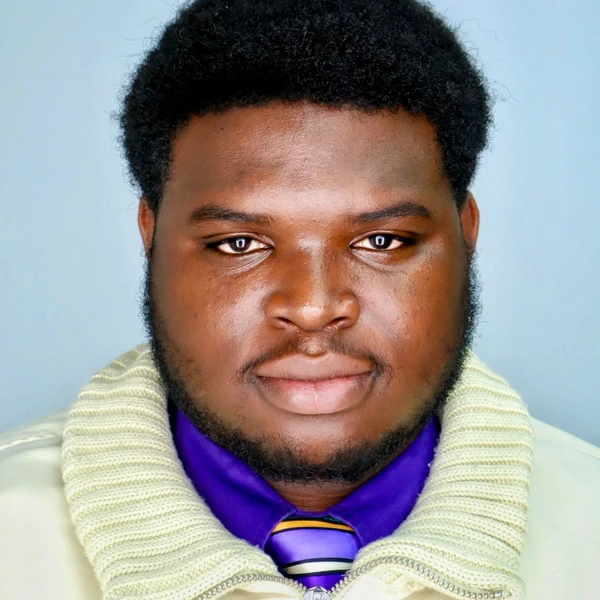
Epaphras Akinola
1x
Finalist
Epaphras Akinola
1x
FinalistBio
I’m a first-generation college student studying Computer Science and Accounting with a passion for solving real problems using data and technology. I’ve built tools that help teams work more efficiently and I love digging into messy data to find meaningful insights. My journey so far has taught me resilience, adaptability, and the value of learning by doing both inside and outside the classroom. I’m driven by the belief that access to education opens doors not just for me, but for my community as well. I’m actively pursuing opportunities that help me grow technically, professionally, and personally while giving back where I can. Winning scholarship support would help me focus on my goals and continue creating impact as I advance through college and beyond.
Education
Grambling State University
Bachelor's degree programMajors:
- Computer Science
Miscellaneous
Desired degree level:
Bachelor's degree program
Graduate schools of interest:
Transfer schools of interest:
Majors of interest:
Career
Dream career field:
Computer Software
Dream career goals:
Software Engineer
Sotware Engineering Intern
Amazon2025 – 2025
Public services
Volunteering
Freecodecamp — Technical Author2024 – Present
Future Interests
Volunteering
Philanthropy
Entrepreneurship
Lotus Scholarship
Growing up in a low-income household taught me perseverance before I ever learned the word for it. Many of my early years were shaped by instability, limited resources, and the constant need to adapt. There were moments when basic things like school supplies, textbooks, or access to technology felt out of reach, and I learned quickly that progress would require creativity, patience, and resilience. Coming from a background where every decision mattered forced me to value discipline, self-reliance, and long-term thinking.
Those experiences shaped how I approach challenges today. Instead of being discouraged by obstacles, I’ve learned to treat them as problems to solve. I pursued education not because it was easy or guaranteed, but because it represented opportunity and possibility. Despite financial constraints, I have actively worked toward my goals by taking on demanding coursework, participating in competitive programs, and securing internships that allow me to gain real-world experience while continuing my education.
I plan to use my life experiences to create positive impact by building tools and systems that expand access and reduce inequality. Whether through mentoring, community leadership, or technology that supports underserved populations, I want my work to help others move forward more easily than I did. I am already taking steps toward this by supporting peers, organizing educational initiatives, and pursuing a career where problem-solving is tied to real human needs.
This scholarship would help ease the cost of essential college expenses like textbooks and technology, allowing me to focus more fully on learning and impact. More importantly, it would affirm that students from low-income backgrounds deserve support as they work to build better futures, not only for themselves, but for others as well.
Bick First Generation Scholarship
The first classroom I ever knew was not a school building. It was the sidewalk outside a tailor’s shop in Shomolu, Nigeria, where a young man named Uncle Tolu used scraps of cardboard and chalk to teach neighborhood children basic arithmetic. My parents never had the chance to attend school themselves, so education was something we respected deeply, but did not fully understand how to navigate. From the beginning, being a first-generation student meant learning without a map.
To me, being first-generation is carrying responsibility before you are ready for it. It means figuring out applications, systems, and expectations that no one at home has experienced, while also feeling the weight of proving that the sacrifice is worth it. I started school later than most, grew up with limited resources, and learned early how fragile stability can be. During my teenage years, I lost my sister, and shortly after, my parents separated. Those moments were devastating. However, they forced me to mature quickly and taught me how to keep moving forward even when life felt unfair.
Despite these challenges, I found refuge in the logic of mathematics. While my personal life felt chaotic, math and quantitative sciences offered a structure and certainty that I craved. I became fascinated by how complex problems could be solved through systematic thinking. That curiosity led me to computer science, a field where I could apply that logic to build real-world solutions. This drive helped me earn a freshman-year internship as a Software Development Engineer at Amazon. Walking into that space as a first-generation student was intimidating, but it affirmed that my aptitude for quantitative problem-solving belongs in high-level spaces, even if I started far behind.
My dream is to use software engineering to build systems for people who are often overlooked. I want to create data-driven technology that helps families prepare for predictable challenges and improves access to critical information in underserved communities like Shomolu. What drives me is the belief that education in the quantitative sciences should not just change individual lives, but entire communities.
This scholarship would mean more than financial support. It would give me the breathing room to focus on mastering complex algorithms and systems without the constant worry of how to afford the journey. It would represent a belief in a first-generation student who is still learning the rules but is determined to rewrite the outcomes. I am not pursuing education for comfort or prestige. I am pursuing it because I know what is possible when someone is finally given a chance, and I intend to make the most of it.
Lyndsey Scott Coding+ Scholarship
I learned early that broken systems don’t announce themselves as failures, they show up as everyday life.
As a child in Nigeria, rain meant darkness when the power went out, fear when floodwater crept into our home, and silence from systems that were supposed to protect us. At the time, I didn’t know words like infrastructure, modeling, or algorithms. I just knew that these problems were predictable, and no one seemed prepared. Years later, when I wrote my first lines of code, I realized computer science gave me something I never had growing up: the ability to turn uncertainty into structure and chaos into solutions.
My computer science goal is to become a software engineer who builds intelligent, scalable systems. I am currently studying computer science and have already worked as a Software Development Engineer intern at Amazon. There, I built internal tools using data automation to improve team efficiency. I thrive close to the system level, understanding how data flows and how small design choices impact thousands of users. Long term, I intend to master data-driven infrastructure, specifically within environments where correctness and efficiency are critical.
My non-computer science goal is to become a leader in urban resilience and community advocacy. I am deeply invested in how communities, especially underserved ones, anticipate and survive climate instability. This is not theoretical for me; it is rooted in my lived experience of flooding in Nigeria. Beyond just observing, I have taken active roles in community building, serving as a mentor to organize workshops that make technical knowledge accessible to underrepresented students. I view community organizing and disaster preparedness as essential work that requires as much dedication as coding.
In the future, I will combine these goals by acting as a bridge between high-level engineering and on-the-ground disaster relief. I do not want to simply build software; I want to engineer socially conscious systems. This looks like building predictive models that map flooding patterns in vulnerable African regions or developing offline-first communication platforms for areas with unstable infrastructure. My background in systems engineering allows me to build the "how," while my dedication to urban resilience guides the "what."
As a BIPOC and first-generation college student, I bring a perspective shaped by urgency. I know what it means to solve problems with limited resources and to persist when the path is unclear. This scholarship would not just support my education; it would validate a vision of a computer scientist who is not just a coder, but a community builder. I am pursuing this field because I believe technology should protect and empower, and I intend to build exactly that.