user profile avatar

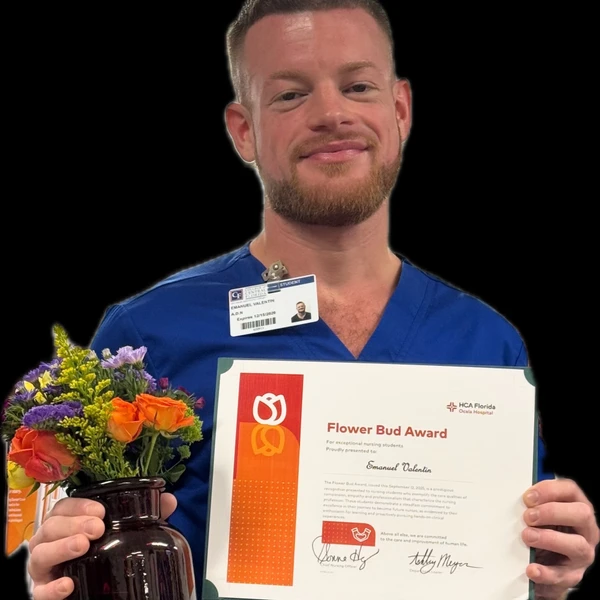
Emanuel Valentin

1x

Finalist

1x

Winner

General information

Hobbies & Interests

  • Athletic Training

Bio

I am a first responder, a single father, and a future Emergency Department RN. My time on the frontlines of emergency medicine as an EMT has cemented my passion for healthcare and patient advocacy. I am dedicated to expanding my clinical scope of practice to provide continuous, empathetic care in the trauma bay, and ultimately aim to serve my community as a Family Nurse Practitioner.

Education

College of Central Florida

Associate's degree program

2023 – 2026

Majors:
  • Medicine

Miscellaneous

Desired degree level:
Master's degree program
Graduate schools of interest:
The University of West Florida
Majors of interest:
Gerontology, Health Professions and Related Clinical Sciences, Other, Human Biology, Registered Nursing, Nursing Administration, Nursing Research and Clinical Nursing
Desired degree modality:
Online, Full-Time
Medical school interest:
No
English as first language:
Yes
Homeschooled:
No

Career

  • EMT-Basic

    Emergency Medical Services (EMS) · HCA

    Jan 2021 – Jan 2024

Miscellaneous

Dream career field:
Medical Practice, Nursing
Dream career goals:
Family Nurse practitioner
Work experience:
10+ years
Has nursing license:
No
Leadership experience:
No

Future Interests

  • Volunteering
  • Entrepreneurship
Learner Online Learning Innovator Scholarship for Veterans
As a single father in nursing school, I don’t have the luxury of learning only in a classroom. My education happens in the margins: after my eight-year-old daughter, Lydia, goes to bed, during lunch breaks, and in the few quiet minutes between school pickup and dinner. Online tools are what make that possible. My most important resource is NCLEX-style practice question banks. Nursing exams don’t just test whether you’ve memorized facts. They test whether you can make safe clinical decisions under pressure. Practice questions train me to think the way a nurse has to think: prioritizing, recognizing the most urgent problem, and choosing the safest action. When I studied for my exams on intracranial pressure, seizures, stroke, and spinal cord injury, I worked through practice questions until I could explain not just the right answer, but why every other answer was wrong. I also use AI study tools to fill the gaps a textbook can’t. When a concept doesn’t click, I can ask for it explained in a different way, quiz myself on demand, or work through practice problems at 11 p.m. when no instructor or tutor is available. After I missed a couple of IV pump dosage calculation questions on an exam, I used these tools to generate extra practice problems and build them into every study session until those calculations became automatic. In nursing, a math error isn’t just a lost point. It can harm a patient. Online practice gave me the repetition I needed to make sure that never happens. These tools matter most when I apply what I’ve learned in the real world. I spent three years as an EMT before nursing school, and I’m now preparing to start my career on a cardiac or progressive care unit at AdventHealth Ocala, with the goal of becoming an emergency department nurse. When I perform a neurological assessment in clinicals, I’m drawing on hours of online practice recognizing the early signs of rising intracranial pressure. When I calculate a medication drip, I’m relying on the repetition I built at my kitchen table. Online learning turned my study time into clinical confidence. Military service runs in my family. My brother has served in the Air Force for 13 years, and my uncle served in the Marine Corps. Watching my brother keep learning and advancing throughout his career has shown me how flexible, self-driven education helps people grow no matter where life takes them. I’ve taken that same approach. I can’t always control my schedule, but I can control how I use every available minute. Online tools have made my education accessible, flexible, and practical. They’ve helped me turn weaknesses into strengths and learn in a way that fits my life as a single parent. Most importantly, they’re preparing me to be a safe, confident nurse for the patients who will one day depend on me.
Lotus Scholarship
I’ve seen single parenthood from both sides. I was raised by a single mother, and now I’m a single father. After my parents divorced when I was eleven, my mom carried our household alone. There was no backup plan. If something went wrong, we figured it out ourselves. Today I’m raising my eight-year-old daughter, Lydia, on my own, and I finally understand her sacrifice. That upbringing taught me responsibility, resilience, and empathy. I learned to finish what I start. I grew up Puerto Rican, learning Spanish and English at the same time and adapting between two cultures. Later, I overcame my own battle with alcohol, and I’ve now been sober for four years. And I learned not to judge people by their circumstances, because I know how much families carry that no one sees. I’m actively working toward becoming an emergency department nurse. I spent three years as an EMT, I’m completing nursing school, and I’ve interviewed with cardiac and progressive care units at AdventHealth Ocala. I study after Lydia’s bedtime and between clinicals, because single parents make it work. The ED is where many under-resourced families get their care, and many are Hispanic patients who speak little English. As a fluent Spanish speaker, I can explain a diagnosis to a frightened abuela in her own language and make sure no patient leaves confused about their care. Textbooks, equipment, and board prep add up fast on one income. This scholarship would ease those costs so I can finish strong. My mom showed me that one person can hold a family together. Lydia is watching me prove that one person can build a better future too.
Eddie Hankins Medical Service Scholarship
There’s a moment every EMT knows: the doors open, you step into someone’s home or onto the side of a road, and for the next few minutes you’re the calmest person in the room. For three years, I lived for those moments. What most of my patients never knew was how much I had overcome to become the person who could stay calm for them. Personal challenges My parents divorced when I was eleven, and I grew up watching one parent carry everything alone. Alcohol ran through my family. During the worst of my mother’s drinking, she hurt me and was arrested. As a kid, I learned to stay quiet, keep my head down, and take care of myself. Years later, I found myself fighting the same battle my mother had. Alcohol became my way of handling pressure I didn’t know how to talk about. Four years ago, I chose sobriety. It was the hardest thing I’ve ever done, and it gave me my life back. My mother recovered too, and today we have a loving relationship. Our family’s story taught me that a person’s worst moment doesn’t define them. I’ve also faced loss. My Abuela Nilda raised me every summer in Puerto Rico. I watched cancer spread through her body and eventually to her brain. Saying goodbye to her at her viewing was one of the hardest moments of my life. Today I’m a single father to my eight-year-old daughter, Lydia, and a nursing student. Every one of these challenges taught me the same lesson: resilience isn’t about never falling. It’s about getting up every day and choosing the next right thing, even when nobody is watching. Service and community My greatest service so far has been my three years as an EMT. That work put me in my community’s homes, streets, and worst days. I cared for people having heart attacks, strokes, seizures, and diabetic emergencies. I held hands with frightened patients and talked families through moments they’ll never forget. I learned to treat everyone the same, whether they lived in a nice house or had nowhere to live at all, whether they were sober or struggling with addiction the way I once had. EMS shaped my character more than anything else in my life. It taught me humility, because you can’t fix everything. It taught me discipline, because your patient depends on you getting it right. And it taught me compassion, because nobody calls 911 on a good day. Being trusted with people at their most vulnerable is an honor I don’t take lightly. Future aspirations My goal is to become an emergency department nurse. As an EMT, every call ended at the hospital doors, where I handed my patient off and drove away. I want to be on the other side of those doors, continuing care through diagnosis, treatment, and recovery. I’ve already interviewed with cardiac and progressive care units at AdventHealth Ocala to build a strong foundation before moving into the ED. I want my impact to be simple but lasting. I want to be the nurse who gives every patient dignity, no matter how they arrived. Some of them will be struggling with addiction. Some will be families facing the worst news of their lives. Some will be EMTs and paramedics bringing in their patients, and I’ll never forget what their job is like. I want to be the nurse who makes the handoff smoother, respects their work, and carries the care forward. Eddie Hankins was a paramedic who showed compassion and resilience in everything he did. I recognize those values because EMS gave them to me. I plan to carry them into every shift: staying calm under pressure, treating people without judgment, and never forgetting that every patient is someone’s whole world. I started my journey in the back of an ambulance. I’ll continue it at the bedside, and I’ll keep honoring the first responders who taught me what service really means.
Skin, Bones, Hearts & Private Parts Scholarship for Nurse Practitioners, Physician Assistants, and Registered Nurse Students
I didn’t take the traditional path to nursing school. I came to it as an adult, a single father, a former EMT, and a man in recovery. By the time I sat down in my first nursing class, I had already lived enough to know exactly why I was there. For three years as an EMT, I worked on the front edge of emergency medicine. I responded to chest pain, strokes, diabetic emergencies, and people on the worst days of their lives. I learned to assess fast, stay calm, and act under pressure. But every call ended the same way: I wheeled my patient through the emergency department doors and handed them off. I wanted to know what happened next, and I wanted to be part of it. That’s what brought me to nursing. My motivation runs deeper than career change, though. Four years ago, I got sober. Recovery gave me the clarity and discipline to chase goals that had felt out of reach for most of my life. My education is the clearest proof of that change. Every exam I pass shows me that the person I’m becoming is stronger than the person I used to be. I’m also doing this for my eight-year-old daughter, Lydia. I’m raising her on my own, and I want her to grow up watching her father finish what he starts. Education changed the direction of my life, and I want her to see that it can change hers too. My goal is to become an emergency department nurse with a strong foundation in cardiac care. I’ve already interviewed with the med-surg cardiology and progressive care units at AdventHealth Ocala, where I can build my skills in telemetry and cardiac management before moving into the ED. I see my RN as a beginning, not a finish line. Emergency medicine changes constantly, and I plan to keep learning through continuing education and, eventually, specialty certification in emergency nursing. The patients who come through the ED deserve nurses who never stop sharpening their skills. This scholarship would benefit me in practical and immediate ways. As a single parent, I support my household on one income while paying for tuition, books, fees, and the costs of preparing for my nursing boards. Every extra shift I pick up to keep up takes time away from studying and from my daughter. This $500 would ease that pressure. It would help cover school expenses so I can focus on finishing my degree and passing the NCLEX on my first attempt. It would also mean something beyond the money. Support from an organization dedicated to educating nurses tells me that people in this profession believe in students like me: adult learners who came the long way, worked hard to get here, and are ready to give back. I’m motivated by where I’ve been, who I’m raising, and the patients waiting on the other side of my license. With this scholarship, I’ll be one step closer to caring for them.
EverGreen Trails of Service Scholarship
The first time I watched a patient’s heart rhythm change on a monitor in the back of an ambulance, I understood how quickly a life can turn. A man who had been talking to me minutes earlier was suddenly fighting for his life, and everything depended on how fast and how well the people around him responded. As an EMT for three years, I was one of those people. Now, as a nursing student, I’m preparing to become the nurse who receives those patients when they arrive. I chose nursing because I want to do more than transport people to care. I want to be the care. EMT work taught me to stay calm in chaos, assess quickly, and treat frightened patients like people instead of emergencies. But I always handed them off at the hospital doors. Nursing lets me stay with patients longer and be part of what happens next. My planned specialty is emergency nursing, with a strong focus on cardiac patients. Chest pain, arrhythmias, heart failure, and heart attacks are among the most common and time-sensitive situations in the ED. Many of those patients also live with chronic illnesses like diabetes and hypertension that complicate every decision. A nurse who recognizes a subtle EKG change or a diabetic emergency hiding behind confusion can save a life. I want to be that nurse. I’m already building toward this path. I’ve interviewed with the med-surg cardiology and progressive care units at AdventHealth Ocala. Starting on a cardiac unit would give me a strong foundation in telemetry, cardiac medications, and long-term disease management before I move into emergency nursing. I’m drawn to chronically ill patients because I understand chronic illness from the inside. Addiction is a chronic disease, and I’ve been in recovery from alcohol addiction for four years. Managing it is a daily commitment, much like managing diabetes or heart disease: consistent habits, accountability, and support. I’ve learned that long-term conditions aren’t fixed in one visit. They’re managed one day at a time, and patients do best when their care team treats them with patience instead of judgment. My recovery made nursing school possible, and it’s why I want to walk alongside patients facing long-term health challenges. I’ve also seen chronic illness from a family member’s side. My Abuela Nilda, who raised me every summer in Puerto Rico, battled a long, serious illness before she passed. Watching her showed me how much patients need nurses who explain things clearly and see them as whole people, not diagnoses. I’m pursuing all of this as a single father to my eight-year-old daughter, Lydia. Balancing school and parenting has taught me the same discipline my recovery did. This scholarship would help me finish my degree and pass my boards so I can start caring for cardiac and chronically ill patients as soon as possible. I’m ready to spend my career being the calm, capable nurse in someone’s most frightening moment, and the steady support in their long road after.
Powering The Future - Whiddon Memorial Scholarship
I come from a family where alcohol did real damage. My mother’s drinking once got so bad that she hurt me and was arrested. Years later, I found myself fighting the same battle. Alcohol became my way of handling pressure I didn’t know how to talk about, until I realized it was taking the future I wanted. Four years ago, I got sober. I know firsthand what alcohol can destroy, and I’ve spent the last four years proving it doesn’t have to destroy everything. Recovery is what made my education possible. Before sobriety, my goals felt far away. Afterward, I had the clarity and discipline to go after them. I spent three years as an EMT, and that work showed me what I wanted to do with my life. Now I’m a nursing student working toward becoming an emergency department nurse, and I’m doing it as a single father to my eight-year-old daughter, Lydia. Every exam I pass is proof that the cycle in my family can end with me. My passion for STEM started in the back of an ambulance. As an EMT, I saw that every good decision in emergency care comes from science. A blood pressure reading, a change in breathing, a pupil that won’t react: each is data, and reading it correctly can save a life. Nursing school deepened that fascination. I’ve studied how pressure inside the skull affects the brain, how stroke and spinal cord injury change the body, and how a medication dosage calculated one decimal off can harm a patient. I love that nursing demands both precision and compassion. The science tells me what’s happening, and the human side tells me how to help. Richard and Rebecca’s story hits close to home. The ED is where victims of impaired driving arrive, often in the most critical minutes of their lives. I want to be the nurse who’s ready for those moments: trained, sharp, and calm under pressure. I also know the other side of addiction, and I want to treat patients struggling with alcohol with the honesty and dignity that helped me change. Financially, I’m stretched thin. As a single parent, I support my household on one income while paying for nursing school, books, fees, and the costs that come with preparing for licensure. Every extra shift I take to keep up means less time studying and less time with my daughter. There’s no second income to fall back on and no room for unexpected expenses. This scholarship would make a direct difference. It would help cover my remaining education costs so I can work fewer hours, focus on finishing my degree, and pass my nursing boards on the first attempt. That means reaching the ED sooner, where my education can start serving patients and families on their worst days. Richard and Rebecca dedicated their lives to building knowledge and sharing it to make others’ lives easier. I hope to carry their light the same way: by using science to care for people, one patient at a time.
Kyla Jo Burridge Memorial Scholarship for Brain Cancer Awareness and Support
When Abuela Nilda was diagnosed with metastatic bone cancer, I thought I understood what we were facing. Then the cancer spread to her brain. Abuela Nilda raised me every summer of my childhood in Puerto Rico. After my parents divorced when I was eleven, she became one of the steadiest people in my life. She was strong, sharp, and always the one taking care of everyone else. Brain metastases threaten exactly the things that make a person who they are: memory, personality, and the ability to communicate. Watching cancer reach that part of her was a different kind of grief. It felt like losing her in pieces before we lost her completely. The hardest moment came at her funeral viewing, when it finally became real that she was gone. That experience changed how I see brain cancer. It isn’t only a diagnosis. It’s a disease that affects the whole family, because loved ones are grieving someone who is still with them. I also saw how little most people understand about brain metastases, and how often families are left confused, overwhelmed, and unsure what to expect. That gap is a big part of why awareness matters to me. My advocacy so far has been at the bedside. I spent three years as an EMT, and I’m now a nursing student working toward becoming an emergency department nurse. In nursing school, I’ve studied intracranial regulation: how pressure inside the skull, seizures, and neurological changes affect patients. Every lesson felt personal. I know these aren’t just exam topics. They’re someone’s grandmother, mother, or child. I bring that understanding into patient care by watching closely for neurological changes, explaining what’s happening in plain language, and treating frightened families with patience. For many families, a clear explanation and a calm presence is support they never forget. My goal is to build on that. Brain tumors and brain metastases often first appear in the emergency department as a seizure, sudden confusion, a severe headache, or a fall. ED nurses are often the first to recognize something serious is wrong and the first to help a family through it. I want to be a nurse who catches those warning signs early, advocates for patients when symptoms are dismissed, and makes sure families leave with understanding instead of fear. As my career grows, I plan to pursue neurological and emergency nursing education, share what I learn with colleagues and my community, and support families going through what mine did. As a single father to my eight-year-old daughter, Lydia, every dollar and every hour of my education is stretched thin. This scholarship would ease the cost of finishing my degree and preparing for my nursing boards. That would give me more time to study, more time with my daughter, and a faster path to the bedside, where I can make a difference. Abuela Nilda deserved care from people who understood what she and our family were going through. I’m becoming that kind of nurse for every patient and family who faces brain cancer after her.
Brooks Martin Memorial Scholarship
Every summer of my childhood ended the same way: saying goodbye to Abuela Nilda in Puerto Rico and counting the months until I could come back. I never imagined there would be a goodbye with no summer after it. My parents divorced when I was eleven, and from then on Abuela Nilda became one of the steadiest people in my life. During the school year, home was one parent doing everything alone. In the summer, home was her. She raised me for those months with structure, faith, and the kind of love that doesn’t need to be announced because it shows up every single day. Without realizing it, I was learning from her what it means to take care of people. When she was diagnosed with metastatic bone cancer, I watched the strongest woman I knew lose her strength piece by piece. Then came her funeral viewing, which was the hardest moment of all. Seeing her there made it final. Standing in that room, I understood that the summers were over, and that whatever she had taught me now had to live on in me. Her loss reshaped me in three ways. First, it changed how I show up for my family. I’m now a single father to my eight-year-old daughter, Lydia. Abuela Nilda showed me that a child needs one person who is consistently, reliably there. I’m determined to be that person for Lydia, even while working through nursing school. When I’m exhausted, I think about how my grandmother never made me feel like a burden, and I keep going. Second, it changed how I see patients. I spent three years as an EMT, and since losing her, I can’t see a patient as just a call or a chart. Every elderly woman on a stretcher is somebody’s abuela. Every family in a waiting room is about to face what mine faced. That perspective makes me slower to judge, quicker to explain, and more careful about dignity, especially for patients who are frightened or near the end. Third, it sharpened my goals. I’m working toward becoming an emergency department nurse because the ED is where families receive the worst news of their lives, often without warning. I know what it’s like to stand in a room and not recognize the person you love. I want to be the nurse who helps families through that moment with honesty and compassion, the way I wish every family could be treated. Grief didn’t make my life smaller. It made it more focused. I don’t waste time I could spend with my daughter. I don’t treat my education as optional. And I don’t take for granted the chance to care for someone else’s loved one, because I know how much that loved one means. Abuela Nilda gave me every summer of my childhood. I honor her by living the way she taught me: showing up, taking care of people, and never giving up on family.
Francis E. Moore Prime Time Ministries Scholarship
The night my mother was arrested, alcohol had taken over the person I loved most. Her drinking had been getting worse for a long time, and that night it ended with her hurting me and police taking her away. I remember the strange mix of relief and guilt. I was safe, but my mom was in jail, and some part of me felt responsible for it. Incarceration doesn’t only affect the person behind bars. It ripples through the whole family. For me, it brought confusion, instability, and a kind of loneliness that’s hard to explain to anyone who hasn’t lived it. I learned to keep my head down, to stay quiet, and to take care of myself. Those survival skills got me through, but they also made it harder to ask for help, plan for the future, or believe that school was something meant for someone like me. Today, I’m a single father to my eight-year-old daughter, Lydia, and a nursing student working toward becoming an emergency department nurse. Before nursing school, I spent three years as an EMT. Getting here has meant overcoming that early instability and my own battle with alcohol. I’ve now been sober for four years. Addiction ran through my family, and I’ve had to work hard to make sure it stops with me. Here’s the part of my story I’m proudest of: my mother recovered too. She got sober, rebuilt her life, and today we have a loving relationship. Watching her come back from her lowest point taught me something I carry into everything I do. A person’s worst moment does not define who they are. People can change, families can heal, and second chances matter. That belief is exactly why I want to be an ED nurse. The emergency department is the front door of the healthcare system for people who have nowhere else to go: the uninsured, people struggling with addiction, people recently released from jail, families in crisis. These patients are often treated as problems instead of people. I know what it looks like from the other side, as the child of a parent in active addiction, as someone in recovery myself, and as a father trying to give his daughter a stable life. I want to be the nurse who sees the whole person and treats them with dignity, because someone once gave my mother that same chance. My educational goals are clear. I want to finish my nursing degree, pass my boards, and begin my career in emergency nursing. Eventually I’d like to keep advancing my education so I can advocate for patients affected by addiction and incarceration. But as a single parent, every hour and every dollar is stretched. Extra shifts to cover tuition and bills take time away from my daughter and my studies. This scholarship would ease that pressure so I can focus on finishing strong. My family’s story started with addiction and incarceration. It doesn’t have to end there. With my degree, I’ll help write a different ending for my family and for the patients who come through my doors on their hardest days.
Elizabeth Schalk Memorial Scholarship
I’m a Puerto Rican single father, a former EMT, a nursing student, and a man four years into recovery from alcohol addiction. Each of those parts of me has shaped the others, but recovery is the one that made the rest possible. I grew up between two worlds. My parents divorced when I was eleven, and during the school year I watched my parent work to hold our household together alone. Every summer I went to Puerto Rico, where my Abuela Nilda raised me with structure, faith, and a kitchen that never ran out of food. Between those two homes, I learned early that family means showing up, even when it’s hard. For a while, I wasn’t showing up the way I should have. Alcohol became the way I handled pressure I didn’t know how to talk about. I didn’t see it as a mental illness then. I saw it as something I could manage on my own. But addiction doesn’t stay contained to one person. It quietly takes your patience, your presence, and your energy, and the people closest to you feel that loss even when they can’t name it. Four years ago, I chose sobriety. Getting sober was the hardest decision I’ve ever made and the most important. It changed how I understand mental illness. It’s not a character flaw or a lack of willpower. It’s a real condition that needs real treatment, honesty, and support, and recovery is something I choose every single day. The person who has benefited most from that choice is my daughter, Lydia. She’s eight, and the dad she knows is sober, steady, and present. I’m raising her on my own, and I’m determined to break the silence around mental health in our family. I want her to grow up knowing that struggling isn’t shameful and that asking for help is a sign of strength. Recovery also gave me direction. I spent three years as an EMT, caring for people on their worst days, and many of them were fighting battles no one could see. That work led me to nursing. My goal is to become an emergency department nurse, because the ED is often where people in crisis land first. I know what it means to be judged at your lowest point, and I want to be the nurse who meets those patients with dignity instead. Getting there isn’t easy. As a single parent in nursing school, every dollar and every hour is stretched. Extra shifts to cover tuition and bills mean less time with Lydia and less time to study. This $2,000 would ease that pressure directly, helping me cover school costs so I can focus on finishing my degree, passing my boards, and being present at home. Elizabeth Schalk’s story is a reminder that mental illness touches entire families. Mine is proof that families can heal too. I’m building a life, and a career, around that belief.
Elijah's Helping Hand Scholarship Award
For a long time, I didn’t think mental health had anything to do with me. I was the one who handled things. I worked, I took care of people, I kept going. If something was wrong, I didn’t talk about it. I just found a way to get through the day. For me, that way was alcohol. It took me a long time to understand that addiction isn’t a weakness of character. It’s a mental health condition, and it grows best in silence. The hardest step I ever took wasn’t putting the drink down. It was admitting that I couldn’t do this alone. Four years ago, I chose sobriety, and with it I chose to stop pretending I was fine. Recovery taught me what mental health really is. It isn’t about never struggling. It’s about being honest when you are. It’s about building habits that protect your mind the way you’d protect your body: routine, rest, accountability, and people you can call. Some days that work is easy. Some days it’s the hardest thing I do. But every sober day proves that change is possible, even when it doesn’t feel that way. My daughter, Lydia, is eight. The father she knows is present, clear-headed, and honest with her, and that’s the most important result of my recovery. I want her to grow up knowing that it’s okay to say “I’m not okay,” and that asking for help is an act of courage, not shame. I can only teach her that by living it. My mental health journey also shaped my career. I spent three years as an EMT, meeting people on the worst days of their lives. Many of the people we treat aren’t only physically sick. They’re scared, overwhelmed, or carrying something nobody can see. Now, as a single father in nursing school, I’m working toward becoming an emergency department nurse. The ED is often the first place someone in a mental health crisis ends up, and too often they’re met with impatience instead of compassion. I want to be the nurse who sees the person, not just the problem, because I know what it’s like to be judged by your worst moment and to come back from it. Elijah’s story is a reminder of how much is at stake when people suffer in silence. Not everyone gets the chance I got to turn things around. That’s exactly why I want to spend my career making sure the people who come through those doors feel seen, safe, and worth saving. Mental health has impacted my life in the hardest and most meaningful ways. It nearly took my future from me. Instead, through recovery, it gave me a purpose: to be the kind of father, and the kind of nurse, who never lets someone believe they’re beyond help.
Lost Dreams Awaken Scholarship
Recovery means I get to be present. Four years ago, I put down alcohol for good. I didn’t just stop drinking. I started showing up. For my daughter, Lydia, that means a dad who is clear-headed at breakfast, patient at homework time, and fully there at bedtime. She’s eight now, and the father she knows is the sober one. That’s the gift recovery gave both of us. Recovery also means discipline. The same daily choices that keep me sober are the ones carrying me through nursing school as a single father: one day at a time, one exam at a time, one shift at a time. I’ve learned that I don’t have to feel strong to keep going. I just have to keep choosing the next right thing. Most of all, recovery means purpose. After three years as an EMT, I’m working toward becoming an emergency department nurse. The ED is where people arrive on their worst days, sometimes because of addiction. I want to be the nurse who treats them with dignity instead of judgment, because I know that a person’s worst moment is not the end of their story. Recovery isn’t something I finished four years ago. It’s something I choose every morning, and every morning it gives me my life back.
Poynter Scholarship
Every night, after Lydia is asleep, my real school day begins. The house gets quiet, the dishes are done, and I open my notes on stroke assessment or medication calculations. Being a single father in nursing school means my education happens in the margins of the day. But those margins are where I’m building a future for both of us. I know what single parenthood costs because I grew up inside it. My parents divorced when I was eleven, and I watched my parent carry the whole household alone. Now I’m carrying it myself. The difference is that I’ve decided my daughter won’t just watch me sacrifice. She’ll watch me finish. My plan for balancing school and family is simple: Lydia comes first, and my education gets everything that’s left, with no wasted time. I build my week around her schedule, not the other way around. School drop-offs, homework, and dinner are fixed points, and I fit studying, clinicals, and work around them. I study in short, focused blocks: practice questions while dinner cooks, review while I wait at pickup, deeper work after bedtime. I’ve learned to treat every spare twenty minutes like an exam I can’t afford to fail. I also bring Lydia into my education instead of hiding it from her. She’s eight, and when she does her homework, I do mine at the same table. She sees me studying, struggling, and pushing through anyway. I want her to understand that school isn’t something you finish and forget. It’s how you change your life. If I want her to take her own education seriously, I have to show her what that looks like. My goal is to become an emergency department nurse. I spent three years as an EMT, bringing patients through the ED doors, and I want to be the one caring for them once they arrive. I’m already moving toward that goal: I’ve interviewed with several units at AdventHealth Ocala as I prepare for my first nursing job. The hardest part of this journey isn’t the coursework. It’s the money and the time money takes away. Every extra shift I pick up to cover tuition, books, and bills is time I’m not with my daughter and not studying. This scholarship would directly reduce that pressure. It would help cover my remaining school costs and the expenses that come with finishing a nursing degree, so I can spend fewer hours working just to stay afloat and more hours preparing for my exams, my licensure, and my family. For us, this scholarship means more than $3,000. It means a dad who’s home for dinner more often. It means passing my exams with fewer sleepless nights. And it means Lydia watching her dad cross the finish line, then knowing that someday she can cross hers too. I’m not asking for an easier road. I’m asking for a little more room to finish strong.
Eden Alaine Memorial Scholarship
The hardest part wasn’t hearing that she was gone. It was the viewing. Walking into that room and seeing Abuela Nilda lying still made it real in a way nothing else had. The woman who raised me every summer of my childhood, who was always moving and always taking care of someone, was quiet. I stood there and couldn’t make the picture in front of me match the person I knew. My parents divorced when I was eleven. After that, the school year meant one parent stretched thin, trying to hold everything together alone. But every summer I went home to Puerto Rico, to Abuela Nilda. She didn’t just watch me for those months. She raised me. Her house was where I felt safe, where I was fed and corrected and loved without having to ask for any of it. Much of who I am, the way I work, the way I treat people, the way I show up for family, I learned in her care. Then she was diagnosed with metastatic bone cancer. It’s a slow, painful disease that takes strength, comfort, and independence one piece at a time. Watching it happen to the strongest woman I knew was something no amount of medical knowledge could prepare me for. Love doesn’t make you an objective observer. It just makes you hurt. Losing her could have stopped me. Grief is heavy, and I was already carrying a lot. Instead, her loss changed how I see the work I’ve chosen. After three years as an EMT, walking into strangers’ worst moments, I don’t see “patients” anymore. I see someone’s abuela. I see a family about to stand in a room like the one I stood in. Today I’m in nursing school as a single father. I know what it’s like to be the only one holding everything together, because I watched my parent do it, and now I’m doing it myself. Some days the exhaustion is real, but quitting has never been an option. Abuela Nilda never quit on me, not one summer, and I won’t quit on my kids or on the career she helped shape. My goal is emergency department nursing. The ED is where families get the worst news of their lives, often with no warning at all. I want to be the nurse who slows down for those families, explains things plainly, and treats the person they love with the same dignity my grandmother deserved. She gave me every summer of my childhood. I’m spending my career giving others the kind of care she gave me.
Learner Math Lover Scholarship
In the back of an ambulance, almost nothing is certain. The road shakes, the patient’s condition changes by the minute, and everyone is talking at once. But when I count chest compressions, 100 to 120 per minute, thirty compressions to two breaths, the chaos gets quieter. The numbers give me something steady to hold onto. That is what I love about math. It brings order to moments that feel impossible to control. For three years as an EMT, I used math constantly, even when it did not look like math. I added up Glasgow Coma Scale scores to measure a patient’s level of consciousness. I tracked respiratory rates, heart rates, and blood pressures to see whether someone was getting better or worse. Every number told part of a story. Now, in nursing school, math has become even more personal. Dosage calculations can feel intimidating at first, but I have come to love them because every problem has a clear path to the truth. If a patient needs 1,000 mL of fluid over eight hours with a 15-drop-per-milliliter IV set, I can work out the drip rate: about 31 drops per minute. If a medication is ordered by weight, I convert pounds to kilograms, multiply carefully, and double-check the answer. Each step matters, because in nursing a decimal point in the wrong place is not just a wrong answer. It can be a patient’s life. That responsibility is exactly why math feels meaningful to me. It is not abstract or distant. It is a form of protection. When I solve a calculation correctly, I am keeping someone safe. Math also helps me outside the hospital. As a single father, I use it to build budgets, plan grocery trips, and decide how many hours I can work while still studying and caring for my child. Math helps me turn stress into a plan. My goal is to become an emergency department nurse, where quick thinking and precise calculations happen side by side. I want to be the nurse who can stay calm, check the numbers, and get them right when it matters most. I love math because it is honest. It does not care how tired I am or how loud the room is. If I follow the steps, it leads me to the answer. In a world full of uncertainty, that kind of clarity is a gift.
Learner Mental Health Empowerment for Health Students Scholarship
I have ADHD, and for most of my life I thought it meant I was lazy. I would sit down to study with every intention of focusing, then look up an hour later and realize I had read the same page six times. I forgot deadlines I cared about. I started projects with excitement and abandoned them halfway through. For years, I blamed myself and kept the struggle quiet, because I did not want anyone to see it. Now I am a single father in nursing school, and quiet is no longer an option. Nursing school requires memorizing medications, lab values, and complex disease processes, often on very little sleep. Learning to understand my ADHD, instead of hiding from it, has been the most important thing I have done as a student. I study in short, focused blocks with timers. I use color-coded notes, practice questions, and teaching concepts out loud, because my brain learns better when it is moving. I ask for help earlier than I used to. None of this makes school easy, but it makes it possible. That is why mental health matters so much to me as a student. Grades are not only a measure of intelligence or effort. They are also affected by stress, sleep, family responsibilities, and how our minds work. When students are taught to be ashamed of their struggles, they hide them until those struggles become crises. When they are taught to understand them, they can build tools and keep going. My time as an EMT taught me the same lesson from another angle. For three years, I responded to car accidents, overdoses, cardiac arrests, and the deaths of patients of every age. First responders are often expected to absorb all of it and move on to the next call. Many of my coworkers carried that weight silently. I saw how stress, poor sleep, and unspoken trauma affected people I respected. I also saw how much it helped when someone simply asked, “Are you okay after that one?” I try to be that person now. In my own community, I advocate for mental health in practical, everyday ways. At home, I talk with my child about feelings openly. I want my child to grow up knowing that sadness, frustration, and anxiety are normal human experiences, not signs of weakness. When I am having a hard day, I name it honestly, and I show what healthy coping looks like. At school, I am open with classmates about having ADHD. When someone admits they are overwhelmed or falling behind, I share the study strategies that help me and remind them that struggling does not mean they do not belong in nursing. Sometimes the most powerful thing I can say is, “Me too.” In my future career as an emergency department nurse, I plan to carry that advocacy with me. The ER is where many people arrive in mental health crises, and it is also where healthcare workers face intense stress. I want to treat patients in crisis with dignity and patience, and support coworkers by checking in after difficult shifts and encouraging them to use the resources available to them. I used to think my ADHD was something to hide. Now I see it as one of the reasons I understand people who are struggling. Mental health is not a side issue in education or healthcare. It is the foundation that everything else is built on.
Bulkthreads.com's "Let's Aim Higher" Scholarship
By the time our ambulance arrived, the man had been on the floor for eight minutes. His family was standing around him, crying and calling his name. No one had started CPR. Later, his daughter told me, “We didn’t know how. We were afraid we’d hurt him.” I have never forgotten those eight minutes. What I want to build is a community where no one has to stand helpless like that family did. My plan is to create free, bilingual, hands-only CPR and bleeding-control classes for families in my community, taught in both English and Spanish, in the places where people already gather: churches, community centers, schools, and neighborhood events. I am a Puerto Rican single father, a nursing student, and an EMT with three years of experience on an ambulance. I have seen what happens in the minutes before help arrives. For someone in cardiac arrest, those minutes often decide the outcome. Paramedics and nurses can do incredible things, but we cannot change what happened before we got there. Bystanders can. Many families in my community never get this training. Some cannot afford a certification course. Some do not know where to find one. Others, especially Spanish-speaking families, may not feel comfortable in a class taught only in English. I want to remove every one of those barriers. A grandmother should be able to learn hands-only CPR in Spanish after Mass. A teenager should be able to learn how to stop severe bleeding at a community center for free. I am building toward this now. I am finishing nursing school, and my goal is to become an emergency department nurse, where I will continue to see the difference bystander care makes. As I gain experience, I plan to become a certified CPR instructor, partner with local organizations, and begin teaching small classes for neighbors and my church community. From there, I hope to train other bilingual volunteers so the program can keep growing without depending only on me. This project matters to me personally too. As a parent, I want my child to grow up seeing that the skills we learn are meant to be shared. My education is not only about building a better career for our family. It is about building something that makes our whole community safer. I cannot go back to those eight minutes. But I can help make sure that the next family knows exactly what to do. If I can teach enough people, the next time an ambulance arrives, someone will already be pushing on that chest, keeping a heart going until help gets there. That is what I want to build.
Camille S. Amantine Scholarship
On my back porch in Ocala, there is a row of fig cuttings in plastic cups. For weeks, they look like nothing more than bare sticks in dirt. But underneath, where no one can see, they are growing roots. I think about those cuttings a lot, because they remind me of my own life right now. I am a Puerto Rican single father, a former EMT, and a nursing student. My parents divorced when I was eleven, and I learned early how to be responsible, how to stretch what we had, and how to keep going when life changed without warning. Those lessons carried me through three years on an ambulance, where I learned to stay calm in other people’s worst moments. They carry me now, as I raise my child while studying for nursing exams late into the night. From the outside, this season of my life might not look impressive. There are no titles yet, no license, no finished degree. But like those cuttings, I am building roots: knowledge, discipline, and a clear sense of purpose. My goal is to become an emergency department nurse. I have spent years bringing patients to the ER, and I know what that work demands. I want to be the nurse who treats every patient with dignity, explains things clearly, and makes frightened families feel less alone. I especially want to serve the Spanish-speaking and working-class families in my community, people who often walk into a hospital already expecting to be overlooked. My impact will not stop at the bedside. I want to show my child, and other kids from single-parent homes, that a family’s circumstances do not decide its future. One day, I hope to mentor future nurses from backgrounds like mine, the same way someone once took the time to teach me. That is also why I love growing figs. Once a cutting takes root, I can take cuttings from it and give them away, and each one can grow into a tree of its own. That is how I see paying it forward. The support I receive now will not end with me. It will grow into care for my patients, opportunities for my child, and encouragement for the next person trying to start over. Right now, I am still building roots. With your help, I will keep growing.
VNutrition and Wellness Nursing Scholarship
The man’s blood sugar was 38 when we found him on his kitchen floor. While my partner started an IV, I opened his refrigerator looking for juice. Inside, there was a bottle of insulin, a jar of mustard, and nothing else. That call, from my three years as an EMT, changed how I think about health. We brought his sugar back up in minutes. But the real emergency was not his insulin. It was the empty refrigerator. No ambulance ride could fix that. Only education, planning, and someone willing to ask the right questions could. I am now in nursing school, working toward my goal of becoming an emergency department nurse. Some people assume the ER has little to do with nutrition, but I have seen the opposite. So many of the patients I transported were living with the consequences of what, and whether, they were able to eat: diabetic emergencies, heart failure made worse by salty food, and older adults weak from not eating enough. The emergency department is often where those stories finally surface. I want to be the nurse who notices them. Here are the steps I plan to take. First, I will ask about food. Nutrition questions are easy to skip in a busy ER, but they can reveal why a patient keeps coming back. When I care for a patient with diabetes, heart failure, or repeated falls, I will ask simple questions: What did you eat today? Do you have enough food at home? Who cooks for you? The answers often matter as much as the vital signs. Second, I will teach in a way people can actually use. I am Puerto Rican, and I know how deeply food is tied to family and culture. Telling a patient to stop eating rice and beans will not work. Helping them adjust portions, choose lower-sodium seasonings, or add vegetables to the meals they already love will. I want to give education that fits patients’ cultures, budgets, and real kitchens, and I want to offer it in Spanish for families who need it. Third, I will make every discharge count. Before a patient leaves, I will use teach-back to confirm they understand their plan. For a diabetic patient, that means knowing how to treat low blood sugar and keeping fast-acting sugar in the house. For a heart failure patient, it means understanding how sodium affects swelling and breathing. Fourth, I will connect patients to help beyond the hospital. Education alone cannot fill an empty refrigerator. I will advocate for dietitian referrals and connect patients with social workers, food assistance programs, local food banks, and diabetes education classes. Sometimes the most important intervention is a phone number. Finally, I will practice what I teach. As a single father in nursing school, I know how hard it is to eat well on a tight budget and an even tighter schedule. I cook simple, affordable meals at home, and I involve my child so they grow up understanding that healthy food does not have to be expensive or complicated. Those real-life lessons make me a more honest teacher. I still think about that man on the kitchen floor. We saved him that night, but I have often wondered whether anyone ever helped him fill that refrigerator. As a nurse, I want to be the one who does. Treating emergencies matters, but helping patients avoid the next one is how nurses truly improve health.
Raise Me Up to DO GOOD Scholarship
I was eleven when my parents divorced, and the first thing I remember learning afterward was how to make white rice. My mother taught me on a Tuesday night, standing beside me at the stove after a long shift. She showed me how to rinse it, how much water to add, and when to turn the heat down. “If I’m late,” she said, “you’ll know how to feed yourself.” I did not realize then that she was not really teaching me to cook. She was teaching me that our family would keep going, even if it looked different now. Growing up in a single-parent Puerto Rican household meant my mother carried everything at once. She worked, paid every bill, drove me to school, and still found the energy to ask about my day. Some nights she fell asleep on the couch before dinner was finished, still in her work clothes. As a kid, I sometimes felt the absence of the life we used to have. As an adult, I understand what I was really watching: a person choosing every day to show up, even when she was exhausted. Her example shaped me more than any lecture could have. I learned responsibility early. I learned how to stretch a dollar, how to be useful instead of waiting to be told, and how to keep a calm face for someone else when you are scared yourself. Those lessons followed me into my three years as an EMT, where calm under pressure is not optional. They also followed me into fatherhood. Today, I am a single father myself, raising my child while attending nursing school. Now I am the one standing at the stove after a long day, and I finally understand what my mother felt. I also understand what my child needs, because I was once that eleven-year-old trying to make sense of a changed home. I make sure my child knows that our family is whole, not broken, and that being loved does not depend on how many parents live in the house. My future is about taking what my mother gave me and multiplying it. My goal is to become an emergency department nurse. The ER is where families meet their worst moments: a sudden diagnosis, an accident, a frightening night with no warning. I want to be the steady presence in those rooms, the nurse who keeps a calm face for a frightened parent the way my mother kept one for me. Because I am bilingual and Puerto Rican, I also want to serve the Spanish-speaking families in my community who often walk into a hospital feeling unseen. Beyond my career, I want to give back to kids growing up the way I did. I hope one day to mentor young people from single-parent homes, especially boys who lose their sense of direction after a family breaks apart. I want them to see someone who came from the same place and built something steady anyway. My mother never had the chance to finish a degree. Every exam I pass is partly hers. When I graduate and put on my nursing badge, I will be carrying her lesson with me: that when life changes, you learn what you need to learn, and you keep feeding the people who depend on you. It started with a pot of rice. It is becoming a career.
SnapWell Scholarship
The number was $30 an hour. I wrote it on the back of a gas receipt in the ambulance bay, under the number I was making as an EMT, and I stared at the gap between them for a long time. That was the night I decided to become a nurse instead of a paramedic. Paramedic school would have been faster. I already had three years of experience on an ambulance, and I loved the work. But I was also a single father, and I had started to notice what my paycheck was doing to my mind. I would be with my child at dinner, physically present, while part of me was quietly adding up rent, daycare, and the car repair I kept putting off. I was showing up for my patients on every call. I was not always showing up for myself, or fully for my child. So I did the math. A new graduate registered nurse in my area earns roughly $30 an hour, compared with about $19 as an EMT. Over a year of full-time work, that difference is more than $20,000. On paper, that is just a raise. In my life, it is the difference between choosing overtime because I want it and taking it because I am afraid not to. It is the difference between fearing a flat tire and simply getting it fixed. That is what financial stability frees me to become: a present father and a better nurse. When I am not carrying the quiet weight of money into every room, I have more patience at home and more attention at the bedside. In the emergency department, where I plan to build my career, that attention matters. A nurse distracted by their own survival cannot fully hear a frightened patient. I want to be fully in the room, for both the people I treat and the person waiting for me at home. I am building toward that now, in practical ways. I am in nursing school and interviewing for my first registered nurse positions at my local hospital. I keep a simple monthly budget and review it every week, because I learned the hard way that avoiding the numbers only makes them louder. I borrow only what I need for school, and I apply for scholarships like this one as if it were a part-time job, because every dollar I win is one less I will be paying back while my child is growing up. I am also learning that wellbeing is not something I can postpone until graduation. Nursing school is demanding, and so is parenting. Some weeks, protecting my peace looks like turning down an extra shift so I can sleep, study, or sit at the table and actually listen to my child’s day. Those choices cost money in the short term. But I have seen what burnout does to first responders, and I would rather build a career slowly than lose myself trying to build it fast. Financial stability will not solve everything. But it will give me ground to stand on. As a Puerto Rican single father, I want my child to grow up seeing that stability is possible for a family like ours, and that it is built through steady choices, not luck. That gas receipt is still in my glovebox. I keep it as a reminder that the most important number on it was never the money. It was the choice.
Arthur and Elana Panos Scholarship
There is a small wooden rosary in the pocket of every uniform I own. It belonged to my grandmother, and on the hardest nights of my life, I have held it without saying a word. I was raised Roman Catholic in a Puerto Rican family, where faith was not something we only practiced on Sundays. It lived in our kitchen, in the candles my grandmother lit for anyone who was sick, and in the way she blessed us every time we walked out the door. As a child, I thought those were simply habits. As an adult, I have learned they were a foundation. That foundation was tested when I became a single father. There were nights I sat at the edge of my child’s bed, unsure how I would pay the bills, finish school, and still be the parent my child deserved. I did not always have answers. But I had prayer. Prayer did not make my problems disappear, but it reminded me that I was not carrying them alone. My faith gave me the patience to keep going one day at a time, and the humility to ask for help when I needed it. My faith also shaped my work. For three years as an EMT, I saw people on the worst days of their lives. Some calls ended well. Some did not. After the hardest ones, I would sit in the ambulance, hold that rosary, and pray for the patient and their family. Faith did not take away the weight of what I had seen, but it gave me a place to set it down so I could be ready for the next call. Now I am in nursing school, working toward my goal of becoming an emergency department nurse, and my faith is guiding that path too. In the Gospel of Matthew, Jesus says, “I was sick and you visited me.” I have always understood that verse as a calling. When I care for a patient, I am not just treating a diagnosis. I am caring for a person made in the image of God, no matter who they are, how they arrived, or how they treat me. I believe my faith will make me a better nurse in three ways. First, it gives me compassion for patients who are difficult, frightened, or alone. Second, it gives me integrity. Nursing requires honesty when no one is watching, from accurate charting to admitting a mistake before it harms someone. My faith holds me to that standard. Third, it gives me resilience. Emergency nursing is exhausting, and burnout is real. Prayer, Mass, and my faith community help me rest and recover so I can keep serving. I often think about Saint Camillus de Lellis, the patron saint of nurses and the sick. He was not perfect, and he did not start out as a saint. But he gave his life to caring for others, and he treated every patient as if he were caring for Christ Himself. That is the kind of nurse I want to be. The two immigrants this scholarship honors built success through hard work, faith, and integrity. My grandmother would have understood their story. I am trying to live it in my own way, one shift, one exam, and one patient at a time.
Champions Of A New Path Scholarship
Most students in nursing school learn what a cardiac arrest looks like from a textbook. I learned it on a living room floor at three in the morning, counting compressions out loud while a family watched from the hallway. I do not believe I deserve this scholarship because my life has been harder than anyone else’s. Many applicants have faced real struggles, and many of them are brilliant. I believe I deserve it because of what I bring with me into every class, and because of how far this money will go in my hands. Here is what gives me an advantage. First, I have already done the work I am training for. I spent three years as an EMT before starting nursing school. When my professors teach heart rhythms, I picture the monitor bouncing in the back of an ambulance. When we study stroke assessment, I remember the patients whose faces I watched for a droop and whose hands I asked to squeeze mine. The material does not stay abstract for me. Every concept has a face attached to it, and that is why it sticks. Second, I am not still figuring out who I want to be. Many students change majors or spend years searching for direction, and that is a normal part of college. But I already know exactly where I am going: the emergency department, as a registered nurse. I have seen that work up close, I know how demanding it is, and I still want it. Every dollar invested in me goes toward a finish line I can already see. Third, I know how to perform under pressure because my life requires it. I am a single father. I do not get to study whenever I feel like it. I study in the hour after my child falls asleep, in the car before clinicals, and in the margins of a schedule that has no room for wasted time. Keeping my GPA above a 3.0 while raising a child on my own has taught me discipline that no orientation course could teach. Fourth, I bring something my future patients need. I am Puerto Rican, and I can comfort Spanish-speaking patients and families in their own language at the moment they are most afraid. In Central Florida, where so many families speak Spanish at home, that is not a small thing. It can be the difference between a patient who feels lost and one who feels safe. Finally, I understand what this scholarship actually represents. To some students, five hundred dollars might be a nice bonus. To me, it is a set of textbooks I will not have to rent, an NCLEX review course I will not have to skip, or one less extra shift that keeps me away from home. I will not waste it, because I have never had the luxury of wasting anything. I am not asking to be chosen because I am the smartest person applying. I am asking to be chosen because I am one of the most certain. I know what I want, I have already proven I can handle the hard parts, and I will spend my career giving back to the people who walk into the emergency department on the worst night of their lives. That family in the hallway taught me what showing up looks like. With your help, I will keep showing up as a nurse.
Olivia Rodrigo Fan Scholarship
I was nearly thirty years old the first time I heard “teenage dream,” and I had to pull my car over. The song closes Olivia Rodrigo’s album GUTS, and on the surface it is about being nineteen. But listen closely and it is really about a fear that has no age limit: the fear that your best years are already behind you. Olivia sings about everyone telling her how much promise she has, and wondering what happens when that promise runs out. She asks whether she will ever be as good as people once believed she would be.One line stopped me cold. Got a motel and Built a fort out of sheets I finally found you My missing puzzle piece I'm complete I am not a teenager. I am a Puerto Rican single father in nursing school, and that song described my life more honestly than anything I had heard in years. For most of my twenties, I thought my window had closed. While other people my age were finishing degrees, I was working, paying bills, and eventually raising a child on my own. I spent three years as an EMT, bringing patients to the emergency department doors and handing them off to nurses. I loved the work, but every time those doors closed behind me, a quiet voice asked the same question Olivia asks: was this as far as I was going to get? What I admire most about “teenage dream” is that Olivia does not answer that question with fake confidence. She does not promise that everything will turn out fine. She simply admits the fear out loud. That honesty is what made me brave enough to admit my own. I was scared that it was too late to start over, scared that I would fail in front of my child, and scared that I would never become more than people expected. But I noticed something else in the song. Its fear only makes sense if the dream is still alive. You do not worry about losing something you have already given up on. The anxiety in “teenage dream” is proof that Olivia still wants more for herself. When I realized that, my own fear started to look different. I was not afraid because my chance was gone. I was afraid because part of me still believed I could become a nurse. So I enrolled. Now my days begin with packing my child’s lunch and end with flashcards at the kitchen table after bedtime. I am studying neurological assessments and cardiac rhythms while interviewing for my first nursing positions. My goal is to become an emergency department nurse, to finally walk through those doors and stay on the other side. Olivia’s music taught me that vulnerability is not the opposite of strength. It is where strength starts. Her songs are popular because she says what everyone else is afraid to say. Every night when I open my textbook, I am doing a version of the same thing: admitting that I am behind, that I am tired, and that I am scared, and then doing the work anyway. “teenage dream” asks whether we ever stop being afraid that we peaked too soon. I do not know if that fear ever fully goes away. But I have learned that a dream does not expire at nineteen. Mine is just getting started.
Bright Lights Scholarship
The woman on the stretcher kept asking the same question, and no one in the room could understand her. Her blood pressure was dropping, her daughter was still twenty minutes away, and every time someone spoke to her in English, she looked more afraid. So I knelt beside her and said, in Spanish, “Señora, estoy aquí. Le voy a explicar todo.” Her shoulders dropped. She took my hand. She had been asking whether she was dying. I am Puerto Rican, and in that moment my language did something no monitor or medication could. It made her feel safe. That call, from my three years as an EMT, is when my plans for the future came into focus. My plan has three steps. The first is to finish nursing school and pass the NCLEX. I am in my nursing program now, and I am doing it as a single father. My days start with packing a lunchbox and end with flashcards at the kitchen table after my child is asleep. It is not the easy way to become a nurse, but it is my way, and I have not missed a step yet. The second is to begin my career as a registered nurse and build the skills I will need for the emergency department. I am already interviewing for nursing positions at my local hospital, including on cardiac and progressive care units. I see those roles as training ground. Every rhythm strip I read and every patient I stabilize there will make me a stronger emergency nurse later. The third step is my real goal: to become an emergency department nurse and earn my Certified Emergency Nurse credential. The ED is where I belong. I have spent years bringing patients through its doors, and I want to be the one who receives them. I especially want to serve the Spanish-speaking families in my community, the abuelas and fathers and frightened kids who walk into a hospital already worried that no one will understand them. Eventually, I plan to complete my BSN and mentor future nurses from backgrounds like mine, so the next frightened patient has more than one person in the room who speaks her language. This scholarship would help me in practical, immediate ways. Nursing school has costs that tuition does not cover: textbooks, clinical uniforms, equipment, licensing fees, and an NCLEX review course I need to prepare properly. As a single parent, every one of those expenses competes with groceries, childcare, and gas for clinical days. A scholarship means I can buy the review materials I need instead of hoping I can manage without them. It means fewer extra shifts and more hours of studying, and more time with my child. It would also mean something less practical but just as real. It would tell me that someone outside my own household believes in where I am going. On the hardest nights, when I am tired and the exam is tomorrow, that kind of belief matters. I think often about that woman on the stretcher. I never learned her name, but I remember how quickly her fear turned into trust once someone spoke to her in a way she understood. That is the nurse I am becoming: skilled enough to treat the emergency and human enough to treat the person. With your support, I will get there sooner, and I will bring my community with me.
Ruthie Brown Scholarship
The first time I opened my financial aid award letter, I did the math twice. Then I looked at the lunchbox I had just packed for my child and did it a third time. I am a single father in nursing school. For three years, I worked as an EMT, and I know what it costs to care for other people. What I had not fully understood until that night was what it would cost to learn to care for them better. Student debt is not just my problem. Every dollar I borrow is a dollar that follows my child, too. So I treat my debt the way I learned to treat a patient in the field: assess it early, act on what I can control, and plan for what comes next. My first strategy is simple: borrow less. Every semester, I accept only the loans I need to cover what my grants and savings cannot. I keep a monthly budget on a single page taped inside a kitchen cabinet, and I review it every Sunday night. As a parent, I have learned that small decisions add up. Buying used textbooks, renting the ones I can, and packing meals instead of buying them on clinical days have saved me hundreds of dollars a year. Those hundreds are loans I never have to take. My second strategy is to work for every dollar I can. I keep working while I study, even when it means late nights at the kitchen table after bedtime. I also treat scholarship applications like a part-time job. Each one I win, including this one, comes directly off the balance I would otherwise carry for a decade or more. My third strategy begins on graduation day. My goal is to become an emergency department nurse, and I have already started applying for nursing positions at my local hospital. Once I am licensed, I plan to use the programs built for nurses who serve their communities. The Nurse Corps Loan Repayment Program can pay off a large share of nursing education debt for registered nurses who commit to working at a facility with a critical shortage of care. Public Service Loan Forgiveness is another path for nurses employed by nonprofit hospitals. I am not counting on luck. I am choosing a career where serving my community and paying off my debt can happen at the same time. Finally, I plan to pay aggressively once I am earning a nurse’s salary. My child will be watching how I handle money, the same way they watch how I handle stress and setbacks. I want them to see a parent who borrowed carefully, worked hard, and paid off what he owed, not one who was buried by it. A scholarship like this one does more than reduce a number on a statement. For a working parent, it means fewer extra shifts and more time at home. It means I can focus on passing my boards instead of worrying about my next payment. Most of all, it means that when I finally walk through the emergency department doors as a nurse, I can give my patients my full attention, without a mountain of debt pulling me in another direction.
Hines Scholarship
For three years, my job ended at a set of double doors. As an EMT, I have rolled hundreds of patients into the emergency department. I give my report, help slide them onto the bed, and then I step back while the nurses take over. Behind me, the doors swing shut. I have always wanted to know what happens next: the assessments, the medications, the decisions that change how a patient’s night ends. To me, college is the way through those doors. I am in nursing school now, and I am a single father. Those two facts shape every part of what going to college means to me. Most nights, my studying starts after bedtime. I sit at the kitchen table with flashcards, a highlighter, and a cold cup of coffee, working through pathophysiology while the house is finally quiet. Some mornings my child finds my notes spread across the table before I have a chance to clean them up. I used to apologize for the mess. Now I think of it as part of the lesson. That is the first thing college means to me: proof. Proof to my child that a hard road is still a road. I cannot give my child a perfect life, but I can show what it looks like to keep going when you are tired, when money is tight, and when the exam is tomorrow and the laundry is still not done. Children learn more from what we do than from what we tell them. I want my child to grow up believing that a college degree is not something meant for other families. It is something people like us earn. The second thing college means is stability. A nursing degree is not just a dream job for me; it is a way to build a future that does not depend on luck. Too many families in communities like mine live one emergency away from losing everything. A nursing career means steady work, health insurance, and the chance to save for my child’s own education. It is how a cycle ends and a new legacy begins. The third thing college means is the chance to serve better. My goal is to become an emergency department nurse. I have already seen what that work demands, because I have stood at the edge of it. I have seen frightened patients who did not understand what was happening to them, families who did not know what questions to ask, and people who arrived at the hospital already expecting to be rushed or dismissed. I want to be the nurse who slows down long enough to explain, who treats every patient with dignity no matter who they are or where they come from, and who reflects the communities walking through those doors. What I am trying to accomplish is simple to say and hard to do: earn my degree, pass my boards, and become the emergency nurse I wish every patient had. I am already working toward it. I am completing my coursework, applying for nursing positions at my local hospital, and bringing three years of field experience into every clinical shift. Someday soon, an EMT will roll a patient through those double doors, and I will be the one waiting on the other side. That is what college means to me.
RonranGlee Literary Scholarship
“Begin the morning by saying to thyself, I shall meet with the busy-body, the ungrateful, arrogant, deceitful, envious, unsocial. All these things happen to them by reason of their ignorance of what is good and evil. But I who have seen the nature of the good that it is beautiful, and of the bad that it is ugly, and the nature of him who does wrong, that it is akin to me, not only of the same blood or seed, but that it participates in the same intelligence and the same portion of the divinity, I can neither be injured by any of them, for no one can fix on me what is ugly, nor can I be angry with my kinsman, nor hate him. For we are made for co-operation, like feet, like hands, like eyelids, like the rows of the upper and lower teeth. To act against one another then is contrary to nature; and it is acting against one another to be vexed and to turn away.” — Marcus Aurelius, Meditations, Book II, 1 (trans. George Long) At first glance, this passage reads like the morning grumbling of a tired emperor bracing for a day of difficult people. I believe it means almost the opposite. Marcus is not predicting that people will be bad; he is training himself, before the day begins, to see a difficult person as a relative rather than an enemy. His deeper claim is radical: the only real protection against other people’s ugliness is not distance but kinship, and pulling away from someone in quiet resentment is itself a way of harming them. I first read this passage in a break room after a night shift as an EMT. Hours earlier, a man I was treating had called me every name he could think of. By the end of the transport, he was asking me, very quietly, whether someone could call his daughter. I did not have words for what changed in that ambulance until I read Marcus. He had the words two thousand years ago. The Exercise Comes Before the Event The first word that matters is “Begin.” Marcus does not write, “When someone insults you, remember.” He tells himself to say this in the morning, before anyone has done anything. That timing is the point. The Meditations was never meant for publication; it was a private notebook, and the command “saying to thyself” shows us a man rehearsing. The Stoics called this kind of practice premeditation of evils: picturing hardship in advance so it cannot ambush you. But notice what he rehearses. He does not picture plagues, wars, or the death of a child, though he lived through all three. His list is entirely social: the busy-body, the ungrateful, the arrogant, the deceitful, the envious, the unsocial. Marcus knew that the injuries most likely to knock him off course on an ordinary day would not be catastrophes. They would be people. Anyone who has worked a twelve-hour shift in healthcare knows he was right. A Diagnosis, Not a Verdict The second sentence changes everything: “All these things happen to them by reason of their ignorance of what is good and evil.” Grammatically, the faults “happen to them.” The arrogant man is not the author of his arrogance so much as the one it is happening to. Marcus has moved these people out of the category of villains and into the category of the afflicted. This is the language of diagnosis rather than judgment. A nurse does not take a fever personally. In the same way, Marcus suggests that cruelty and envy are symptoms of a mind that cannot yet see what is truly good. That does not make bad behavior acceptable. It makes it understandable, and what is understandable can be treated rather than simply resented. Kinship as the Real Armor The long middle sentence is the heart of the passage, and its structure is worth slowing down for. Marcus piles up what he has “seen”: the beauty of the good, the ugliness of the bad, and finally “the nature of him who does wrong, that it is akin to me.” He saves the wrongdoer for last, and he goes further than family resemblance. The wrongdoer is related to him “not only of the same blood or seed,” but because he shares “the same intelligence and the same portion of the divinity.” The person insulting him carries the same spark of reason that Marcus carries. Only after establishing this kinship does Marcus reach his conclusion: “I can neither be injured by any of them.” The order matters. He does not say he is safe because he is emperor, or because he is better than the people around him. He is safe because he refuses to see them as foreign. His explanation, “no one can fix on me what is ugly,” reveals the Stoic idea that another person’s wrong can only become my injury if I take it in and make it my own. Insults are attempts to hand me something ugly. I do not have to accept the handoff. Then the sentence ends with two refusals: “nor can I be angry with my kinsman, nor hate him.” The word “kinsman” turns anger into something almost absurd. We may be frustrated with a brother, but it is strange to hate him for being sick. Teeth That Push Against Each Other The most beautiful part of the passage is its image: “we are made for co-operation, like feet, like hands, like eyelids, like the rows of the upper and lower teeth.” It would be easy to skim this list as a simple picture of teamwork, but look closely at the examples Marcus chooses. Every one of them is a pair. And most of them work by meeting each other from opposite directions. Eyelids close by coming together from above and below. Upper and lower teeth do their job only by pressing hard against each other. This is the hidden genius of the metaphor. Marcus is not pretending that cooperation means the absence of friction. Teeth grind. That pressure is not a failure of their partnership; it is how chewing happens. People who rub against us, who push back, who are difficult, are not proof that we were not meant to work together. Sometimes the resistance is the work. The Quietest Way to Do Harm The final sentence carries the passage’s most demanding idea: “To act against one another then is contrary to nature; and it is acting against one another to be vexed and to turn away.” Most of us think of harm as something active, like a lie, an insult, or a blow. Marcus widens the definition. Simply being irritated and turning your back counts as acting against someone. This is uncomfortable because it removes our favorite excuse. I may never yell at a rude patient, but if I answer his call light last, chart the bare minimum, and avoid his room because he annoyed me, I have still acted against him. Marcus would say I have also acted against my own nature, the way a hand would if it refused to help the other hand. Why This Matters to Me I am a single father in nursing school, and my goal is to become an emergency department nurse. The emergency department is where Marcus’s list walks through the doors every night: the intoxicated, the frightened, the ungrateful, the people who are at their worst on the worst day of their lives. If I treat each of them as an injury to absorb, I will burn out. If I see them the way Marcus teaches, as kinsmen whose behavior is happening to them, I can stay present without being poisoned. That is what close reading has given me. It is not just a way to understand old books. It is a way to slow down and notice what a text is really asking of me. On the surface, Marcus tells us that people will be difficult. Underneath, he tells us that we belong to each other anyway, and that the decision not to turn away is one we have to make before the day begins. So most mornings, before I wake my child for school, I begin the way Marcus did. I tell myself that I will meet difficult people today. Then I remind myself who they are.
Shaunterrio Hudson Memorial Scholarship
She couldn’t tell me her name, but when I asked if she was scared, she squeezed my hand twice. It was a little after two in the morning. Ruth was seventy-four, sitting on the edge of her bed with her right arm limp in her lap and the right side of her face sagging. She understood every word we said. She just couldn’t find any of her own. Her husband, Harold, stood in the doorway in his slippers, holding her reading glasses like he didn’t know what else to do with his hands. The first part of that call was pure skill, and it had to be. Last known well. Blood glucose. Stroke scale. Call the alert ahead so the team would be waiting. In a stroke, minutes are brain, and I have spent three years as an EMT learning to move fast without moving carelessly. But once she was loaded and the alert was called, there were fourteen minutes of dark highway left, and nothing left to do with my hands. So I talked to her. I told her what I was doing before I touched her. I told her the words were still in there, that the road to them was blocked for now. I told her Harold was right behind us, and that I could see his headlights. Two squeezes for yes. One for no. For fourteen minutes, that was our whole language. At the hospital, the stroke team took her to CT. Usually that’s where my part ends: clean the stretcher, restock, go back in service. That night I waited at the entrance until Harold pulled in. I walked him to the family room and told him she had been squeezing my hand the whole way, and that she knew he was coming. He didn’t say anything. He just nodded and held on to those glasses. That moment didn’t ask me to be a hero. It asked me to stay. It revealed something I hadn’t admitted to myself: I had been measuring my worth by how fast I worked and how well I followed protocol. Those things matter. But Ruth taught me that the minutes between interventions are where patients actually live, and that presence is a clinical skill too. When I read Shaun’s story, I thought about Ruth. A patient like her may have ended up in a room like Shaun’s, where clots are pulled from the brain and every second is counted. What stays with me is that the people who knew him didn’t talk first about his technical ability. They talked about how he made people feel at ease. That is the balance I am trying to learn: skill and humanity, neither one optional. I understand what it means to be someone’s whole world, because I am a single father. Most nights I study pathophysiology at the kitchen table after bedtime, and I know that every patient I will ever care for has a Harold somewhere, waiting in a doorway or a parking lot. My goal is to become an emergency department nurse. The ED is fast and loud, and it is easy to start seeing people as room numbers and chief complaints. I want to be the nurse who introduces himself, explains before he touches, and walks out to the waiting room to find the person holding the reading glasses. I never found out how Ruth’s story ended. But I know that for fourteen minutes, she wasn’t alone in the dark. Shaun spent his career making sure patients weren’t alone. I intend to spend mine the same way.
Robert F. Lawson Fund for Careers that Care
The rhythmic click of the cardiac monitor and the steady hum of tires against asphalt under my boots taught me early on that human connection is often forged in the dark. As an Emergency Medical Technician, I have held the hands of strangers when their worlds were falling apart. In the back of an ambulance, status and titles disappear; all that remains is raw vulnerability and the desperate need for someone to stay steady, capable, and compassionate. Those runs did not just teach me how to evaluate vital signs under pressure—they revealed how fragile life can be, and how quickly an unexpected crisis can unravel a family living on the financial edge. That reality is not an abstract concept to me. As a single father balancing undergraduate coursework while working long evening shifts on my feet, every single day demands resilience. There are late nights when physical exhaustion sets in and every dollar must be carefully stretched, but quitting has never been an option. My daughter watches how I handle the weight when things get hard. I want her to grow up knowing that circumstance does not dictate our worth, and that perseverance in the service of others is the highest calling one can answer. My immediate step forward is entering acute critical care as an Emergency Department Registered Nurse. The emergency room is the ultimate safety net for society's most vulnerable: the parent without insurance who delayed care until pain became debilitating, the elderly patient navigating chronic illness alone, and the working family caught off guard by sudden catastrophe. In those high-stakes moments, my purpose is to deliver more than clinical interventions; it is to provide steady advocacy, calm competence, and respect to individuals who often feel invisible to the systems around them. Over the long term, my commitment is to advance into primary care as a Family Nurse Practitioner serving medically underserved communities. Working on the front lines has shown me that far too many emergencies stem from preventable conditions—unmanaged diabetes, runaway hypertension, and simple lack of accessible health education. By establishing community-centered care and chronic disease management, I intend to catch these problems before they become catastrophic, shielding working-class families from the medical and economic devastation that often follows. Robert F. Lawson’s legacy demonstrates that a life spent in service leaves a permanent mark on the world. My path has required sacrifice and discipline, but the grit developed through emergency medicine, hard work, and single fatherhood has given me unwavering focus. With the support of this scholarship, I will complete my clinical training, step onto the front lines of patient advocacy, and dedicate my life to making healthcare a place of genuine refuge and healing.
Henry Respert Alzheimer's and Dementia Awareness Scholarship
The first time you watch someone you love slip behind the fog of dementia, you realize that grief does not wait for death. It arrives in slow, quiet increments—a forgotten name, a repeated question asked with rising panic, and the sudden, terrifying realization that the person who once guided your every step is now searching your face for clues about who you are. Watching a family member unravel under the weight of cognitive decline transformed my understanding of human vulnerability, fundamentally altering the trajectory of my life and forging my commitment to a career in acute healthcare and emergency medicine. Dementia does not just affect the patient; it fractures an entire household. In the early stages, the changes were subtle enough to be brushed aside as normal aging. Keys were misplaced in odd corners, and familiar routines took longer to complete. But subtlety soon gave way to profound disorientation. Sundowning brought restless evenings filled with agitation, confusion, and fear of familiar shadows. The hardest part was never the physical labor of caregiving—the endless appointments, medication tracking, or safety checks. The hardest part was the quiet heartbreak of watching an independent, proud adult lose the thread of their own narrative. One evening, during an episode of acute confusion, my loved one looked directly at me with eyes full of dread and asked when their ride home would arrive. We were standing in the very living room they had lived in for decades. In that moment, arguing or correcting the facts would have only multiplied their terror. Instead, I learned to step inside their reality, take their trembling hands, and say, "You’re safe here. I’m staying right with you." That shift from trying to control a declining mind to offering unconditional emotional safety was the single most formative lesson of my life. That profound experience taught me that dementia strips away memory, but it never fully erases emotion. A person may not remember what year it is, what they ate an hour ago, or even their own relationship to you, but their nervous system still registers warmth, patience, and dignity. It taught me the art of presence—how to listen beneath the words, decode body language, and remain completely composed when someone else’s world is crumbling into chaos. These lessons became the bedrock of my journey in pre-hospital emergency medical care and my current undergraduate path toward becoming an Emergency Department Registered Nurse. Working in acute settings and medical transports, I frequently encounter elderly patients in the throes of acute delirium, advanced Alzheimer’s, and neurodegenerative decline. Far too often, fast-paced clinical environments treat dementia as an operational obstacle—a difficult patient who pulls out IV lines, wanders off, or resists vital sign checks. Having lived on the caregiver side of that fear, I see them differently. I recognize the terror behind their resistance. I know that an emergency room can feel like a sensory nightmare to an aging brain, and that taking sixty seconds to lower my voice, make gentle eye contact, and validate their feelings can accomplish more than physical restraints or harsh commands ever could. Henry Respert’s story deeply resonates with me because it embodies the quiet strength of those who serve others while fighting an invisible, devastating disease. Dementia takes so much, but it cannot take the legacy of compassion left behind by those who care for its victims. This illness has taught me that true strength in healthcare is not measured merely by clinical procedures, but by the capacity to protect a patient's dignity when they can no longer protect it themselves. As I advance in my undergraduate degree and dedicate my career to acute emergency care, I carry this purpose with me into every patient room: to be a steady anchor in the storm, ensuring that no patient and no family walks through the darkness of cognitive decline feeling invisible or forgotten.
Kitchen to Campus Scholarship
Every Friday night at Catrina Mexican Restaurant begins with a storm. The front door swings open to an immediate wall of voices, the kitchen printer spits tickets in an unbroken rhythm, and the floor transforms into a sprint. When dinner service reaches maximum volume, there is nowhere to hide. Tables turn fast, glassware clatters, an order gets delayed, and tension spikes. In those moments, I learned that composure is not the absence of pressure; it is the conscious decision to absorb chaos so the people around you do not drown in it. You look a stressed coworker in the eyes, step in to carry the heaviest tray, and approach an overwhelmed guest with a grounded, calming warmth. The most enduring lesson this dining room gave me is that dignity is preserved in the details: recognizing someone’s fatigue before they voice it, moving swiftly without creating panic, and holding space for human vulnerability. Standing in that rush, carrying the weight of tired families seeking an hour of ease, I discovered my lifelong purpose. It is the exact same discipline required in the acute trenches of an emergency department—where split-second triage, absolute composure, and deep compassion are all that keep fear from taking over the room. If I were handed a single, completely free Saturday and $100, I would spend every cent and second anchoring my young daughter. Raising her alone while putting myself through an undergraduate degree demands an exhausting tally of sacrifices. Too often, she watches me study under lamplight after a double shift, our time measured in hurried car rides and whispered goodnights. A whole day without an alarm or a shift clock would be our sanctuary. We would spend $20 at the grocery store for fresh berries, farm eggs, and Mexican hot chocolate, letting her take all morning to whisk the cinnamon-spiced milk at our counter without rushing. With $8 for admission, we would spend the afternoon beneath the quiet oak canopy of our local spring, watching the cool water drift past while sitting side by side with sketchpads from home. Around dusk, we’d spend $45 sharing tacos and horchata downtown, followed by $12 for double scoops of dulce de leche ice cream. The last $15 would slip straight into her college envelope. That Saturday wouldn’t be about spending money; it would be about looking my daughter in the eyes for twelve unbroken hours and letting her feel, unequivocally, that she is the reason I fight so hard to build our future. If I could add one signature creation to our menu, it would be Slow-Braised Guajillo Lamb Shank Birria, resting on a bed of charred-corn and goat cheese polenta, crowned with crispy epazote and pickled red onions. Traditional birria is the soul of communal gatherings—it is food born from patience, meant to sustain people through cold nights and heavy labor. Our version would steep a substantial, bone-in lamb shank in a velvet reduction of toasted guajillo and ancho chiles, roasted garlic, and Mexican cinnamon, simmered low and slow for six hours until the meat collapses at the touch of a fork. The rich, ruby-red consommé, ladled tableside over the creamy, heirloom corn base, offers the kind of deep, restorative comfort that stops a room in its tracks. It is a dish that honors our heritage not as a novelty, but as an embrace—a plate that reminds anyone sitting at our tables that they are family, and that they are home.
Lovely B. Thomas Education Scholarship
The sound that defined my late twenties was the sharp, mechanical wail of a siren vibrating through the floorboards of an ambulance. As an EMT running transports and emergency calls, I learned early that when someone waits on a gurney, they are often facing the most terrifying day of their life. In that narrow metal compartment, hard work ceased being an abstract concept—it became an immediate physical obligation to keep another human being anchored to this world. One evening call cemented that truth permanently. We were dispatched to an elderly man in severe acute respiratory distress. When we entered the home, the panic was suffocating. Family members were frantic, and the patient sat rigidly on the edge of his bed, chest heaving, skin cool and diaphoretic, fighting for every fractional breath. The isolation of air hunger was written clearly across his face. My partner and I moved into immediate clinical protocol: securing vitals, administering high-flow oxygen, and preparing for transport. Yet in moments of profound vulnerability, clinical procedures alone are not enough. While setting up ventilation and monitoring his declining saturation, I leaned down to his eye level, gripped his hand firmly, and spoke with calm, deliberate intention: "I’ve got you. Focus on my voice. We are breathing through this together." Throughout that high-intensity transport, the physical and mental demands were relentless—monitoring unstable vitals, maintaining bag-valve-mask assistance over rough roads, and keeping him conscious. Beneath the clinical chaos, that physical grip never broke. By the time we transferred care to the trauma team in the emergency bay, his vitals had stabilized enough to give him a fighting chance. Before the team took over, his fingers tightened around mine, and without the air to speak, he offered a single, resolute nod. That silent moment redefined my purpose. Healthcare is not passive sympathy; it is active endurance. It means stepping directly into someone’s worst moment, absorbing the fear in the room, and expending every ounce of energy and skill to provide stability when everything is collapsing. Carrying this vision forward as a first-generation college student navigating financial hurdles and demanding shifts has required relentless grit. There are countless late nights where exhaustion takes hold, but my resolve never wavers. I remember that ambulance bay and the patients who rely on providers with both clinical competence and profound empathy. Lovely B. Thomas believed deeply in the transformative power of hard work and lending a helping hand to neighbors in need. That ethos is the foundation of my life's work. This scholarship represents vital support in my journey to serve on the frontlines of community healthcare—advocating for the vulnerable, restoring calm amid crisis, and ensuring that no one facing an emergency has to endure it alone.
Framework Scholarship for Aspiring Local Business Owners
Working on the front lines of emergency medical transport, I witnessed a painful, recurring pattern: men arriving in acute physical and emotional crisis simply because they avoided care until it was almost too late. In our working-class communities, silent stoicism frequently replaces preventive health. Pride, fear of judgment, and an impersonal clinical system push hard-working men away from routine screenings, hormonal health consultations, and mental well-being. Watching fathers, brothers, and sons break down from preventable conditions inspired my entrepreneurial calling: to establish a dedicated, community-based men’s wellness clinic that transforms healthcare from a reactive emergency into proactive vitality. My business plan centers on a hybrid direct-care model that blends in-person consultations with ongoing digital management. The clinic will provide comprehensive preventative screenings, hormone optimization, metabolic health programs, and cardiovascular risk assessments tailored specifically to men. To date, I have built practical clinical experience managing patient acuity, drafted clinical standard operating procedures, researched licensing and malpractice requirements, and mapped local supply pipelines for lab diagnostics and specialized therapies. To differentiate from corporate telehealth mills and intimidating clinical offices, our practice will prioritize genuine relational continuity and culturally attuned care. Rather than rushed, transactional fifteen-minute visits, we will offer dedicated lifestyle coaching, transparent monthly membership pricing, and an environment designed to dismantle clinical anxiety. We replace the sterile, judgmental medical dynamic with a grounded, collaborative partnership focused on long-term performance and quality of life. The primary hurdle will be shifting consumer mindset and optimizing operational execution. Overcoming men's ingrained reluctance to seek proactive care requires aggressive, educational community outreach and tailored marketing. Furthermore, mastering regulatory compliance, commercial leasing, and back-office scaling are areas where hands-on business mentorship from Framework would prove pivotal in turning this mission into a sustainable enterprise. Integrating modern technology is essential for operating a lean, high-touch practice. I will leverage artificial intelligence for automated ambient medical charting, eliminating computer distraction during appointments so I can remain completely focused on the individual. Furthermore, predictive AI analytics will monitor longitudinal blood panels and metabolic trends, triggering automated alerts for clinical follow-ups and personalized lifestyle adjustments that ensure high treatment adherence. My educational trajectory is the foundational pillar of this venture. Advancing toward becoming a licensed Family Nurse Practitioner provides the rigorous diagnostic training, pharmacology expertise, and prescriptive authority needed to deliver autonomous, high-quality care. Just as importantly, advanced clinical education fosters the holistic perspective necessary to treat the person within their family and community context. By bridging advanced healthcare practice with ambitious local entrepreneurship, this clinic will empower men to reclaim their vitality, protect their families, and thrive.
Maxwell Tuan Nguyen Memorial Scholarship
Before I ever studied medicine from a textbook, I learned its reality in the back of an ambulance. As an Emergency Medical Technician, you quickly realize that crises rarely arrive under ideal conditions. You meet people on what is often the most terrifying day of their lives—an elderly patient in acute respiratory failure, a frantic family watching a loved one lose consciousness, or a chronically ill neighbor whose symptoms escalated past the breaking point. Early in my time working pre-hospital transport, I responded to an elderly man suffering severe dyspnea. He was gripping his chest, trembling, and entirely consumed by panic. While my hands moved through the clinical protocols—monitoring vital signs, applying high-flow oxygen, and preparing for transport—I noticed how his eyes desperately searched for reassurance. I met his gaze, leveled my voice, and told him firmly, "You are not alone; we are right here with you." Watching the terror begin to subside from his face even before our interventions fully stabilized him taught me a foundational truth: clinical competence without steady, compassionate presence is incomplete. Medicine is not merely managing data on a monitor; it is standing directly between fear and stability. That realization shaped my commitment to advance from an EMT into an Emergency Room Registered Nurse. Pre-hospital care taught me decisiveness under pressure, rapid triage, and resilience, but it also revealed the critical importance of the continuity that follows emergency delivery. In the Emergency Department, I want to be that grounded anchor during a patient's acute crisis—delivering rapid, precise bedside interventions while ensuring every individual is treated with unwavering dignity, regardless of their background or circumstances. Yet, working frontline emergencies also exposes a stark reality: many acute crises are the direct result of unmanaged conditions in communities lacking accessible preventive care. Because of this, my ultimate goal is to advance to a Family Nurse Practitioner. By transitioning emergency experience into primary care, I plan to bridge the divide between acute response and long-term wellness. As an FNP, I will focus on preventative medicine, chronic disease management, and patient education to stop manageable conditions from becoming life-threatening emergencies. Honoring the memory of Maxwell Tuan Nguyen means carrying forward a standard of purposeful service, empathy, and active dedication to healing. Through my trajectory from EMT to ER nurse and future Family Nurse Practitioner, I will dedicate my career to protecting vulnerable patients across the full spectrum of care—ensuring that whether in an acute crisis or a routine clinic visit, no patient has to face illness alone.
Ethel Hayes Destigmatization of Mental Health Scholarship
When you work in emergency medical services, you are conditioned to be the calmest person in the room. For the past three years as an EMT in Marion County, Florida, my job has been to step into someone else’s worst moment and take control. Because of this, there is a pervasive, unspoken expectation in the first responder community that we must be bulletproof. For a long time, I tried to live up to that impossible standard. But suppressing my own internal realities did not make them disappear; it only made them heavier. Being diagnosed with PTSD and ADHD fundamentally shattered my understanding of the world, but it also rebuilt it into something much more compassionate. For years, I viewed my mental health struggles as a personal failing—a lack of discipline or toughness. PTSD turned high-stress situations into a complex emotional minefield, while ADHD made focusing on long-term stability feel like trying to hold water in my hands. Like Dr. Hayes experienced after the tragic loss of his mother, my default coping mechanism was suppression. I buried the anxiety and the trauma because speaking about it felt like an admission of defeat. The turning point for me was my daughter. As a single father, I am the center of my six-year-old's universe. I began to realize that by suppressing my feelings and wearing a mask of invulnerability, I was building an emotional wall between us. I wasn't just exhausted; I was disconnected. I realized that if I wanted her to grow up with the emotional intelligence to process her own feelings, I had to model what it looked like to ask for help. I chose to bring my own struggles into the light. Seeking therapy and actively managing my diagnoses changed our relationship profoundly. It allowed me to be a truly present father, teaching my daughter that true strength isn't about hiding your pain—it is about having the courage to heal. This shift in my personal life inevitably bled into my professional relationships. I decided to stop hiding my diagnoses from my EMS colleagues. I began speaking openly about my PTSD, the realities of neurodivergence, and the necessity of mental health days. By lowering my own armor, I gave my partners permission to lower theirs. In an industry plagued by burnout and silent suffering, I found that vulnerability is the most effective tool for building genuine, supportive relationships. My journey with mental health is the direct catalyst for my career aspirations. I am currently advancing my clinical education to become a Registered Nurse in the emergency room, with the ultimate goal of becoming a Family Nurse Practitioner. I want to provide holistic care that treats the mind and the body with equal urgency. When I respond to a psychiatric emergency today, I don't see a clinical burden; I see a fellow human being navigating the dark. I want to spend my career ensuring my patients feel seen, respected, and safe. The Ethel Hayes Destigmatization of Mental Health Scholarship would provide critical financial relief as I navigate the heavy costs of my education. More importantly, it would be a profound honor to carry forward Ethel Hayes’s legacy. By refusing to suffer in silence, I am committed to spending my career bringing the realities of mental health into the light, so that the darkness can finally fade for my patients, my community, and my family.
Learner Mental Health Empowerment for Health Students Scholarship
When the ambulance doors open, my job as an Emergency Medical Technician in Marion County requires absolute focus and emotional regulation. I am tasked with stabilizing patients on their worst days. Yet, for a long time, the hardest battles I fought were entirely internal. Being diagnosed with ADHD and PTSD fundamentally changed how I understand both myself and the healthcare system. As a single father and a nursing student, mental health is not just a theoretical concept I study in textbooks; it is the absolute foundation that determines my ability to succeed, provide for my daughter, and care for my patients. Navigating the rigorous demands of an Associate Degree in Nursing program while working in emergency services is inherently taxing. Adding ADHD and PTSD to the equation requires a profound level of self-awareness and active management. PTSD can turn the high-stress environment of emergency response into a complex emotional landscape, while ADHD makes the sheer volume of nursing pharmacology and pathophysiology a unique daily hurdle. Prioritizing my mental health is vital because my academic success directly dictates the future I can offer my daughter. My diagnoses have taught me that utilizing coping strategies and acknowledging my limits are not signs of weakness, but essential tools for resilience. In the first responder and healthcare communities, there is a pervasive, unspoken rule that we must be bulletproof. I advocate for mental health by actively breaking that rule. Among my EMT colleagues and my nursing cohort, I am open about my diagnoses and the active work it takes to manage them. By sharing my experiences and normalizing therapy and mental health days, I try to create a safe space for my peers to acknowledge their own struggles without fear of professional stigma or judgment. This advocacy extends directly to my patient care. When I respond to a 911 call for a psychiatric emergency, I do not see a burden; I see a person fighting a war in their own mind. Because I understand the paralyzing weight of PTSD and the mental exhaustion of neurodivergence, I treat these patients with the exact same urgency, dignity, and respect as someone with a physical trauma. During a recent clinical rotation at HCA Florida Ocala Hospital, I was honored to earn an award for clinical excellence. That milestone affirmed my core belief: empathy born from personal struggle is a clinician's greatest asset. My ultimate goal is to transition into the emergency room as a Registered Nurse, and eventually serve my community as a Family Nurse Practitioner. I want to build a career where mental health care is seamlessly integrated into holistic primary care. The Learner Mental Health Empowerment Scholarship would provide crucial financial relief, allowing me to focus on my intensive clinical training rather than the stress of tuition bills. It would support my mission to prove that facing mental health challenges does not disqualify you from providing exceptional care—it equips you to understand it on a much deeper, more human level.
Trudgers Fund
Here is the adjusted essay. Modifying the timeline adds a lot of raw honesty and emotional weight to the narrative. It shows that recovery wasn't an instant fix at her birth, but a hard-won realization as she started to grow up. When I respond to a 911 call as an Emergency Medical Technician in Marion County, Florida, I often encounter patients at their absolute lowest point. I can look them in the eye and offer genuine empathy because I know exactly what it feels like to be trapped in the dark. For ten years, my life was consumed by addiction. It was an isolating, exhausting cycle that kept my world incredibly small and my future entirely out of reach. During that decade, pursuing higher education wasn't even a consideration; simply surviving the day was the only goal I had the energy for. For the first six years of my daughter's life, my addiction was a constant, heavy shadow. I was physically in the room, but I wasn't truly present. The turning point finally came when she turned six. I looked at her and realized she was getting old enough to remember, and the reality of my situation hit me with a force I couldn't ignore. I was solely responsible for this little girl, and I could not be the steadfast father she deserved while actively struggling with substance abuse. I made the grueling, intentional choice to get sober. I stepped away from the chaos, took accountability, and began the deliberate process of rebuilding. Sobriety changed the entire trajectory of my life. It gave me the clarity and discipline to become a licensed EMT and serve my community for the past three years. Instead of being a source of worry, I became a source of stability—both for my daughter and for my patients. But working in the pre-hospital setting also showed me the limitations of emergency response. I realized I wanted to do more for the people I was treating, which led me to finally pursue the higher education I had delayed for so long. Today, I am enrolled in an Associate Degree in Nursing program. During a recent clinical rotation at HCA Florida Ocala Hospital, I was honored to receive an award for clinical excellence. But the true reward is how I plan to use this education. I want to become a Registered Nurse in the emergency room, and eventually, a Family Nurse Practitioner. Having been on the other side of despair, I treat every patient—especially those battling their own addictions—with profound respect and zero judgment. My education will allow me to transition from simply stabilizing patients in crisis to providing holistic, long-term care that can genuinely help them rebuild their lives, just as I did. Navigating nursing school as a single father on a low-income EMT salary is incredibly challenging. The financial strain is a constant hurdle, but it is one I am willing to face for my daughter’s future. The Trudgers Fund would alleviate a massive burden, allowing me to focus entirely on my clinical training rather than worrying about how to afford tuition. I am deeply committed to taking the second chance I fought so hard for and using it to bring compassionate, high-quality healthcare to the people in my community who need it most.
Catrina Celestine Aquilino Memorial Scholarship
When you work in the back of an ambulance, you quickly learn that the healthcare system is not a level playing field. For the past three years as an EMT in Marion County, Florida, I have seen the direct results of what happens when people cannot access basic medical care. We don't just treat the immediate trauma; we often treat the chronic neglect caused by a system that leaves too many vulnerable people behind. It’s one thing to stabilize a patient in crisis, but handing them over at the hospital doors always left me wondering what would happen to them next. That unresolved feeling is exactly why I decided to pursue a degree in nursing. My path into the medical field has been driven by a profound sense of responsibility. As a single father, my daughter remains my biggest driving force. She gave me the clarity and the courage to demand more of myself. I enrolled in an Associate Degree in Nursing program because I want to show her firsthand the value of dedicating your life to serving others. I want her to see that the trajectory of our lives is defined by the impact we choose to make in our community. During my recent clinical rotations at HCA Florida Ocala Hospital, I was honored to receive an award for clinical excellence. But honestly, the most rewarding part of clinicals hasn't been the recognition—it has been sitting at the bedside of patients who just needed someone to listen without judgment. I was deeply moved reading about Catrina’s life and her core belief that no matter where a person was born or what family they came from, it should never dictate the level of care and justice they receive. That philosophy is the absolute bedrock of my own nursing practice. When I treat a patient—whether they are unhoused, struggling with a mental health crisis, or simply terrified—I make sure they know they are seen, respected, and worthy of high-quality care. My long-term goal is to become a Family Nurse Practitioner so I can cast my circle beyond the emergency room. I want to transition from reacting to acute medical crises to actually preventing them. By providing accessible, holistic primary care right here in my local community, I hope to break down the barriers that keep low-income and marginalized families from getting the help they need. Balancing nursing school, EMT shifts, and single parenthood is incredibly demanding, and the financial burden of tuition is a constant source of stress. Receiving this scholarship would provide crucial breathing room, allowing me to focus fully on my clinical training rather than worrying about my next tuition bill. I would be incredibly proud to honor Catrina Aquilino’s legacy of fierce advocacy and boundless compassion by spending the rest of my career fighting for the health and dignity of my patients.
Jeffrey Robert Burris Memorial Scholarship for Nursing
Winner
There is a profound clarity that comes when the sirens fade and you are the one responsible for stabilizing a life. Yet, for a decade, the life that most desperately needed saving was my own. My battle with alcohol addiction lasted ten long years, a period defined by quiet isolation and a desperate search for a way out. It is a profound irony that the most difficult chapter of my life ultimately prepared me to care for others on their hardest days. Overcoming a decade-long reliance on alcohol was not an overnight miracle; it was a grueling, intentional choice made day after day. The catalyst for my sobriety was not found in a clinic, but in the eyes of my daughter. Becoming a single father fundamentally shifted the axis of my world. I realized I could not be the steadfast, present parent she deserved while tethered to a bottle. My recovery was built on radical accountability, a commitment to my family's future, and the unwavering belief that my past did not have to dictate my trajectory. That same desire to be a protective pillar for my daughter evolved into a calling to serve my community. Over the last three years working as an Emergency Medical Technician here in Florida, I have responded to countless patients in the throes of their own crises. When I look at a patient struggling with substance abuse or a medical emergency, I do not pass judgment; I see someone who is fighting, much like I once did. This deep-seated empathy drove my decision to advance my scope of practice and enroll in an Associate Degree in Nursing program. Earning the Budding Flower award for clinical excellence during a recent hospital rotation in Ocala was a humbling reminder that the compassion born from my darkest years has a vital place in the clinical setting. I am pursuing nursing because I want to offer the same grace and critical care that gave me a second chance. My goal is to transition into the emergency room as a Registered Nurse, and eventually serve my community as a Family Nurse Practitioner. Like Jeffrey Robert Burris, I know what it means to fight your way out of the dark, and I know the profound responsibility of holding someone else's life in your hands. Receiving this scholarship would alleviate the heavy financial strain of tuition, allowing me to focus fully on mastering my nursing practice while being a present father. I am deeply dedicated to honoring Jeffrey’s legacy by using my hard-won resilience to help my patients find theirs.
Healing Self and Community Scholarship
When my friend quietly admitted she couldn't afford therapy, it felt like a door slamming shut. In my community, just talking about anxiety or depression is often treated as a taboo. When you attach a massive medical bill to it, seeking help becomes practically impossible. As someone passionate about both art and healthcare, my unique contribution to the world will be creating "Canvas & Care" pop-up workshops in local community centers. These spaces won't be clinical, expensive, or intimidating. Instead, they will be free, accessible environments where BIPOC youth can process their mental health challenges through guided painting, music, and spoken word. To bridge the gap to actual healthcare, I plan to partner these creative spaces with volunteer counselors and psychology students who can offer free peer-support and resources on-site. Art naturally lowers our defenses and helps us communicate what we can’t say out loud. By merging creative expression with direct mental health resources, we can bypass both the financial barrier and the cultural stigma. Therapy shouldn't be a luxury item reserved for those who can afford it. By bringing mental health support directly into our neighborhoods through the power of art, I want to make healing free, welcoming, and a standard part of our community rather than an out-of-reach privilege.
Emanuel Valentin Student Profile | Bold.org