
Hobbies and interests
Volleyball
Painting and Studio Art
Artificial Intelligence
Calligraphy
Sewing
Mathematics
Music
Reading
Mystery
Action
Adventure
Suspense
Thriller
I read books multiple times per month
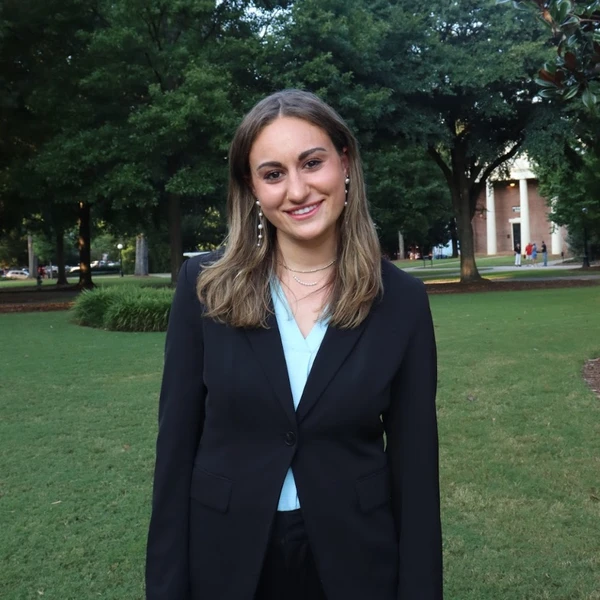
Ella Wileman
1x
Finalist
Ella Wileman
1x
FinalistBio
Computer Science and Data Science student at the University of Georgia passionate about building intelligent, data-driven systems. I enjoy working at the intersection of backend engineering, optimization, and machine learning to turn complex data into practical applications.
I thrive in fast-paced, collaborative environments and have led backend development for projects involving database design, algorithmic scheduling, and ML-driven decision making. My interests include machine learning engineering, NLP, computer vision, recommender systems, and scalable ML infrastructure.
Currently exploring opportunities to build impactful, real-world systems alongside driven teams. Applying to Masters degree programs in Artificial Intelligence, Machine Learning, Computer Science, Computer Vision, and Computer Engineering.
Education
University of Georgia
Bachelor's degree programMajors:
- Data Science
- Computer Science
Minors:
- Statistics
Wheeler High School
High SchoolMiscellaneous
Desired degree level:
Master's degree program
Graduate schools of interest:
Transfer schools of interest:
Majors of interest:
- Computer Science
- Data Science
Career
Dream career field:
Computer Software
Dream career goals:
Machine Learning Engineer, Data Scientist
Robotic Process Automation and Healthcare Advisory Intern
Windham Brannon & SHOAR LLC2023 – 20241 yearSolutions Architect Intern
Milliman MedInsight2024 – 2024IT Applications Intern
Regeneron Pharmaceuticals2025 – 2025
Sports
Volleyball
Intramural2022 – Present4 years
Volleyball
Club2022 – 20231 year
Research
Computer Science
University of Georgia Vertically Integrated Projects for Research — Personalization and Data Science Subgroup Leader- Created algorithm for real-time pet-specific heat stress assessment and notification based on literature findings.2025 – 2025Data Science
University of Georgia School of Computing — Student Research Assistant2025 – 2025Data Science
Kennesaw State University School of Data Science and Analytics — Data Science & Statistics Research Intern2022 – 2022
Public services
Volunteering
Girls who Code — Member & Volunteer2023 – 2025
Future Interests
Volunteering
Philanthropy
Entrepreneurship
Lyndsey Scott Coding+ Scholarship
I plan to be purposeful in my career in the development of intelligent and computational systems, towards making the world a better place. I have a unique duality of strengths—experience in healthcare/biopharma technologies, along with computer science and statistical tools. These experiences together provide me with a niche insight into medical and healthcare use cases for the newest machine learning and automation technologies.
In my personal research, I have built models to predict various diseases such as cirrhosis and heart disease. Additionally, I have built holistic datasets and modeling pipelines to understand the relationship between state-level sex education policies and biases, and related health outcomes in their areas to understand how to better promote student health. Furthermore, I have worked with a team of peers to ideate and create an application college students can use to improve their course-scheduling experience by identifying the most optimal course schedule to align with their preferences, professor ratings, convenience, etc. I have also built complex NLP model ensembles to identify potential fraudulent job postings, as victims of these postings were reporting their personal information and funds being stolen. Currently, I am working with professors in my School of Computing to model and predict student behaviors and corresponding success in an early foundational computer science course at my school.
This semester, I have served as a subgroup leader in a faculty-led research group that aims to engineer a wearable heat-sensor and notification system for canines. My subgroup is designing the heat stress assessment algorithm based on pet-level personalization, environmental readings from the device, and insights from a literature review. Once completed, these algorithms and applications can be generalized to protect pets, farm animals, and even people in the United States from heat-related injury.
I have extensive experience with upholding data integrity and security principles, through working with healthcare, biopharma, and student-level institutional and academic data. These experiences, matched with my passion for helping others, truly excites me about pursuing future postgraduate education after completing my undergraduate degree in order to strengthen my technical knowledge in emerging fields, collaborate in group-based assignments with peers and industry professionals, and contribute to academia and research at my institution. For example, I have worked on building large language model agents to objectively and efficiently judge other agentic AI models, exploring how AI decisions align with fairness, accountability, and societal impact. Truly understanding these new and powerful technological tools is necessary for their ethical and purposeful implementation.
Together, these computer science and non-computer science experiences demonstrate how I aim to combine my technical expertise with societal impact. I intend to continue developing ML solutions that address real-world problems, particularly in healthcare and education, while ensuring ethical considerations are prioritized. By integrating insights from healthcare, statistics, and computational systems, I hope to create tools that improve human well-being, inform policy decisions, and safeguard data and communities. Ultimately, my goal is to leverage my unique skill set to bridge technical innovation with meaningful societal contribution, embodying a purpose-driven approach to my career in computer science.
Building on these experiences, my short-term goal is to deepen my expertise in NLP, ensemble architectures, and complex ML systems, while collaborating on projects with peers and faculty. Long-term, I aspire to apply these skills as a RAG engineer, recommender systems engineer, or deep learning architect, particularly in healthcare and education. By combining my computational expertise with insights from healthcare, statistics, and societal impact, I aim to create technology that is both innovative and purpose-driven, improving human well-being and contributing meaningfully to my community.
Trees for Tuition Scholarship Fund
I plan to be purposeful in my career in the development of intelligent and computational systems, towards making the world a better place. I have a unique duality of strengths - experience in healthcare/biopharma technologies, along with computer science and statistical tools. These experiences together provide me with a niche insight into medical and healthcare use cases for the newest machine learning and automation technologies.
In my personal research, I have built models to predict various diseases such as cirrhosis and heart disease. I have built holistic datasets and modeling pipelines to understand the relationship between state-level sex education policies and biases, and related health outcomes in their areas to understand how to better promote student health. I have worked with a team of peers to ideate and create an application college students can use to improve their course-scheduling experience by identifying the most optimal course schedule to align with their preferences, professor ratings, convenience, etc. I have built complex NLP model ensembles to identify potential fraudulent job postings, as victims of these postings were reporting their personal information and funds being stolen. I am currently working with professors in my School of Computing to model and predict student behaviors and corresponding success in an early foundational computer science course at my school. The number of enrolled students has historically made it impossible to target individual student need and flag problems in student engagement before they continue. This semester, I have served as a subgroup leader in a faculty-led research group that aims to engineer a wearable heat-sensor and notification system for canines. My subgroup is designing the heat stress assessment algorithm based on pet-level personalization, environmental readings from the device, and insights from a literature review. Once completed, these algorithms and applications can be generalized to protect pets, farm animals, and even people in the United States from heat-related injury. These projects have allowed me to apply technical skills to real-world problems, reinforced my commitment to using data and computational methods for societal benefit, and inspired me to continue developing solutions that improve health, safety, and well-being across communities.
I have extensive experience with upholding data integrity and security principles, through working with healthcare, biopharma, and student-level institutional and academic data. These experiences, matched continued with my passion for helping others truly excites me about pursuing future postgraduate education after completing my undergraduate degree in order to strengthen my technical knowledge in emerging fields, collaborate in group-based assignments with peers and industry professionals, and contribute to academia and research at my institution. For example, I have worked on building a large language model agents to objectively and efficiently judge other agentic AI models, exploring how AI decisions align with fairness, accountability, and societal impact. Truly understanding these new and powerful and technological tools is necessary for their ethical and purposeful implementation.