Hobbies and interests
Soccer
Track and Field
Tennis
Art
Piano
National Honor Society (NHS)
Key Club
Community Service And Volunteering
DECA
Volunteering
Advocacy And Activism
Mental Health
Animals
Medicine
Reading
Historical
I read books daily
Erin Irelan
1x
FinalistErin Irelan
1x
FinalistBio
Hello, my name is Erin Irelan, and I am currently a senior at Cashmere High School as well as a college sophomore at Wenatchee Valley College. I will be graduating with a high school diploma, my AA degree, and all of my nursing prerequisites by the end of this year. I hope to become a PA in the future to build upon my passion for caretaking that I have developed as a primary caretaker of 11 years for several handicapped elderly family members. Here is a little more about myself!
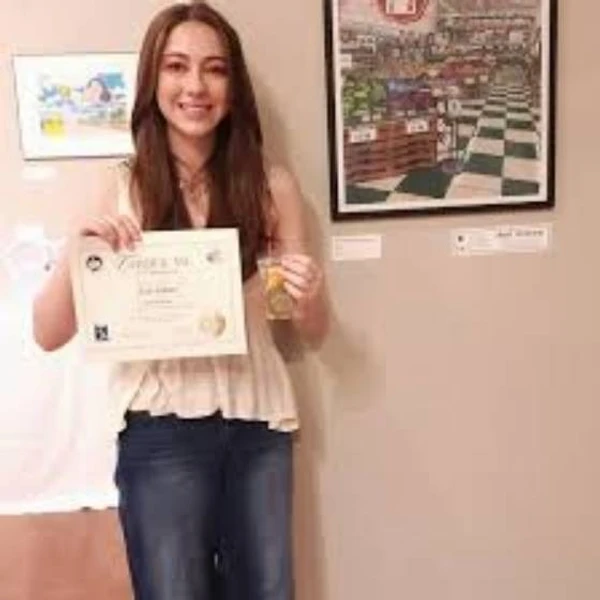
5 years volunteering at Okandogs (Dog Rescue), four-year varsity soccer letterman, fourth in state soccer appearance (2024), captain of varsity soccer (2025), main caretaker for family member, NHS member, Key Club (Kiwanis) member, CHS Equity Club Officer, two-time DECA state competitor, WA state High School Art Show Scholarship Winner (2025), two-time state track competitor, track and field all league honors, Peer Mentor, Confluence Health Observation Program (ARNP), Confluence Health CSI Camp, Dual Enrollment (Cashmere High School and Wenatchee Valley College), North central Washington Teen Poetry Slam Finalist, Directed District Wide Financial Literacy Campaign.
Education
Wenatchee Valley College
Associate's degree programMajors:
- Liberal Arts and Sciences, General Studies and Humanities
Minors:
- Liberal Arts and Sciences, General Studies and Humanities
Cashmere High School
High SchoolMiscellaneous
Desired degree level:
Bachelor's degree program
Graduate schools of interest:
Transfer schools of interest:
Majors of interest:
- Medicine
- Visual and Performing Arts, Other
Career
Dream career field:
Hospital & Health Care
Dream career goals:
Becoming a Physicians Assistant
Participant in Observation
Confluence Health2022 – 20231 yearObservation Program
Confluence Health2025 – Present1 year
Sports
Track & Field
Varsity2022 – 20242 years
Awards
- All League Honors, Two State Appearances
Tennis
Junior Varsity2024 – Present2 years
Soccer
Varsity2022 – Present4 years
Awards
- Captain
Research
Finance and Financial Management Services
Cashmere High School DECA — Director2023 – Present
Arts
Washington State Superintendent's High School Art Show (State Art)
Drawing2025 – Present
Public services
Volunteering
Okandogs — Volunteer (Used as test for aggression towards children)2020 – Present
Future Interests
Advocacy
Volunteering
Philanthropy
Sabrina Carpenter Superfan Scholarship
I became a fan of Sabrina Carpenter after watching her star in the Disney Channel Original movie Adventures in Babysitting. Watching her and Sofia Carson partake in crazy, fun, adventures on my television gave me some serious Sabrina-itis. Adventures in Babysitting isn't the only part of Sabrina's career that impacted me though, as most of her influence on me can be attributed to her music. When she dropped Because I liked a Boy on Emails I Can't Send, I became a superfan. At the time she was facing a public feud with a publicly favored celebrity, and the fact that she fought back, not through physical actions but with powerful lyrics and heart wrenching melodies stole my heart. It made me realize that sometimes we have to find a way to stand up for ourselves when no one else will. For Sabrina, it was dropping hit after hit and cementing herself as a global superstar. Its fun to see the same friends that criticized Sabrina during her Emails I can't Send era blast Espresso and sing Feather at the top of their lungs. To me, Sabrina demonstrated that being yourself, even when others criticize you for it, is the most important thing you can do. By staying truly and unapologetically herself, Sabrina Carpenter demonstrated to millions of people across the world that nothing could bring her down, and translated every setback into more ammunition. She taught me that no matter how many haters you have, you can still get back up and make them sing to your catchy songs.
Women in Healthcare Scholarship
At seven, I split my first pill with the precision of an orchardist pruning a tree. My great‑grandma sat across from me, her smile, as I soon found out, was the easiest drug to become addicted to. In Dryden, Washington, orchards touched every corner of life, and spread out into every horizon. Our family had farmed this valley for decades, generations of ancestors working sun up to sun down all on the same trees. My great‑grandmother could tell you how many fruits hung on each branch and how deep their roots ran. But as the big companies moved in and our trees were ripped one by one from the ground, our family’s harvest shrank until caring for people replaced caring for trees.
I spent afternoons on her porch listening to stories that made our empty land feel like an orchard again. As we looked out onto our fields of charred stumps and broken dreams, she told me about the better days. Days when we Irelans still had something to care for. She told me about my grandfather who brought a baby alligator home and hid it in her bathtub, about my great-uncle who played bluegrass at pie socials, and about my dad and uncle hiding in the orchards until dawn. Those stories were louder than the wind blowing through the trees of the orchards we couldn’t keep; they overshadowed the loss we had suffered, and began to map out a family that I suddenly found myself wanting to protect. So, I chose to protect her.
While other kids raced down slides and swung on monkey bars, I learned to crush pills, change bed sheets, and coax her into eating even the smallest portions of food. I learned to notice small things, things that she tried to hide but I could still sense. Like when an angry bruise suddenly appeared on her arm, or the particular stiffness in her gait when it became cold outside, because noticing these things let me act in a way that could mean the difference between her being home, or another long hospital visit.
Caring for her taught me patience and attention. It taught me to translate quiet observations into simple actions: warm socks for cold skin, the right words to use when stories looped back on themselves, a hand on the small of her back when stair steps began to look like mountains. Those were the skills my family used on our trees for decades. Read the signs, intervene early, and nurse what’s still living. Only my trees were now human.
Being responsible for my great-grandmother reshaped my idea of purpose. I stopped imagining myself in the fields and started imagining myself in rooms where people needed steady hands and an even steadier presence. I would find myself noticing what others missed; a medication left untaken, a lonely evening, and I fixed it. I felt the same quiet satisfaction I used to get from pulling warm sheets over my great‑grandmother.
Looking forward, I want to bring that attention and steadiness to others outside of my family circle. I hope to intertwine my passions for both medicine and caretaking into a future career where I can help build small supports that keep people growing, like caretakers who tend to blackened roots so fruit can come back someday. My family taught me how to identify what needs tending. Now I want to learn how to do it on a larger scale. The world is now my orchard.
Chi Changemaker Scholarship
Growing up in a town that has a large wealth gap has helped influence me in multiple different ways. I grew up with multiple different friends from several drastically different backgrounds that could be attributed to a lack of financial literacy teachings from schools in my area. Which led to the lightbulb idea I had my sophomore year of high school. At the beginning of sophomore year, I and another classmate in my DECA chapter decided to create and direct a community wide program that would teach and promote financial literacy in order to help ease financial pressure on families and prepare students for a financially responsible future. To do this, we conducted activities throughout schools of different levels in my district, such as conducting a presentation to fourth graders at my local elementary school, and hosting a financial literacy night open to the public at my high school with speakers who specialized in specific financial fields. My favorite of these however, was our paper bag decorating event for the middle school. Here, middle schoolers were able to listen to a presentation about ways to be and stay financially literate, and then decorated the paper bags which were later donated to the local food bank with financial literacy advice and slogans.
Teaching an entire community about the importance of being financially literate is a big task for anyone, and it proved to be quite challenging for just two students to run. From doing research to interviewing professionals, our financial literacy program began to take up more and more time. Something that I would like to do to help expand our efforts would to be to promote our cause more in the community, and get others like myself interested in the importance of financial literacy. Something that I learned through this project is that nobody can teach an entire town how to be financially literate alone, and that its okay to ask for help. I hope that by asking for more help during the further duration of my project my partner and I are able to touch more peoples lives with the importance of becoming financially literate.
Big Picture Scholarship
Hamburger Hill, it was just a dusty DVD sitting in our movie cabinet until I watched it. I didn't know why it was there or why we had it in the first place. In fact, I had no clue whatsoever to what it was even about. I popped it out of its tray and into the DVD player, pushed start and sat on the couch next to my father. His face went white when the screen lit up, his eyes glazed over as he turned towards me. In a tone of voice I had never heard before he told me: "pay attention, I'll explain it all after its done". The rest of the movie was a blur of soldiers rushing around the jungles of Vietnam, battling in gory detail. To me it was just a movie, a seemingly fictional story about the Vietnam War. But to my family, the battle of Hamburger Hill was where my grandfather experienced horrors that would follow generations. After the movie finished, and my father started to explain, a realization washed over me. I learned why my dad didn't have a father growing up, and why I could never go into my great-grandmothers basement. All because of a battle with a silly name fought over 50 years ago.
The first time I went into my great-grandmothers basement after watching Hamburger Hill was eye opening. The screaming faces drawn crudely on the crumbling cellar walls finally made sense. Years of wondering why my grandpa was so silent, why all he would do was sit on his back porch smoking blunts while staring out into the distance made sense. My grandfather was a combat photographer in the Vietnam War, where he spent hours tied to a rope hanging out the side of a helicopter taking photos of his comrades fighting below. He took photos of his friends as they died, unable to turn away or to help from his position in the air. All my grandfather could do was keep taking photos.
Scenes from war movies often embody a feeling of hope and bravery, they make the viewer proud of their country and the soldiers who fought valiantly to win. As I rewatched Hamburger Hill after learning of my grandfathers decades of suffering, all I felt was sadness. The movie Hamburger Hill pushed me down a rabbit hole of exploration regarding the topic of veteran PTSD cases. My grandfather exhibited blatant signs of combat PTSD, and yet had never received any form of help or counseling. I want to change that, and make sure that one day he can take photos again without constant pain. That some day he will be able to enjoy the art of photography again.
Too many veterans have experienced PTSD with little to no help. Much like my grandfather, PTSD symptoms can and do effect everyday life, and will continue to do so for as long as one may live. Something that I want to focus on when I pursue my higher education is PTSD studies. As someone learning about and preparing to go into the medical field, I feel as though veteran PTSD is often overlooked. Too often we find ourselves searching for some miraculous cure all solution to the problem. But there is no one size fits all fix for PTSD. Everyone has different experiences, and therefore, everyone requires a different solution. I would like to pursue finding different strategies for providers to explore when attempting to treat PTSD. I would have never developed a passion for PTSD research and exploration if it weren't for the movie Hamburger Hill.
Leading Through Humanity & Heart Scholarship
The World is My Orchard
At seven, I split my first pill with the precision of an orchardist pruning a tree. My great‑grandma sat across from me, her smile, as I soon found out, was the easiest drug to become addicted to. In Dryden, Washington, orchards touched every corner of life, and spread out into every horizon. Our family had farmed this valley for decades, generations of ancestors working sun up to sun down all on the same trees. My great‑grandmother could tell you how many fruits hung on each branch and how deep their roots ran. But as the big companies moved in and our trees were ripped one by one from the ground, our family’s harvest shrank until caring for people replaced caring for trees.
I spent afternoons on her porch listening to stories that made our empty land feel like an orchard again. As we looked out onto our fields of charred stumps and broken dreams, she told me about the better days. Days when we Irelans still had something to care for. She told me about my grandfather who brought a baby alligator home and hid it in her bathtub, about my great-uncle who played bluegrass at pie socials, and about my dad and uncle hiding in the orchards until dawn. Those stories were louder than the wind blowing through the trees of the orchards we couldn’t keep; they overshadowed the loss we had suffered, and began to map out a family that I suddenly found myself wanting to protect. So, I chose to protect her.
While other kids raced down slides and swung on monkey bars, I learned to crush pills, change bed sheets, and coax her into eating even the smallest portions of food. My friends thought it was weird, but I thought it was a game. I timed how fast I could get laundry done, how many dishes I could finish, how much of the porch I could sweep before the sun set over the hills. I learned to notice small things, things that she tried to hide but I could still sense. Like when an angry bruise suddenly appeared on her arm, or the particular stiffness in her gait when it became cold outside—because noticing these things let me act.
Caring for her taught me patience and attention. It taught me to translate quiet observations into simple actions: warm socks for cold skin, the right words when stories looped back on themselves, a hand on the small of her back when the steps began to look like mountains. Those were the skills my family used on our trees for decades. Read the signs, intervene early, and nurse what’s still living. Only my trees were now human.
Being responsible for my great-grandmother reshaped my idea of purpose. I stopped imagining myself in the fields and started imagining myself in rooms where people needed steady hands and an even steadier presence. I took responsibility at home without being asked, volunteered at the local dog rescue through middle and high school, and began caring for my other grandmother as well after my great-grandma's passing. During these tasks I found myself noticing what others missed; a medication left untaken, a lonely evening, and I fixed it. I felt the same quiet satisfaction I used to get from pulling warm sheets over my great‑grandmother.
Looking forward, I want to bring that attention and steadiness to others outside of my family circle. I hope to intertwine my passions for both medicine and caretaking into a future career where I can help build small supports that keep people growing, like caretakers who tend to blackened roots so fruit can come back someday. My family taught me how to identify what needs tending. Now I want to learn how to do it on a larger scale. The world is now my orchard.
David Foster Memorial Scholarship
The first day of my freshman year I witnessed a fight, one of my teachers crying, a desk get lit on fire, and a couple making out in the hallway. I don't think this is what any freshman would have expected, and I know I didn't. However, I also didn't expect to meet Mr. Simmons. I didn't know that the person standing behind a cluttered desk sixth period would become one of the driving forces behind my ambitious goals and dreams. A teacher who encouraged me to participate in class, and a teacher who pushed me to go beyond what I thought I was capable of. This teacher was Mr. Simmons.
I didn't click with Mr. Simmons right away, I thought he was too loud, too sarcastic, and way too into my personal business. When I walked into class my heart dropped; seeing a man dressed up as a crazed scientist, swirling around colorful potions in beakers with a maniacal grin, and blasting Taylor Swift was just the cherry on top of a crap-tastic day. All I wanted to do was hunker down in the corner of the classroom and survive the year. Fortunately, Mr. Simmons had a different idea of how my school year would go.
Mr. Simmons proved to me early on that he wasn't just another teacher that would let me hover under the radar. No matter what I did, however far away from his desk I sat, I just couldn't shake him. I thought it was weird, I never had a teacher who went out of their way to talk to me, or make sure I was doing okay on a particularly lonely day, but Mr. Simmons did.
Growing up in a very traditional small town as someone who didn't exactly fit the community norms was rough. My opinions were always different, ideas "stupid", and interests too weird for a teenage girl to have. So what if I really like trains, anyone should be able to. But after years and years of being told to shut my trap about things nobody cared about, I simply gave up. There was no one in my community that wanted to listen, no figure to look up to for support, and there definitely wasn't a teacher who would go out of their way to talk to me not just as a student, but as a person. Mr. Simmons changed all of that. He didn't come at me outright, but used our small interactions as a foundation for a trusting relationship. As I gradually warmed up to him, I learned that he wasn't just a loud middle aged man, but someone who placed great importance on building real, personal relationships. Just having an adult who was there to support me, a teacher nonetheless, was a huge stepping stone in the process of me building my self confidence. Having someone who made me feel worthy of receiving support from others made me more comfortable in my body, more comfortable in interactions with others, and most importantly, someone who now felt comfortable in pursuing their dreams. Every student should have a Mr. Simmons, and I know I wouldn't have had the courage to apply for this scholarship without him.
Kalia D. Davis Memorial Scholarship
Hello, my name is Erin Irelan and I am from Dryden Washington. Throughout my high school years, I have participated in a variety of different sports, ranging from soccer and tennis to track and field. Sports have not only taught me how to be a good teammate, but they have also taught me the valuable skills of balancing a schedule, as late night victory bus ride homes with the team also turned into group study sessions to keep my grades up.
Helping others in my community has made a large impact on what I want to accomplish in life. I have dedicated more than five years of my life to volunteering at Okandogs, a rescue organization that serves surrendered, feral, and previously abused dogs. During my time volunteering, I was able to learn how to be kind and compassionate to others, even if they aren't human. Patience is key when dealing with shut down dogs, and one of my main responsibilities while volunteering is to act as a test subject in order to see if a dog is aggressive towards a child. And if so, I am tasked with attempting to rehabilitate and care for the dog in order to make it more adoptable. It is important to remember while dealing with a particularly tough dog, that there is a reason why it must be this way. That it is my responsibility to treat this dog with the upmost of care that it had never received in its past. And if that dog is to bark, scratch or bite me, I must never retaliate and stay calm. One of the main concepts driven into my mind while volunteering is that it is almost never the dogs fault. We cannot blame the results of our actions on animals that have no control over what their life will entail.
Caring for dogs that have been treated so wrongly in this world has translated into my future career goals, as I want to become an ARNP. Becoming an ARNP would give me the ability to help others in my community, and give back to those that have helped me succeed. I recently completed a mentorship program at my local hospital that confirmed my desire to pursue this career. This scholarship would help me get through college, and hopefully take a financial load off my shoulder ensuring that I still have time to volunteer.