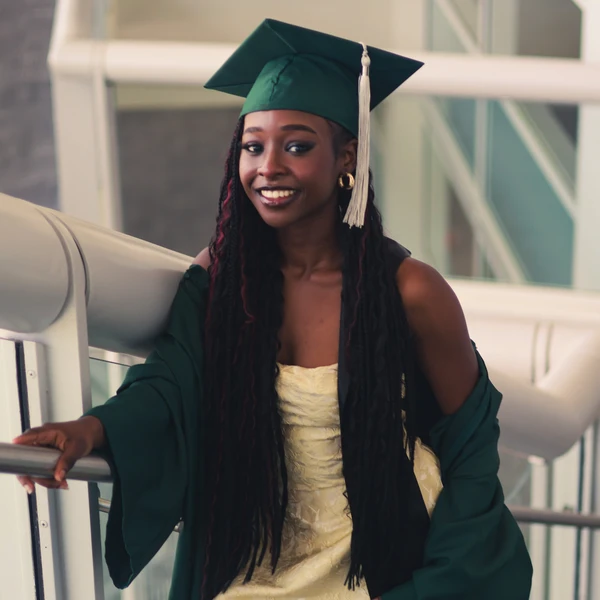
Wheaton, IL
Hobbies and interests
Bodybuilding
Art
Reading
Academic
I read books daily
Edwina Gitonga
1x
Finalist
Edwina Gitonga
1x
FinalistBio
Hi, my name is Edwina, and my life goal is to become a mechanical engineer. I’ve always loved STEM, creating things, finding solutions that help people, and that passion is what led me toward engineering. I’m a hardworking, self-driven, and goal-oriented person, and even when things get difficult, I stay motivated because I know what I’m working toward.
Growing up, I didn’t see many women — especially African women — in engineering. Coming from a place where access to higher education is limited, I had very few examples to look up to. That lack of representation inspires me to become the kind of role model I wished I had. I want to make it, not just for myself, but so other young girls who share my background can see what’s possible.
Finances have been my biggest barrier, but I refuse to let that stop me. Any support I receive brings me closer to completing my degree and opens the door for me to give back. One of my long-term goals is to mentor and support young African women who dream of careers in STEM but don’t have the resources. I want my success to create a ripple effect and uplift others the same way I hope to be uplifted today.
Education
College of DuPage
Associate's degree programMajors:
- Mechanical Engineering
GPA:
3.9
Miscellaneous
Desired degree level:
Bachelor's degree program
Graduate schools of interest:
Transfer schools of interest:
Majors of interest:
- Mechanical Engineering
Career
Dream career field:
Mechanical or Industrial Engineering
Dream career goals:
My career goal is to become a mechanical engineer who uses technical skills to solve practical problems and improve quality of life, particularly in underserved communities. I hope to design sustainable, accessible solutions in areas such as infrastructure, energy, or manufacturing while also serving as a mentor and example for other women and international students pursuing STEM. Through my career, I aim to support my family, give back to my community, and contribute to meaningful, long-term impact both locally and globally.
My role is being a life coach.I oversee activities of adults living with disabilities
Stars family services2025 – Present1 year
Sports
Swimming
Club2019 – 20212 years
Arts
Talanta hub
Musichttps://youtu.be/F4yjA1ZtGx0?si=L4Wr9HRygodMezJQ, This is a link to a song I produced with my mum2015 – 2017Machachari
ActingI was an actor in one of the Kenyan tv programs called 'Machachari'2016 – 2018
Public services
Volunteering
First Presbyterian church — Serving,catering,baby sitting2023 – 2025Volunteering
Stars family services — lifeskill coaching2025 – Present
Future Interests
Advocacy
Volunteering
Dream BIG, Rise HIGHER Scholarship
Education has never been just a step in my life plan—it has been my direction, my stability, and my hope in moments when everything else felt uncertain.
I remember sitting at a small desk in Kenya, carefully working through math problems long after the rest of the class had finished. Outside, life moved as usual—children playing, conversations drifting through open windows—but I stayed focused, determined to get every answer right. There was something about solving problems that gave me a sense of control and clarity. Even then, without fully realizing it, I was building a foundation for the future I would one day pursue.
At that time, education felt important, but it did not yet feel urgent. That changed as my family’s circumstances began to shift. My mother made the life-changing decision to move to the United States to pursue her master’s degree. She left behind everything familiar, carrying with her the belief that education could transform our lives. While studying, she also carried the full responsibility of providing for our family.
When my siblings and I joined her in the United States, I began to understand the true weight of that decision. What once felt like a dream quickly became a reality filled with both opportunity and uncertainty. I had already begun my college education in Kenya, but now I had to adapt to a completely new academic system while navigating life in a different country.
The financial reality we faced was one of the greatest challenges. As an undocumented student, I found myself in a position where many of the resources available to my peers were out of reach. I remember moments of quiet fear, wondering whether I would be able to continue my education at all. There were days when the uncertainty felt overwhelming, when the path ahead seemed unclear.
But in those moments, I was reminded that I was not alone. My mother’s resilience became my example. Even when she was stretched thin, she never stopped believing in the power of education or in my ability to succeed. My community also became a source of strength. When I was at risk of not continuing school, my church stepped in and organized a fundraiser to support me. That act of generosity is something I will never forget. It showed me that education is not always an individual journey—it can be a collective investment in someone’s future.
Through these experiences, education became my anchor. It gave me direction when everything else felt uncertain. It taught me discipline, resilience, and the importance of continuing forward, even when the outcome is not guaranteed.
I chose to pursue engineering because it reflects both who I am and what I hope to do in the world. I have always been drawn to understanding how things work and finding ways to improve them. Engineering allows me to take that curiosity and turn it into something meaningful—solutions that can impact real lives. It is a field where ideas become tangible, where creativity meets logic, and where innovation can create lasting change.
However, my goals are not limited to personal success. As the firstborn in my family, I carry a deep sense of responsibility. My education represents more than my own future—it represents stability, opportunity, and hope for my siblings and my mother, who has sacrificed so much to get me here.
Beyond my family, I am driven by the desire to create representation and opportunity for others. Growing up, I rarely saw African women in engineering. That absence made me question, at times, whether I truly belonged in that space. Now, I see that as part of my purpose. I want to become someone that young girls can look to and feel encouraged, knowing that their dreams are valid and achievable.
I also hope to use my education to contribute to underserved communities, both in the United States and in Africa. Access to resources, infrastructure, and opportunities is not equal, and I want to be part of the change that helps bridge that gap. Whether through designing systems that improve daily life or contributing to industrial development, I want my work to create impact that extends beyond myself.
My experiences have also shaped how I engage with my community today. As a life skills coach, I work with adults with disabilities, supporting them in their daily lives. This role has taught me that impact is not always measured in large achievements. Sometimes, it is found in small, consistent acts of care—helping someone gain independence, confidence, and dignity.
Looking back, the challenges I have faced—adapting to a new country, navigating financial hardship, and overcoming barriers as an undocumented student—could have easily discouraged me. But instead, they strengthened my sense of purpose. They taught me that while the path may not always be straightforward, it is still worth pursuing.
Education gave me direction when I needed it most. It turned uncertainty into purpose and struggle into motivation. It became the foundation on which I am building my future.
I am not just pursuing a degree—I am carrying the sacrifices of my mother, the support of my community, and the hopes of those who will come after me. And with that, I am committed to using my education not only to change my life, but to open doors so that others can walk through them as well.
Anderson Engineering Scholarship
Long before I understood what engineering was, I was already drawn to it.
As a child in Kenya, I was constantly curious about how things worked. I would take apart small household items—sometimes struggling to put them back together—but always determined to understand the mechanics behind them. I did not have the language for it then, but I was already thinking like an engineer: observing, questioning, and imagining how systems could be improved.
That curiosity followed me into the classroom, where mathematics and science quickly became my strongest subjects. I was drawn to the logic behind equations and the satisfaction of solving complex problems. My father, who had a deep love for mathematics, influenced this part of me. Watching his appreciation for numbers shaped my own, and over time, I began to see STEM not just as subjects, but as tools for understanding and improving the world around me.
As I grew older, I wanted a path that would allow me to create, innovate, and make a tangible impact. Mechanical engineering stood out because it combined everything I was passionate about—designing, building, and improving systems that people rely on every day. I was especially drawn to its versatility, knowing it would allow me to explore different industries and continuously grow.
But my decision to pursue engineering is also deeply personal. Growing up, I rarely saw African women represented in engineering spaces. That absence stayed with me. I realized that pursuing this field was not just about my own success—it was about becoming the representation I once lacked. I want young girls, especially in Africa, to see someone who looks like them building, innovating, and leading in engineering.
My journey has not been easy. Moving to the United States introduced new academic systems, financial challenges, and increased responsibilities as the firstborn in a single-parent household. Despite these obstacles, I remained committed to my path, understanding that my education represents hope—not only for me, but for my family and those who will come after me.
One of my most impactful hands-on engineering experiences has been working on a mechanical tennis ball launcher project as part of a team. Our goal was to design a fully mechanical system capable of launching tennis balls consistently and efficiently without electrical components. I contributed to developing the objective tree, defining performance metrics such as launch distance and accuracy, and exploring design concepts through a morphological chart.
We evaluated different mechanisms, including spring-loaded systems and rotating wheel designs, carefully considering trade-offs between power, control, and reliability. This process required critical thinking and collaboration, as we refined ideas based on both theoretical calculations and practical feasibility. Through this project, I gained a deeper understanding of the engineering design process—moving from concept to function while balancing constraints.
Although I am not currently part of a co-op engineering program, I actively seek opportunities to apply my knowledge in hands-on settings and continue building practical experience.
Ultimately, engineering, for me, is about more than building machines—it is about building possibilities. I aspire to use my degree to contribute to industrial and technological development, particularly in underserved communities. I hope to one day bring knowledge and innovation back to Africa, helping create systems and industries that empower local talent and expand access to opportunity.
What began as childhood curiosity has grown into a clear sense of purpose. I am not just pursuing engineering to succeed—I am pursuing it to open doors, challenge expectations, and help redefine who belongs in engineering.
Tawkify Meaningful Connections Scholarship
One of the most meaningful relationships in my life is the relationship I have with my mother. It is a relationship built not only on love, but on sacrifice, quiet resilience, and shared responsibility. Watching her navigate life as a single parent while pursuing her own education has shaped who I am far more than any classroom ever could.
When my father returned to Kenya, my mother was still completing her master’s degree. Overnight, she became the sole provider for three children in a country that was not originally hers. She carried the weight of tuition, rent, food, and emotional stability, all while attending classes and writing papers late into the night. I remember seeing her exhaustion, but I also remember her determination. She never spoke about quitting. She never framed our situation as hopeless. Instead, she framed education as the bridge that would carry our family forward.
As the firstborn, I felt the shift immediately. I was no longer just a daughter; I was a partner in responsibility. My academic success became more than a personal goal — it became a promise. That promise has driven me through cultural adjustment, financial uncertainty, and the rigor of pursuing mechanical engineering as an international student.
Because of my relationship with my mother, I approach relationships with intentionality. I understand that support is not always loud or dramatic. Sometimes it looks like staying up late to help someone study. Sometimes it looks like praying for someone when they feel discouraged. Sometimes it looks like believing in someone before they believe in themselves.
This understanding has shaped how I build connections in my church, classrooms, and workplace. As a youth praise and worship leader, I make it a point to ensure every member feels seen and valued. I know what it feels like to carry pressure quietly, so I try to create spaces where people can exhale. As a life skills coach working with adults with disabilities, I approach my clients with patience and dignity, recognizing that empowerment often begins with simple, consistent support.
My mother also taught me that strength and softness can coexist. She leads with faith but acts with discipline. She prays, but she also plans. That balance influences how I approach engineering. Mechanical engineering, at its core, is about solving problems that affect real people. It is not just equations and machines; it is about designing systems that improve lives. I carry into my studies the same relational mindset she modeled — that success is most meaningful when it lifts others.
Our relationship has also shaped how I view vulnerability. There were moments when finances were uncertain, when I did not know if I could register for the next semester. Instead of hiding that fear, my mother and I faced it together. We leaned on faith, community, and persistence. That experience taught me that authentic connection is not built on perfection; it is built on honesty and shared perseverance.
The relationship I have with my mother continues to shape the woman I am becoming — resilient but compassionate, ambitious but grounded. It reminds me that relationships are not distractions from purpose; they are the foundation of it.
In the future, as I grow in my engineering career, I hope to build the kind of professional relationships that reflect what I learned at home — collaborative, supportive, and purpose-driven. Because at the end of the day, achievements may open doors, but it is relationships that sustain the journey.
American Dream Scholarship
When I was younger, I believed the American Dream was simple: work hard, go to school, and everything will fall into place. It was a promise I carried with me when I left Kenya and moved to the United States—a belief that opportunity would match effort.
But I quickly learned that the American Dream is not the same for everyone.
As an undocumented student, I realized that no matter how hard I worked, certain doors were already closed. Financial aid, scholarships, and even basic opportunities that many of my peers relied on were not always available to me. I remember sitting with that realization, questioning what my future would look like if the path I had been told to follow did not fully include me.
Yet, in that moment, my definition of the American Dream began to change.
For me, the American Dream is no longer about guaranteed success—it is about persistence despite uncertainty. It is about continuing to move forward even when the system makes it harder to do so.
My understanding of this dream is rooted in my family’s journey. I watched my mother come to the United States to pursue her master’s degree while raising three children and providing for our family. I saw her choose perseverance every day, even when the path was unclear. Her sacrifices taught me that the American Dream is not something given—it is something built through resilience, faith, and determination.
As the firstborn, I carry that responsibility with me. My education is not just for myself; it represents opportunity for my family and those who will come after me. That is why I have remained committed to my studies, pursuing engineering despite the financial and structural barriers I face. I have taken on challenging coursework, including physics, calculus, and engineering design, because I believe that knowledge is one of the few things no one can take away from me.
At the same time, I have learned that the American Dream is also about impact. Through my work as a life skills coach, I support adults with disabilities in navigating everyday tasks. I have also served in my church community, helping lead and mentor younger students. These experiences have shown me that even when opportunities feel limited, I can still create change in the lives of others.
That is my American Dream—to succeed not only for myself, but to uplift others along the way.
I dream of becoming an engineer who designs systems that improve access to resources and opportunities, especially in underseved communities. I also hope to mentor students from immigrant and underrepresented backgrounds, showing them that their circumstances do not define their potential.
The American Dream, to me, is not about status, documents, or a guaranteed path. It is about resilience in the face of barriers, the courage to keep going, and the determination to create opportunities where none seem to exist.
It is about becoming proof that even when the odds are not in your favor, your dreams are still valid.
And no matter what obstacles stand in my way, I will continue to pursue mine.
Sgt. Albert Dono Ware Memorial Scholarship
I learned early that service is not simply something people talk about—it is something they live. My father served as a pastor in Kenya, and our church was often a place where people came not only for spiritual guidance but also for support, encouragement, and community. From a young age, I saw how much a single act of compassion could mean to someone else. Whether it was visiting children’s homes, organizing community outreach events, or simply helping someone in need, service was part of everyday life. Those experiences taught me that leadership is rooted in responsibility and care for others.
When I think about the legacy of Sgt. Albert Dono Ware, I see those same values reflected in his life—service, sacrifice, and bravery. His willingness to serve a nation that he had adopted as his own demonstrates a powerful commitment to something greater than himself. His example reminds me that true impact often requires perseverance and courage, especially when facing difficult circumstances.
My own journey has also been shaped by sacrifice, particularly the sacrifices made by my mother. In pursuit of better opportunities for our family, she came to the United States to pursue her master’s degree at Wheaton College. While studying, she also carried the immense responsibility of providing for three children and navigating life in a new country. Watching her balance those challenges with determination showed me what resilience truly looks like. It taught me that education is not just about personal achievement—it is about creating opportunities for those who come after you.
As the firstborn in my family, I often felt a strong responsibility to make the most of the opportunities my parents had worked so hard to create. I dedicated myself to my education while growing up in Kenya, particularly in mathematics and science. I graduated from Maryhill Girls High School with a mean grade of A, developing a deep interest in subjects such as physics, chemistry, and mathematics. These subjects challenged me to think critically and inspired my desire to pursue engineering as a career.
When I later moved to the United States to continue my education, I encountered new challenges that tested my determination. As an undocumented student, I quickly learned that many of the financial resources available to other students, such as federal financial aid, were not accessible to me. The realization that my education would depend almost entirely on scholarships and personal perseverance was daunting. However, instead of allowing these barriers to discourage me, they strengthened my commitment to my goals.
Today, I am pursuing engineering at College of DuPage, where I am building the technical knowledge necessary to design solutions that improve communities. Engineering fascinates me because it transforms ideas into systems that solve real-world problems. Whether designing mechanical systems or improving infrastructure, engineering offers a way to create lasting impact through innovation and problem-solving.
At the same time, my commitment to service continues to shape my path. I currently work as a life skills coach, assisting adults with disabilities as they navigate daily tasks such as cooking, transportation, and personal organization. This experience has been deeply meaningful because it reminds me that service often happens in small, consistent acts of support that empower others to live independently and confidently. I have also remained active in my church community, serving as a youth praise and worship leader and helping guide younger members of the congregation.
Through these experiences, I have come to understand that the challenges faced by individuals are often connected to broader systemic issues affecting entire communities. As a member of the African diaspora in the United States, I have seen how many immigrant and minority communities face barriers in accessing educational opportunities, mentorship, and professional pathways. These challenges are not always the result of a lack of talent or ambition but often stem from structural inequalities and limited access to resources.
One of the most critical reforms needed to address these challenges is expanding equitable access to education. Many students from immigrant and minority backgrounds lack the mentorship, financial support, and guidance necessary to navigate higher education successfully. Expanding scholarship programs, strengthening mentorship initiatives, and providing culturally responsive academic advising could significantly improve opportunities for these students.
Immigration policy reform is also essential. Many students from immigrant backgrounds, including undocumented students, face significant uncertainty regarding their ability to pursue professional careers despite their academic achievements. Creating clearer pathways that allow talented students to fully participate in the workforce would not only benefit individuals but also strengthen communities and industries that rely on diverse perspectives and skills.
To effectively implement these reforms, collaboration among key stakeholders is essential. Policymakers must work to address systemic barriers through inclusive legislation. Educational institutions must expand programs that support underrepresented students. Community organizations and advocacy groups must continue providing mentorship, resources, and guidance for immigrant communities. Finally, members of the African diaspora themselves must remain active participants in shaping the policies and systems that affect their futures.
The life and legacy of Sgt. Albert Dono Ware demonstrate that service and courage can create lasting change. His example reminds us that one person’s commitment to others can inspire countless acts of leadership and compassion.
As I continue my journey in engineering, I carry those values with me. My goal is not only to succeed academically and professionally but also to use my education as a tool for service—uplifting communities, expanding opportunities, and helping ensure that future generations of the African diaspora have greater access to the resources and opportunities they deserve.
Eric W. Larson Memorial STEM Scholarship
Some of my earliest memories of education are not from a classroom, but from watching my mother study late into the night. I remember the quiet determination on her face as she balanced textbooks beside responsibilities that never seemed to end—raising three children, supporting our family, and pursuing her own education . At the time, I did not fully understand the sacrifices she was making. What I understood was that education mattered in our family. It was not optional; it was the path forward.
I was born and raised in Kenya in a family that valued faith, service, and learning. My father served as a pastor, and from him I learned the importance of using your life to serve others. My mother showed me what perseverance looked like in practice. When she came to the United States to pursue her master’s degree at Wheaton College, she did so with the hope of creating better opportunities for our family. During that time, she also carried the responsibility of being the primary provider for three children. Watching her navigate both motherhood and academic life with resilience left a lasting impression on me.
As the firstborn child, I often felt the weight of responsibility early on. My success in school was never just about me; it represented hope for my entire family. I took my education seriously, pushing myself to excel academically even when resources were limited. At Maryhill Girls High School in Kenya, I developed a strong foundation in mathematics and science, subjects that challenged me to think critically and solve complex problems. When I completed my Kenya Certificate of Secondary Education, I graduated with a mean grade of A, with strong performance in mathematics, physics, chemistry, and biology.
Those subjects sparked a curiosity in me that extended beyond the classroom. I became fascinated by the idea that through science and engineering, people could design solutions that improved everyday life. Whether it was infrastructure, technology, or mechanical systems, engineering offered a way to transform ideas into practical tools that could serve communities.
Eventually, my journey brought me to the United States to continue my education. While the move opened doors academically, it also introduced new challenges. As an undocumented student, I quickly learned that many financial resources that other students rely on—such as federal financial aid and FAFSA—were not available to me. The realization that my college education would depend almost entirely on scholarships and personal determination was both daunting and motivating.
Instead of allowing those barriers to discourage me, they strengthened my resolve. I enrolled at College of DuPage to pursue a degree in engineering and began tackling some of the most challenging courses in STEM. My coursework has included Physics I and II, Calculus I through III, Differential Equations, Chemistry, and Statics. Each class has pushed me to expand my understanding of how the world works mathematically and physically.
One of the most meaningful experiences in my engineering studies has been a design project in which my team was tasked with creating a mechanical tennis ball launcher using only mechanical components. Our group had to think critically about design constraints, performance objectives, and safety considerations. My role involved developing the objective tree, identifying measurable design criteria, and helping evaluate potential solutions through a morphological chart and evaluation matrix. Through this project, I saw how engineering requires not only technical knowledge but also creativity, collaboration, and persistence. It reinforced my belief that engineering is ultimately about solving problems that affect real people.
Beyond academics, my experiences have also shaped my desire to use my education to serve others. In Kenya, I participated in community outreach through church activities that included visiting children’s homes and organizing service initiatives. After moving to the United States, I continued serving in my church community as a youth praise and worship leader. I have also worked as a life skills coach, supporting adults with disabilities by assisting them with daily living tasks such as cooking, cleaning, and transportation. These roles have taught me that meaningful impact often begins with empathy and a willingness to help where help is needed.
As a woman of color pursuing engineering, I am also aware of the barriers that many women face in STEM fields. Women, especially women from minority backgrounds, remain underrepresented in many technical disciplines. Representation matters not only for equality but also for innovation. Diverse perspectives bring new ideas, challenge assumptions, and lead to stronger solutions.
My journey—from growing up in Kenya to pursuing engineering in the United States—has given me a unique perspective on the role that technology and infrastructure play in shaping opportunities for communities. In many parts of the world, limited access to reliable systems—whether transportation, machinery, or energy—can significantly affect daily life. These experiences motivate me to pursue engineering as a way to contribute solutions that improve accessibility and quality of life.
In the future, I hope to work as an engineer designing systems that make essential technologies more efficient and accessible, particularly in underserved communities. I also hope to mentor younger students, especially young women of color, who may not initially see themselves represented in STEM careers. If my journey can inspire even one student to believe that they belong in engineering, then the challenges I have faced will have served a greater purpose.
Receiving the Eric W. Larson Memorial STEM Scholarship would significantly reduce the financial burden of my education and allow me to focus more fully on my studies and professional development. More importantly, it would represent support for a student who is determined to use her education not only for personal success but also to uplift others.
The sacrifices my family has made, particularly my mother’s perseverance, have taught me that education is one of the most powerful tools for creating change. Through engineering, I hope to honor those sacrifices by building solutions that expand opportunities for others—just as education has expanded opportunities for me.
Hearts on Sleeves, Minds in College Scholarship
When I first moved to the United States, everything felt unfamiliar. I was in a new country, adjusting to a new school system, and far away from the community I had always known. Like many people searching for belonging, I looked for spaces where I could connect with others. One of the first places I tried was a church youth group. I hoped it would help me make friends and feel less alone.
At first, I tried to ignore the small moments that made me uncomfortable. Sometimes the way people interacted with me felt different from how they treated everyone else. At the time, I did not fully understand what racism or microaggressions looked like, so I told myself I might just be overthinking things.
One evening, the youth group gathered at one of the leaders’ houses for fellowship. She had a dog, and I remember feeling nervous because I had always been afraid of dogs. I tried to stay away from it quietly, hoping no one would make a big deal about it.
Instead, the homeowner looked at me and said something I will never forget. She asked why I was afraid of the dog because it was “excited to meet me since it had never seen someone that looks like it.”
The dog was black.
In that moment, the room felt very small. I was the only Black person there, and I suddenly felt every eye on me. I did not fully have the language to explain what had just happened, but I knew it was wrong. I had just been compared to a dog.
I remember feeling shocked and embarrassed. I didn’t know how to respond, so I stayed silent. I just looked uncomfortable, and eventually she apologized. Even though the moment passed, it stayed with me.
Looking back, I wish I had spoken up. That moment was not the last time I experienced something like that in the group. Sometimes when I changed my hairstyle, the same leader would greet me as if I were a completely new person. I would have to explain that it was still me—I had just changed my hair. At the time those moments felt confusing, but now I recognize them as microaggressions.
Eventually, I realized that staying silent was not protecting my peace the way I thought it was. I had come to the youth group looking for community, but I began to understand that not every space is meant to hold you with respect. Even though I felt lonely in a new country, I decided it was better to leave than to continue placing myself in an environment where I felt diminished.
Walking away was difficult, but it taught me something important about using my voice. Speaking up does not always mean confronting someone in the moment. Sometimes it means setting boundaries and choosing not to stay in spaces that do not respect you.
That experience changed how I see communication and confidence. Today, I understand that my voice matters, even when I am the only person who looks like me in a room. As someone pursuing a future in STEM, I know there may be times when I find myself in spaces where people of color are underrepresented. Because of what I have experienced, I want to be someone who helps create more inclusive environments where everyone feels respected and heard.
The younger version of me stayed silent because she was still learning. But now I know that my voice—whether through speaking up, setting boundaries, or advocating for others—has the power to create change.
Pastor Thomas Rorie Jr. Christian Values Scholarship
I did not encounter Christianity as a distant concept; I grew up inside it. My father was a pastor in Kenya, and the church was woven into my earliest memories. Faith was not just something we practiced on Sundays—it shaped how we handled hardship, how we treated people, and how we defined success. However, growing up around faith is not the same as personally choosing it. My true journey with Christ began when life became uncertain.
When my father returned to Kenya and my mother was left to raise three children while completing her master’s degree, our family entered a season of instability. I watched my mother carry financial pressure, emotional strain, and academic responsibilities all at once. During that time, faith shifted from routine to refuge. There were moments when tuition payments were uncertain and when continuing my education in the United States felt fragile. In those moments, prayer was no longer just tradition—it was dependence.
I found the Lord personally in the quiet spaces of fear and responsibility. As the firstborn, I felt the weight of needing to succeed for my family. I struggled with anxiety about finances and whether I truly belonged in engineering as an international student. Through prayer, worship, and community, I began to understand that my identity was not rooted in performance but in God’s faithfulness. Leading youth praise and worship at church deepened that understanding. Worship was no longer about singing songs; it became a reminder that even in uncertainty, God remains constant.
My faith now anchors my academic journey. Pursuing mechanical engineering requires discipline, problem-solving, and perseverance—qualities my faith continually strengthens. I view engineering not only as a profession but as stewardship. God has given me the opportunity to study in a country with vast resources and advanced technology. I believe I am called to use that education to serve others.
My career goal is to become a mechanical engineer who develops practical, sustainable solutions that improve quality of life, especially in underserved communities. Whether through improving infrastructure, contributing to energy systems, or designing accessible technologies, I want my work to reflect both excellence and compassion. I also hope to mentor young women—particularly those from immigrant and underrepresented backgrounds—who may not see themselves represented in STEM fields.
Receiving this scholarship would directly support both my academic progress and my calling. As an international student, I am not eligible for federal financial aid, and my mother continues to support our family on a limited income. Financial strain has often competed with my academic focus. This scholarship would relieve part of that burden, allowing me to concentrate fully on my coursework, research opportunities, and professional development without constant anxiety about tuition.
My future plans include completing my bachelor’s degree in mechanical engineering, gaining hands-on industry experience, and eventually contributing to projects that serve communities both in the United States and in Africa. Long term, I hope to combine engineering, mentorship, and faith-based service—using my skills to build systems that uplift people materially while encouraging them spiritually.
My journey into Christianity has been one of moving from inherited faith to personal conviction. I have found the Lord not only in church services but in late nights studying, in financial uncertainty, and in quiet prayers for guidance. This scholarship would not only invest in my education; it would affirm the calling I believe God has placed on my life—to pursue excellence, serve faithfully, and use my gifts to build for His glory.
Harvest Scholarship for Women Dreamers
My “pie in the sky” dream is to become a mechanical engineer whose work not only transforms my own family’s future, but also creates tangible change for communities that have long been underserved—especially in Africa. It is a dream that feels both deeply inspiring and, at times, just out of reach because of the path it requires: crossing borders, overcoming financial barriers, and navigating spaces where people like me are still underrepresented.
This dream was sparked early in my life. Growing up in Kenya, I saw firsthand how access—or lack of access—to reliable infrastructure, technology, and systems affected people’s daily lives. I watched families struggle because basic systems failed them, not because they lacked effort or intelligence, but because opportunity and innovation were unevenly distributed. At the same time, my parents instilled in me a deep belief in education as a tool for change. Even when resources were limited, they sacrificed so I could attend better schools and dream beyond my immediate circumstances.
Choosing engineering felt natural. I have always loved math and science, but more importantly, I loved solving problems. Engineering gave me a language for curiosity and a structure for creativity. Still, pursuing this path has never been easy. As an international student, finances have been my biggest obstacle. Community college was the most realistic option, yet even that came with constant uncertainty. There were moments when continuing my education felt fragile, dependent on scholarships, community support, and faith. Each semester completed felt like a small victory.
What keeps this dream alive is the belief that it is bigger than me. I am the firstborn in my family, and my education represents hope—not just for my future, but for my siblings and my mother. Becoming an engineer is my way of building stability where there has been strain and opportunity where there has been limitation. It is also my way of showing other young African women that they belong in STEM spaces, even when the path feels intimidating.
To reach this dream, I know I will need persistence more than perfection. I will need to continue excelling academically, seeking mentorship, and remaining open to learning beyond the classroom. I will need to advocate for myself, apply for opportunities even when rejection feels likely, and lean into community rather than isolation. Most of all, I will need to keep choosing courage—choosing to believe that a girl who started her education in Kenya can thrive as an engineer in the United States and beyond.
My “pie in the sky” dream may feel distant at times, but every class passed, every challenge faced, and every step forward brings it closer. It is a dream built on resilience, fueled by purpose, and grounded in the hope that engineering can be a force for good—not just for me, but for many others who come after me.
Pierson Family Scholarship for U.S. Studies
I come from a close-knit family shaped by resilience, faith, and responsibility. I was raised in Kenya in a household where education was deeply valued, even when resources were limited. My mother has been the primary provider for my siblings and me, especially after my father returned to Kenya and became absent from our daily lives. As the firstborn, I grew up understanding that my actions and choices carried weight beyond myself. My education was never just my own—it represented hope, stability, and a future for my family.
My educational journey began in Kenya, where I completed high school and briefly started college before relocating to the United States. Choosing to pursue higher education in the U.S. was driven by the opportunity for academic rigor, innovation, and exposure to global perspectives, especially in engineering. American universities emphasize critical thinking, hands-on learning, and problem-solving—skills I knew would prepare me not just for a career, but for meaningful impact. Despite the challenges of being an international student, I believed that studying in the U.S. would equip me with the tools to uplift my family and eventually contribute to communities both locally and globally.
One of the most significant challenges I have overcome was transitioning to life in the U.S. while facing financial uncertainty. Community college was the most affordable option, yet even then, tuition and living costs were overwhelming. At the same time, my mother was supporting three children on a limited income. There were moments when continuing my education felt uncertain. Through this experience, I learned the importance of perseverance and community. Support from my church, mentors, and my mother made it possible for me to continue. I learned to advocate for myself, seek help when needed, and remain focused even when circumstances were discouraging. This season strengthened my resilience and taught me that setbacks do not define the future—how we respond to them does.
The person who has inspired me most is my mother. Watching her pursue her own education while raising children alone showed me what determination truly looks like. Even when finances were strained, she never allowed hardship to diminish her belief in education or faith in the future. Her sacrifices motivate me to work harder, not only to succeed academically, but to honor everything she has given up for my siblings and me. She is the reason I remain hopeful even in difficult seasons.
After completing my undergraduate degree in engineering, I plan to continue developing skills that allow me to solve real-world problems and serve underserved communities. My long-term goal is to use my education to support my family, mentor other international and first-generation students, and contribute to sustainable solutions that improve quality of life, particularly in African communities. Higher education in the United States is not just a personal milestone for me—it is a responsibility I carry with purpose, gratitude, and hope.
Rose Ifebigh Memorial Scholarship
I would describe myself as resilient, purpose-driven, and deeply shaped by both responsibility and hope. I am an international student from Kenya and part of the African diaspora, raised in a family where perseverance was not optional but necessary. As the firstborn in a single-parent household, I learned early what it means to carry responsibility—not just for myself, but for my siblings and my mother. Education has always been more than a personal ambition for me; it has been a source of collective hope for my family and a pathway toward stability and impact.
Living and studying in the United States has challenged and transformed me in ways I could not have anticipated. The educational system here is more discussion-based, independent, and self-directed than what I was used to in Kenya. At first, navigating cultural differences, academic expectations, and financial realities as an international student was overwhelming. I had to learn how to advocate for myself, ask questions confidently, and adapt quickly. Over time, these challenges strengthened my resilience and broadened my worldview. Being immersed in a multicultural environment taught me the importance of listening deeply, respecting differences, and recognizing the value that diverse perspectives bring to learning and problem-solving.
One of the most meaningful lessons I have learned through my educational journey is the power of community. When financial hardship threatened my ability to continue my studies, I experienced firsthand how support systems—through my church, mentors, and family—can uplift someone in moments of uncertainty. This experience reshaped how I view success: not as an individual achievement alone, but as something that grows through shared effort and compassion. It also taught me humility, gratitude, and the responsibility to extend the same support to others when I am able.
Academically, my interest in engineering has grown from a desire to solve real-world problems and create practical solutions that improve lives. I am drawn to the way engineering combines creativity, logic, and service. Coming from a background where resources were limited, I have seen how thoughtful design and innovation can bridge gaps in access—whether in infrastructure, technology, or everyday systems people rely on. My long-term goal is to use my education to contribute to sustainable, inclusive solutions that serve underserved communities, both in the United States and across Africa.
Receiving this scholarship would do more than ease my financial burden—it would affirm my journey and allow me to focus fully on my education without constant uncertainty. As an international student with limited access to traditional financial aid, scholarships like this one are essential to my ability to complete my degree and pursue my goals. More importantly, they empower me to continue forward with the confidence that my story, identity, and aspirations are valued.
My education is not just an investment in my future, but in the communities I hope to serve. Through perseverance, learning across cultures, and a commitment to impact, I aim to honor both where I come from and where I am going.
New Beginnings Immigrant Scholarship
My immigrant experience has been defined by courage, responsibility, and hope. Moving from Kenya to the United States was not just a change in geography; it reshaped my understanding of resilience, independence, and the power of education. I arrived with the dream of pursuing Mechanical Engineering, but I also carried the weight of responsibility as the firstborn. My father remained in Kenya, leaving my mother to provide for three children while completing her master’s degree at Wheaton College. Despite her tireless efforts, resources were limited, and I realized my education was not only a personal dream but a source of hope for my family.
Adjusting to life in the U.S. presented challenges I had never faced. Beyond navigating a new culture and education system, I confronted the financial pressures of studying as an international student, without access to federal aid. Community college offered a more affordable path, but tuition remained daunting. I turned to my local church, which graciously organized a fundraiser to help me enroll at College of DuPage. Their generosity, combined with my mother’s unwavering support, allowed me to continue my studies. This experience taught me the value of community, perseverance, and gratitude.
Academically, I have always been driven by curiosity and a love for STEM. Even as a young student in Kenya, I was fascinated by how things work and dreamed of designing machines to improve lives. Excelling in math and science earned me admission to one of Kenya’s top engineering schools. After a semester, I chose to continue my education in the U.S., seeking greater opportunities for hands-on learning and mentorship in Mechanical Engineering.
Beyond academics, my immigrant journey has shaped my character and leadership skills. As a youth leader in Kenya, I organized outreach programs for children’s homes and prisons. In the U.S., I serve as a life skills coach, helping adults with disabilities manage daily activities. These experiences taught me that success is not only personal but also measured by the impact we have on others.
Looking ahead, I plan to use my Mechanical Engineering degree to create innovative solutions that improve lives, especially in underserved communities in Kenya and elsewhere. I hope to mentor young African girls in STEM, showing them that resilience, dedication, and faith can overcome barriers. Every challenge I have faced—adapting to a new country, financing my education, and balancing family responsibilities—has strengthened my determination. My immigrant experience has shaped not only my journey but my commitment to serve others. I am driven to use my skills and opportunities to inspire, uplift, and create positive change in the world.
Robert F. Lawson Fund for Careers that Care
I am a Kenyan-born student pursuing a degree in Mechanical Engineering, driven by a deep belief that education is one of the most powerful tools for change. My journey has been shaped by resilience, faith, and a strong desire to uplift not only my own life, but the lives of those who come after me.
I grew up in Nairobi in a family that valued education despite limited financial means. My parents made significant sacrifices to ensure my siblings and I had access to good schooling, even when that meant long commutes and constant financial strain. From a young age, I learned that progress is earned through consistency and hard work. Math became the subject that transformed my confidence; with dedication and support, I discovered that persistence could turn difficulty into strength. That lesson has stayed with me throughout my academic journey.
After excelling in Kenya’s national exams, I began studying Mechanical Engineering at a leading university in Kenya before relocating to the United States in search of broader academic opportunities. The transition was not easy. As an international student, I faced financial uncertainty, cultural adjustment, and the challenge of starting over academically. Shortly after my arrival, my father returned to Kenya, leaving my mother as the sole provider for my family. Despite these challenges, I remained committed to my education, enrolling at the College of DuPage and maintaining a high GPA while completing rigorous STEM coursework.
Mechanical Engineering resonates with me because it combines creativity with problem-solving. I am fascinated by how machines and systems work, and how thoughtful design can improve daily life. My passion for engineering goes beyond technical skill—I want my work to serve people. Growing up in Kenya, I witnessed how limited access to infrastructure, technology, and sustainable systems affects communities. These experiences shaped my desire to become an engineer who designs practical, affordable solutions that address real-world problems.
Beyond academics, service has always been central to who I am. I have volunteered extensively through church outreach programs, worked as a youth leader, and currently serve as a life skills coach supporting adults with disabilities. These roles have taught me empathy, leadership, and the importance of community-centered impact. They have also reinforced my belief that success is most meaningful when it is shared.
Looking ahead, I plan to use my engineering education to contribute to innovation that improves quality of life, particularly in underserved communities. I hope to mentor young women—especially African girls—who aspire to pursue STEM careers but lack representation or resources. By becoming both a professional engineer and a visible role model, I want to show that perseverance and education can break barriers.
My story is one of determination shaped by circumstance, but guided by purpose. Through my career in engineering, I aim to create solutions, open doors for others, and give back to the communities that shaped me. This scholarship would not only support my education—it would amplify the impact I hope to make in the world.
Raise Me Up to DO GOOD Scholarship
When my father returned to Kenya, my family’s life shifted in ways I was too young to fully understand but old enough to feel deeply. At the time, my mother was a student at Wheaton College, working toward her master’s degree. She could not yet work freely, yet she suddenly carried the full responsibility of providing for three children on her own. There was no financial support from my father and no safety net to fall back on. Still, my mother pressed forward with quiet strength, determined to create stability where there was uncertainty.
As the firstborn, I learned early what responsibility meant. I felt a deep sense of obligation—not just to succeed for myself, but to become a source of hope for my siblings and my mother. Education became more than a personal goal; it became our family’s lifeline. Even when finances were stretched thin and the future felt overwhelming, I held onto the belief that my education could change the trajectory of our lives.
Pursuing engineering is my way of honoring that belief. Engineering represents problem-solving, resilience, and the ability to build solutions where none seem to exist—values I have lived by long before I ever stepped into a classroom. I am drawn to engineering because it allows me to turn hardship into innovation and challenges into opportunities for impact. Through this path, I hope not only to uplift my family financially, but also to be a living example to other young women, especially those from single-parent households, that their circumstances do not define their limits.
Looking ahead, I envision a future where my skills and experiences allow me to serve others meaningfully. I hope to use my engineering education to contribute to projects that improve access to resources, infrastructure, and technology—especially in underserved communities both in the United States and back in Kenya. I want to be part of solutions that improve daily life, whether through safer systems, more efficient technologies, or opportunities that empower others to rise above hardship.
Being raised in a single-parent household taught me perseverance, empathy, and the importance of lifting others as I climb. My mother’s sacrifice shaped my work ethic, and my family’s struggles shaped my purpose. No matter where my career leads, I know that “doing good” will always be central to who I am—using what I have been given to build, serve, and create hope where it is needed most.
Rev. and Mrs. E B Dunbar Scholarship
Pursuing higher education has required me to overcome obstacles that go far beyond academics. As an international student from Kenya and a first-generation college student in the United States, finances have been my greatest and most constant challenge. Education has always mattered deeply in my family, but access to it has never been easy.
I was raised in a low-income household where every opportunity came with sacrifice. My parents believed education was the only way to change the trajectory of our lives, and they poured everything they had into supporting my siblings and me. Even with that support, there were moments when continuing school felt uncertain. When I moved to the U.S. to pursue higher education, those challenges multiplied. As an international student, I am ineligible for federal aid, and even community college tuition represents a significant financial burden. I have had to balance full academic course loads with work, caregiving roles, and constant uncertainty about whether I could afford the next semester.
Despite this, I have persevered. I maintained a high GPA, pushed through demanding STEM coursework, and refused to let financial pressure derail my goals. When I could not legally work, I took on informal caregiving and babysitting roles. When I received work authorization, I sought employment that aligned with service, becoming a life skills coach supporting adults with disabilities. These experiences reinforced my belief that education is not just personal advancement—it is a responsibility.
My pursuit of a Mechanical Engineering degree is rooted in a desire to solve real problems and uplift others. Coming from a country where access to infrastructure, technology, and resources is limited for many communities, I have seen how innovation can transform lives. I plan to use my education to design practical, affordable engineering solutions and to mentor young people—especially African girls—who often doubt whether STEM is a place they belong.
In the future, I hope to return to my community through mentorship, outreach programs, and eventually financial sponsorships for students who, like me, have the talent but not the means. I want to be visible proof that perseverance works—that someone from a low-income, international background can succeed in STEM and give back meaningfully.
The obstacles I’ve faced have shaped my resilience, discipline, and compassion. They have taught me to keep going even when the path feels uncertain. With the support of this scholarship, I would be able to continue my education with greater stability and focus, allowing me to fully grow into the kind of engineer and community advocate I aspire to be.
Lotus Scholarship
Life changed significantly when my family structure shifted and my mother became the sole provider for my siblings and me. With my father living back in Kenya, my mother has carried the responsibility of raising three children on her own, both emotionally and financially. Watching her persevere through constant pressure shaped how I respond to challenges today.
Resources were limited, and nothing came easily. Tuition, daily needs, and long-term plans required sacrifice and careful decisions. Despite this, my mother never allowed our circumstances to define our potential. She emphasized education as the one thing that could not be taken away from us, even when providing it stretched her beyond her comfort. Her resilience taught me that perseverance is not about having enough, but about continuing anyway.
As an international student in the United States, I have carried those lessons with me. Financial challenges continue to be one of my biggest obstacles, yet I remain focused on my goal of becoming a mechanical engineer. I have maintained a strong academic record, sought out work opportunities when permitted, and consistently applied for scholarships to lessen the burden on my family. Each step forward is fueled by the sacrifices my mother has made and my desire to honor them.
My experiences have also shaped how I give back. I am passionate about supporting and mentoring young people—especially girls from underrepresented and low-income backgrounds—who may feel limited by their circumstances. I want to be living proof that perseverance, combined with opportunity, can change the trajectory of an entire family.
Through my education and future career, I plan to uplift my community by mentoring, advocating for access to education, and eventually supporting students who face the same financial barriers I have navigated. My story is rooted in perseverance, and my future is dedicated to impact.
Jim Maxwell Memorial Scholarship
Growing up in Kenya, faith was not just something my family practiced—it was the foundation of our lives. I was raised in a Christian household where church was home. My father was a pastor and my mother a praise and worship leader, and when my father started his church, he did so with nothing but faith and the support of his family. We were the praise team, the congregation, and the encouragement behind him. Watching that church grow slowly, step by step, taught me one of the most important lessons of my life: to trust God even when the path ahead is unclear.
That lesson followed me into every area of my life, especially my education. I was not always the strongest student academically, but through faith, discipline, and persistence, I learned to work hard and trust God with the outcome. In primary school, I beat the odds and scored 408 out of 500 on the KCPE, Kenya’s national examination—an achievement that placed me among the top 500 girls in the country. This opened the door for me to attend a national high school, which in Kenya is reserved for top-performing students. I knew this opportunity was not only a personal victory, but a responsibility to my family and community.
High school, however, came with immense pressure. My family struggled financially, and paying tuition was often uncertain. Everyone around me expected success, and the weight of those expectations began to take a toll on my mental health. I developed anxiety and insomnia, all while living in a boarding school far from the comfort of my family. During this season, my faith deepened in ways I never imagined. God became my present help—my constant source of peace when everything else felt overwhelming.
The greatest test of my faith came as I prepared for the KCSE, the final national examination that determines a student’s future in Kenya. To pursue Mechanical Engineering, I needed to earn an “A.” At the time, that goal felt nearly impossible. I was overwhelmed, attending therapy, and struggling with fear that one exam could undo everything I had worked for. Yet even in that fear, I experienced an unexplainable peace rooted in my faith. I reminded myself of the God I serve—the God of the impossible. I immersed myself in scripture, countering every fearful thought with words of faith and victory.
When the results were released and I saw that I had earned an “A,” I fell to my knees in gratitude. I knew without doubt that it was God’s faithfulness that carried me through. Soon after, I was admitted to the top engineering university in Kenya, and later, God opened doors for me to continue my education in the United States.
My journey has been a testimony of grace, resilience, and unwavering faith. Today, as I pursue my education in the U.S. and prepare to transfer to a four-year institution, finances remain my greatest challenge. Yet I am not afraid. For two years, God has sustained me, and I trust that He will continue to make a way. This opportunity is meaningful to me because it is not just about my education—it is about honoring God, uplifting my family, and becoming living proof that faith, when paired with perseverance, can take you further than you ever imagined.
Learner Math Lover Scholarship
My love for math began in one of the most unexpected ways: during quiet evenings at home, sitting with my dad as he patiently explained problems step by step. For years, I had been labeled a “slow learner,” and those words followed me everywhere I went. By the time I reached a new school at twelve, I had almost accepted that label. But math was the first subject that proved something different about me.
Every day after school, I would come home, open my books, and try again. Math didn’t come to me instantly, but it came honestly — through effort, repetition, small breakthroughs, and the moments when something suddenly made sense. My dad saw how determined I was and would come home early from work just to teach me. Those lessons weren’t just about numbers; they were about confidence, discipline, and believing that I was capable.
As I kept practicing, math transformed from something intimidating into something empowering. Solving a problem felt like unlocking a door, and each solved equation reminded me that I wasn’t “not smart” — I had simply never been given the right chance to grow. Math became the first subject that showed me what I could achieve when I pushed myself. That feeling spread to my other classes, and for the first time, I walked into school believing I belonged there.
I love math because it changed the way I saw myself. It taught me that hard work can rewrite your story, and that understanding doesn’t always come instantly — sometimes it grows slowly, the way confidence does. Math didn’t just make me better at school; it helped me discover who I could become.
Mohamed Magdi Taha Memorial Scholarship
Growing up, I learned early what it felt like to be underestimated. Being labeled a “slow learner” as a child taught me how damaging it can be when someone else decides your potential for you. But it also taught me something more important: how much can change when even one person chooses to believe in you. My father’s belief in me, shown through the hours he spent teaching me after work, awakened a determination I didn’t know I had. That experience became the foundation of the person I am today—someone who refuses to let others be written off or left behind.
Because of my own journey, I try to be an “up-stander” in the quiet, everyday ways that can change the direction of a life. I’ve learned that helping others doesn’t always look like a grand gesture. Sometimes, it’s sitting with a struggling classmate and explaining a concept until it finally makes sense to them. Sometimes it’s speaking up for someone who feels invisible. Sometimes it’s simply listening. These small acts may seem ordinary, but I know from my own past that they can spark confidence and hope in someone who needs it most.
Coming to the United States as an immigrant strengthened this part of me even more. I’ve met people from different backgrounds—some navigating a new country, some working multiple jobs while studying, some silently carrying heavy responsibilities at home. Each time I see someone trying their best under difficult circumstances, I feel an instinctive pull to support or encourage them. I know what it means to feel like the odds are stacked against you, and I also know the power of one voice that says, “You can do this.”
My goal as a future STEM professional is to turn that instinct into a lifelong mission. STEM isn’t just a field of numbers and theories to me; it’s a tool for solving real problems faced by real communities. I want to use my education to create opportunities for people who, like me, have had to push their way through challenges just to get a chance. Whether it’s mentoring younger immigrants, organizing tutoring programs, contributing to community projects, or eventually creating initiatives that expand access to STEM education, I want my voice and skills to help make doors open more easily for others.
I plan to be someone who notices when people are being left behind, and who takes action instead of waiting for someone else to fix it. Mohamed Magdi Taha believed that change happens both in big acts of courage and in small moments of compassion. That belief aligns deeply with the lessons that shaped me. I’ve seen how powerful one supportive person can be, and I want to be that person for others—someone who stands up, speaks up, and lifts up their community.
I am still becoming the woman I want to be, but one thing is clear: my voice will always be used to fight for those who deserve to be seen, believed in, and given a fair chance.
Ja-Tek Scholarship Award
1. What is an experience in your life that has helped to shape you into the person you are today?Growing up, I was often labeled a “slow learner,” and that label started to define me. By the age of seven, I had already attended four different schools. My parents kept transferring me in the hope that a new environment would make me “smarter,” but the problem was never the schools—it was the belief I had formed about myself. By the time I was twelve, my father was exhausted and nearly out of hope, but he decided to try once more. He enrolled me in a highly respected school in the city, even though it was far from our home. His determination, and my mother’s, pushed me in a way I had never felt before.
Seeing how much they believed in me awakened something inside. For the first time, I made the choice to try. After school, I would sit down with my books and study on my own—something completely new for me. Some mornings, I woke up early just to get extra practice in. My father noticed the change and started coming home earlier from work to tutor me, especially in math. Slowly, math became my strongest subject, and as my confidence grew, I began raising my hand in class. That courage spread to my other subjects as well. I finally felt like I could learn, grow, and become someone capable of success.
At the end of the semester, we took final exams. I remember feeling hopeful for the first time, and when the results came back, I had moved up thirty positions in the class. Out of sixty students, I was now ranked twentieth—a huge milestone for someone who had always been near the bottom. I even received the "Most Improved Girl" award. In that moment, I realized that I wasn’t “slow” at all—I just needed belief, consistency, and a push in the right direction. The names I had been called were never my truth.
That experience changed the course of my life. It taught me that nothing is impossible when I truly commit myself. Now, whenever I face challenges, I see them as opportunities to learn instead of proof that I’m failing. The mindset I gained from that moment continues to guide me today, shaping me into the woman I am becoming—resilient, determined, and confident in my ability to rise.