I never thought I would pursue higher education, let alone dream of becoming a professor. I grew up in a small agricultural town with a population of less than a thousand people. In communities like mine, the path was simple and often predetermined, most people spent their entire lives working on the land or in trades, and few ever considered college, let alone graduate school. Growing up, I had very limited exposure to what a life in academia looked like. Education beyond high school was not commonly discussed, and it certainly wasn’t something I imagined for myself. The idea of becoming a professor, someone who teaches, researches, and contributes to global knowledge, seemed like a distant and unattainable goal reserved for a world I didn’t belong to.
That changed when I received a fellowship through Harvard University and had the opportunity to work in the Democratic Republic of Congo with Professor Martin Surbeck and his team. It was there, in the heart of one of the most biologically rich regions in the world, that my view of myself, and of what was possible, was forever altered.
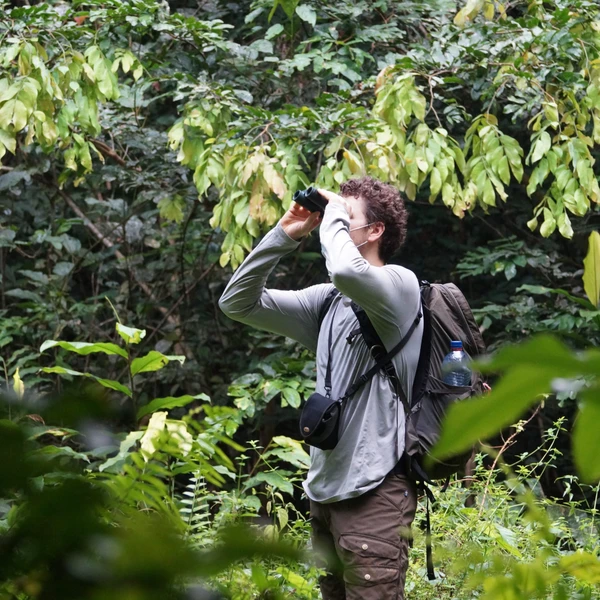
As part of the Harvard project, I worked at the Kokolopori Bonobo Reserve, assisting in long-term research on bonobo ecology. The work was both intellectually and physically demanding, we conducted behavioral observations, managed ecological data, and collected organic samples for genetic, dietary, and pathogen analysis. I was part of a team that included postdoctoral researchers, PhD candidates, and local field assistants. I found myself immersed in a vibrant, collaborative academic community working toward a shared goal, to better understand bonobos and the ecological factors shaping their survival, while also examining the implications for zoonotic disease transmission and conservation.
It was my experience with Professor Surbeck and his PhD students that had the most profound impact on me. Until that point, I had never met a professor, let alone seen what daily life in academia looked like in the field. Martin was not only incredibly knowledgeable, but also deeply committed to mentoring others, whether they were graduate students from leading institutions or local field assistants from surrounding Congolese villages. He treated everyone with respect and curiosity, always taking time to teach, listen, and guide. His leadership was not rooted in ego, but in an authentic passion for discovery and education.
Watching Martin’s team, especially the PhD students, navigate their work was eye-opening. They came from different countries and backgrounds, yet they all shared a drive to contribute to scientific knowledge and make a difference. They didn’t seem fundamentally different from me, they weren’t born knowing everything or destined for success. They were just people who had worked hard, asked the right questions, and committed themselves to their goals. For the first time, I saw the path to becoming a professor not as an abstract dream, but as a tangible reality, one that, with enough dedication and persistence, could be within my reach.
What struck me most about that experience was not just the science, but the power of education to uplift and empower. In Kokolopori, I helped train local field assistants in data collection, species identification, and ecological monitoring. Many of these individuals had never received formal scientific training, yet they learned quickly and took great pride in their work. Watching them grow in confidence and skill reminded me of my own journey. Just as I had once underestimated myself, they too were discovering new possibilities through education. I realized that teaching and mentorship were not just responsibilities of a professor, they were powerful tools for changing lives.
That realization set the course for my future. I knew then that I wanted to devote my life to education, not only as a means of continuing my own learning and research, but as a way to help others, especially those from under-resourced and rural communities. I wanted to become a professor so that I could contribute to the knowledge base of global health and zoonotic disease research, and just as importantly, so I could mentor and support the next generation of scholars, especially those who may not initially see themselves as belonging in academia.
Since returning from the Congo, I’ve continued to pursue experiences that align with this vision. I’m currently earning my Master of Public Health at Colorado State University, focusing on zoonotic diseases and the One Health approach. My academic interests remain rooted in understanding the complex connections between wildlife, human populations, and environmental change. But beyond the research, my driving force is still the same, to one day stand in front of a classroom or in the field and help others believe in their potential, just as Martin Surbeck and his students helped me believe in mine.
In many ways, that fellowship with Harvard didn’t just open a door, it tore down walls I didn’t even know existed. It challenged the narrative I had internalized for years, that people like me didn’t become scholars or professors. Thanks to the profound mentorship of Martin Surbeck and the example set by his team, I now see education not just as a personal achievement, but as a shared responsibility, to teach, to uplift, and to pass on the inspiration I was fortunate enough to receive.