
Hobbies and interests
Writing
Research
Advocacy And Activism
Social Justice
Public Speaking
Criminal Justice
Speech and Debate
Community Service And Volunteering
Law
Psychology
Criminology
Deidre Carapella
1x
Finalist
Deidre Carapella
1x
FinalistBio
I am a Criminal Justice student with a 3.89 GPA and a licensed EMT whose emergency response experience has fueled a strong commitment to justice and advocacy. As a mother and adult learner, I balance academic excellence with family responsibilities while pursuing long-term goals in law and investigative work. I am passionate about writing, research, and ethical decision making, and I hope to use my education and service experience to create meaningful, positive change within the justice system.
Education
University of Phoenix
Associate's degree programMajors:
- Criminal Justice and Corrections, General
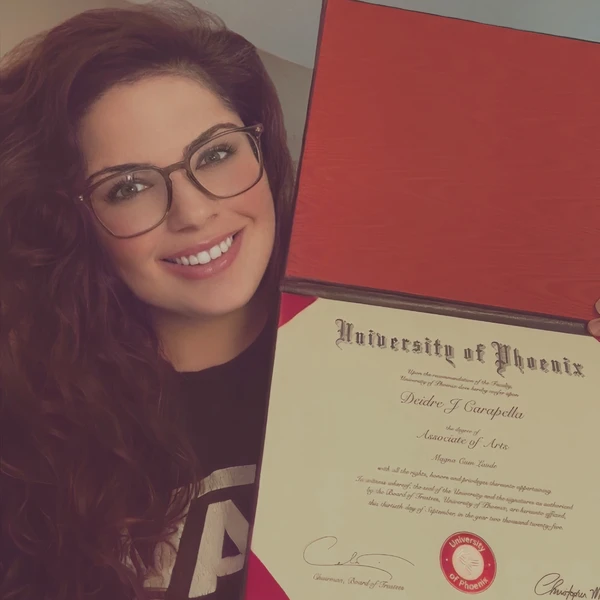
University of Phoenix
Bachelor's degree programMajors:
- Sociology
- Criminal Justice and Corrections, General
Bonny Eagle High School
High SchoolMiscellaneous
Desired degree level:
Master's degree program
Graduate schools of interest:
Transfer schools of interest:
Majors of interest:
Career
Dream career field:
Law Practice
Dream career goals:
Public services
Volunteering
ambulance — EMT2023 – Present
Future Interests
Advocacy
Politics
Volunteering
Raise Me Up to DO GOOD Scholarship
I was raised by a woman who made a choice that changed everything. My mother became pregnant with me as a teenager, the result of rape, and nearly everyone around her told her not to keep me. She was fifteen when she became pregnant and sixteen when she gave birth. She graduated a year after her class, raising a baby while still growing up herself. Later, she raised my little brother too. She did not have money, privilege, or a roadmap. What she had was conviction, grit, and an unshakable belief that life, even when it begins in violence, can still be shaped by love and purpose.
Growing up in a single parent household meant learning early what responsibility looks like. I watched my mother work, sacrifice, and keep going even when it would have been easier to give up. She never let the circumstances of my conception define who I was allowed to become. Instead, she taught me something I carry into every part of my life now, genetics are not destiny, and origin stories do not get the final word. Choices do.
That belief shaped me long before I ever stepped into college, long before I became an EMT and a CNA, long before I became a mother myself. I learned how to show up for people because I watched her do it every day. I learned empathy because she lived it. I learned resilience because quitting was never presented as an option.
I returned to school as an adult already carrying those lessons, and then life added more. After starting college, I suffered a traumatic brain injury that changed the way I process information. Reading became slower. Concentration took more effort. Confidence wavered. But just like my mother, I adapted. I rebuilt my study habits, learned how to advocate for myself, and kept going. I continued my education while working in healthcare, while raising my children, while managing a brain that no longer works the way it once did.
As a mother, I now understand my own childhood differently. Balancing school and family is not about perfection. It is about commitment. My children see me study at the kitchen table. They see me exhausted and still trying. They see me refuse to let circumstances decide the limits of my life. In that way, I am continuing the legacy my mother started.
This scholarship represents more than financial support. It represents belief in people whose paths were never simple. It would help me continue my education while honoring both where I come from and where I am going. I plan to use my education, my healthcare background, and my lived experience to serve others, especially those whose stories are complicated, who have been written off, or who feel defined by things they did not choose.
I am a child born from violence, raised by love, shaped by choice, and committed to doing good. I stand by the truth that we are not always our DNA. We are our decisions, our perseverance, and the people who refuse to give up on us, even before we can believe in ourselves.
Poynter Scholarship
Balancing my education with my responsibility as a single mother is not something I plan out neatly on a calendar … it is something I live every single day. I was already in school, already building a future for myself and my children, when my life changed. When I experienced a traumatic brain injury, everything I thought I understood about learning, focus, and endurance shifted. I did not stop being a student … but becoming one again felt entirely different.
Before my injury, reading came easily. I trusted my mind. After my injury, processing information slowed. Concentration required effort. I reread pages, lost my place, and fought frustration that felt deeply personal. Some days my brain feels clear, other days it feels heavy and crowded. Healing is not linear, and neither is learning. Still, I show up. I adapt. I build systems to support myself, because quitting was never an option.
Alongside school, I trained and worked in emergency medicine. EMT school taught me how to function under pressure, how to stay calm when everything around me is chaotic, how to help people on what is often the worst day of their lives. Working as a CNA deepened that understanding. I learned patience, humility, and the quiet strength it takes to care for others when no one is watching. I learned how much dignity matters. I also learned how emotionally and physically exhausting it is to give everything to others while still trying to hold yourself together.
Motherhood sits at the center of all of this. Studying happens while meals are cooking, while homework is checked, while little voices ask for attention. I have written papers late at night when the house is finally quiet, reviewed notes with toys scattered at my feet, and carried the invisible weight of knowing I am the one my children rely on. There is no pause button. There is no safety net. There is only commitment.
What keeps me moving forward is knowing my children are watching. They see me struggle and continue. They see me rest when I need to, then try again when my brain slows me down. They are learning that strength is not perfection, it is persistence. Education is not just my goal, it is part of how I parent.
This scholarship would ease a burden that single parents carry quietly. Every dollar matters. Tuition competes with groceries, books compete with bills, time for school competes with rest and healing. Financial support would give me breathing room in a life that rarely allows it. It would allow me to focus more fully on completing my education without sacrificing my family’s stability.
I am pursuing my degree with intention. My experiences in emergency care, caregiving, motherhood, and recovery have shaped my desire to advocate for others who feel overwhelmed by systems they do not understand. I know what it feels like to need help, to be dismissed, to keep pushing anyway. I want to turn what I have lived into service and impact.
Balancing education, work, healing, and motherhood is not easy. It is emotional, exhausting, and real. But it is also powerful. I was a student before my injury, and I am still here after it. This scholarship would not change my determination … it would support the work I am already doing, every single day.
Erase.com Scholarship
I learned early that books are not just stories, they are mirrors and lifelines. Growing up, reading helped me understand people, pain, and systems that were bigger than me. As I got older, I gravitated toward books about justice, trauma, ethics, and human behavior. I read about how laws are written, who they protect, and who they leave behind. I read survivor stories, medical narratives, and legal cases that forced me to sit with discomfort instead of turning away. Those books shaped my goals by teaching me that knowledge without compassion is hollow, and compassion without action is incomplete.
My relationship with reading changed after a traumatic brain injury. Reading used to come easily. After my injury, it became slower, heavier, and emotionally exhausting. Words blurred, comprehension fractured, and I had to reread the same sentence again and again. That struggle affected my mental health deeply. I felt grief for the version of myself I was before, and fear that I might never fully return. But instead of walking away from reading, I leaned into it differently. I learned patience. I learned how to sit with frustration without quitting. I learned that healing is not linear, and neither is learning.
Working as a licensed EMT and CNA exposed me to the intersection of mental health, trauma, and systemic failure. I have seen how untreated mental illness can spiral into criminalization instead of care. I have watched people be judged for reactions rooted in pain rather than intent. Those experiences reinforced what I read in books, that justice systems often meet people at their worst moments without understanding how they arrived there. That realization shaped my career aspirations toward law and advocacy. I want to be someone who understands both the human story and the legal framework surrounding it.
My identity has also shaped how I see the world and my responsibility within it. I am Irish, Puerto Rican, and Nigerian. I carry histories of survival, resilience, and cultural strength. Those identities taught me that voices matter, especially the ones that are overlooked or dismissed. They also taught me that healing and justice are communal acts, not individual ones.
Mental health is the social issue I am most committed to addressing. Too many people fall through the cracks because systems respond with punishment instead of understanding. Through my education in criminology and legal studies, I am working toward a future where mental health awareness is integrated into legal advocacy, policy, and reform. I want to help create pathways that prioritize treatment, dignity, and prevention, not just consequences.
Books taught me how to think critically. My injury taught me how to persevere. My experiences taught me why change is necessary. Together, they shaped my goal to pursue law as a means of protection, advocacy, and accountability. I am not chasing titles or prestige. I am chasing impact. I want to stand beside people when systems feel overwhelming and help turn knowledge into justice that is accessible, humane, and real.
JobTest Career Coach Scholarship for Law Students
I did not choose law from a distance. I chose it from the floor of emergency rooms, from patient rooms where families whispered fear into their hands, from moments where systems failed people who did everything right and still lost. As a licensed EMT and CNA, I have spent years standing beside people at their most vulnerable, watching how quickly a lack of advocacy can change the course of a life. Those moments stayed with me. They are the reason I am pursuing a career in law.
My path has not been simple. A traumatic brain injury changed the way I process information, the way I read, the way I learn. Reading used to be easy for me. After my injury, it became something I had to fight for. I reread sentences. I slow down. I work harder than I ever imagined I would have to. For a long time, I questioned whether law school was still possible. Then I realized something important. The same persistence that carries me through long shifts, complex patients, and moments of crisis is the same persistence that carries me through academics. I am still here. I am still capable. And I am still moving forward.
As a Nigerian, Irish, and Puerto Rican woman, I have lived at the intersection of multiple identities. I understand what it feels like to navigate systems that were not designed with you in mind. I have seen how race, income, health, and education shape outcomes long before a person ever steps into a courtroom. These experiences shape my desire to practice law in a way that centers people, not paperwork, and justice, not ego.
My goal is to become an attorney who bridges the gap between lived experience and legal advocacy. I plan to pursue law with a focus on protecting individuals who are often dismissed or overwhelmed by the legal system, including those facing housing insecurity, injury related claims, and institutional neglect. I am already taking steps toward this goal through my education, maintaining a strong GPA, and continuing to serve others in healthcare while balancing family and recovery. Every step I take is intentional.
What I bring to the legal profession is not just ambition, but empathy earned through experience. I know how to listen when someone cannot find the words. I know how to stay calm when everything feels urgent. I know how to advocate when someone feels powerless. These are not skills learned from textbooks. They are lived.
Law is where my resilience, compassion, and commitment to service come together. I am not pursuing this path to win arguments. I am pursuing it to protect people, to stand beside them, and to help make justice something they can actually reach.
Online Education No Essay Scholarship
Margot Pickering Aspiring Attorney Scholarship
I did not decide to pursue law because it looked impressive or safe. I chose it because I have spent years standing next to people during some of the hardest moments of their lives and watching how much power systems have over them … and how often those systems fail when compassion is missing.
Before law was ever on my radar, I worked on the front lines as a licensed EMT and CNA. I have been in ambulances at all hours of the night, in hospital rooms where fear sat heavier than silence, and in long shifts where families were exhausted, confused, and desperate for answers. In those moments, what mattered most was not authority or speed. It was communication. It was empathy. It was trust. Those experiences shaped me in ways no textbook ever could.
Then my own life shifted.
After a traumatic brain injury, reading, comprehension, and processing information became slower and more exhausting than they had ever been before. Things that once felt automatic suddenly required patience, repetition, and determination. Returning to college while healing was intimidating and emotional. I questioned myself more times than I can count. But I refused to quit. Instead, I learned how to adapt. I developed structured study habits, leaned into writing as a way to process information, and learned how to advocate for myself when I needed support.
Healing taught me something powerful … struggle does not weaken purpose, it sharpens it.
Maintaining a strong GPA while navigating injury recovery, supporting my family, and continuing to serve others through healthcare showed me who I am when things are hard. It showed me resilience. It showed me discipline. It showed me that limits do not define potential.
That is when law stopped being an abstract idea and became personal.
I have watched people feel powerless in systems they do not understand. I have seen families overwhelmed by paperwork, deadlines, and legal language that feels intentionally confusing. I know what it feels like to be intelligent, capable, and still disadvantaged by how information is delivered. I also know how much relief comes when someone finally explains things clearly and treats you like a human being instead of a case file.
As a woman of Nigerian, Irish, and Puerto Rican heritage, I understand what it means to exist at intersections. Of culture. Of identity. Of expectations. Representation matters, but how that representation behaves matters more. I do not want to practice law from a place of distance. I want to practice from lived understanding.
Margot Pickering believed that success in law comes from diligence, empathy, and earning trust. That belief reflects everything that has shaped me. In healthcare, trust can calm panic. In law, it can restore dignity. I want to be the kind of attorney people feel safe speaking honestly with. The kind who listens before speaking. The kind who explains, not intimidates.
I plan to use my legal education to advocate for individuals and families navigating complex systems, especially those impacted by injury, disability, or unequal access to resources. I want to help translate the law into something people can understand and use, not something they fear.
Law school matters to me because it is not a departure from my past experiences … it is a continuation of them. It is where my resilience, my empathy, and my commitment to service can become action. I am not pursuing law to win arguments. I am pursuing it to protect people, to stand beside them, and to make sure justice is something they can actually reach.
Women of Impact Education Scholarship
I chose to pursue criminal justice and law because I have spent years standing beside people in moments when they felt invisible, powerless, or forgotten. As a woman, a mother, a licensed EMT, and a CNA, I have held hands in hospital rooms, responded to emergencies in the middle of the night, and watched families try to make sense of systems that felt overwhelming and impersonal. Those experiences changed me. They taught me that justice is not abstract. It is deeply human, and when it fails, people suffer quietly.
Working in emergency services and healthcare exposed me to realities most people never see. I have cared for patients who depended on others to speak for them, advocate for them, and protect their dignity. As a CNA, I learned how easily vulnerable people are overlooked, and how much power exists in simply being present and paying attention. As an EMT, I saw how quickly crises escalate when resources are scarce or when systems respond too late. I realized that while medical care can stabilize a moment, it does not fix the deeper issues that brought people there in the first place.
My identity also shapes how I see the world. I am Nigerian, Irish, and Puerto Rican, and I grew up understanding that identity affects how people are perceived, treated, and believed. That awareness followed me into my professional life, where I saw how race, gender, and socioeconomic status influence access to care, legal protection, and opportunity. Too often, people who need help the most are the ones forced to navigate the most barriers. I knew I wanted to be part of changing that.
My path has not been easy. After experiencing a traumatic brain injury, my ability to process information changed in ways I could not ignore. Tasks that once felt natural required patience and repetition. Continuing my education while healing, raising a family, and working demanded resilience I did not know I possessed. There were moments when I questioned whether I could keep going. But every time I returned to my work, my studies, or my family, I was reminded why I started. I learned that strength does not mean pretending nothing changed. It means adapting and moving forward anyway.
Maintaining a strong academic record despite those challenges reshaped how I see myself. What once felt like loss became proof of perseverance. Each obstacle deepened my empathy and strengthened my commitment to advocacy. I no longer want to only respond to emergencies. I want to address the systems that allow harm to repeat.
Through a career in criminal justice and law, I intend to advocate for accountability, fairness, and access. I want to work in spaces where people feel heard, protected, and represented, especially those who have historically been marginalized. My goal is to bridge lived experience with legal action, ensuring that justice reflects compassion as much as it does authority.
The Women of Impact Education Scholarship represents belief in women who lead with resilience and purpose. This scholarship would allow me to continue building a future rooted in service and advocacy, not just for my family, but for the communities I am committed to standing beside. I am not pursuing this path despite my experiences. I am pursuing it because of them.
RonranGlee Literary Scholarship
“You have power over your mind, not outside events. Realize this, and you will find strength.”
This line from Marcus Aurelius stayed with me because it speaks to a kind of strength that is earned, not given. It does not deny pain, loss, or hardship. Instead, it draws a sharp line between what we can control and what we cannot, and challenges the reader to build resilience in that space. Marcus Aurelius is not offering comfort in the form of false optimism. He is offering responsibility, and with it, freedom.
For much of my life, reading came easily to me. Learning felt natural and familiar, something I trusted myself to do well. That changed after I experienced a traumatic brain injury. Suddenly, my ability to process information slowed. Reading required repetition. Comprehension took patience I did not think I possessed. Returning to school meant facing the reality that an outside event had altered something fundamental about how my mind worked. In that moment, Marcus Aurelius’ words stopped being philosophical and became deeply personal.
What struck me most about this passage is that Marcus does not claim we can control what happens to us. Injury, loss, and disruption are real, and they leave marks. What he insists on is that meaning is not created by the event itself, but by how we respond internally. Strength, in his view, is not about resisting reality or pretending hardship does not exist. It is about refusing to surrender one’s sense of agency.
This idea reshaped how I approached both healing and learning. I could not undo what had happened to me. I could not force my brain to work the way it once did. But I could decide how I met that reality. I could choose to adapt rather than withdraw. I could decide that needing more time, rereading material, or approaching learning differently did not mean failure. It meant persistence.
Marcus Aurelius understood that the mind is both fragile and powerful. When he says we have power over our minds, he is not claiming it is easy. He is claiming it is necessary. Without that internal control, we become defined by circumstance. With it, we regain authorship over our lives. This distinction matters deeply to me because rebuilding confidence after injury required reclaiming that internal space. Each time I returned to an assignment instead of walking away, I exercised the kind of strength Marcus describes.
As a mother and a licensed EMT, this lesson extends beyond the classroom. Emergency work teaches you quickly that control is limited. You cannot control outcomes, only responses. You show up, you act with intention, and you remain steady even when situations unfold unpredictably. Marcus Aurelius’ words reflect this reality with striking clarity. Strength is not calm circumstances. Strength is composure within chaos.
Close reading this passage reveals that Marcus is not offering detachment from the world, but engagement with it on honest terms. He is reminding the reader that while life will apply pressure, it does not get to decide who we become. That choice remains internal. For someone navigating recovery, education, family responsibility, and professional service, that idea is not abstract. It is lived daily.
This passage matters because it reframes adversity as a proving ground rather than a sentence. It does not glorify suffering, but it refuses to let suffering erase purpose. Marcus Aurelius teaches that strength is not the absence of struggle, but the decision to remain present, intentional, and grounded within it. That understanding has shaped how I move forward, not as someone unchanged by hardship, but as someone who continues to choose resilience, effort, and meaning.
Lippey Family Scholarship
Reading used to come easily to me. I never questioned my ability to learn or keep up academically until my life changed in ways I never expected. After experiencing a traumatic brain injury, things that once felt automatic suddenly required effort, patience, and repetition. Processing information became slower. Reading took longer. Comprehension no longer came instantly. Returning to college as an adult meant facing that reality head-on, and it was terrifying. I wondered if I was still capable of succeeding, or if the version of me who thrived academically was gone.
Those fears hit hard, especially because I am also a mother. My days are already full of responsibility, exhaustion, and putting others first. There were nights when I sat with assignments feeling overwhelmed, frustrated, and emotional. Not because I lacked motivation, but because my brain no longer worked the way it used to. It would have been easier to walk away and tell myself that school was no longer realistic for me. But quitting would have meant giving up on the future I am fighting to rebuild, for myself and for my family.
Instead, I chose to adapt. I learned how my brain works now, not how it used to. I developed structured study routines, broke assignments into smaller pieces, reread material as many times as needed, and leaned heavily on writing to process information. Writing became my lifeline. It slowed everything down and allowed me to organize my thoughts when reading felt overwhelming. I also learned how to advocate for myself, something that did not come naturally at first, but became essential to my growth. Every small victory rebuilt confidence I thought I had lost forever.
Alongside school, I continue working as a licensed EMT. Emergency services taught me resilience in a way nothing else could. I have shown up during chaos, pain, and uncertainty, both for others and for myself. That experience reminded me that I am capable of functioning under pressure, adapting to change, and continuing forward even when things are difficult. When school felt heavy, I reminded myself that healing does not mean returning to who I was, it means becoming someone stronger in new ways.
Maintaining a high GPA while balancing recovery, family life, and professional responsibility reshaped how I see my challenges. What once felt like loss became proof of strength. Every late night, every reread page, and every moment I pushed through frustration showed me that I am still here, still capable, and still moving forward.
This journey has shaped my desire to pursue a career in criminal justice and law, where persistence, empathy, and advocacy matter. I want to stand up for people who feel overlooked, misunderstood, or underestimated, because I know that feeling deeply. The Lippey Family Scholarship would support my education, but more importantly, it would affirm that healing is not linear, challenges do not define limits, and resilience can grow even after life changes everything.