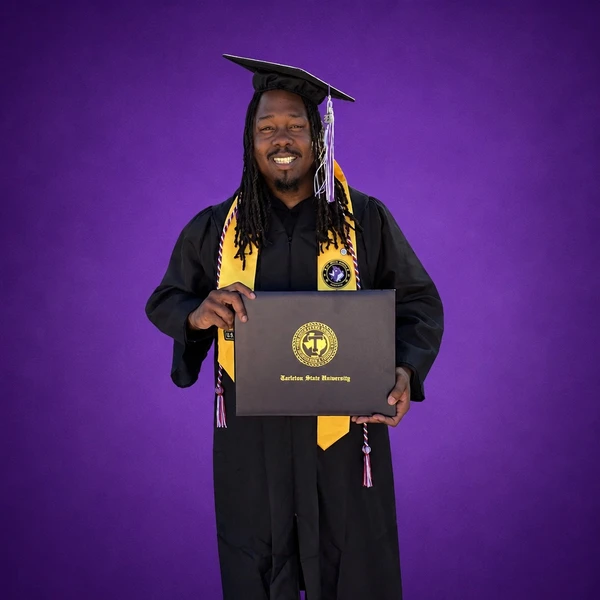
Education has never been something I took for granted. As a first-generation college student, every step of my educational journey has required determination, sacrifice, and faith. There was no blueprint in my family for navigating college admissions, financial aid, degree plans, or graduate school. Everything I have accomplished academically has come through persistence, self-education, and the belief that education could change not only my life but the lives of those around me. Being the first means learning as you go, making mistakes, asking questions, and continuing forward even when the path feels uncertain. Rather than viewing those challenges as obstacles, I have come to see them as opportunities to grow into the person and professional I am becoming.
I earned my GED after realizing that my path to success would not follow the traditional route. Instead of allowing that to discourage me, I viewed it as a second chance to build a better future. Rather than immediately attending college, I chose to serve my country in the United States Army. Military service became one of the greatest teachers of my life. It strengthened my discipline, leadership, resilience, and commitment to serving something greater than myself. The Army taught me that true leadership begins with service and that perseverance often matters more than talent.
Like many veterans, my military experience also came with lasting challenges. After completing my service, I returned home with service-connected disabilities that affected both my physical and mental health. Transitioning back into civilian life was far more difficult than I anticipated. There were moments when uncertainty, financial pressure, and adjusting to a new way of life made higher education seem out of reach. However, those experiences also gave me a deeper understanding of struggle, healing, and resilience. They taught me that asking for help is not a sign of weakness and that growth often comes through adversity.
Instead of allowing those challenges to define me, I made the decision to redefine myself. I enrolled in college as a nontraditional student and committed myself fully to my education. What began as a goal to earn one degree evolved into a passion for lifelong learning. Each class expanded not only my knowledge but also my confidence that I could create a meaningful career dedicated to helping others. Today, I am pursuing my Master of Social Work at The University of Texas at Arlington while balancing the responsibilities of being a husband, father, and disabled Army veteran.
Throughout my academic journey, I have excelled not simply through grades but through perseverance, discipline, and purpose. Every assignment, internship, and classroom discussion has been an opportunity to become a better advocate for those who often feel unheard. Through my clinical internship, I have worked directly with individuals experiencing substance use disorders, trauma, and mental health challenges. Facilitating groups, supporting clients through difficult conversations, and witnessing people rediscover hope has confirmed that I chose the right profession. Those experiences have shown me that healing is possible when people are treated with dignity, compassion, and respect.
Social work is more than my field of study—it is my calling. My long-term goal is to become a Licensed Clinical Social Worker who specializes in supporting veterans, individuals recovering from substance use disorders, and families navigating trauma and mental health challenges. As someone who has personally experienced military service, transition, and adversity, I understand the importance of meeting people with empathy rather than judgment. I want to combine my lived experiences with professional education to provide trauma-informed, culturally responsive care that empowers individuals and families to rebuild their lives.
Beyond direct clinical practice, I hope to contribute to improving the field itself. I want to advocate for greater access to quality mental health services, particularly for underserved communities and veterans who often face barriers to care. I also hope to mentor future social workers and encourage more men, especially Black men, to pursue careers in helping professions. Representation matters, and I believe that sharing lived experiences alongside professional knowledge can help build trust with individuals who may otherwise be reluctant to seek support. My vision extends beyond individual counseling to strengthening systems of care through education, advocacy, community partnerships, and leadership.
Personally, earning my MSW represents much more than achieving a career goal. It represents changing the trajectory of my family's future. As a first-generation college student, I understand that every degree I earn becomes a new example for my children. I want them to grow up believing that obstacles do not determine outcomes and that education can open doors that once seemed impossible to reach. I hope my journey demonstrates that resilience, integrity, humility, and service are values worth pursuing throughout life.
I also recognize that education carries responsibility. Every opportunity I have received has been made possible by people who believed in investing in others. Whether through mentors, professors, veteran benefits, or scholarship donors, I have experienced the generosity of individuals who wanted to see students succeed. That has inspired me to live with the same mindset. My goal is not simply to earn degrees but to use my education to create opportunities for others, advocate for those whose voices are often overlooked, and contribute positively to my community for years to come.
The values Grandmaster Nam K. Hyong embodied deeply resonate with me. Although our life experiences are different, I connect strongly with his belief that education has the power to transform lives. His willingness to overcome tremendous hardship in pursuit of knowledge reminds me that education is both a privilege and a responsibility. His story demonstrates that one person's determination can create opportunities for generations to come. That is the type of legacy I hope to leave for my own family and the people I will serve throughout my career.
Receiving this scholarship would reduce the financial burden of graduate school and allow me to devote more time and energy to my education, clinical training, and professional development. More importantly, it would represent an investment in someone who is committed to multiplying that opportunity through a lifetime of service. My goal is not simply to build a successful career but to become the kind of social worker, mentor, and leader who helps others recognize their own strength and potential.
Everything I have overcome—from earning my GED, to serving in the United States Army, to rebuilding my life after returning home with service-connected disabilities, to becoming a graduate student pursuing a Master of Social Work—has prepared me for this next chapter. I remain grateful for every opportunity I have been given, and I am committed to honoring those opportunities through integrity, compassion, lifelong learning, and service. I hope that the education I continue to pursue will not only change my own life, but will also create lasting change for my family, my profession, and the countless individuals and communities I will have the privilege to serve.