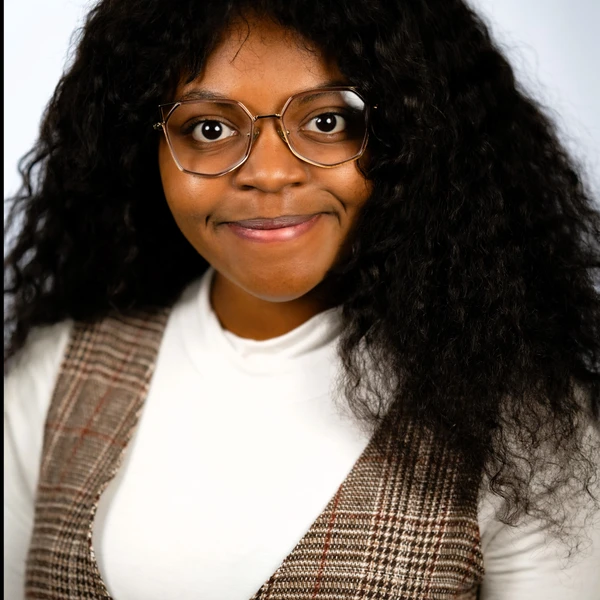
Douglasville, GA
Age
26
Gender
Female
Ethnicity
Black/African
Religion
Jewish
Hobbies and interests
Anthropology
African American Studies
Volunteering
Viola
Saxophone
HOSA
Journaling
Writing
Spanish
Reading
Psychology
Psychiatry
Reading
Academic
Adult Fiction
Anthropology
Adventure
Book Club
Action
Classics
Contemporary
Psychology
I read books daily
US CITIZENSHIP
US Citizen
LOW INCOME STUDENT
Yes
FIRST GENERATION STUDENT
No
Danielle Davis
1x
Finalist
Danielle Davis
1x
FinalistBio
I am a passionate and dedicated educator, currently teaching high school humanities. I earned my B.A in English with an emphasis in multicultural literature and creative writing from the University of Georgia.
In addition to teaching role, I have experience mentoring students and advocating for diversity, equity, and belonging in educational spaces. They are committed to creating engaging, student-centered classrooms and exploring innovative ways to connect with learners. Beyond teaching, I love literature, an aspiring writer, and someone who values personal growth and the transformative power of education.
Education
Pepperdine University
Master's degree programMajors:
- Psychology, General
GPA:
4
University of Georgia
Bachelor's degree programMajors:
- English Language and Literature, General
GPA:
3.5
Paulding County High School
High SchoolGPA:
3.8
Miscellaneous
Desired degree level:
Doctoral degree program (PhD, MD, JD, etc.)
Graduate schools of interest:
Transfer schools of interest:
Majors of interest:
- Psychology, General
Career
Dream career field:
Mental Health Care
Dream career goals:
Psychiatrist
Teacher
Culver Academies2023 – 20252 years
Sports
Volleyball
Intramural2018 – 2018
Research
Psychology, General
University of Georgia — Student researcher2021 – 2022
Arts
University of Georgia
Music2011 – 2022
Public services
Volunteering
Georgia Service Project — Participant2020 – 2021
Future Interests
Advocacy
Volunteering
Philanthropy
Entrepreneurship
Sabrina Carpenter Superfan Scholarship
I became a fan of Sabrina Carpenter because she represents a version of girlhood I never believed I was allowed to have. Growing up, being girly was treated as childish, unserious, and embarrassing. I was taught that if I wanted to be respected or equal to men, I had to act like men. Femininity was framed as a weakness. Emotions were labeled irrational. Girls who cared about fashion or romance were dismissed as silly or boy‑crazy. I internalized all of it. I learned to hide the parts of myself that felt soft, expressive, or emotional because I thought they made me less worthy.
Sabrina Carpenter is an artist who made me question that narrative. Her unapologetic personality, her bold performances, and her refusal to shrink herself showed me that femininity is not a liability. It is a strength. Watching her evolve from her early Disney Channel days to the confident, charismatic performer she is now helped me understand that girlhood is not something to outgrow. It is something to reclaim.
Her album “Man’s Best Friend” was especially transformative for me. It taught me that in any relationship, romantic or otherwise, you can stay in control and still have fun. You can be playful without being powerless. You can be emotional without being irrational. Sabrina’s music reframed emotions as something necessary for making clear, grounded decisions. Instead of treating feelings as obstacles, she treats them as information. That perspective changed the way I understood myself, especially as an autistic woman who was often told my emotions were “too much” or “not appropriate.”
Her confidence helped me feel secure in my own girlhood. For so long, I believed femininity made me less serious, less intelligent, and less capable. Sabrina’s career proves the opposite. She has built a path that spans television, music, and film without ever abandoning the glitter, humor, or emotional honesty that define her style. She succeeds not in spite of her femininity, but through it. Seeing her thrive while being fully herself gave me permission to do the same.
Her impact on me goes beyond aesthetics or personality. Sabrina helped me understand that embracing my femininity could coexist with ambition. As I grew older, her music became a source of grounding during moments when I doubted myself. When I felt pressured to tone myself down or act more “neutral,” her work reminded me that authenticity is not only allowed but powerful. Her confidence encouraged me to pursue my goals without sacrificing the parts of myself that feel soft, emotional, or expressive.
This mattered deeply during my undergraduate years as an English major and now informsmy graduate studiesin psychology. Sabrina’s boldness helped me trust my voice. Her success reminded me that maturing and femininity are not opposites. They can coexist and even strengthen each other.
Sabrina’s influence continues to shape me. She reminds me that I can combine my love for literature, mental health, and emotional expression without abandoning the parts of myself that feel most authentic. Her career shows that you can be multifaceted and still be taken seriously. You can be ambitious and feminine. You can be emotional and logical. You can be soft and strong.
I am a fan of Sabrina Carpenter because she helped me reclaim parts of myself I once hid. Her career impacted me by showing that girlhood is not something to suppress, but something to celebrate. She taught me that embracing who I am is not a barrier to success. It is the foundation of it.
Taylor Swift Fan Scholarship
The Taylor Swift performance that moves me most is her Eras Tour acoustic set in Cardiff, where she performed a mash‑up of “I Hate It Here” and “The Lakes.” I remember watching it and feeling something inside me settle, as if someone had finally articulated an inner landscape I had been living in my whole life. Both songs capture the emotional texture of being autistic in a world that often feels too sharp, too fast, and too demanding. Taylor describes the longing to escape into a private inner world, a place untouched by judgment or misunderstanding. For me, that inner world was not a metaphor. It was reality.
Growing up, I often felt like I “hated here,” not because I disliked life itself, but because the environments around me were overwhelming. I spent much of my childhood retreating into what I thought of as "secret gardens in my mind," places where I could finally breathe. Daydreaming was not a distraction. It was the only space where I felt safe from bullying, misinterpretation, and the constant pressure to perform a version of myself that never fit. When Taylor sang about creating a mental refuge no one else could taint, it felt like she was describing the coping strategies I had built long before I had the language for autism.
Her mash‑up also spoke to me as a poet. “The Lakes” captures the ache of being told what your art is worth by people who do not understand you. As an English major in undergrad, I experienced that ache constantly. Teachers and classmates dismissed my writing with a casual cruelty that stayed with me long after class ended. I remember calling my mother in tears after receiving comments that made me question whether I should keep writing at all. Taylor’s performance reminded me that art does not need to please everyone. It needs to be honest. It needs to find the people who resonate with it. Hearing her sing about belonging with those who feel out of place helped me reclaim my voice.
Her music encouraged me to keep writing, as a form of self expression previouslyunattainableto me as someone struggling with autism and mental health issues. This led to me being published in two literary magazines, something I once believed was impossible for someone like me. Taylor’s songs helped me understand that my perspective is not a flaw. It is a lens. It is a way of seeing the world that deserves expression.
As I’ve grown older, Taylor’s music has continued to guide me toward acceptance of my autism and toward building a life that fits me rather than forcing myself into spaces that do not. Now, as a graduate student studying psychology, her work resonates in new ways. It helps me bridge my love for literature with my passion for mental health. Her ability to articulate emotional experiences with clarity and artistry inspires me to do the same in my academic and professional life. I want to communicate about mental health in ways that are accessible, compassionate, and creatively honest. I want to help others feel seen the way her music helped me feel seen.
The Cardiff mash‑up moves me because it is more than a performance. It is a reminder that escape can be a form of resilience, that art can be a refuge, and that being different does not mean being alone. Taylor’s music helps me survive, grow, and imagine a future where my voice in writing, psychology, and my own life is something worth protecting.
Selective Mutism Step Forward Scholarship
Growing up, I did not have a name for what was happening to me. I only knew that when I was expected to speak, something inside me froze. Words dissolved before they reached my mouth. I now understand this as selective mutism, but as a child it felt as though there was something inherently wrong with me.
I was diagnosed with anxiety in middle school, and that diagnosis helped me begin to understand the roots of my silence. It also helped me recognize how selective mutism had shaped my life long before I had a word for it. My anxiety and autism made friendships difficult, and I rarely spoke to anyone outside my immediate family. I did not have the kind of social life most children take for granted. I was left out of school events, and after elementary school I never had or attended any birthday parties. My silence was often misinterpreted as disinterest or inability, when in reality it was fear and overwhelm that I could not control.
One moment that still stays with me happened in high school band. The director asked me a simple beginner question, something I could have answered easily at home. But in that moment, in front of the class, my body locked up. I stared at her, unable to move or speak. The silence stretched so long that the room grew uncomfortable, and eventually the teacher laughed before moving on. I remember feeling both exposed and invisible. I was seen enough to be laughed at, but not understood enough for anyone to realize what was actually happening.
This was not an isolated experience. In elementary school, teachers assumed I did not know how to talk at all. They placed me in speech therapy, believing the issue was mechanical rather than psychological. It was not an articulation issue, but fear, sensory overload, and a nervous system that shut down under pressure. No one around me had the language for selective mutism. I internalized the idea that something was wrong with me, when in reality the systems around me lacked the knowledge to recognize what I was experiencing.
These moments shaped me more than I realized at the time. They taught me how easily children can be misunderstood when adults rely on assumptions instead of curiosity. They taught me how painful it is to be mislabeled, dismissed, or laughed at for something you cannot control. They taught me how deeply the right kind of understanding, or the absence of it, can affect a child’s sense of self.
This is why pursuing a master’s degree in psychology is so important to me. I want to be part of the research and education that fills the gaps I fell through. My goal is to help create a world where teachers, school counselors, and educational systems can recognize selective mutism and other internalizing conditions early, accurately, and compassionately. I want to contribute to research that clarifies how these conditions manifest, especially in students who may mask well or who are misinterpreted as shy, defiant, or unmotivated.
Pursuing a master’s in psychology is not just a career goal for me. It is a way to transform experiences that once made me feel powerless into knowledge that can empower others. I want to help build educational environments where silence is not misread as incompetence, where children are not laughed at for their struggles, and where every student receives the understanding and care they deserve. I want to use my voice in research, in advocacy, and in education to ensure that no child’s silence is ever misunderstood again.
Learner Mental Health Empowerment for Health Students Scholarship
Mental health is deeply important to me as a student because it impacts every aspect of my life, from academic performance to my ability to build meaningful relationships. My journey with neurodivergence, depression, and anxiety has shaped who I am and fueled my passion for advocating for mental health awareness and accessibility. These challenges are not just personal; they are the reason I am pursuing a career in psychology, aiming to help others navigate similar paths and find their own strength.
Living with neurodivergence means I often experience the world differently, and navigating school has required creative problem-solving and self-advocacy. For example, I rely on tools like planners, timers, and noise-dampening headphones to manage my time and reduce overstimulation. While these tools help, they do not erase the added emotional and mental labor that comes with trying to fit into systems not built with people like me in mind. On top of this, my depression and anxiety often create additional hurdles. There are days when even the simplest tasks feel insurmountable, and I have had to learn the importance of prioritizing self-care, seeking support, and forgiving myself for not always meeting perfectionist standards.
These experiences have made me deeply empathetic toward others and have driven me to become a mental health advocate in my community. At school, I actively foster open conversations about mental health by sharing my own struggles and encouraging others to do the same. This transparency helps reduce stigma and creates a sense of solidarity among my peers. Additionally, I advocate for more accessible accommodations for neurodivergent students and work to promote an inclusive environment where everyone feels valued.
At home, I bring these lessons into my family dynamic. I encourage open communication about emotions and mental health challenges, helping normalize these discussions and empowering my loved ones to seek help when needed. I’ve learned that small actions, like sharing resources or simply listening, can make a profound difference.
My passion for mental health extends beyond personal advocacy. I aspire to create a center that provides neurodivergent individuals and their families with the skills, resources, and support they need to thrive. This dream encompasses housing, recreational activities, classes, daycare, and a more holistic approach to improving lives. By studying psychology, I am building the knowledge and skills necessary to turn this vision into reality. For me, mental health advocacy is not just a personal commitment; it’s a lifelong mission to help others find strength, resilience, and joy.
ADHDAdvisor's Mental Health Advocate Scholarship for Health Students
Throughout my life, I have been deeply committed to helping others navigate challenges and find empowerment, especially when it comes to mental health. As someone who is neurodivergent, I understand firsthand the unique struggles and triumphs that come with navigating a world not always built for you. This personal experience has inspired me to create spaces where others can feel seen, valued, and equipped with the tools they need to thrive.
In my current role as an educator, I focus on fostering inclusive classrooms where all students feel safe and supported. Whether mentoring neurodivergent students, providing emotional support, or advocating for accommodations that allow them to succeed, I aim to create an environment that celebrates individuality while building community. Additionally, I am actively involved in initiatives that prioritize mental well-being, such as student affinity groups and peer support networks. These opportunities allow me to champion the importance of mental health while learning from diverse perspectives.
Looking ahead, my ultimate goal is to establish a center dedicated to serving neurodivergent individuals of all ages and their families. This center would not only offer resources like classes, counseling, and skill-building workshops but also provide housing, recreational activities, and daycare services to support the whole person and their community. My dream is to create a space where neurodivergent individuals can feel empowered, learn practical life skills, and build meaningful connections.
To bring this vision to life, I plan to combine my lived experiences, ongoing education, and professional growth. Pursuing further studies in psychology and education will deepen my understanding of the diverse needs within the neurodivergent community. Additionally, I will continue advocating for systemic change that increases accessibility and equity in mental health care.
I believe mental health support extends beyond offering resources—it’s about creating a culture of acceptance and understanding. By dedicating my career to this mission, I hope to be a source of emotional support for others, helping them embrace their unique strengths and live fulfilling lives. Through education, advocacy, and community-building, I am committed to making a meaningful and lasting impact.
Black Leaders Scholarship
When I think of Black leaders who inspire me, my thoughts immediately turn to my mum. She is not a historical figure whose name echoes through textbooks, but her story, woven from the threads of sacrifice, resilience, and love, is one of unparalleled leadership. My mum is the daughter of immigrants who arrived in England to help rebuild the country after World War II, contributing their labor to a nation in recovery while facing the pervasive racism of the time. The same work ethic that fueled their sacrifices was passed down to my mum, shaping her into the resilient, selfless woman I know today.
Though she grew up surrounded by struggles, my mum's ambition and determination burned brightly. She worked tirelessly to create opportunities for herself, a difficult task in a society where systemic barriers constantly sought to dim her light. She immigrated to the United States in search of a better life, not just for herself, but for her future children.
My mum’s sacrifices are too numerous to count. She worked long hours at jobs that were often thankless, enduring physical and emotional exhaustion to ensure that my sister and I had opportunities she could only dream of. My mother worked at Walmart so she would have flexible hours. During this time she injured her knee, had a lung infection, and survived the COVID pandemic. The job did not pay well, but she needed it so that she could work around my sister;s and my schooling. My mum always puts others first. Even when faced with poverty, she refused to let it define us. She made sure we never went to bed hungry, even if it meant going without herself. She found ways to stretch limited resources, turning hardships into lessons in gratitude and creativity.
My mum also faced racism head-on, standing tall in a world that sought to diminish her. Whether it was enduring prejudice at work or encountering ignorance in everyday life, she remained steadfast. When I spoke to her about my own experiences of racism adn feeling left out, she told me something that stayed with me forever, “I am not missing out on knowing them. They are missing out on knowing me.” My mother does not know how to “suffer” or be sowerful, because her confidence and trust in God surpass it all. Her resilience in the face of these challenges taught me that dignity and strength are not conditional on the acceptance of others. She showed me the power of grace under pressure and the importance of standing up for oneself and others.
Her family was not always a source of comfort; cultural and generational divides often left her feeling isolated. My grandparents, originally from Jamaica and holding traditional beliefs, wanted my mother to move to Jamaica and marry a Jamaican man. Yet, my mum chose love over bitterness. Imagine their deride when she married a man from the projects of Bed Stuy Brooklyn. She still worked to maintain those relationships, understanding that connection and forgiveness were part of the legacy she wanted to leave behind, but she always stayed true to her own heart.
What makes my mum a leader is not just her ability to endure hardship but her determination to transform it into something greater. She taught my sister and me to value education, to work hard, and to never take our opportunities for granted. Her sacrifices were not in vain; they were investments in a future she knew she might never fully see.