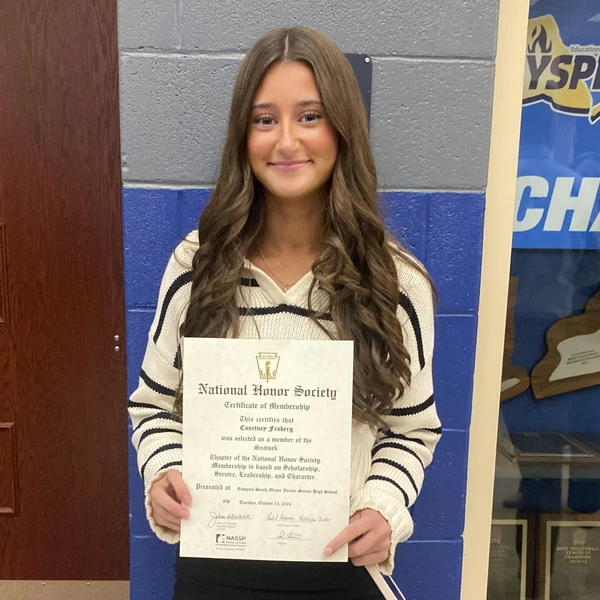
Hobbies and interests
Volunteering
Courtney Froberg
1x
Finalist1x
Winner
Courtney Froberg
1x
Finalist1x
WinnerBio
I’ve set high standards and believed that effort mattered just as much as grades. Taking challenging courses pushed me out of my comfort zone and helped me develop strong study habits and discipline, especially as the workload became more demanding.
I have been able to do volunteer work that has directly helped families who were facing difficult situations. Seeing families in need and understanding the challenges they experience had a strong impact on me and helped shape my perspective. Volunteering taught me to be responsible, to always find ways to be kind and the importance of giving back to the community. This time also motivated me to make a meaningful difference in the lives of others.
As I move into college, my academic goals include maintaining a strong GPA and staying actively involved in my classes. Professionally, I am entering college with a clear goal of earning my bachelor’s degree and preparing for a successful future. I want to take advantage of opportunities outside the classroom, such as internships and hands-on learning to gain real-world experiences related to my academics and interests. Balancing academics, extracurricular activities, work, and my social life in high school taught me important time management skills, which I know will continue to help me succeed in college.
Receiving scholarships would allow me to continue to chase my dreams and focus on my education, pursue my goals and commit to making a positive impact with the same dedication and effort that I had in high school.
Education
Eastport-south Manor Junior Senior High School
High SchoolMiscellaneous
Desired degree level:
Bachelor's degree program
Majors of interest:
- Health Professions and Related Clinical Sciences, Other
Career
Dream career field:
Hospital & Health Care
Dream career goals:
Sales Associate
DSW2025 – Present1 year
Sports
Volleyball
Varsity2024 – 20251 year
Arts
Lion's Heart
Photography2025 – Present
Public services
Volunteering
Lion's Heart — Member, Historian, Secretary and President2021 – Present
Future Interests
Volunteering
Entrepreneurship
Sharon Oshatz Memorial Scholarship
My passion for pursuing a degree in STEM and healthcare comes from seeing how gaps in access to medical care can deeply affect patients and families. One of the biggest challenges in healthcare today is how difficult it can be for patients to receive timely appointments, especially with specialists. Long wait times can increase stress, worsen health conditions, and make people feel overlooked by the healthcare system. Experiencing this firsthand helped shape my desire to pursue a healthcare-related degree where I can work toward improving patient access and outcomes.
I first became aware of this issue when my mom tried to schedule a specialist appointment for me. Although it was not an emergency, the appointment was scheduled weeks away. That experience made me realize how common delays in care are, even for routine concerns. I later noticed the same issue while volunteering and working with families in my community. Conversations with parents often revealed how difficult it was to secure timely doctor visits for themselves or their children. Many spoke about long waitlists, limited provider availability, and the challenges of taking time off work for appointments scheduled far in advance.
These experiences helped me understand that healthcare access is not just about having insurance or a nearby clinic, but about receiving care when it is truly needed. When appointments are delayed, minor health concerns can become more serious, leading to unnecessary complications and anxiety. For families already facing financial stress or limited resources, waiting weeks or months to see a doctor can feel overwhelming. Seeing this impact on real people made healthcare feel personal to me and strengthened my interest in pursuing a STEM-based healthcare degree.
One conversation that stayed with me was with a parent who shared how difficult it was to schedule routine medical appointments for their child. By the time an appointment became available, the issue often required urgent care instead. Hearing this made me think about how stressful it must be to worry about your child’s health while feeling powerless in a slow-moving system. It also showed me how important early intervention and efficient care are in preventing avoidable emergencies.
These experiences are what drive my passion for studying healthcare through a STEM-focused degree. I want to be part of a healthcare system that values efficiency, communication, and patient-centered care. Whether through direct patient care or supporting healthcare systems behind the scenes, I hope to use my education to help reduce barriers that prevent people from receiving timely medical attention. Even small improvements, such as clearer communication or better coordination of care, can make a meaningful difference in a patient’s experience.
Volunteering has also shown me how underserved communities are often affected the most by delays in care. Many individuals feel discouraged from seeking medical help due to past negative experiences. This has motivated me to pursue a healthcare career where I can help rebuild trust, treat patients with compassion, and advocate for those who feel unheard.
Balancing academics, volunteer work, and part-time jobs has taught me responsibility, time management, and the importance of showing up for others. These skills, along with my passion for improving access to care, have solidified my decision to pursue a degree in STEM and healthcare. I am motivated to use my education to help create a more accessible and compassionate healthcare system for the future.
Julie Adams Memorial Scholarship – Women in STEM
My passion for pursuing a degree in STEM and healthcare comes from seeing how gaps in access to medical care can deeply affect patients and families. One of the biggest challenges in healthcare today is how difficult it can be for patients to receive timely appointments, especially with specialists. Long wait times can increase stress, worsen health conditions, and make people feel overlooked by the healthcare system. Experiencing this firsthand helped shape my desire to pursue a healthcare-related degree where I can work toward improving patient access and outcomes.
I first became aware of this issue when my mom tried to schedule a specialist appointment for me. Although it was not an emergency, the appointment was scheduled weeks away. That experience made me realize how common delays in care are, even for routine concerns. I later noticed the same issue while volunteering and working with families in my community. Conversations with parents often revealed how difficult it was to secure timely doctor visits for themselves or their children. Many spoke about long waitlists, limited provider availability, and the challenges of taking time off work for appointments scheduled far in advance.
These experiences helped me understand that healthcare access is not just about having insurance or a nearby clinic, but about receiving care when it is truly needed. When appointments are delayed, minor health concerns can become more serious, leading to unnecessary complications and anxiety. For families already facing financial stress or limited resources, waiting weeks or months to see a doctor can feel overwhelming. Seeing this impact on real people made healthcare feel personal to me and strengthened my interest in pursuing a STEM-based healthcare degree.
One conversation that stayed with me was with a parent who shared how difficult it was to schedule routine medical appointments for their child. By the time an appointment became available, the issue often required urgent care instead. Hearing this made me think about how stressful it must be to worry about your child’s health while feeling powerless in a slow-moving system. It also showed me how important early intervention and efficient care are in preventing avoidable emergencies.
These experiences are what drive my passion for studying healthcare through a STEM-focused degree. I want to be part of a healthcare system that values efficiency, communication, and patient-centered care. Whether through direct patient care or supporting healthcare systems behind the scenes, I hope to use my education to help reduce barriers that prevent people from receiving timely medical attention. Even small improvements, such as clearer communication or better coordination of care, can make a meaningful difference in a patient’s experience.
Volunteering has also shown me how underserved communities are often affected the most by delays in care. Many individuals feel discouraged from seeking medical help due to past negative experiences. This has motivated me to pursue a healthcare career where I can help rebuild trust, treat patients with compassion, and advocate for those who feel unheard.
Balancing academics, volunteer work, and part-time jobs has taught me responsibility, time management, and the importance of showing up for others. These skills, along with my passion for improving access to care, have solidified my decision to pursue a degree in STEM and healthcare. I am motivated to use my education to help create a more accessible and compassionate healthcare system for the future.
Kalia D. Davis Memorial Scholarship
Since 11th grade, working part‑time has been a regular part of my life. I made the decision to get a job during the school year because I wanted to start taking responsibility for my future and save for college on my own. I knew it would be difficult to balance school, clubs, and extracurricular activities while working, but I felt it was important to challenge myself and learn what it meant to manage real‑world responsibilities.
Most days followed a demanding routine. I would leave school and head straight to work, often not getting home until later in the evening. After that, I still had homework to complete, tests to study for, or club responsibilities to prepare. There were nights when I felt exhausted and questioned whether I was taking on too much, but I kept reminding myself why I started. Learning how to organize my time, plan ahead, and push through tired days helped me grow more confident in my ability to handle responsibility.
Working while staying committed to my academics taught me lessons that went far beyond earning a paycheck. I learned how to be dependable, how to prioritize what truly mattered, and how to stay focused on long‑term goals even when short‑term sacrifices were required. Earning and saving my own money also gave me a greater appreciation for the cost of education and the value of hard work. Knowing that each shift contributed to my future made every effort feel meaningful.
Receiving this scholarship would make a significant difference in my college journey. While I have worked hard to save money, the cost of tuition, books, housing, and other expenses is still overwhelming. This scholarship would relieve some of that financial pressure and allow me to focus more on my education rather than worrying about how many extra hours I need to work to afford school. It would also give me the freedom to become more involved on campus, academically and socially, without sacrificing my financial stability.
My goal is to pursue a career in healthcare, a field that requires dedication, empathy, and perseverance. The skills I have developed through working while in high school are the same qualities I will rely on as a college student and future healthcare professional. Balancing responsibilities has prepared me for the challenges ahead and reinforced my determination to succeed.
This scholarship would not only support me financially but also serve as a reminder that my hard work and persistence matter. It would help me continue building a future where I can give back to others, make a positive impact, and turn the lessons I have learned into meaningful contributions in my career and community.
Chi Changemaker Scholarship
An issue that was brought to our attention through volunteering in my community was that many students were beginning the school year without basic school supplies. Through conversations with community members and families we worked with, it became clear that some students lacked essential items like notebooks, folders, and backpacks. These shortages were not due to a lack of effort by families, but rather financial stress and competing responsibilities that made it difficult to prioritize school supplies. Hearing about this issue made it clear that something small could have a large impact on a student’s confidence and ability to focus in school.
Motivated by these conversations, I took the initiative to help organize a school supply drive through Lions Heart, a teen volunteer and leadership organization I have been involved in for several years. I helped plan and coordinate the drive, created a sign‑up system to keep donations organized, and worked with other volunteers to ensure supplies were distributed to students from kindergarten through high school. Our goal was not only to provide materials, but to do so in a way that protected students’ dignity and made them feel supported rather than singled out.
So far, the supply drive has helped provide students with the tools they need to start the school year feeling prepared and confident. It also opened meaningful conversations with families about the challenges they face, reinforcing the importance of listening and responding to community needs. This experience showed me how impactful organized, student‑led efforts can be.
Looking ahead, I would like to expand this initiative by working more closely with school social workers and local organizations to reach additional students. I hope to turn the drive into an ongoing effort that supports families throughout the school year, not just at the beginning. Addressing this issue has taught me that positive change often starts when a community’s needs are heard and acted upon.
Aserina Hill Memorial Scholarship
Volunteering has been a major part of my life and has deeply influenced my desire to pursue healthcare. I have been a member of Lions Heart, a teen volunteer and leadership organization, since 2021, where I have served as Secretary, President, and currently Historian. Through this organization, I helped organize school supply drives for students from kindergarten through high school. Seeing how something as simple as notebooks and backpacks could help students feel more confident walking into school showed me how small acts can make a meaningful difference. I’ve also participated in food drives, meal packaging events supporting over 200 families through Long Island Cares, and preparing hot meals for St. John’s Street Ministry. These experiences taught me that many families face challenges that aren’t always visible, and compassion and support can go a long way.
In addition to volunteering, working part‑time while balancing academics has taught me responsibility, time management, and communication. Jobs in retail and customer service pushed me out of my comfort zone and helped me learn how to interact with people from all backgrounds. These skills are important in healthcare, where listening, patience, and empathy matter just as much as medical knowledge.
Outside of academics and volunteering, I enjoy playing varsity volleyball, which has taught me teamwork, discipline, and perseverance. I am also involved in school organizations such as National Honor Society and Student Government, which allow me to stay connected and give back to my school community.
I am passionate about healthcare because I want to be a provider who understands how frustrating delays in care can be. In my future career, I hope to improve patient access by supporting efficient, patient‑centered systems and by making people feel heard and respected. Even clear communication and guidance can ease anxiety during long waits. I am especially interested in working with underserved communities, where barriers to care are often greater.
If I could start my own charity I would look to reduce everyday barriers that prevent families from accessing timely healthcare by providing support, guidance, and resources. I could name the charity "Bridge to Care" with the goal of making sure patients don't feel lost while waiting for care.
The organization would be student‑led and dedicated to helping individuals and families feel more prepared and supported when navigating the healthcare system. Student volunteers would provide appointment preparation support by helping patients organize symptoms, develop thoughtful questions for specialists, and understand appropriate next steps when appointments are delayed. The organization would also partner with schools and community centers to share clear, accessible healthcare navigation resources. Rather than offering medical advice, the focus would be on promoting effective communication, patient education, and advocacy, empowering families to feel informed, confident, and supported while seeking care.
Ava Wood Stupendous Love Scholarship
“Kindness in Action”
One of the most meaningful acts of kindness I’ve been part of was organizing a school supply drive through the teen volunteer organization that I am a member of (Lions Heart). I know it sounds simple—paper, folders, notebooks, backpacks—but it didn’t feel simple when I realized what it actually meant to the students receiving them. We all talk about school like it’s just classes and homework, but for a lot of kids, it’s also stress: “Do I have what I need?” “Am I going to stand out for the wrong reason?” The supply drive was my way of making sure someone could walk into school feeling prepared instead of embarrassed.
I helped plan it and make sure we were organized (even down to doing a sign‑up so it didn’t turn into chaos). What stayed with me wasn’t just dropping things off, it was knowing that behind every donation was a family trying to keep up. Through volunteering, I’ve heard parents talk about a lot of hidden pressures. Sometimes kindness is not a huge action. It’s reducing one of those pressures in a real way. People don’t always need “perfect” help. They need someone to notice, to care, and to show up with something practical. That’s the kind of provider I want to be someday.
“Creating Connection”
I’ve learned that belonging doesn’t happen by accident, you have to build it. For me, I’ve helped create connection through joining clubs, volunteering and also being a team player. I’ve been a volunteer member for years and held leadership roles including President, Secretary, and Historian. Being in leadership pushed me to think beyond “getting things done” and focus more on how people feel while doing them. As President, I worked to make meetings and service projects feel welcoming, especially for quieter members who might not jump in right away.
Connection also came from bringing different groups together for a shared purpose. I’ve collaborated with community organizations and supported projects and fundraising efforts with our school district social workers and local Girl Scout troops. We’ve also taken part in large-scale food drives and meal packaging that support over 200 families annually through Long Island Cares, which is a reminder of how many people around us are carrying real needs. Another meaningful experience was helping prepare and provide hot meals through St. John’s Street Ministry.
What I like most about these experiences is that they bring people together who might not normally cross paths such as students, parents, volunteers, social workers, and community members. We all were working toward the same goal. It creates a space where people feel seen, not judged. Helping people feel like they matter the second they walk in the door.
Our Destiny Our Future Scholarship
My plan in college is to focus on healthcare. One of the biggest challenges in healthcare today is how difficult it can be for patients to receive timely medical care. Scheduling an appointment with a doctor, especially a specialist, can take weeks or even months. These long wait times can cause stress, allow health issues to worsen, and leave patients feeling frustrated or overlooked. While medical technology and treatments continue to advance, access to care, particularly when it is needed most, remains a serious concern.
I first became aware of this issue when my mom tried to schedule a specialist appointment for me. Thankfully, it was not an urgent situation, but the appointment was still scheduled several weeks out. At the time, it made me realize how common delays in care have become, even for routine or non-emergency concerns. As I continued volunteering and working with families in my community, I heard similar frustrations expressed by parents and community members. Many shared how difficult it was to find available providers, deal with long waiting lists, or take time off work for appointments scheduled far in advance.
Through these experiences, I began to understand that delays in healthcare affect people in ways that are not always visible. When appointments are hard to get, health concerns may go untreated, and minor issues can turn into serious problems. For families already facing financial stress or limited resources, waiting weeks or months for medical care can feel overwhelming. These conversations helped me realize that access to healthcare is not just about having insurance or living near a clinic—it is also about being able to receive care at the right time.
One conversation that stayed with me was with a parent who explained how challenging it was to schedule routine medical appointments for their child. Often, by the time an appointment became available, the issue had worsened and required urgent care instead. Hearing this made me think about the stress of worrying about a child’s health while feeling stuck in a system that moves too slowly. It also showed me how important timely care is in preventing unnecessary complications and anxiety.
As someone interested in pursuing a career in healthcare, this issue has strongly influenced my goals. In my future career, I hope to help improve patient access by being part of a healthcare system that values efficiency, communication, and patient-centered care. I want to be a provider who understands how frustrating long wait times can be and who works to make patients feel heard and supported, even when schedules are tight. Clear communication, guidance on next steps, and alternative care options can make a meaningful difference in a patient’s experience.
I also hope to work with underserved communities, where delays in care are often more common. Through volunteering, I have seen how discouraging past experiences can cause people to hesitate before seeking medical help. I want to help rebuild trust by treating patients with compassion and respect, and by recognizing how critical timely care is to their overall health and well-being.
Wesley Beck Memorial Scholarship
I have always been someone who enjoys helping others, and that instinct is what led me toward a field where I can support individuals with special needs. Growing up, I learned early on how meaningful it is to make someone feel seen, supported, and included. My volunteer work strengthened that belief and showed me how powerful compassion can be when it’s put into action.
As an active volunteer, I’ve had many opportunities to contribute to my community. I’ve helped organize annual school supply drives, served hot meals to the homeless through our Street Ministry, and participated in large food drives supporting the Long Island Cares food bank. These experiences opened my eyes to the challenges many people face and taught me how important it is to show up for others, even in small ways. Seeing the direct impact of our efforts—whether it was a child receiving a backpack or a family receiving groceries—motivated me to continue serving and shaped my desire to work with individuals who need extra support.
One of the most meaningful lessons I learned came from the school supply drive. Watching students my age and younger worry about starting school without basic supplies made me realize how deeply something simple can affect someone’s confidence. When we handed out backpacks and saw their faces light up, I understood how important it is to create environments where people feel prepared, supported, and valued. That feeling is exactly what I hope to bring into the lives of individuals with special needs. I want to help them feel capable, confident, and included in every space they enter.
My volunteer work also taught me how to handle difficult or uncomfortable situations. There were moments when people questioned why we were collecting donations outside grocery stores or made assumptions about who “should” be helping. Instead of letting those comments discourage me, I learned to stay focused, remain respectful, and continue doing what I knew was right. That maturity and patience will be essential when working with individuals who may face misunderstanding or judgment from others.
Looking ahead, I plan to make a difference by offering patience, empathy, and consistent support to those with special needs. I want to help create opportunities for them to thrive academically, socially, and emotionally. My goal is to be someone who listens, advocates, and encourages independence while celebrating every achievement, big or small.
Receiving support would allow me to continue pursuing this path without the added stress of financial barriers. I am committed to using my education and experiences to make a meaningful difference in the lives of others, and I’m grateful for the opportunity to share my story.
William T. Sullivan Memorial Scholarship
As an active volunteer, I have had several occasions and opportunities to help others and contribute to my community. Over the years, I’ve participated in a variety of service projects that allowed me to support people both locally and beyond. As a group, we have held annual school supply drives, provided hot meals for the homeless through our Street Ministry, and collaborated on large food drives with several other organizations to support the Long Island Cares food bank. Each event taught me something new about compassion, teamwork, and the impact that even small acts of service can have. I felt honored to help my community, and seeing the benefits of our hard work motivated me to continue giving my time. Knowing that our efforts made a positive difference in someone else’s life also made a positive impact on me.
One event that stands out the most was the school supply drive. It was eye‑opening to realize how many students my age and younger were starting the school year without the basic supplies they needed. Many of them were nervous or stressed about going to school unprepared, and I could imagine how difficult that must feel. School is challenging enough without the added pressure of not having notebooks, pencils, or even a backpack. Being able to hand those students brand‑new supplies—and seeing the smiles on their faces—was incredibly humbling. It reminded me that something as simple as a backpack can change the way a child feels walking into a classroom. That moment made all the planning, sorting, and organizing completely worth it.
Surprisingly, there were also several instances where we were approached by people who questioned why we were running food drives or collecting donations outside grocery stores. Some assumed we didn’t “look like” we needed assistance or didn’t understand why young people would be involved in this kind of work. Being put in that position was eye‑opening. It taught me how to handle tense or uncomfortable situations with maturity and patience. Instead of letting those comments discourage me, I learned to stay focused on the purpose of our work and the people we were helping. Those experiences strengthened my confidence and reminded me that doing the right thing isn’t always easy, but it’s always worth it.
Looking ahead, I’m excited to continue volunteering and to explore new opportunities to serve others. Each experience has shaped me into someone who values empathy, leadership, and community, and I look forward to carrying those lessons with me wherever I go.