Hobbies and interests
American Sign Language (ASL)
Animation
Acting And Theater
Voice Acting
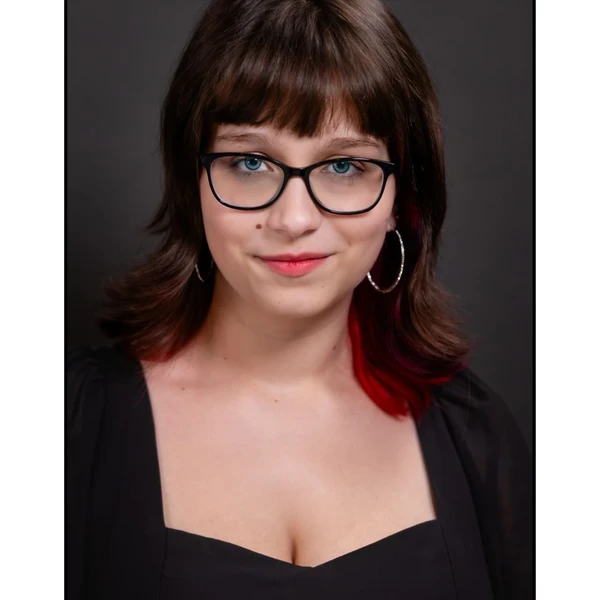
Claire Hill
1x
Finalist
Claire Hill
1x
FinalistBio
I grew up not being able to say my own name right. A speech impediment made every R sound feel impossible, and for a long time I thought being heard just wasn't something I got to do. Then I walked into a theater, and everything changed.
Four years later, I've earned Superior ratings at both state and national Thespian competitions, played lead roles like Molly in Peter and the Starcatcher, and I'm heading to AMDA College of the Performing Arts in Los Angeles this fall to pursue a BFA in Acting. Theater didn't just give me a voice; it gave me a reason to use it.
I'm a Thespian officer, a drama department TA, and the person who sits with a trembling, freaked out freshman before their first audition because I remember exactly what that feels like. I've spent four years studying ASL, which completely changed how I think about physicality and expression onstage. I am really excited to bring that into my performance.
I'm queer, I'm Female, and I want to tell stories about people whose lives don't usually make it to the stage: working-class families, people navigating their own mental health, communities that get flattened into stereotypes. I want to actually make a living doing this, and I know that starts with getting the training I need without drowning in debt.
Education
Sehome High School
High SchoolMiscellaneous
Desired degree level:
Bachelor's degree program
Majors of interest:
- Drama/Theatre Arts and Stagecraft
Career
Dream career field:
Arts
Dream career goals:
Professional stage and screen actress telling stories about underrepresented communities
Drama Department Teaching Assistant
Sehome High School2024 – 20262 years
Arts
Sehome High School Drama Department / Thespian Troupe #4614
ActingPeter and the Starcatcher2022 – 2026
Ethel Hayes Destigmatization of Mental Health Scholarship
I don't remember a time when my brain wasn't loud.
Like... I know that sounds dramatic. But I was the kid sitting in the back of fourth grade feeling like the world was happening behind glass. Everyone else seemed to know how to just BE, and I was over here trying to figure out why getting out of bed felt like running a marathon before 8 AM. I was nine. Nine year olds aren't supposed to feel like that.
I didn't have a word for it then. Depression was something adults had, something on TV shows where people stared out rainy windows. Nobody told me it could look like a kid who still laughed at lunch but cried in the bathroom during passing period and couldn't explain why.
And then COVID hit, and whatever thread I'd been holding onto just... snapped. I was thirteen, stuck in my room, watching the world shut down, and my brain went, "See? I TOLD you nothing matters." The isolation confirmed every lie depression had been whispering. You're too much. You're not enough. Nobody would notice if you disappeared.
I didn't disappear. But I got close to invisible.
The thing that pulled me back was so stupid and small. One of my teachers teacher started doing these online theater exercises during remote learning. Just goofy stuff. Improv games over Zoom where everyone's audio was terrible and half the class had their cameras off. But she kept showing up, and eventually I kept my camera on, and eventually I unmuted, and eventually I said something that made someone laugh. And I thought... oh. There I am.
Theater didn't fix my depression. I want to be really clear about that because I think people want that narrative and it's not true. I still have bad days. I still have weeks where the glass comes back and everything feels distant and fake. But theater gave me a place where feeling things deeply wasn't a problem. It was literally the job.
When you're acting, you have to go INTO the hard stuff. You have to sit with grief, with rage, with loneliness, and not run from it. And doing that onstage taught me how to do it offstage too. Not perfectly. But better than I was doing at nine, staring at the ceiling wondering what was wrong with me.
It changed my relationships too. I used to hide everything. Smile, say I'm fine, change the subject. Now I'm the friend who asks "no, how are you ACTUALLY doing" because I know what it's like when nobody asks. I'm a TA for our drama department and I work with freshmen, and some of them come in so nervous they're shaking. I always think... that was me. That's still me sometimes. And I just try to be the person who sees them.
My goal is to make theater that does what Ms. McGowan's terrible Zoom improv did for me. Theater that reaches people who feel like they're behind glass. Stories about depression that aren't just the sad part... stories that include the weird, ugly, funny parts too. Because that's what it actually looks like. It looks like crying in a bathroom AND laughing at lunch. Both things are true.
I'm going to AMDA in the fall to study acting. And I know that sounds like a career goal, not a mental health goal, but for me they're the same thing. Every time I get onstage, I'm choosing to be visible. Every time I tell a story about someone who's struggling, I'm saying out loud the thing I couldn't say at nine.
I'm not behind the glass anymore. And I want to make sure other people know they don't have to be either.
Alexis Mackenzie Memorial Scholarship for the Arts
The first time I made someone cry with something I created, I was sixteen.
I'd written a short piece for my school's 24-Hour Play Program, where you get assigned a prompt at night and have to write, rehearse, and perform an entire show by the next evening. My piece was supposed to be funny. It was about two sisters arguing over who had to give the eulogy at their grandmother's funeral, and it was full of ridiculous bickering and petty drama. I thought it was a comedy.
But one of the actors found something in the script I hadn't planned. She played the last scene... the one where the sisters finally stop fighting and just sit there... with so much quiet grief that the entire audience went silent. I looked out from backstage and saw a woman in the third row wiping her eyes. After the show she found me and said her sister had died the year before, and watching that scene felt like permission to miss her.
I had no idea what to do with that. I was sixteen. I wrote a funny play about sisters arguing. And somehow it reached into this stranger's chest and touched something real.
That's when I understood what theater actually is. Not entertainment. Not performance. It's a conversation between the people onstage and the people watching, and sometimes that conversation goes places nobody expected. You can walk into a theater carrying something heavy... grief, loneliness, anger, shame... and see it reflected back at you in a way that makes it a little lighter. Not fixed. Just... held.
That's my vision for what art can do, and it's why I'm starting my BFA in Acting at AMDA Los Angeles this fall.
I want to make theater that creates the kind of moments I stumbled into with that first play. Not by being preachy or trying to "teach" an audience something. Just by telling true stories about complicated people and trusting that someone out there will recognize themselves.
I want to build work for audiences that don't usually see themselves onstage. I grew up in Bellingham, Washington, and I can count on one hand the number of times I saw a character in a school play who looked like anyone in my family. I want to change that. Not by making "issue plays" about being brown, but by making plays where Latina characters just exist... falling in love, being weird, making mistakes.
I also want to make theater more accessible. I studied ASL for four years, and it completely changed how I think about who gets invited into the room and who doesn't. My dream is to create ensemble work where access isn't an afterthought but part of the art itself.
Alexis Mackenzie lit up rooms. That's what art does at its best... it makes a room brighter and wider and more alive. I want to spend my career building those rooms. Making spaces where people laugh and cry and recognize each other. Where a woman in the third row can grieve her sister, and a queer kid in the back can feel a little less alone, and everyone walks out feeling like they were part of something that mattered.
Big Picture Scholarship
I know I'm supposed to say something like Dead Poets Society or Rent. Something that screams "I'm a theater kid and this movie changed my LIFE." But the movie that actually hit me the hardest was Lisa Frankenstein, and I'm not even a little bit sorry about it.
If you haven't seen it... it's about this girl Lisa who is deeply weird and completely isolated and processing a trauma she can't talk about, and she accidentally reanimates a corpse from a Victorian cemetery. It's a horror comedy. It's ridiculous. And it made me cry in a way that none of the "important" movies ever have.
Lisa doesn't fit. She's in this house with a stepfamily that doesn't get her, in a school full of people who think she's a freak, and she's carrying around this massive thing that happened to her that she can't make anyone understand. So she stops trying. She retreats into this world of weirdness and dark humor and talking to a literal dead person because at least he doesn't judge her.
I watched that movie during a really bad stretch of my junior year. I'd been dealing with depression since I was a kid, and that winter it got worse. I felt like I was performing "normal" for everyone around me all day, then going home and falling apart. And watching Lisa do basically the same thing... being this strange, dark, funny, broken girl who was just trying to survive... I felt so seen it almost made me angry.
Because that's what the best movies do. They don't just entertain you. They show you a version of yourself you didn't know someone else understood.
The thing about Lisa Frankenstein that really got me is that it doesn't try to fix Lisa. She doesn't become normal by the end. She doesn't learn to fit in. She just... finds her people. Even if her people happen to include a reanimated 19th-century corpse. The movie says: you don't have to become less weird to be loved. You just have to find the right weirdos.
That hit me harder than any prestige drama ever could. Because I spent most of high school feeling like I was too much and not enough at the same time. Too loud in drama class, too quiet everywhere else. Too queer for the straight kids, too "not queer enough" for some of the queer kids. Too obsessed with theater to be normal, too normal to be the kind of tortured artist people take seriously.
Lisa Frankenstein told me that all of that is fine. That being a strange, intense, creative person who processes the world differently isn't something to apologize for. It's the whole point.
I'm starting my BFA in Acting at AMDA Los Angeles this fall, and honestly? Lisa Frankenstein is part of why I had the guts to commit to it. Because that movie reminded me that the weirdest, most specific, most "too much" version of yourself is the one worth betting on.
And if a girl can fall in love with a reanimated corpse and make it work, I can move to LA and chase a theater career. The odds are probably about the same.
J. L. Lund Memorial Scholarship
When I was seven, my speech therapist told my mom I might never fully correct my R sound. I remember sitting in the waiting room pretending to read a magazine while my mom cried in the car. I couldn't say my own name right. "Claire" came out wrong every time, and by second grade I'd basically stopped introducing myself to people.
That's the event. That's where the chain reaction starts.
Because when you can't talk right, you figure out other ways to exist in a room. I got really good at watching people. Reading faces. Understanding what someone meant from how they held their shoulders or where they looked when they were lying. I didn't know it at the time, but I was teaching myself to act.
My drama teacher Ms. McGowan saw something in me before I did. She put me onstage, and suddenly all those years of watching people... all that practice communicating without words... it wasn't a disability anymore. It was a skill. I could make an audience feel something real using my face, my body, the way I breathed. The thing that made me different was actually the thing that made me good.
That first show led to four years of theater. Theater led to learning ASL, because sign language and acting are basically the same thing... communicating with your whole self. ASL led to understanding accessibility. And ALL of it led to the realization that I don't just want to perform. I want to make theater.
This fall I'm starting my BFA in Acting at AMDA Los Angeles. I'm going because I want to build the kind of work that doesn't exist enough yet. Theater for people who grew up feeling like I did... like their voice didn't count. Working class families, queer kids, people of color, people with disabilities. I want to write shows and create ensemble pieces that say: you belong in this room.
I've already started. I wrote original work for my school's 24-Hour Play Program. I captained the ensemble in Hadestown. I TA'd for freshmen who were terrified of the stage the same way I was terrified of speaking.
The chain reaction from that speech therapist's waiting room hasn't stopped. Every setback pushed me toward something I didn't know I needed. I couldn't talk right, so I learned to listen. I learned to watch. I learned to perform. And now I'm turning all of it into a career that serves people who know what it feels like to be unheard.
I don't think my speech impediment was a tragedy. I think it was the beginning of everything.
Ms Ida Mae’s College Bound Scholarship
I couldn't say my own name right until I was twelve.
That's not a metaphor. I had a speech impediment that made the R sound impossible, so "Claire" came out mangled every single time. Speech therapy twice a week for years. Kids noticing. Teachers correcting. Me just... wanting to disappear.
The thing about not being able to talk right is that people decide you don't have anything worth saying. They talk over you. They answer for you. They smile in that way that means they feel sorry for you. And after a while you start believing them. You start thinking maybe you really DON'T have anything worth saying.
Theater broke that open for me.
My drama teacher Ms. McGowan basically refused to let me stay invisible. She put me onstage and I discovered that performing isn't just about words. It's your whole body. Your face. The way you breathe. I learned to communicate in ways that had nothing to do with whether I could pronounce things "correctly." And for the first time in my life I felt like people were actually listening to me.
But here's the thing that changed everything... once I knew what it felt like to finally be heard, I started noticing all the other people who weren't.
I grew up in Bellingham, Washington. It's beautiful but it's not exactly diverse. I'm a wierd kid, and queer, and for most of my life I didn't see people like me in the stories my school chose to tell. The plays we did were good. I loved a lot of them. But I kept looking around the audience thinking... who's NOT here? Whose mom didn't bring them because nothing onstage looked like their family? Whose kid is sitting in the back row feeling the exact same invisible I used to feel?
That's what I want to fix. That's literally why I'm going to AMDA Los Angeles this fall for my BFA in Acting.
Not just to perform, though I love performing. I want to make theater. Write it. Build it from the ground up. The kind of work where a queer kid in a small town watches a show and thinks oh... that's me. Where a family that speaks Spanish at home doesn't have to pretend their experience is something else to fit into someone else's story.
I've already started doing this. I wrote and performed in my school's 24-Hour Play Program, where you create an entire show from nothing in one night. I captained the ensemble in our production of Hadestown. I TA'd for the freshmen drama class because I remember being fifteen and terrified and needing someone to say hey, you belong here.
I also studied American Sign Language for four years, which sounds unrelated but it's actually the same thing. ASL taught me that communication is either inclusive or it's not. When a theater doesn't provide interpretation, they're telling an entire community: this isn't for you. That's the kind of thing I refuse to accept.
I know I'm eighteen and I haven't even started college yet. I know this all sounds like a lot. But Ms. Ida Mae left everything she knew and traveled across the country because she believed education could change what was possible for her family. I believe that too. My education at AMDA is how I'm going to build the thing I've been missing my whole life... theater that says to every single person in the room, your voice counts. Even if it doesn't sound like everyone else's.
Taylor Swift Fan Scholarship
The first Taylor Swift song I ever loved was "Mean." I was in middle school and I had a speech impediment and kids were not nice about it. I used to listen to that song on repeat and think... someday I'm going to prove all of you wrong. That sounds dramatic but I was twelve and Taylor Swift literally taught me how to be dramatic in a productive way.
What I love about Taylor is that she never let anyone else write her story. The music industry tried to box her in as a country girl, then as a pop star, then tried to take her masters and she just... kept going. She re-recorded entire albums. She directed her own music videos. She built an empire by being stubborn about her own art and I find that SO inspiring as someone who wants to build a career in performing arts.
I'm about to go to conservatory for acting and people love to tell me that's not a "real" career path. Every time I hear that I think about Taylor selling out stadiums in a world that told her she was too young, too country, too pop, too whatever. She didn't listen. She just kept making things.
The Eras Tour was a turning point for me honestly. Watching her perform for three and a half hours and give absolutely everything to that audience... that's the kind of performer I want to be. Not just someone who shows up and hits their marks but someone who makes every single person in the room feel like they're part of something. That's what great theater does too. Taylor just does it in arenas.
I also think Taylor normalized being a fan of things unironically and that changed my life. Before her I was embarrassed about how much I loved theater. Now I'm like... no. Loving something deeply is a superpower. Taylor taught me that.
Sabrina Carpenter Superfan Scholarship
I'm going to be honest... I found Sabrina Carpenter through Girl Meets World when I was like 11 and I was OBSESSED with Maya Hart. She was funny and tough and artistic and she didn't care what anyone thought. I wanted to be her so bad.
But the thing that actually made me a real fan and not just a nostalgic Disney kid was watching what Sabrina did after the show ended. She didn't just disappear. She kept going. She did music, she did Broadway, she did movies, she kept showing up and getting better and doing things that surprised people. That's the part that hit different for me.
I'm a senior in high school and I'm about to go to conservatory for acting. People have a lot of opinions about that. Like a LOT. And when I'm feeling unsure about choosing a performing arts career over something "safe," I think about artists like Sabrina who just... kept going. She didn't wait for permission. She made her own path and she kept evolving as an artist even when the industry tried to put her in a box.
The "Nonsense" era was when I really became a stan because she was so unapologetically herself and funny and weird and I was like... that's what I want my career to look like. Not just serious dramatic actress all the time. Someone who can do it all and make people laugh and feel things.
Sabrina Carpenter showed me that you can start as a kid on a Disney show and turn that into a legitimate, boundary-pushing career. That's exactly what I'm trying to do with theater.
Christal Carter Creative Arts Scholarship
I started doing theater because I couldn't talk right.
That's the short version. The longer version is I had a speech impediment growing up where I couldn't say my R sounds, and kids are... not kind about that. I got quiet. I got small. I was really, really sad for a while. Then in middle school I went to see a play at my high school and something just clicked. These people were up there being LOUD and weird and emotional on purpose, and everyone was watching, and it was allowed. Like, that was the whole point.
So I signed up for drama. The first year was rough honestly. I was still the quiet kid who didn't talk much. But my teacher Ms. McGowan kept putting me in things, kept pushing, and eventually something shifted. I stopped trying to hide my voice and started actually using it. By junior year I was ensemble captain for Hadestown. By senior year I was playing Molly, the lead in Peter and the Starcatcher, and I got a Superior at the national Thespian competition for monologue.
But here's the thing. The reason I'm passionate about theater isn't really about the awards or getting the lead. It's about what happens in the room. I've spent four years watching what this does to people. I've watched a freshman who wouldn't make eye contact get up and do a monologue that made everyone in the class cry. I've seen kids who had literally nowhere else to go find their people in the drama room. I WAS that kid.
Theater also gave me four years of ASL, because my school offers it and it turns out sign language and acting have a freaking lot in common. Both are about communicating with your whole body. Making someone feel something without saying a word. It changed how I move onstage and it made me a better listener, which sounds weird for a visual language but it's true.
I'm going to AMDA Los Angeles this fall for my BFA in Acting because I want to spend my life doing this. Not just performing, but making theater that tells stories about people who don't usually get heard. Working class people, people dealing with mental health stuff, queer people whose stories aren't just about suffering. I want to make the kind of work where someone in the audience goes... oh. I'm not the only one.
Because that's what happened to me the first time I sat in a theater. And I've been chasing that feeling ever since.
Pamela Branchini Memorial Scholarship
There's this thing people don't tell you about theater. You literally cannot do it alone. Like, even a one-person show has a director and a stage manager and someone running the lights. That's what I love about it. You show up to a room full of people who all have different jobs, and somehow by opening night you've made something that none of you could've built on your own.
The first time I REALLY got this was during Hadestown my junior year. I was ensemble captain, which... honestly mostly meant I was the one going "okay everyone let's run it again" while also being in the ensemble myself. But the thing about Hadestown is the ensemble IS the show. You can't just stand there and sing your part. You have to breathe together, react to each other in real time, feel where everyone else is without looking. One rehearsal our director had us run a scene with no choreography. Just respond to each other and the music. It was messy and kind of chaotic and it was also the most alive I've ever felt onstage. That was when it clicked for me that collaboration isn't about everyone doing their assigned thing perfectly. It's about listening.
I've carried that into everything since. Our 24-Hour Play Program is probably the best example. I've been both a performer and a playwright for it, and the best part is always that moment when someone takes what you wrote and does something you never imagined. Last year I wrote a scene I thought was funny, and the actor who performed it found this heartbreaking thing in it that made the whole audience go silent. I remember thinking... that's not what I wrote. That's better than what I wrote. That's collaboration.
I'm also a TA for our drama department, and collaboration looks really different when you're working with freshmen who are literally shaking before their first monologue. It's less about making art and more about sitting next to someone and going "hey, I couldn't even say my own name right until I was twelve, and now I'm up here, so." I know that sounds dramatic but it's true. Watching a kid go from frozen to actually performing because you helped make the room feel safe enough... I don't know. I can't really describe it without sounding cheesy. But it matters.
I'm heading to AMDA Los Angeles this fall for my BFA in Acting, and I already know collaboration is going to be the center of everything. Theater only works when everyone trusts each other enough to fail in front of each other, to try something weird, to be vulnerable on purpose. That's what it really means to me. Not just working together. Building something together that couldn't exist any other way.