Hobbies and interests
Advocacy And Activism
Art
Astrophysics
Astronomy
Baking
Bible Study
Chemistry
Church
Coding And Computer Science
Community Service And Volunteering
Conservation
Ecology
Ethics
Engineering
Environmental Science and Sustainability
Exploring Nature And Being Outside
History
Physics
Poetry
Research
Reading
Science
Science Olympiad
STEM
Sustainability
True Crime
Volunteering
Agriculture
Marine Biology
Reading
History
Adult Fiction
Literature
Cultural
Young Adult
Social Issues
Law
Horror
Environment
I read books multiple times per week
Christina Pan
1x
FinalistChristina Pan
1x
FinalistBio
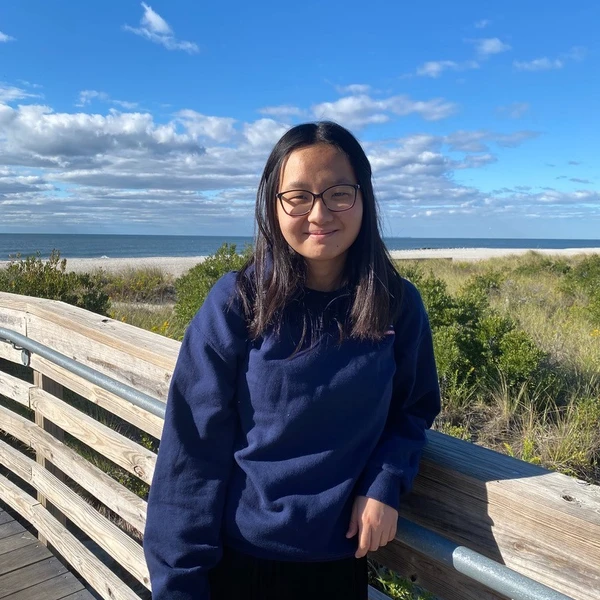
I am an undergraduate Chemical Engineering student at Stony Brook University with a minor in Marine Science. I have a deep love and curiosity for our planet, and I hope to pursue a career in innovative climate solutions. I especially hope to work in clean water, clean energy, catalysis and nanomaterials, or waste management. I have been involved in green chemistry research to turn waste material into useful chemicals and catalysts. I am curious and love a good book, especially memoirs of people with great accomplishments or poetry exposing social and environmental topics. Outside of academics, I love hiking, running, photography, spending time outdoors, and admiring musical theater.
Education
Stony Brook University
Bachelor's degree programMajors:
- Chemical Engineering
Minors:
- Marine Sciences
Plainview-Old Bethpage John F Kennedy High School
High SchoolMiscellaneous
Desired degree level:
Bachelor's degree program
Graduate schools of interest:
Transfer schools of interest:
Majors of interest:
- Chemical Engineering
Career
Dream career field:
Renewables & Environment
Dream career goals:
Pushing forward climate tech for innovative environmental solutions
Marine Technician Intern
Urban Assembly New York Harbor School2025 – 2025Climate Intern
New York Climate Exchange2025 – 2025Sustainable Materials Researcher
Energy & Environmental Catalysis Lab2024 – 20251 yearResearch Intern
Xing Research Lab at Hofstra University2023 – 2023
Research
Chemistry
Hofstra University, Plainview Old Bethpage John F Kennedy High School — Primary researcher of the project, collaborated with mentors2022 – 2024Chemical Engineering
Stony Brook University — Primary researcher of the project, collaborated with mentors2024 – 2025Physics
Beamline for Schools, Plainview Old Bethpage John F Kennedy High School — Team leader and member in a team of 5 in writing a proposal for CERN/DESY2023 – 2023Physics
CERN Beamline for Schools, Plainview Old Bethpage John F Kennedy High School — Team leader and member in a group of 6 writing research proposal for CERN2023 – 2024
Arts
Walt Whitman Birthplace Association
Poetry2023 – 2023
Public services
Volunteering
Camp Manatawny — counselor, dishwasher2022 – Present
Future Interests
Advocacy
Volunteering
Philanthropy
Entrepreneurship
Priscilla Shireen Luke Scholarship
Growing up, I was constantly seeing the destructive impact of environmental issues around me. I live near a plume site where my town’s drinking water has been contaminated by local manufacturers decades ago, continuously resulting in high local levels of cancer from industrial chemical exposure to this day. My grandparents are farmers in an area with little resources to advocate for themselves as they face the brunt of climate change on their livelihoods. I remember not seeing a blue sky for months at a time in my elementary school’s city because of the thick smog, being told not to spend time outside to play. Realizing that climate change is a global issue requiring global solution, I am pursuing a degree in chemical engineering where I can conduct quality research toward environmental stewardship.
More than ever, the industry requires innovative solutions and corporate responsibility to ensure that regular people and the land and water around us are not constantly being hurt. I have worked on sustainable materials research by trying to define a mechanism to synthesize metal-fabric composite materials from the massive amounts of clothing waste being produced, which can then be used as a catalyst to clean up water pollutants. I put in countless hours in this project on parsing through complicated literature, collaborating with the research team, and making sense of confusing or inconsistent results. In the coming semester, I will be joining a new research project on improving water treatment membranes, where I hope to work on material science solutions that can directly integrate in my community’s water pollution such as the PFAS leaching from the Brookhaven Landfill or the TCE from the Bethpage plume.
I was also a part of the intern cohort last summer in the New York Climate Exchange, a startup NYC nonprofit working with on-the-ground community-based advocacy projects. I worked on various water pollution projects such as sampling and testing water from the New York Harbor, creating a community proposal on algal bloom monitoring in public parks, and supporting aquaculture education. I also demonstrated solar panel installation to high school students, helped maintain an urban farm’s harvesting and distribution, and delivered a short workshop session on college applications. Through this internship, I worked with a diverse cohort group and collaborated with various organizations in NYC including Bloomberg Philanthropies, EarthMatter, SolarOne, and Waterfront Alliance.
In all my experiences spanning research and nonprofit spaces, I emphasize the importance of bottom-up approach to make real differences. Solutions need to be implemented on a community based level and answer to the specific needs of different areas, and I have loved working with others to address issues through internship and research projects. In the future, I hope to bridge the gap between the lab-to-market jump that prevents many engineering solutions from growing out of the academia space. I have received the opportunity to pursue higher education, and I hope to give back in every way I can to the environment and to people impacted most by climate change. I greatly appreciate the opportunity to be considered for the scholarship, and I will make the most of it by pursuing a career in impactful engineering for environmental issues after graduation.
Immigrant Daughters in STEM Scholarship
As the blonde woman looms over me, I tell myself I would at least catch a “class” or “good morning” or even just my name. But my cute little textbook did nothing to prepare me for a classroom of people speaking gibberish. As she brings me to my desk, I silently gawk as everyone else heads straight to work, scribbling lines across pages like seismographs.
My teacher writes her daily agenda on the whiteboard, “Go Math!” being the last one on the bottom. Finally! I know what this is! I know the word “go”, so naturally, context clues tell me “math” probably means “home”. I get it!
Imagine my disappointment when a two-inch-thick textbook plops onto my desk.
When I first came to the United States, I did not speak English beyond a few words like “hello” and “my name is Chris”. I often find myself looking around me with a sense of shame, starting from behind, clueless about where I am while everyone else walks with confidence. But looking back, I can see that I did not let myself cower and stay idle. In challenging situations, I am someone who always seeks to prove myself and get ahead.
And it starts when I grab a random book off the shelf.
Flipping through the Picasso-like drawings, I squeeze out any bit of storyline I can detect. The bookworm girl. The desperation in the children’s faces as they flee a burning building. The trapezoid arms and triangular fingers waving through the air.Instead of complex lexicons such as “library” and “fire”, I write what I know, “book shop” and “very hot”. I morph multiple people into just two names, “boy” and “girl”. Periods feel like terrifying walls barricading my flow of ideas, so I use exclusively commas until the very end of my monstrous run-on five-line sentence.
I walk to the table at the back of the classroom, pulling up a little chair beside my teacher. I watched as her cherry-red pen covered my page with dots of punctuation and new vocabulary over crossed-out lines. I knew it. My atrocities against the English language are in too deep. Challenge failed.
Yet by the end of her nudging corrections, she smiles. It’s time to move up a reading level, she said.
Now, I have the opportunity to pursue university studies, an opportunity that my grandparents never had. Growing up, I was constantly seeing the destructive impact of environmental issues around me. I live near a plume site where my town’s drinking water has been contaminated by local manufacturers decades ago, continuously resulting in high local levels of cancer from industrial chemical exposure to this day. My grandparents are farmers in an area with little resources to advocate for themselves as they face the brunt of climate change on their livelihoods. All of this spurred me toward pursuing chemical engineering, and I plan to apply my technical background toward a career in environmental technologies.
Technology is a field of people searching the unknown. Studying engineering is like studying a new language, only this time it is a language made up of mathematics and physics. Although the unknown is terrifying, I know I cannot let myself be scared of the unknown. Not if I want to make a real difference.
Bright Lights Scholarship
Growing up, I was constantly seeing the destructive impact of environmental issues around me. I live near a plume site where my town’s drinking water has been contaminated by local manufacturers decades ago, continuously resulting in high local levels of cancer from industrial chemical exposure to this day. My grandparents are farmers in an area with little resources to advocate for themselves as they face the brunt of climate change on their livelihoods. I remember not seeing a blue sky for months at a time in my elementary school’s city because of the thick smog, being told not to spend time outside to play. All of this spurred me toward pursuing chemical engineering, and I plan to apply my technical background toward a career in environmental technologies. I hope to pursue a PhD and conduct research focused on lab-to-market water pollution solutions and bring it to the real world.
After an incredible summer internship with the New York Climate Exchange, I was eager to learn more about the world of innovative climate technologies. I decided to attend various events at the NYC Climate Week. I have always been heavily involved in research, spending countless hours pouring over complex literature and at-times confusing results in my efforts to develop sustainable composite materials to remove industrial pollutants. But at Climate Week, my passion was spurred on even further, especially by one particular event.
At the Climate Tech Fellows Showcase, I watched a cohort of startup founders present their lab-to-market solutions in topics from green hydrogen storage to reef restoration. The most memorable to me was a startup by a young chemical engineering professor to remove trace lead ions from drinking water through waste yeast from beer breweries. For the first time, I can meet, in person, people on their way to bring their research out of the lab and out of traditional science publications and instead, into the business world, with a name and logo of their own and a tangible product they can introduce to the world.
For a long time, I had a major frustration with research projects I loved so much. I put in so much work to develop reaction mechanisms and synthesize materials, yet I wondered what even are the chances anyone will see the fruits. What are the chances that the reaction vials in the lab right now can make it to polluted rivers or water treatment systems? But that day, I can see clearly the difference between science and technology.
At heart, I hope to be a scientist in chemical engineering. I love solving problems and finding new things, and I have a special love for aquatic biomes, protecting our beautiful planets, and doing right by human and ecological respect. However, to truly make a difference, I want to pursue technology. I want to make connections with business, industry, and startup spaces so that the research I do will be made out of the lab one day. After finishing my undergraduate degree, during which I will continue to work on my research projects in water treatment to develop my scientific skills, I hope to pursue a PhD in a project that has the potential to become an actual startup. This scholarship will help me gain the financial freedom to focus on high quality scientific research during my undergraduate studies, allowing me to pour over complex literature and innovative directions while maintaining good academic standing. I deeply appreciate the opportunity and will persevere to one day contribute to a cleaner planet.
Ja-Tek Scholarship Award
I am a Chemical Engineering major with a minor in Marine Sciences. Growing up, I was constantly seeing the destructive impact of environmental issues around me. I live near a plume site where my town’s drinking water has been contaminated by local manufacturers decades ago, continuously resulting in high local levels of cancer from industrial chemical exposure to this day. I see devastating layers of harmful algal bloom stretch across beautiful ponds and ecosystems all over Long Island. My grandparents are farmers in an area with little resources to advocate for themselves as they face the brunt of climate change on their livelihoods. I remember not seeing a blue sky for months at a time in my elementary school’s city because of the thick smog, being told not to spend time outside to play. All of this spurred me toward pursuing chemical engineering, where I can conduct research and gain a technical background I can apply towards environmental stewardship. More than ever, the industry requires innovative solutions and corporate responsibility to ensure that regular people and the land and water around us are not constantly being hurt. At my university, I have worked on sustainable materials research by trying to define a mechanism to synthesize metal-fabric composite materials from the massive amounts of clothing waste being produced, which can then be used as a catalyst to clean up water pollutants. I put in countless hours in this project on parsing through complicated literature, collaborating with the research team, and making sense of confusing or inconsistent results. I was also a part of the intern cohort last summer in the New York Climate Exchange, introducing the engineering perspective in a diverse cohort working with on-the-ground community-based advocacy projects. I found so much fulfillment and purpose in working on water quality related projects in New York City, including sampling and testing water to upkeep a public database of the New York Harbor and presenting my community proposal on algal bloom monitoring in public parks. In the coming semester, I will be joining a new research project on improving water treatment membranes, where I hope to work on material science solutions that can directly integrate my local Long Island community water pollution such as the PFAS leaching from the Brookhaven Landfill or the TCE from the Bethpage plume. Receiving this scholarship will allow me the freedom to focus on high quality scientific research, especially during the onboarding process in the research group. I greatly appreciate the opportunity to be considered for the scholarship, and I will make the most of it by pursuing a career in impactful climate tech after graduation.
Grandmaster Nam K Hyong Scholarship
When wildfire smoke spread to my high school, tinting the air orange with a smell of charcoal, familiar feelings came to me. I was reminded of the elephant sewn on my baby blue mask that I wore in second grade. The dull, gray smog that hovered over the Beijing skyline every day, hiding the blue sky until we forgot its beauty.
The world around us is heading toward a climate catastrophe, and throwing plastic bottles in the recycling bins, while better than nothing, isn’t going to save us. The world is just so big, spinning out of control towards the anxiety of a glaring news screen blasting out disasters after disasters. But I’m not one to sit around. It is my dream to pursue a PhD in environmental engineering and become a research professor so I can dedicate my career to contribute to tangible solutions and a better understanding of our incredible world while mentoring other passionate, curious people.
When I learned that my high school ended its recycling program shortly before my freshman year, I found it disturbing that one of the main reasons is that companies are unwilling to take recyclable material, unable to turn a profit. The immigrant kid in me grew up watching my parents refusing to accept the state of their life, of the world, as it is, sparking in me my first step toward science research. Despite being publicly hailed as a sustainable solution to our plastic waste problem, plastic recycling rates have been underwhelming. In fact, the recycling rate of polystyrene, the class of plastic commonly found in styrofoam and packaging products, is less than one percent in the US despite its hazards to natural environments, including the release of potential carcinogens.
Sixteen-year-old me had no experience in organic chemistry, the nightmare of anyone who had to take the MCAT, yet I was hooked. When I find my new obsessions, nothing can pull me away. Debates over sustainability cannot be separated from other disciplines, especially economics, to implement solutions in the real world. In such an exciting yet exhausting time for science, I found upcycling to be a fascinating development in creating a new sustainable circular economy.
In the unfamiliar, I looked for patterns. In my challenge to better understand overarching recycling systems, my notebook began filling with sketches of experiments and references. Observing similar trends in the literature of initiating hydrogen abstraction to weaken the polymer structure, I decided to look for more efficient, higher-yielding radical abstraction methods, teaching myself concepts such as mechanisms along the way. I might be a naive sixteen-year-old kid, but I am a kid who can teach myself mechanisms and comb through 80-something page documents.
Fenton reaction is a process used in water treatment, but I wondered if it can have a wider application. The reaction is a green oxidative process and is extremely destructive, which can improve efficiency of polystyrene upcycling. In theory, my process can take place in relatively mild conditions compared to conventional mechanical recycling, in ambient temperatures and pressure without the use of harsh or expensive catalysts.
After weeks of combing through local university catalogs, compiling a list of countless professors to cold-email, I was fortunate to be able to find a mentor willing to work with me. Bringing my ideas into a university lab, I was able to synthesize more valuable petroleum-derived phenyl compounds such as benzoic acid from polystyrene commonly found in household trash, providing justification for further experimentation that could find implementation of my results on an industrial scale. A lot more work is needed to truly create a more sustainable circular economy, but I am proud to have contributed a small part to a larger body of scientific knowledge.
In January, more than a year after I first declared my recycling challenge, I was recognized amongst the top three hundred high school seniors in the nation in the Regeneron Science Talent Search for my work and passion for science. In the excitement of the moment, I looked back. It was hours every day added on to my hectic schedule of six AP classes in the middle of college application season and preparing for other competitions. It was sitting by my desk for hours, tracing through spectrums and formulating reports. My brain is pretty much made up of half styrofoam, my lungs of ethyl acetate, my hands of enough organic solvents to make a dermatologist cry. The first polystyrene article I’ve ever read from VirginiaTech led me to some of my highest highs and my worst panic attacks. Yet at the same time, there was something new in me I could not deny.
There was a sense of agency in me, an answer to the frustration inside at the news screens burning my eyes. If I and everyone around me can recognize problems existing in the world, who am I to sit around and wait on whoever as the planet burns?
Scientists used to feel like a fantasy. I knew nobody who would call themselves a scientist. My grandparents are subsistence farmers in a secluded town without many opportunities, and I came to the US knowing very little English. No one in my family studied STEM, and the word “scientist” felt more like a kid saying they wanted to be an astronaut than an actual path legitimate people take.
I always wanted my work to be grounded to the human world. People affected by extreme climate calamities often contribute far less to the climate crisis but are often left to rebuild their lives with already limited resources. As a devastating mark of exploitation, majority world countries see themselves becoming less resilient to future disasters, especially with unequal access to life-saving technologies. An engineer must stay connected to the humanities while applying ecological processes to new innovations, not losing focus on the humans driving their motivations.
I am very fortunate to have family and outside organizations that offer financial resources, but the total cost of college is still very high, especially because my family’s income is not very high for the part of New York we live in. My parents work hard to provide good educational opportunities for me, and I work to make sure their efforts are not in vain. Any scholarship would be extremely helpful, and I am extremely grateful for generous organizations giving students like me a chance to help us fund our education. Over the next few years, I hope to become a part of a larger community of passionate people, encouraging and enabling each other to actively work for a better future. I will take every opportunity to access resources that will help me in the next step of my education that will be crucial to realizing my dreams in academia. One day, I hope to be able to tell little me that I am fighting for a blue sky.
Connie Konatsotis Scholarship
When wildfire smoke spread to my high school, tinting the air orange with smells of charcoal, familiar feelings came to me. I was reminded of the elephant sewn on my baby blue mask that I wore in second grade. The dull, gray smog that hovered over the Beijing skyline every day, hiding the blue sky until we forgot its beauty.
The world around us is heading toward a climate catastrophe, and throwing plastic bottles in the recycling bins, while better than nothing, isn’t going to save us. Sometimes, it feels like the world is just so big, spinning out of control towards the anxiety of a glaring news screen blasting out disasters after disasters. But I am not one to sit around. It is my dream to pursue a PhD in environmental engineering and become a research professor so I can dedicate my career to understanding the incredible world while mentoring other curious, passionate people.
When I learned that my high school ended its recycling program shortly before my freshman year, I found it disturbing that one of the main reasons is that companies are unwilling to take the recyclable material, unable to turn a profit. So, in my challenge to develop solutions in the overarching recycling system, my notebook began filling with sketches of experiments and references, sketches that I had the opportunity to take to a real organic chemistry lab at a local university, working with a professor who took a chance on me.
At the same time, I had the opportunity to form a research team to submit a proposal for the world’s leading physics lab CERN, another chance to use my imagination to apply modern technologies as solutions to environmental issues. I was excited about the prospect of generating high amounts of carbon-free energy through nuclear power, yet keenly aware of the dire consequences. Approaching with hope and caution, I worked with the team to discuss using particle accelerators in the nuclear transmutation of radioactive waste. With our lofty goal, I went from never having heard of the standard model to piecing together experimental models and appropriate surrogate isotopes to test my theory in a matter of months.
So far, my experience in high school pursuing STEM opportunities outside the classroom showed me the sense of creativity and agency in me when I think through looming problems, giving me a sense of purpose that I crave. Scientists used to feel like a fantasy. I knew nobody who would call themselves a scientist. No one in my family studied STEM, and the word “scientist” felt more like a kid saying they want to be an astronaut than an actual path legitimate people take. My grandparents are subsistence farmers in a secluded town without many opportunities. I moved to the US knowing very little English, yet my family has always valued education as the way towards our passions.
Even through the imposter syndrome-filled panic attacks and the late nights staying up tracing through spectrums or cold-emailing professors, there was something new in me that I could not deny. There was a sense of agency in me, an answer to the frustration inside as glaring news screens burn my eyes. There was an obsession in me that no one could pull me away from. If I and everyone around me can recognize problems existing in the world, who am I to sit around and wait on whoever as the planet burns? I crave the creativity that science brings. One day, I hope to be able to tell little me that I am fighting for a blue sky.
Janie Mae "Loving You to Wholeness" Scholarship
“I won’t tell you what to do. I know it’s tough for you, but you have to decide if the happy memories you made with her, if your love for her, outweighs the hurt that you are feeling right now.”
The tween years can be difficult, just as kids learn to develop relationships and work through social problems. Trust me, I’ve had enough of my desperate-to-be-cool middle school flashbacks.
And that led me to my afternoon as a camp counselor, with one pouting, cross-armed girl giving death stares and one weeping for her lost friendship.
And that led me to my afternoon dealing with two of the girls, one giving death stares with her arms crossed and one heartbroken at the thought of losing her friendship.
Me? I’m no Mr. Rogers. I’m just an anxiety-ridden high school kid who managed to spend years in middle school with no friends.
But I couldn’t just pass up a good opportunity for some emotional growth. So, letting one of the girls run to cool off, I sat down with the crying girl, beginning with her story. It turned into an hour of sniffles and hugs, of desperate self-doubt and gentle consolation. I thought back to the kid I was, crying on the last day of school as I watched everyone else make their summer plans while I buried my head alone on the bus. What I needed then is exactly what the girl needed now, to know that she is loved, an affirmation of her worth.
Although it’s only a small portion of the year, camp offers a break from problems kids face in the outside world. And to maintain that safe community, I needed to create an empathetic space, an outlet for a kid’s confusing mess of feelings. Hopefully, the girls can take the toolbox and build a middle school experience better than mine.
As one girl looked to me to give her hugs before bedtime, I thought of the people who were there for me as I navigated my embarrassingly bratty preteenhood. At that moment, I just wanted to let her, and the girls I was responsible for at that time, know their worth and love, even if camp is just a short segment of their summers, through the tear-filled drama and chatty nights.
Three paper bags on my closet door, each of them decorated with stickers and written “you are loved”. A mosaic tile on my bookshelf and elastic bands with rainbow beads, stringing together BFF messages. Emblems in my room, letting me know that the girls felt that impact.
Courage/Yongqi Scholarship
As the blonde woman looms over me, I tell myself I would at least catch a “class” or “good morning” or even just my name. But my cute little textbook did nothing to prepare me for a classroom of people speaking gibberish. As she brings me to my desk, I silently gawk as everyone else heads straight to work, scribbling lines across pages like seismographs.
Being an immigrant kid got frustrating at times, filling me with an isolating sense of inadequacy. Spend a few hours with photocopied pages of my social studies textbook. Recite new words after the sun goes down while everyone else gets to just be kids. Make sure the tears dried up before turning the worksheet in. I can’t even distinguish between “place” and “play”, or “whatever” and “whatsoever.” But at the same time, there was a message for me to hold on to: the world might not be kind, so wherever I want to go, I have to fight for it.
Years later, when the wildfire smoke spread to my high school, tinting the atmosphere orange and the air with burnt smells, familiar feelings came to me. I was reminded of the elephant sewn on my baby blue mask that I wore in second grade. The dull, gray smog that hovered over the Beijing skyline every day, hiding the blue sky until we forgot its beauty. I came to develop a deep discomfort at the lack of progress toward change necessary to ensure our planet’s survival, a discomfort that stayed with me as I now pursue my degree in chemical engineering as one step towards dedicating my career to sustainability.
When I learned that my high school ended its recycling program shortly before my freshman year, I found it disturbing that one of the main reasons is that companies are unwilling to take recyclable material, unable to turn a profit. The immigrant kid in me grew up watching my parents refusing to accept the state of their life, of the world, as it is, sparking in me my first step toward science research. Despite being publicly hailed as a sustainable solution to our plastic waste problem, plastic recycling rates have been underwhelming. In fact, the recycling rate of polystyrene, the class of plastic commonly found in styrofoam and packaging products, is less than one percent in the US despite its hazards to natural environments, including the release of potential carcinogens. Perhaps it’s my weird obsession with the hexagonal phenyl group or the novelty of organic chemistry as a whole. But when I find my new obsessions, nothing can pull me away.
I am proud of my heritage and my family’s drive, yet I often find myself looking around me with a sense of shame, starting behind the starting line, clueless about my place in the world while everyone else walks with confidence. I hope to pursue science research in academia, an entire field of people searching the unknown. It’s terrifying, but I know I cannot let myself be scared of the unknown. The same way I pushed myself to write an essay in a foreign language or cold-email chemistry professors for anyone willing to take a chance on me, I had to and will have to lose my safety net over and over again, starting over from the ABCs.
In January, more than a year after I declared my recycling challenge, I was recognized amongst the top three hundred high school seniors in the nation in the Regeneron Science Talent Search for my work and passion for science. In the excitement of the moment, I looked back. It was hours every day added to my hectic schedule of six AP classes in the middle of college application season and preparing for other competitions. It was sitting by my desk late at night, tracing through spectrums and formulating papers and cold-emailing local professors. My brain is pretty much made up of half styrofoam, my lungs of ethyl acetate, my hands of enough organic solvents to make a dermatologist cry. The first polystyrene article I’ve ever read from VirginiaTech led me to some of my highest highs and my worst panic attacks. It led to me coming home with a breakdown every day, to me holding back tears in the physical chemistry lab at an OPUS tab that crashed for the fifth time, to me sitting in the NMR lab in the basement next to the adjunct offices.
Scientists used to feel like a fantasy. I knew nobody who would call themselves a scientist. My grandparents are subsistence farmers in a secluded town without many opportunities. No one in my family studied STEM, and the word “scientist” felt more like a kid saying they wanted to be an astronaut than an actual path legitimate people take. Yet even through the world spinning around me, my legs weakening as I walked up the stairs to the lab, there was something new in me that I could not deny. There was a sense of agency in me, an answer to the frustration inside as glaring news screens burned my eyes. If I and everyone around me can recognize problems existing in the world, who am I to sit around and wait on whoever as the planet burns?
Now, I crave the creativity that science brings. It is my dream to pursue a PhD in environmental engineering and become a research professor, enabling me to dedicate my career to the development of tangible solutions to major environmental problems looming over us all while mentoring other curious people. And one day, I hope to be able to tell little me that I am fighting for a blue sky.
“Remember how little English you knew? Look at you now,” the blonde woman I met, my teacher, says to me two years later, watching me win my first writing competition.
John Young 'Pursue Your Passion' Scholarship
When the Canadian wildfire smoke spread to my Long Island high school, familiar feelings came to me. I was reminded of the elephant sewn on my baby blue mask that I wore in second grade. The dull, gray smog that hovered over the Beijing skyline every day, hiding the blue sky until we forgot its beauty.
The world around us is heading toward a climate catastrophe, and throwing plastic bottles in the recycling bins, while better than nothing, isn’t going to save us. Sometimes, it feels like the world is just so big, spinning out of control while my mind confine itself to the anxiety of a glaring news screen blasting out disasters after disasters. However, I refuse to waste my time and the planet away.
I plan to study chemical engineering with a minor in environmental engineering at Stony Brook University. I plan on pursuing ambitious research, taking advantage of my close proximity to the Brookhaven National Lab. I am especially interested in studying alternative energy and polymer science, and I hope that my work will result in advancing science and lead to developing real, tangible solutions to environmental challenges facing us, ultimately serving communities impacted the most by the climate crisis.
When I learned that my school ended its recycling program shortly before my freshman year, I found it disturbing that one of the main reasons is that companies are unwilling to take the recyclable material, unable to turn a profit. So, in my challenge to develop solutions in the overarching recycling system, my notebook began filling with sketches of experiments and references, sketches that I had the opportunity to take to a real organic chemistry lab at a local university, working with a professor who took a chance on me.
From conducting my chemical upcycling research to writing proposals for one of the most prestigious physics labs in the world, I always wanted my work to be connected, grounded to the human world. My grandparents are subsistence farmers in a secluded town without many opportunities. I moved to the US knowing very little English, yet my family has always valued education as the way towards our passions.
I am fascinated in grappling with the intersection of STEM and the humanities. People affected by extreme climate calamities often contribute far less to the climate crisis but are often left to rebuild their lives with already limited resources. As a devastating mark of exploitation, majority world countries see themselves becoming less resilient to future disasters, especially with unequal access to life-saving technologies. An engineer must stay connected to the humanities while applying ecological processes to new innovations, not losing focus on the humans driving their motivations.Over the next few years, I will become a part of a larger community of passionate people, encouraging and enabling each other to actively work to put my curiosities towards change. I hope to be able to tell little me that I am fighting for a blue sky.
Hines Scholarship
When the Canadian wildfire smoke spread to my Long Island high school, familiar feelings came to me. I was reminded of the elephant sewn on my baby blue mask that I wore in second grade. The dull, gray smog that hovered over the Beijing skyline every day, hiding the blue sky until we forgot its beauty.
The world around us is heading toward a climate catastrophe, and throwing plastic bottles in the recycling bins, while better than nothing, isn’t going to save us. Sometimes, it feels like the world is just so big, spinning out of control while my mind confine itself to the anxiety of a glaring news screen blasting out disasters after disasters. However, I refuse to waste my time and the planet away.
I plan to study chemical engineering with a minor in environmental engineering at Stony Brook University. I plan on pursuing ambitious research, taking advantage of my close proximity to the Brookhaven National Lab. I am especially interested in studying alternative energy and polymer science, and I hope that my work will result in advancing science and lead to developing real, tangible solutions to environmental challenges facing us, ultimately serving communities impacted the most by the climate crisis.
When I learned that my school ended its recycling program shortly before my freshman year, I found it disturbing that one of the main reasons is that companies are unwilling to take the recyclable material, unable to turn a profit. So, in my challenge to develop solutions in the overarching recycling system, my notebook began filling with sketches of experiments and references, sketches that I had the opportunity to take to a real organic chemistry lab at a local university, working with a professor who took a chance on me.
At the same time, I had the opportunity to form a research team to submit a proposal for the world’s leading physics lab CERN, another chance to use my imagination to apply modern technologies as solutions to environmental issues. I was excited about the prospect of generating high amounts of carbon-free energy through nuclear power, yet keenly aware of the dire consequences. Approaching with hope and caution, I worked with the team to discuss using particle accelerators in the nuclear transmutation of radioactive waste. With our lofty goal, I went from never having heard of the standard model to piecing together experimental models and appropriate surrogate isotopes to test my theory in a matter of months.
I always wanted my work to be connected, grounded to the human world. My grandparents are subsistence farmers in a secluded town without many opportunities. I moved to the US knowing very little English, yet my family has always valued education as the way towards our passions. I am fascinated in grappling with the intersection of STEM and the humanities. People affected by extreme climate calamities often contribute far less to the climate crisis but are often left to rebuild their lives with already limited resources. As a devastating mark of exploitation, majority world countries see themselves becoming less resilient to future disasters, especially with unequal access to life-saving technologies. An engineer must stay connected to the humanities while applying ecological processes to new innovations, not losing focus on the humans driving their motivations. Over the next few years, I will become a part of a larger community of passionate people, encouraging and enabling each other to actively work to put my curiosities towards change. I hope to be able to tell little me that I am fighting for a blue sky.
Kenyada Me'Chon Thomas Legacy Scholarship
“Have you guys heard about COP27?”
To my surprise, no one raised their hands. This will be interesting.
When I joined my school’s Environmental Club, it was like reviving a dying team. Meeting attendance was often in the single digit, ravaged by the impact of covid on student interest. But it was also a new opportunity for me to work with the other members holding on for a fresh start. One of my visions for the club is to discuss topics we don’t hear about in our classes, to offer people a look at what is going on in the world.
When I learned that my school ended its recycling program shortly before my freshman year, I found it disturbing that one of the main reasons is that companies are unwilling to take the recyclable material, unable to turn a profit. So, in my challenge to develop solutions in the overarching recycling system, my notebook began filling with sketches of experiments and references.
As I searched through local universities and found opportunities to conduct my chemical recycling experiments in a college-level lab, I realized I was facing the same problem again. Even though I had my lab notebook and research reports, most people don’t know what was really behind the recycling system. While I combed through 80-something page EPA reports, my teacher didn’t know what a resin number was until I told him our community did not support polypropylene collection in our recycling program.
“I feel so bad now. I always tossed them in the recycling bin, but now I can’t.”
I realized that to make the most out of the passion I was seeing amongst my peers, I have to keep myself and the club informed about the current going-ons of the world. Therefore, when I discussed club organization with other board members, I had the chance to share my interest in current events. So in addition to our fundraisers and Ecochallenges, I allotted time to bring up local elections and nuclear energy developments to generate good conversations, exploring not only the engineering and ecology aspects of the environment but also ways policies and relations impact everyone.
I am proud of the expansion of the Environmental Club, and I have grown to love the community around me of kids who are passionate about science and taking care of the world. However, I am frustrated at the lack of connections we make to the real world in our general education. We must encompass more of the why’s in our science classes, seeing the bigger picture of our progress so we can challenge the bounds of science and encourage each other to take on more leadership positions, especially in policy-making and research. We are all kids in a part of a larger community of people who want to make the world a better place and appreciate the ecological beauty around us, a community worth preserving.
Elevate Women in Technology Scholarship
I have never heard of a muon before my junior year of high school, but when I found out that the world’s leading physics lab was giving high-schoolers an opportunity to come closer to their work, I knew I had to take the chance.
My teacher took many breaks from the standard mechanics curriculum to make small talks on modern physics. Listening to her describing dark matter and LHC felt absolutely magical, stirring something inside me that just wanted to know more about the crazy, unseen universe behind the scenes.
I have always been fascinated by nuclear energy, from ethics debates about atomic weapons to media portrayals of nuclear disasters compared to those deemed as “acceptable” tragedies. Like many, the development in nuclear fusion that came at the end of 2022 fascinated me. I still remember that winter morning, turning on a podcast from The Economist, hearing the news I had not expected. What seemed like science fiction, creating solar-like conditions on earth to extract energy, seemed like a development closer to us in a few decades.
With an opportunity to form a research team to submit a proposal for CERN, I hoped to use my imagination to apply modern technologies as solutions to environmental issues. I was excited about the prospect of generating high amounts of carbon-free energy through nuclear power, yet keenly aware of the dire consequences. Approaching with hope and caution, I worked with the team to discuss using particle accelerators in the nuclear transmutation of radioactive waste. With an ambitious, lofty goal, I went from never having heard of the standard model to piecing together experimental models and appropriate surrogate isotopes to test my theory in a matter of months.
There is currently heavy pushback against the energy transition based on arguments stemming from the job market, overall cost of new infrastructure, and lack of urgency or importance. To truly meet the consumption threshold today, more reliable energy from nuclear sources should be explored. How we can realistically utilize and implement nuclear fusion as an energy supply is a major science question of the future that I hope to explore with my education. And that Economist episode when I first felt that burning sense of drive and hope in me to embrace technology will stay with me as I pursue my degree in chemical engineering over the next few years.
Eleven Scholarship
As the blonde woman looms over me, I tell myself I would at least catch a “class” or “good morning” or even just my name. But my cute little textbook did nothing to prepare me for a classroom of people speaking gibberish. As she brings me to my desk, I silently gawk as everyone else heads straight to work, scribbling lines across pages like seismographs.
My teacher writes her daily agenda on the whiteboard, “Go Math!” being the last one on the bottom. Finally! I know what this is! I know the word “go”, so naturally, context clues tell me “math” probably means “home”. I get it!
Imagine my disappointment when a two-inch-thick textbook plops onto my desk.
Wasn’t it just an excellent start to my year? All the nights crying in bed, wishing I had the ability to pull up a screen over my head and catalog all my memories. If only I can just scroll to the one vocabulary word I need right in front of my eyes.Spend a few hours with my reading worksheet and photocopied pages of my social studies textbook. Recite new words after the sun goes down while everyone else gets to just be kids. Just make sure the tears dried up before turning it in.
Apathy was so easy. I can’t even distinguish between “place” and “play”, or “whatever” and “whatsoever.” Every night ends hopelessly, taking baby steps when the assignment is to scale up to the clouds and invite the angels down to play for a tea party.
But somehow, someway, I am where I am now.
Another looseleaf paper. Another assignment where the only word I know from the prompt is “what”. But I just have to do something. Anything.
And it starts when I grab a random book off the shelf.
Flipping through the Picasso-like drawings, I squeeze out any bit of storyline I can detect. The bookworm girl. The desperation in the children’s faces as they flee a burning building. The trapezoid arms and triangular fingers waving through the air.Instead of complex lexicons such as “library” and “fire”, I write what I know, “book shop” and “very hot”. I morph multiple people into just two names, “boy” and “girl”. Periods feel like terrifying walls barricading my flow of ideas, so I use exclusively commas until the very end of my monstrous run-on five-line sentence.
I walk to the table at the back of the classroom, pulling up a little chair beside my teacher. I watched as her cherry-red pen covered my page with dots of punctuation and new vocabulary over crossed-out lines. I knew it. My atrocities against the English language are in too deep. Challenge failed.
Yet by the end of her nudging corrections, she smiles.
I often find myself looking around me with a sense of shame, starting from behind, clueless about where I am while everyone else walks with confidence. I want to go into science research in the future, an entire field of people searching the unknown. And although it’s terrifying, I know I cannot let myself be scared of the unknown. Pushing myself beyond my fullest was to talk to more people who cannot speak my native language, losing the safety net of reverting to comfort. It’s working on my own research project investigating the waste management of the ecologically dangerous yet rarely recycled polystyrene plastic. It’s being driven not by my social anxiety but by my sheer passion for environmental protection and bringing dispelling the unknown, pushing the boundaries of what we know of science.
Our Destiny Our Future Scholarship
“He risked his own safety, toiling through the demanding construction to ensure the deserted villagers survived. To this day, visitors flocking to the well all say the water tastes a hint sweeter.”
Teacher Wang told stories. I heard about the man who vowed to do a hundred good deeds everyday, or the nine-year-old boy who lured soldiers into a trap to save his village from destruction. And above all, Chairman Mao.
Yet at home, I heard different stories.
“He buried it when his crew left the village,” my dad chuckled.
School was a confusing mess of true and false. Disturbingly, seven-year-old me was told that when I grow up, I should “wipe out” enemies until “clean”, the word “enemies” referring to an ethnicity. Learning in an environment telling me to hate people I never met and to adore idols who did nothing to earn my respect, I began to recognize the terrifying power of one-sided persuasion. I came to wonder how I would turn out if my parents never instilled a sense of cautious cynicism in me to seek truth.
When I came across an obituary of Dr. Gao Yaojie in the NYT recently, it took less than a minute for me to become completely enthralled by her life. As an OBGYN in Henan, my ancestral province, she became alarmed at the spread of HIV through poor farmers encouraged to sell their blood to unlicensed blood banks. Tens of thousands died from what Dr. Gao called a man-made catastrophe.
Even though I am not pursuing a career in medicine, I became fascinated in grappling with the ethics of engineering and finding a balance between necessary progress and preserving livelihoods. People affected by extreme climate calamities often contribute far less to the climate crisis but are often left to rebuild their lives with already limited resources. As a devastating mark of imperial exploitation, majority world countries may see themselves becoming less resilient to future disasters, especially with unequal access to life-saving technologies. A environmental engineer, a good scientist, must stay connected to the humanities while applying ecological processes to new innovations, not losing focus on the humans driving their motivations. Dr. Gao must have understood this when she decided to jeopardize her career and life to call out medical injustices and cover-ups.
I became involved in independent science research because I wanted to find answers to something that bothered me. When I found out that my school ended its recycling program just before my first year despite high amounts of support from students and staff due to lack of profitability, I started my own investigation into the greater problem of recycling systems all over the globe.
I spent two years developing a novel process to chemically upcycle polystyrene plastic, a common yet dangerous and rarely recycled type of plastic. I searched through resources in local universities. Over the summer, I joined a local organic chemistry professor’s lab to test my idea of oxidizing the polystyrene chain through the Fenton reaction, a reaction used in water treatment to generate hydroxyl radicals. I quickly discovered the thrill and agency in me as I thought through major, looming problems.
Leadership, especially amongst engineers, requires strong faith in truth-seeking. From paying electric bills to going to the doctor’s office, everything in modern life depends on the hard work of talented scientific researchers and engineers. Yet science communication and advocacy is riddled with miscommunication and misinformation, intentional or not.
My passion for science comes from my passion to serve humans. People deserve to know what’s going on around them. People deserve the truth.
Zamora Borose Goodwill Scholarship
When the Canadian wildfire smoke spread to my Long Island high school, familiar feelings came to me. I was reminded of the elephant sewn on my baby blue mask that I wore in second grade. The dull, gray smog that hovered over the Beijing skyline every day, hiding the blue sky until we forgot its beauty.
Even when I couldn’t understand the nuances behind the why’s, I scouted for any explanation I could find. Eavesdrop on adult conversations. Peer at the news on the TV when I should have been asleep. I just wanted to know.
I am passionate about studying the sciences to improve the lives of the most disadvantaged, and I remained curious about the world. I became involved in independent science research because I wanted to find answers to something that bothered me. When I found out that my school ended its recycling program just before my first year despite high amounts of support from students and staff due to lack of profitability, I started my own investigation into the greater problem of recycling systems all over the globe. I spent two years developing a novel process to chemically upcycle polystyrene plastic, a common yet dangerous and rarely recycled type of plastic. Over the summer, I joined a local organic chemistry professor’s lab to test my idea of oxidizing the polystyrene chain through the Fenton reaction, a reaction used in water treatment to generate hydroxyl radicals. I discovered the thrill and agency in me as I thought through major, looming problems, giving me a sense of purpose beyond just wasting my summer away.
In the next few years, I hope to develop and pursue my research ambitions without bounds. I am especially interested in grappling with the ethics of engineering and finding a balance between necessary progress and preserving livelihoods. People affected by extreme climate calamities often contribute far less to the climate crisis but are often left to rebuild their lives with already limited resources. As a devastating mark of imperial exploitation, majority world countries may see themselves becoming less resilient to future disasters, especially with unequal access to life-saving technologies. A good engineer, a good scientist, must stay connected to the humanities while applying ecological processes to new innovations, not losing focus on the humans driving their motivations. Lab work might not be the first thing people think of when picturing ways to give back to communities, but understanding the basics of the world around us is key to developing real solutions that ultimately serve communities.
I know I am very fortunate. I know that the immigration system is much harsher and scarier to many more people, people who might not have parents who understand how to navigate difficult acronyms, people who speak a different native language than me or look different from me. But now that I have the opportunity, I want to use my work to serve.
I always wanted my work to be connected, grounded to the human world. Pursuing continued research into sustainable technology, I hope to answer and work towards the question in my mind as a second grader, to tell little me that I will fight for a blue sky.
Walking In Authority International Ministry Scholarship
“He risked his own safety, toiling through the demanding construction to ensure the deserted villagers survived. To this day, visitors flocking to the well all say the water tastes a hint sweeter.”
Teacher Wang told stories. I heard about the man who vowed to do a hundred good deeds everyday, or the nine-year-old boy who lured soldiers into a trap to save his village from destruction. And above all, Chairman Mao.
Yet at home, I heard different stories.
“He buried it when his crew left the village,” my dad chuckled.
School was a confusing mess of true and false. Disturbingly, seven-year-old me was told that when I grow up, I should “wipe out” enemies until “clean”, the word “enemies” referring to an ethnicity. Learning in an environment telling me to hate people I never met and to adore idols who did nothing to earn my respect, I began to recognize the terrifying power of one-sided persuasion. I came to wonder how I would turn out if my parents never instilled a sense of cautious cynicism in me to seek truth.
When I came across an obituary of Dr. Gao Yaojie in the NYT recently, it took less than a minute for me to become completely enthralled by her life. As an OBGYN in Henan, my ancestral province, she became alarmed at the spread of HIV through poor farmers encouraged to sell their blood to unlicensed blood banks. Tens of thousands died from what Dr. Gao called a man-made catastrophe.
Even though I am not pursuing a career in medicine, I became fascinated in grappling with the ethics of engineering and finding a balance between necessary progress and preserving livelihoods. People affected by extreme climate calamities often contribute far less to the climate crisis but are often left to rebuild their lives with already limited resources. As a devastating mark of imperial exploitation, majority world countries may see themselves becoming less resilient to future disasters, especially with unequal access to life-saving technologies. A environmental engineer, a good scientist, must stay connected to the humanities while applying ecological processes to new innovations, not losing focus on the humans driving their motivations. Dr. Gao must have understood this when she decided to jeopardize her career and life to call out medical injustices and cover-ups.
I became involved in independent science research because I wanted to find answers to something that bothered me. When I found out that my school ended its recycling program just before my first year despite high amounts of support from students and staff due to lack of profitability, I started my own investigation into the greater problem of recycling systems all over the globe.
I spent two years developing a novel process to chemically upcycle polystyrene plastic, a common yet dangerous and rarely recycled type of plastic. I searched through resources in local universities. Over the summer, I joined a local organic chemistry professor’s lab to test my idea of oxidizing the polystyrene chain through the Fenton reaction, a reaction used in water treatment to generate hydroxyl radicals. I quickly discovered the thrill and agency in me as I thought through major, looming problems.
Leadership, especially amongst engineers, requires strong faith in truth-seeking. From paying electric bills to going to the doctor’s office, everything in modern life depends on the hard work of talented scientific researchers and engineers. Yet science communication and advocacy is riddled with miscommunication and misinformation, intentional or not.
My passion for science comes from my passion to serve humans. People deserve to know what’s going on around them. People deserve the truth.
Kayla Nicole Monk Memorial Scholarship
When the Canadian wildfire smoke spread to my Long Island high school, familiar feelings came to me. I was reminded of the elephant sewn on my baby blue mask that I wore in second grade. The dull, gray smog that hovered over the Beijing skyline every day, hiding the blue sky until we forgot its beauty.
Even when I couldn’t understand the nuances behind the why’s, I scouted for any explanation I could find. Eavesdrop on adult conversations. Peer at the news on the TV when I should have been asleep. I just wanted to know.
I am passionate about studying the sciences to improve the lives of the most disadvantaged, and I remained curious about the world. I became involved in independent science research because I wanted to find answers to something that bothered me. When I found out that my school ended its recycling program just before my first year despite high amounts of support from students and staff due to lack of profitability, I started my own investigation into the greater problem of recycling systems all over the globe.
I spent two years developing a novel process to chemically upcycle polystyrene plastic, a common yet dangerous and rarely recycled type of plastic. I searched through resources in local colleges. Over the summer, I joined a local organic chemistry professor’s lab to test my idea of oxidizing the polystyrene chain through the Fenton reaction, a reaction used in water treatment to generate hydroxyl radicals. I quickly discovered the thrill and agency in me as I thought through major, looming problems.
At the same time, I also had the opportunity to form a research team to submit a proposal for the world’s leading physics lab CERN, another chance to use my imagination to apply modern technologies as solutions to environmental issues. I was excited about the prospect of generating high amounts of carbon-free energy through nuclear power, yet keenly aware of the dire consequences. Approaching with hope and caution, I worked with the team to discuss using particle accelerators in the nuclear transmutation of radioactive waste. With an ambitious, lofty goal, I went from never having heard of the standard model to piecing together experimental models and appropriate surrogate isotopes to test my theory in a matter of months.
In the next few years, I hope to develop and pursue my research ambitions without bounds. I am especially interested in grappling with the ethics of engineering and finding a balance between necessary progress and preserving livelihoods. People affected by extreme climate calamities often contribute far less to the climate crisis but are often left to rebuild their lives with already limited resources. As a devastating mark of imperial exploitation, majority world countries may see themselves becoming less resilient to future disasters, especially with unequal access to life-saving technologies. A good engineer, a good scientist, must stay connected to the humanities while applying ecological processes to new innovations, not losing focus on the humans driving their motivations. Lab work might not be the first thing people think of when picturing ways to give back to communities, but understanding the basics of the world around us is key to developing real solutions that ultimately serve communities.
I always wanted my work to be connected, grounded to the human world. Pursuing continued research into sustainable technology, I hope to answer and work towards the question in my mind as a second grader, to tell little me that I will fight for a blue sky.
HM Family Scholarship
When the Canadian wildfire smoke spread to Long Island, familiar feelings came to me. I was reminded of the elephant sewn on my baby blue mask that I wore in second grade. The dull, gray smog that hovered over the Beijing skyline every day, hiding the blue sky until we forgot its beauty.
Even when I couldn’t understand the nuances behind the why’s, I scouted for any explanation I could find. Eavesdrop on adult conversations. Peer at the news on the TV when I should have been asleep. I just wanted to know.
I am passionate about studying the sciences to improve the lives of the most disadvantaged, and I remained curious about the world. I became involved in independent science research because I wanted to find answers to something that bothered me. When I found out that my school ended its recycling program just before my first year despite high amounts of support from students and staff due to lack of profitability, I started my own investigation into the greater problem of recycling systems all over the globe.
I spent two years developing a novel process to chemically upcycle polystyrene plastic, a common yet dangerous and rarely recycled type of plastic. I searched through resources in local colleges. Over the summer, I joined a local organic chemistry professor’s lab to test my idea of oxidizing the polystyrene chain through the Fenton reaction, a reaction used in water treatment to generate hydroxyl radicals. I quickly discovered the thrill and agency in me as I thought through major, looming problems.
At the same time, I also had the opportunity to form a research team to submit a proposal for the world’s leading physics lab CERN, another chance to use my imagination to apply modern technologies as solutions to environmental issues. I was excited about the prospect of generating high amounts of carbon-free energy through nuclear power, yet keenly aware of the dire consequences. Approaching with hope and caution, I worked with the team to discuss using particle accelerators in the nuclear transmutation of radioactive waste. With an ambitious, lofty goal, I went from never having heard of the standard model to piecing together experimental models and appropriate surrogate isotopes to test my theory in a matter of months.
In the next few years, I hope to develop and pursue my research ambitions without bounds. I am especially interested in grappling with the ethics of engineering and finding a balance between necessary progress and preserving livelihoods. People affected by extreme climate calamities often contribute far less to the climate crisis but are often left to rebuild their lives with already limited resources. As a devastating mark of imperial exploitation, majority world countries may see themselves becoming less resilient to future disasters, especially with unequal access to life-saving technologies. A good engineer, a good scientist, must stay connected to the humanities while applying ecological processes to new innovations, not losing focus on the humans driving their motivations.
I know I am fortunate. I know that the immigration system is much scarier to many more people, people who might not have parents who understand how to navigate difficult acronyms, people whose native country is different than mine or look different from me. But now that I have the opportunity, I want to use my work to serve.
I always wanted my work to be connected, grounded to the human world. Pursuing continued research into sustainable technology, I hope to answer and work towards the question in my mind as a second grader, to tell little me that I will fight for a blue sky.
Morgan Levine Dolan Community Service Scholarship
When the Canadian wildfire smoke spread to my Long Island high school, familiar feelings came to me. I was reminded of the elephant sewn on my baby blue mask that I wore in second grade. The dull, gray smog that hovered over the Beijing skyline every day, hiding the blue sky until we forgot its beauty.
Even when I couldn’t understand the nuances behind the why’s, I scouted for any explanation I could find. Eavesdrop on adult conversations. Peer at the news on the TV when I should have been asleep. I just wanted to know.
I am passionate about studying the sciences to improve the lives of the most disadvantaged, and I remained curious about the world. I became involved in independent science research because I wanted to find answers to something that bothered me. When I found out that my school ended its recycling program just before my first year despite high amounts of support from students and staff due to lack of profitability, I started my own investigation into the greater problem of recycling systems all over the globe.
I spent two years developing a novel process to chemically upcycle polystyrene plastic, a common yet dangerous and rarely recycled type of plastic. I searched through resources in local colleges, cold-emailing professors and spending hundreds of hours teaching myself orgo concepts. Over the summer, I joined a local organic chemistry professor’s lab to test my idea of oxidizing the polystyrene chain through the Fenton reaction, a reaction used in water treatment to generate hydroxyl radicals. I quickly discovered the thrill and agency in me as I thought through major, looming problems, and my project was later recognized by the Regeneron Science Talent Search as one of the top three hundred high school seniors in the nation in my potential as a future scientist.
In the next few years, I hope to develop and pursue my research ambitions without bounds. I am especially interested in grappling with the ethics of engineering and finding a balance between necessary progress and preserving livelihoods. People affected by extreme climate calamities often contribute far less to the climate crisis but are often left to rebuild their lives with already limited resources. As a devastating mark of imperial exploitation, majority world countries may see themselves becoming less resilient to future disasters, especially with unequal access to life-saving technologies. A good engineer, a good scientist, must stay connected to the humanities while applying ecological processes to new innovations, not losing focus on the humans driving their motivations. Lab work might not be the first thing people think of when picturing ways to give back to communities, but understanding the basics of the world around us is key to developing real solutions that ultimately serve communities.
I know I am very fortunate. I know that the immigration system is much harsher and scarier to many more people, people who might not have parents who understand how to navigate difficult acronyms, people who speak a different native language than me or look different from me. But now that I have the opportunity, I want to use my work to serve.
I always wanted my work to be connected, grounded to the human world. Pursuing continued research into sustainable technology, I hope to answer and work towards the question in my mind as a second grader, to tell little me that I will fight for a blue sky.
William A. Stuart Dream Scholarship
When the Canadian wildfire smoke spread to Long Island, familiar feelings came to me. I was reminded of the elephant sewn on my baby blue mask that I wore in second grade. The dull, gray smog that hovered over every day, hiding the blue sky until we forgot its beauty.
Even when I couldn’t understand the nuances behind the why’s, I scouted for any explanation I could find. Eavesdrop on adult conversations. Peer at the news on the TV when I should have been asleep. I just wanted to know.
My curiosity never left me. I am passionate about studying the sciences to improve the lives of the most disadvantaged. I spent my junior and senior year finding a novel process to chemically upcycle polystyrene plastic, a common yet dangerous and rarely recycled type of plastic. Over the summer, I joined a university lab to test my idea of oxidizing the polystyrene chain through the Fenton reaction, a reaction used in water treatment to generate hydroxyl radicals. I quickly discovered the thrill and agency in me as I thought through major, looming problems. I also had the opportunity to form a research team to submit a proposal for the world’s leading physics lab CERN, another chance to use my imagination to apply modern technologies as solutions to environmental issues. I was excited about the prospect of generating high amounts of carbon-free energy through nuclear power, yet keenly aware of the dire consequences. Approaching with hope and caution, I worked with the team to discuss using particle accelerators in the nuclear transmutation of radioactive waste. With an ambitious, lofty goal, I went from never having heard of the standard model to piecing together experimental models and appropriate surrogate isotopes to test my theory in a matter of months.
In the next few years, I hope to develop and pursue my research ambitions without bounds. I am especially interested in grappling with the ethics of engineering and finding a balance between necessary progress and preserving livelihoods. People affected by extreme climate calamities often contribute far less to the climate crisis but are often left to rebuild their lives with already limited resources. As a devastating mark of imperial exploitation, majority world countries may see themselves becoming less resilient to future disasters, especially with unequal access to life-saving technologies. A environmental engineer, a good scientist, must stay connected to the humanities while applying ecological processes to new innovations, not losing focus on the humans driving their motivations. Lab work might not be the first thing people think of when picturing ways to give back to communities, but understanding the basics of the world around us is key to developing real solutions that ultimately serve communities.
Shays Scholarship
When the Canadian wildfire smoke spread to Long Island, familiar feelings came to me. I was reminded of the elephant sewn on my baby blue mask that I wore in second grade. The dull, gray smog that hovered over every day, hiding the blue sky until we forgot its beauty.
Even when I couldn’t understand the nuances behind the why’s, I scouted for any explanation I could find. Eavesdrop on adult conversations. Peer at the news on the TV when I should have been asleep. I just wanted to know.
My curiosity never left me. I am passionate about studying the sciences to improve the lives of the most disadvantaged. I spent my junior and senior year finding a novel process to chemically upcycle polystyrene plastic, a common yet dangerous and rarely recycled type of plastic. Over the summer, I joined a university lab to test my idea of oxidizing the polystyrene chain through the Fenton reaction, a reaction used in water treatment to generate hydroxyl radicals. I quickly discovered the thrill and agency in me as I thought through major, looming problems. I also had the opportunity to form a research team to submit a proposal for the world’s leading physics lab CERN, another chance to use my imagination to apply modern technologies as solutions to environmental issues.
When I found out that the world’s leading physics lab was giving high-schoolers an opportunity to come closer to their work, I knew I had to take the chance.
My teacher took many breaks from the standard mechanics curriculum to make small talks on modern physics. Listening to her describing dark matter and LHC felt absolutely magical, stirring something inside me that just wanted to know more about the crazy, unseen universe behind the scenes.
I was excited about the prospect of generating high amounts of carbon-free energy through nuclear power, yet keenly aware of the dire consequences. With my team, we discuss using particle accelerators in the nuclear transmutation of radioactive waste. With an ambitious, lofty goal, we spent months, afterschool at the library or leeching onto Panera’s wifi, piecing together experimental models and appropriate surrogate isotopes to feasibly test our theory.
Now, in our second year together, we will once again tackle a new challenge: condensing the scattering of proton beam to improve the precision of proton therapy in brain tumor treatments. I cannot wait to see what we will submit in April.
In the next few years, I hope to develop and pursue my research ambitions without bounds. I am especially interested in grappling with the ethics of engineering and finding a balance between necessary progress and preserving livelihoods. People affected by extreme climate calamities often contribute far less to the climate crisis but are often left to rebuild their lives with already limited resources. As a devastating mark of imperial exploitation, majority world countries may see themselves becoming less resilient to future disasters, especially with unequal access to life-saving technologies. A environmental engineer, a good scientist, must stay connected to the humanities while applying ecological processes to new innovations, not losing focus on the humans driving their motivations. Lab work might not be the first thing people think of when picturing ways to give back to communities, but understanding the basics of the world around us is key to developing real solutions that ultimately serve communities.
Julie Holloway Bryant Memorial Scholarship
As the blonde woman looms over me, I tell myself I would at least catch a “class” or “good morning” or even just my name. But my cute little textbook did nothing to prepare me for a classroom of people speaking gibberish. As she brings me to my desk, I silently gawk as everyone else heads straight to work, scribbling lines across pages like seismographs.
My teacher writes her daily agenda on the whiteboard, “Go Math!” being the last one on the bottom. Finally! I know what this is! I know the word “go”, so naturally, context clues tell me “math” probably means “home”. I get it!
Imagine my disappointment when a two-inch-thick textbook plops onto my desk.
Wasn’t it just an excellent start to my year? All the nights crying in bed, wishing I had the ability to pull up a screen over my head and catalog all my memories. If only I can just scroll to the one vocabulary word I need right in front of my eyes.Spend a few hours with my reading worksheet and photocopied pages of my social studies textbook. Recite new words after the sun goes down while everyone else gets to just be kids. Just make sure the tears dried up before turning it in.
Apathy was so easy. I can’t even distinguish between “place” and “play”, or “whatever” and “whatsoever.” Every night ends hopelessly, taking baby steps when the assignment is to scale up to the clouds and invite the angels down to play for a tea party.
But somehow, someway, I am where I am now.
Another looseleaf paper. Another assignment where the only word I know from the prompt is “what”. But I just have to do something. Anything.
Starting with grabbing a random book off the shelf.
Flipping through the Picasso-like drawings, I squeeze out any bit of storyline I can detect. The bookworm girl. The desperation in the children’s faces as they flee a burning building. The trapezoid arms and triangular fingers waving through the air.Instead of complex lexicons such as “library” and “fire”, I write what I know, “book shop” and “very hot”. I morph multiple people into just two names, “boy” and “girl”. Periods feel like terrifying walls barricading my flow of ideas, so I use exclusively commas until the very end of my monstrous run-on five-line sentence.
I walk to the table at the back of the classroom, pulling up a little chair beside my teacher. I watched as her cherry-red pen covered my page with dots of punctuation and new vocabulary over crossed-out lines. I knew it. My atrocities against the English language are in too deep. Challenge failed.
Yet by the end of her nudging corrections, she smiles. It’s time to move up a reading level, she said.
I often find myself looking around me with a sense of shame, starting from behind, clueless about where I am while everyone else walks with confidence. I want to go into science research in the future, an entire field of people searching the unknown. And although it’s terrifying, I know I cannot let myself be scared of the unknown. Paying it forward is pushing myself to talk to more people who cannot speak my native language, losing the safety net of reverting to comfort. It’s working on my own research project investigating the waste management of the ecologically dangerous yet rarely recycled polystyrene plastic. It’s being driven not by my social anxiety but by my sheer passion for environmental protection and bringing dispelling the unknown, pushing the boundaries of what we know of science.
William Griggs Memorial Scholarship for Science and Math
When the Canadian wildfire smoke spread to Long Island, familiar feelings came to me. I was reminded of the elephant sewn on my baby blue mask that I wore in second grade. The dull, gray smog that hovered over every day, hiding the blue sky until we forgot its beauty.
Even when I couldn’t understand the nuances behind the why’s, I scouted for any explanation I could find. Eavesdrop on adult conversations. Peer at the news on the TV when I should have been asleep. I just wanted to know.
My curiosity never left me. I am passionate about studying the sciences to improve the lives of the most disadvantaged. I spent my junior and senior year finding a novel process to chemically upcycle polystyrene plastic, a common yet dangerous and rarely recycled type of plastic. Over the summer, I joined a university lab to test my idea of oxidizing the polystyrene chain through the Fenton reaction, a reaction used in water treatment to generate hydroxyl radicals. I quickly discovered the thrill and agency in me as I thought through major, looming problems. I also had the opportunity to form a research team to submit a proposal for the world’s leading physics lab CERN, another chance to use my imagination to apply modern technologies as solutions to environmental issues. I was excited about the prospect of generating high amounts of carbon-free energy through nuclear power, yet keenly aware of the dire consequences. Approaching with hope and caution, I worked with the team to discuss using particle accelerators in the nuclear transmutation of radioactive waste. With an ambitious, lofty goal, I went from never having heard of the standard model to piecing together experimental models and appropriate surrogate isotopes to test my theory in a matter of months.
In the next few years, I hope to develop and pursue my research ambitions without bounds. I am especially interested in grappling with the ethics of engineering and finding a balance between necessary progress and preserving livelihoods. People affected by extreme climate calamities often contribute far less to the climate crisis but are often left to rebuild their lives with already limited resources. As a devastating mark of imperial exploitation, majority world countries may see themselves becoming less resilient to future disasters, especially with unequal access to life-saving technologies. A environmental engineer, a good scientist, must stay connected to the humanities while applying ecological processes to new innovations, not losing focus on the humans driving their motivations. Lab work might not be the first thing people think of when picturing ways to give back to communities, but understanding the basics of the world around us is key to developing real solutions that ultimately serve communities.
New Kids Can Scholarship
I skip across the streets, my mom by my side.
“I wish that one day, you can tell your story in English”, she says to me as I tell her about this absolutely incredible monkey.
Her words cut through my energetic streak.
How could I possibly do that?
As the blonde woman looms over me, I tell myself I would at least catch a “class” or “good morning” or even just “Chris”. But my cute little textbook did nothing to prepare me for a classroom of people speaking gibberish. As she brings me to my desk, I silently gawk as everyone else heads straight to work, scribbling lines across pages like seismographs.
My teacher writes her daily agenda on the whiteboard, “Go Math!” being the last one on the bottom. Finally! I know what this is! I know the word “go”, so naturally, context clues tell me “math” probably means “home”. I get it!
Imagine my disappointment when a two-inch-thick textbook plops onto my desk.
Just an excellent start to the year, perhaps. In my dream, my superpower is the ability to pull up a screen over my head and catalog all my memories. If only I can just scroll to the one vocabulary word I need right in front of my eyes.
The crushing reality comes to me during homework as I swipe up at the air above my forehead. Nothing comes up.
Fine. Let’s do it the old-fashioned way. Spend a few hours with my reading worksheet and photocopied pages of my social studies textbook. Recite new words after the sun goes down while everyone else gets to just be kids. Just make sure the tears dried up before turning it in.
But apathy was so easy. I can’t even distinguish between “place” and “play”, or “whatever” and “whatsoever.” Every night ends hopelessly, taking baby steps when the assignment is to scale up to the clouds and invite the angels down to play for a tea party.
I wasn't just the new kid in a new school, but a new kid in a new country.
But somehow, someway, I am where I am now.
And I couldn’t have just sat in a classroom forever.
Another looseleaf paper. Another assignment where the only word I know from the prompt is “what”. But I just have to do something. Anything.
And it starts when I grab a random book off the shelf.
Flipping through the Picasso-like drawings, I squeeze out any bit of storyline I can detect. The bookworm girl. The desperation in the children’s faces as they flee a burning building. The trapezoid arms and triangular fingers waving through the air.
Instead of complex lexicons such as “library” and “fire”, I write what I know, “book shop” and “very hot”. I morph multiple people into just two names, “boy” and “girl”. Periods feel like terrifying walls barricading my flow of ideas, so I use exclusively commas until the very end of my monstrous run-on five-line sentence.
I walk to the table at the back of the classroom, pulling up a little chair beside my teacher.
Her cherry-red pen covers my page with dots of punctuation and new vocabulary over crossed-out lines. I knew it. My atrocities against the English language are in too deep. Challenge failed.
Yet by the end of her nudging corrections, she smiles.
“Are you still reading from the C bin?”
“Yes,” I reply.
“Looks like it’s time for G and H.”