user profile avatar

Christin Lee

1x

Finalist

Bio

Hello, I’m Christin Lee! I’m a queer undergraduate at Texas A&M University and earned my associate's in simulation and game design at Blinn. I’m the lead artist in many of my class’s development team projects. I’m very passionate about art and game development, which is why I’m so dedicated to working hard in school to achieve my dream career (game developer!). In addition, I am collaborating with some of my classmates to develop a video game. For this project, I’m working as the lead artist and designer. I’m really excited to share my work with the world and include it in my portfolio. Currently, I am saving up to earn my Bachelor's and need all the help I can get. Thank you so much!

Education

Texas A&M University- College Station

Bachelor's degree program
2025 - 2028
  • Majors:
    • Fine and Studio Arts
    • Computer Software and Media Applications
    • Visual and Performing Arts, General
  • Minors:
    • Fine and Studio Arts
  • GPA:
    3.7

Blinn College

Associate's degree program
2022 - 2025
  • Majors:
    • Computer Software and Media Applications
  • GPA:
    3.6

Brenham H S

High School
2018 - 2022
  • GPA:
    3.8

Miscellaneous

  • Desired degree level:

    Bachelor's degree program

  • Graduate schools of interest:

  • Transfer schools of interest:

  • Majors of interest:

  • Not planning to go to medical school
  • Career

    • Dream career field:

      • Computer Games
    • Dream career goals:

      Creating a game that will set the standard of excellence in the game development field.

    • Assistant Manager

      Stone Hollow Apartments
      2024 – 20251 year
    • Front Desk, Sign In and Check In

      Brenham Fitness Center
      2022 – 20242 years
    • Associate

      Burger King
      2021 – 20221 year
    • Clerk

      Five Below
      2022 – 20231 year

    Sports

    Weightlifting

    Club
    2025 – Present1 year

    Research

    • Health Professions and Related Clinical Sciences, Other

      HOSA — Member
      2020 – 2022

    Arts

    • Texas A&M

      Sculpture
      2026 – Present
    • Texas A&M

      Drawing
      2025 – Present
    • Texas A&M

      Painting
      2026 – Present
    • Delinquent Ducks

      Graphic Art
      2023 – Present
    • Art Club

      Drawing
      2021 – 2022

    Public services

    • Volunteering

      MCJROTC — Flag Rep
      2020 – 2021
    • Volunteering

      HOSA — Member
      2020 – 2022
    • Volunteering

      MCJROTC — Assistant Retail
      2020 – 2020

    Future Interests

    Advocacy

    Volunteering

    Philanthropy

    Entrepreneurship

    WCEJ Thornton Foundation Low-Income Scholarship
    Financial hardship, so far, has shaped every step of my educational journey. When I began pursuing my associate's degree at Blinn College, I did not feel ready to take on student loan debt, so I worked full-time for nearly a year to save enough money to pay tuition myself. I attended lectures during the day and worked evenings, weekends, and holidays until I earned my degree. Every credit hour represented savings I had earned through my own labor, and completing that degree taught me the heavy weight of financing an education alone. That same determination carried me to Texas A&M, where I now pursue a bachelor's degree in Visualization within the PVFA program. To continue my education, I moved from the small town of Brenham to College Station, and took a risk I still consider one of the boldest decisions of my life. My daily life runs on a tight margin, and yet every semester brings me closer to the future I have envisioned since I first fell in love with digital art. Higher education at Texas A&M has given me access to tools, mentorship, and technical training I could never acquire on my own. Within the Visualization program, I study 3D modeling, digital sculpting, animation principles, and the technical foundations of game development. These disciplines demand expensive software, intensive hardware, and the guidance of experienced faculty. My professors have consistently challenged me to refine my work beyond what I thought possible and push me toward the level of craftsmanship the industry demands. I approach every project with the goal of producing quality work worthy of the professional world I hope to join soon. When I graduate, I intend to enter game development and desire to contribute to game design studios that create meaningful story-driven experiences. My commitment to visualization extends beyond personal ambition, as I want my art to reach people who feel unseen. Growing up in a turbulent household following the violent aftermath of my parents’ divorce, I found refuge in the games and stories other artists had created. Those worlds reminded me that someone, somewhere, understood what it felt like to discover a sense of wonder, even in the most difficult of circumstances. I intend to create work that offers that same comfort to others. I hope, that one day, when a player explores a world I have modeled or engages with a character I have brought to life, they will find a sense of community and understanding. I also hope to serve as living evidence for students who share my background. My degree represents proof that ambitious goals remain achievable for students whose paths begin in financial hardship. Every scholarship I earn, every artwork I create, and every course I complete adds to the case I am building for anyone watching. My degree in Visualization will equip me with the ability tell stories that matter, to build worlds that welcome others, and to demonstrate through my own life that determination has carried me from difficult circumstances toward the fullest pursuit of the work I love.
    RonranGlee Literary Scholarship
    Selected passage: "But nothing damages good character like lounging at the public games — because that’s when vice slips in through the door of pleasure. What do I mean? I mean I come home greedier, more self-seeking, more given to indulgence — even crueler and more inhuman — simply because I’ve been among human beings." Seneca, Letters from a Stoic, Letter VII. When Seneca writes that "nothing damages good character like lounging at the public games," he is making a claim that warrants a measure of surprise. He could have warned Lucilius against thieves, against political enemies, against the openly vicious men who lined the corridors of Roman power. What I recognize instead is that he singles out a threat that lingers in the unguarded ease of an afternoon at the arena and damages one's own character. The word he uses for our posture at the games suggests reclining, idling, and opening oneself to entertainment. And it is precisely in this posture, Seneca insists, that we are most vulnerable to a moral injury. What the passage argues, beneath its specific complaint about the arena, is that vice enters the soul most easily through what we welcome, that the crowd is the environment in which our native compassion and character are lost. Vice, Seneca says, slips in through the door of pleasure. Vice does not break down this metaphorical door, nor does it arrive announced. Vice does not have to overpower the will, for the will, in pleasure, has already turned its back. The image is of an intruder who walks in beside the music, laughter, and gifts thrown into the crowd. For Seneca, there is a kind of threshold inside the soul, a place where reason stands as a guard against what would corrupt us. We cross the threshold every time we make a judgment, every time we choose to be one thing rather than another, and pleasure is the condition under which the guard sleeps. We do not notice him sleeping, nor that something has gone past him unnoticed, and we discover the damage afterward, when we are at home again and find ourselves a little different. Seneca says he returns from the games "greedier, more self-seeking, more given to indulgence, even crueler and more inhuman." He is greedier because the arena is where men gamble and trade and feast within sight of one another, and where the lower class and incarcerated provide the entertainment on the fighting stage. He is more self-seeking because the crowd cheers, and he feels the thinness of his life by comparison with the men in the ring whom thousands are watching. He is more inclined toward indulgence because the senses have spent the day in a bath of food and wine and blood, and the soul that has been treated this way comes home expecting more of the same. Each of these changes is a moral inventory of how an afternoon among the mob has mutated one's character. Cruelty and inhumanity sit at the end of Seneca's list because they have the greatest negative impact upon one's character. Greed and luxury are degradations of a recognizable kind, as we know how a person becomes covetous or soft. Cruelty is a corruption of something deeper, and to be cruel is to take pleasure in another's suffering. Cruelty is a movement of the soul that we know, as Seneca knows, runs counter to what we are, for we are creatures whose nature draws us toward our kind. The Stoic tradition has a name for this disposition, "oikeiosis," the natural affection that begins as self-preservation in the infant and widens outward into care for one's family, one's friends, one's city, and finally for the human race as such. To be human in the Stoic sense is to recognize that the suffering of another human being is your concern. And the man fighting another man in the arena is a fellow citizen of the rational world, and his pain should register in you as your own. Yet in the arena, that registration is overturned. How? Seneca's answer is what his letter is named for: crowds. The mechanism is the mob itself. If one stood alone before a man being killed, it is doubtful that anyone would clap. However, if one were sitting in a stadium of fifty thousand clapping people, almost everyone would. The compassion that is native to us is a quiet thing, and it can be drowned out when the roar of approval around you is louder than the small voice within you that says the act is wrong, and after a while, you stop hearing the voice at all, because you have begun to hear yourself in the roar. What happens on the sand remains the same, but what changes is what the act means to those watching. A killing in the street is a horror, but a killing at the games is a show. This is what Seneca finds so frightening. The mob does not have to argue you out of your humanity. It only has to surround you, and the surroundings do the rest. There is a particular weight to the games Seneca was writing about. He had attended the midday performances, when condemned men were sent into the arena to be killed by other condemned men in a kind of running execution. There were no contests, no skilled hands, and no spectacle of courage between men. Seneca describes himself arriving expecting some relief in the morning's brutality and finding a crowd that demanded death so plainly that, when a fighter showed any reluctance, they shouted for him to be driven onto the sword. The audience had no stake in any of the men involved, as they simply wanted the killing to continue. When Seneca writes that he comes home "crueler and more inhuman," he is describing the experience of having been one of those voices, of having stood near them, and of having found that some part of himself that is susceptible in the face of a crowd. This brings us to the line that Seneca ends with: "simply because I've been among human beings." This construction is stingingly paradoxical. The Stoic word for human being, "homo," carries with it the whole Stoic anthropology, the picture of the creature whose distinction is reason and whose proper sociality is the city of the wise. To be among human beings ought to be the condition under which one becomes more human, more reasonable, and more attuned to the bond that ties one rational creature to another. The arena reverses this situation. The greater the number of people gathered, the further each one drifts from what makes him a person. Seneca is claiming that society can be the very place where it is hardest to maintain our humanity. The phrase warns the reader against any sentimental view of human company. Being with others provides no guarantee of becoming better, because in the wrong setting, and under the wrong stimulus, it can be the surest way to become worse. The crowd is a human environment that produces inhumanity, and that is the contradiction Seneca wants to leave ringing in Lucilius's ear. The Stoic project is the protection of the prohairesis, the inner life, the part of us that judges, chooses, and assents. Everything Seneca writes about Lucilius being himself only in the right company follows from his sense that this inner life is delicate and that the surrounding world is not neutral. Some environments nourish the inner life, while many starve it, and a few actively destroy it, and the arena is one of those destructive environments. He is telling Lucilius that the soul is shaped by what it is steeped in, and that we owe ourselves some attention to what we are steeping it in. The man who lounges at the games chooses more than an entertainment; he chooses the company of fifty thousand strangers whose appetites will, by the end of the afternoon, be a little more his own. There is no neutral exposure to such a crowd. There is only the exchange, the slow trade of one's inner life for the temper of the mass, and the discovery, on the walk home, that the trade has already taken place. The passage ends, in effect, with a confession from Seneca. He admits that he himself comes home altered, that he is the one who has become greedier, harder, and more given to appetite. Such is the moral seriousness of the letter. He is warning Lucilius from within the danger as someone who has felt the corrosion himself. The implication is that no one is exempt, and even a great Stoic can let something slip past his guard during an afternoon at the games. I believe if this statement is true of Seneca, then it is true of all of us. It is important to choose where you stand and who you stand among. Choose what you let through the door, for it becomes, in time, what is in the house. The compassion that makes us recognizable to ourselves is not a possession we keep by default but a fire we tend to.
    Phillip Morales Memorial Art Scholarship
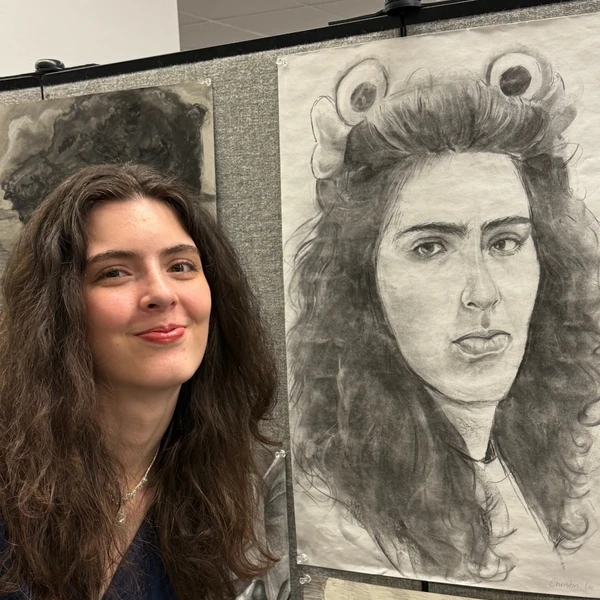
    Since I was a child, art has been the language I turned to when words failed to express the way I felt. Growing up during my parents' turbulent divorce and the subsequent financial instability, drawing became a way for me to make sense of the world. I learned to create work that spoke to me in the hopes that it would speak to others someday. That hope drives me at Texas A&M, where I am pursuing my bachelor's degree in visualization through the PVFA program. My dedication to art has resulted in recognition far beyond my expectations. Many of my works during my first semester at A&M were highlighted in the Fall Show, which celebrates exceptional work created within the PVFA program. In addition, three of my pieces were accepted by Viz-A-Gogo, a fiercely competitive showcase for the best work in the PVFA program. Earning a single spot in that exhibition is difficult, and having the privilege of earning three has made me more confident in my skill as a student. I am determined to continue my studies and continue to develop my art skills. Financial assistance would allow me to continue devoting my time and energy to the art I love and the discipline that has become my life's dream.