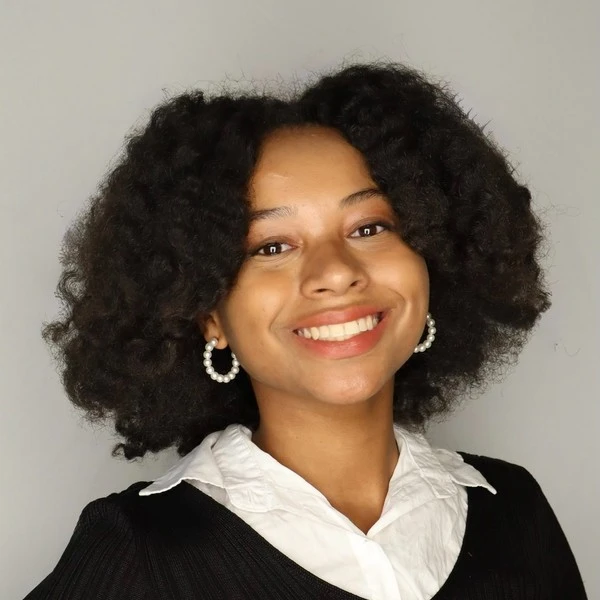
Age
18
Gender
Female
Ethnicity
Black/African
Religion
Christian
Church
Nondenominational
Hobbies and interests
Art
Volleyball
Dance
Cooking
Drawing And Illustration
Architecture
Ballet
Babysitting And Childcare
3D Modeling
Painting and Studio Art
Piano
Roller Skating
Basketball
Shopping And Thrifting
Reading
Adventure
Christianity
Architecture
Art
Classics
I read books multiple times per month
Chloé Banks
1x
Finalist
Chloé Banks
1x
FinalistBio
Hi, I'm Chloé Banks! I'm an incoming second-year architecture student at the University of Nevada-Las Vegas. I aspire to be an architect, an industrial designer, and/or an art director. Before becoming all of those things, I would like to clarify that I'm an artist first. I've been drawing ever since I've had hands, and I want to share my passion for creating with the world. I want to let others know that the arts won't die if they are being given life. Highlighting and showing the new and old beauty that has come from the arts will revive the passion within it. Which is why, through creating and hard work, I want to show that throughout my career.
Education
University of Nevada-Las Vegas
Bachelor's degree programMajors:
- Architecture and Related Services, Other
GPA:
3.5
Miscellaneous
Desired degree level:
Master's degree program
Graduate schools of interest:
Transfer schools of interest:
Majors of interest:
Career
Dream career field:
- Architecture & Planning
Dream career goals:
Inventory Control and Warehouse Support
Lion Wholesale2026 – Present8 months
Sports
Dancing
Club2013 – Present13 years
Research
Psychology, General
University of Nevada Las Vegas — Student2026 – 2026
Arts
A Time to Dance
DanceNight of Praise and Worship2013 – Present
Public services
Volunteering
National Honor Society — Member2024 – 2025
Future Interests
Volunteering
Philanthropy
Entrepreneurship
Sola Family Scholarship
“Nucleus. You guys are my nucleus.” Those words were a reminder that my mom would tell my siblings and me wherever we went. Whether that be spending nights in hotel rooms or sleeping on the floor at my Uncle’s house. My mother, Charlene, made sure that her children were the center of her world, her nucleus.
Now, for starters, my mother isn’t a biologist of any kind, but coming from an artistic background, she definitely knew how to synthesize knowledge and symbolism in her speech, which is why she called us her nucleus. Dance was my mom’s specialty; she taught it during her 20s and has passed that passion on to whoever she could. She definitely planted that seed of creativity in me, which I see blossoming today as I pursue my education in architecture. However, creativity isn’t the only thing that my mother and I share. We are both the youngest siblings and have had to learn from observation in many ways. That habit has led to many silent battles that I’ve seen my mother endure alone. She tries to dance her way through it; however, I observe her pain.
My mom and dad got divorced when I was 2. After that, it was my mother who raised my older sister, brother, and me alone. There were some hiccups, but my mom made sure to dance her way through them. No matter where we were, my mom made sure that we had time for movie nights, deep talks, and just family time in general. Some things, however, required more than just dancing through the pain. Back in 2020, my mom fell on hard times financially, and we had to move out of our apartment. This led to a cycle of living with relatives, sleeping in hotel rooms, and just trying to get by. That time in our lives lasted for 3 years, and to say it was hard would be an understatement; however, my mother would always say that she didn’t have excuses but only results. She couldn’t let her children try to grow up in poverty forever.
That statement shaped my mindset immensely, and I’ve learned that I don’t have to be a victim of my situations but a victor. Even in the midst of living with relatives, I started to go above and beyond in my education. I’ve always been decent in school, but this time, I wanted to excel. Therefore, in high school, I joined clubs such as the National Honor Society and Black Student Union. As well as challenging myself by taking AP and Honors classes. These things weren’t easy; however, this drive I had came from my mom. What I realized is that I should pour into others what she poured into me. I’ve learned from her that even if I didn’t have much money, that shouldn’t equate to how much wisdom I have. I needed to pay attention to my nucleus, my family. However, the knowledge I’ve gained from my mother isn’t stopping with me. When I graduate with my Bachelor of Science in architecture. I plan to further my education and get my Master's to therefore become an architect and plan stable and functional structures centered around family, knowledge, and wisdom; my nucleus.
First Generation Scholarship For Underprivileged Students
Keep Running: The Race of Life
Keep running, keep running, and keep running. Those were the words I told myself growing up. As a kid, I was quite active. Running was and has always been a part of my life. It made me feel as if I could push through anything. However, as I grew up, I came to realize that running wasn’t just a physical act but a mental one as well.
Being the youngest of three siblings, I perceived myself as an observer. I’ve had the blessing of watching and learning from my siblings' mistakes and accomplishments. While I can say I’ve learned a lot from them, my mom was really the ultimate teacher. My sister, brother, and I were raised by a single mother who exemplified that our circumstances aren’t an excuse for our results; we got to keep running. One of her sayings was, “I don’t look like where I come from, but I look like where I’m going.” In our case especially, we couldn’t let where we came from define us. My family and I faced various obstacles of financial instability and homelessness. There would be nights when sleeping in the car or on a friend's couch was the only option. This helped me realize that in situations like that I had two choices: I could either crumble and give up, or I could jump over that hurdle and realize that what I’m going through is only making me stronger.
This mindset overall helped guide me towards my path in higher education. After graduating from high school, I was fully set on going to college and majoring in architecture, one of the hardest degrees to attain. Yet that’s one of the reasons I chose it in the first place. Its complexity is what makes it such a beautiful practice, and due to my past experiences of hurdles and obstacles, this was just another one that I got to jump over. As well as being a first-generation college student, I have even more motivation since I’m paving the way for future generations to come. I don’t like to say the term “I have to,” but rather “I get to.” I get to inspire others to take on the hard challenges. I get to learn more about models and software in architecture school. It’s not a burden to work harder; it’s a blessing.
Which is why I want to pour out into other first-generation students through my education. With all of the knowledge and wisdom I’ve gained so far, it’d be a crime not to edify and teach others with it. I plan to eventually be a mentor for incoming first-generation students. I intend to discuss how there will be those hurdles in life that seem incessant; however, it’s your choice how you handle them. You can either fall or soar. Due to neither of my parents completing college, a variety of lessons I’ve learned so far have been through observing other students' mistakes and even some of my own. Why should that be the same for other first-generation college students? I get to impact that cycle by breaking it with knowledge and experience. Those new students need to know that we can keep running and we get to because of the help that is with them in their race of life.
GD Sandeford Memorial Scholarship
As a result of being raised in such an unstable environment, I came to realize how much the physical environment plays into the lives of individuals, not just literally but emotionally. It was through all those moves that I came to see stability not simply as shelter but as a means to grow and succeed. It was due to this belief that I decided to pursue a degree in architecture at UNLV. With a background in architecture, I would be able to help others experience stability that I never had.
My dedication to community work goes way back before I had any intentions of being an architect. From the age of twelve onwards, I have volunteered in church projects dealing with minority children. This has proven to be one of the most enriching experiences of my life. I learned that the environment could have a big effect on what kind of possibilities children thought of for themselves. A good learning environment, a friendly community center, or even a nice playground could make a big difference when it comes to what kids believe and can achieve in the future.
As my education progresses, I find myself becoming ever more conscious of the way in which design can be used to address social justice issues. Often, there exist many problems in minority communities that include such problems as inadequate housing, lack of funding for public areas, and lack of access to safe and useful infrastructures. These are not only architectural concerns, but social problems that require a holistic approach. Architecture, however, can be one of those approaches. I plan to apply my knowledge in order to construct affordable homes that are sustainable and culturally based.
As for my personal career goal, I would like to become involved in designing community-based architectural structures in Las Vegas and elsewhere. My dream is to be able to work alongside various civic organizations, urban planners, and residents, making sure that the voice of the minority population is taken into account while designing. The problem is that many times decisions regarding the development of a certain area are made by individuals who do not even live in this area.
Ultimately, I want my work to reflect the values that have guided me since childhood: service, empathy, and a commitment to uplifting others. My degree will not just be merely a stepping-stone into my professional life, but a means for me to utilize in order to bring stability, opportunities, and pride back into the communities in which I grew up. Through the synthesis of my personal experience and the knowledge gained in architecture, my intention is not only to provide individuals with space but to offer an environment in which to thrive.
Sgt. Albert Dono Ware Memorial Scholarship
The legacy of Sgt. Albert Dono Ware serves as an inspiration of service, sacrifice, and courage that not only embodies the history of African American military heroism but also defines how I view leadership. The life of Sgt. Albert Dono Ware makes me understand that being in service to one’s people means being committed to lifting them up no matter what challenges there might be along the way. The principles of service that I was raised by were not some distant concepts—they became real for me after I started volunteering with minority children at my church from age twelve. It helped me realize that the essence of service lies in being consistent and relating with other people as well as being motivated by love to one’s community.
As I got older, bravery went beyond mere physicality to encompass a desire to raise one’s voice against injustice and inequality, to be brave enough to stand in those spaces where the voices of Black people are silenced. This sense of obligation influenced me in joining the Black student organization in my university because there, among peers who stood with the same principles of activism, cultural pride, and unity, I knew my voice was stronger. My understanding of bravery also influenced me when I attended the Board of Regents meeting to fight the tuition increase at UNLV. Being in front of those in power to raise an issue about accessibility and affordability was a moment where I felt the weight of Sgt. Ware’s legacy. Advocacy is a form of bravery, and I understood that my presence in that room was not just for myself but for every student whose educational future could be jeopardized by rising costs.
All of this has influenced my ideas on how best to tackle the many problems confronting the African diaspora in America at present. Many of these problems—such as economic inequality, disparity within education, the suppression of culture, and systematic discrimination—are based on past injustices that are still resonating throughout the generations. However, I think that there is hope for a solution to come in the form of the ideals upheld by Sgt. Ware, which involves service, sacrifice, and bravery.
One of the major areas for reform is education. Education continues to play one of the greatest roles in the quest for upward social mobility in the African diaspora, but rising costs, lack of funding, and inequalities in resource allocation undermine access to opportunities. Education reform strategies should include an expansion of need-based assistance for students, greater investments by states in public universities, and pipeline programs for Black students from kindergarten to college. This also includes mentorship programs such as the national organization Top Teens for America, which I was a proud member of, must be incorporated and induced into education communities so that we can build each other up through acts of service and commitment.
Another crucial aspect is that of economic empowerment. It is no secret that the racial wealth gap is still one of the biggest obstacles for the African-American population. Measures aimed at increasing accessibility to grants for businesses, homeownership opportunities, and labor development programs can help solve this issue. Moreover, it is vital to take steps towards ending discriminatory practices in lending, housing, and hiring.
Mental health support is also a critical need. The African diaspora still endures the repercussions of generations of trauma, discrimination, and stigmas about mental health. It is imperative that community-centered programs focused on mental health care, spearheaded by culturally sensitive facilitators, receive top priority. Schools, churches, and community organizations have a significant role to play in making mental health services socially acceptable and accessible.
In order to push through such changes, it is important that a wide range of stakeholders is mobilized for such efforts. Elected officials at various governmental levels are necessary for the implementation of any reforms, but they will not be able to do this alone. It is important that community organizations, religious organizations, educators, students, and activists unite in their efforts to create a foundation based on personal experiences. Universities and school districts should also join in these efforts and not stand on the sidelines. Lastly, individuals from the African diaspora themselves should participate in decision-making processes.
Ultimately, Sgt. Albert Dono Ware’s legacy inspires me to see leadership not as a title but as a responsibility. It is his life that teaches me that advancement is made by individuals who are ready to serve, who are prepared to make sacrifices, and who have the courage to pursue justice. The path that I have taken from being a volunteer for the benefit of children, to an organizer among Black peers, and finally an advocate in front of the Board of Regents, shows that I am willing to carry on the tradition. I believe that through these ideals, we shall be able to meet the challenges faced by the African diaspora head-on.