Age
19
Gender
Female
Ethnicity
Black/African
Hobbies and interests
Tennis
French
Architecture
Biology
Mathematics
Dance
Acting And Theater
Reading
Adult Fiction
Young Adult
Action
Science Fiction
I read books multiple times per week
US CITIZENSHIP
US Citizen
LOW INCOME STUDENT
Yes
Charlize Enchill
1x
FinalistCharlize Enchill
1x
FinalistBio
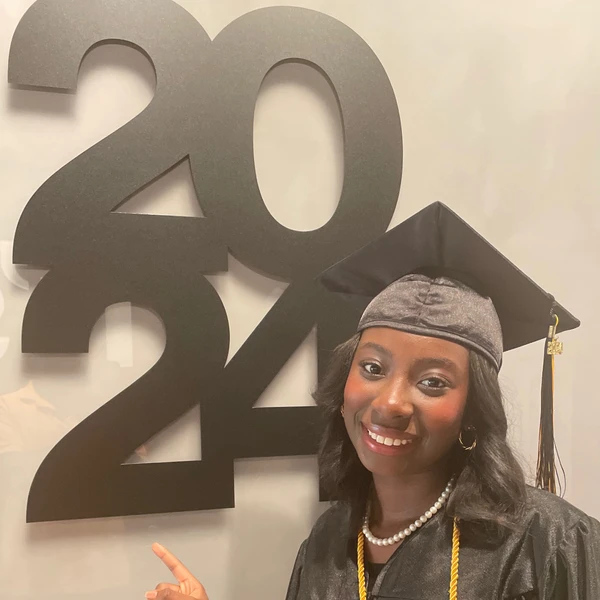
I am Charlize Enchill, a sophomore civil engineering student at Prairie View A&M University with a passion for designing sustainable infrastructure and finding creative solutions to real-world problems. I am fascinated by how math and science can be applied to improve communities and create lasting impact. Beyond my academic pursuits, I am committed to empowering the next generation of engineers through Blueprints & Braids, an initiative I am developing to encourage young Black girls to explore STEM and discover the power of curiosity, creativity, and problem-solving. I aim to combine my technical skills, leadership, and passion for innovation to make meaningful contributions to both the field of engineering and the communities it serves.
Education
Prairie View A & M University
Bachelor's degree programMajors:
- Civil Engineering
GPA:
4
Klein Oak High School
High SchoolGPA:
3.7
Miscellaneous
Desired degree level:
Master's degree program
Graduate schools of interest:
Transfer schools of interest:
Majors of interest:
- Civil Engineering
- Environmental/Environmental Health Engineering
- Construction Management
- Business Administration, Management and Operations
Career
Dream career field:
Civil Engineering
Dream career goals:
My long-term goal as a civil engineer is to design infrastructure that improves quality of life and supports safe, sustainable communities. I plan to earn my Professional Engineer (PE) license and work on projects that address real-world challenges such as aging infrastructure and climate resilience. Ultimately, I hope to use engineering as a tool to serve communities and create long-lasting, positive impact.
Chick-Fil- A Team Member
Chick-fil-A2024 – 20251 year
Sports
Dancing
2015 – 20249 years
Tennis
Club2020 – Present6 years
Research
Biology, General
International Baccalaureate — To analyze and explain experimental factors—such as nutrient distribution, solution conditions, and environmental variables—that influence seed germination and growth,2022 – 2024
Arts
Klein Oak High School
Architecture2022 – 2024Klein Oak High School
Dance2020 – 2024
Public services
Volunteering
Champion Forest Baptist Church — Assist in organizing and conducting services2023 – Present
Future Interests
Advocacy
Volunteering
Philanthropy
Entrepreneurship
Learner Calculus Scholarship
“Is there a legit really really good reason to learn calculus? If there is, what is it? Thanks!”
I first saw this question in a Reddit post while nervously scrolling through discussions about Calculus II. As a sophomore civil engineering major about to tackle some of the most complex coursework I’d faced, I found myself asking the same thing. I had always done exceptionally well in math, but Calculus II carried a reputation that made even the most confident students pause. In a world where CEOs proudly drop out of college and content-creators build careers filming thirty-second tiktoks in their pajamas, it was tempting to wonder whether mastering integrals and derivatives was truly necessary.
This doubt only grew once the semester began. Calculus II quickly lived up to its reputation. Pages of integrals replaced the familiar problems I was used to, and infinite series filled my notebooks. Studying areas under curves and convergence tests felt abstract and distant from the tangible impact I hoped to make as an engineer. I struggled to connect what I was doing on paper to the bridges, drainage systems, and infrastructure I wanted to design. At times, the work felt less like problem-solving and more like endurance.
What slowly shifted my perspective though, was not a single lecture or formula, but repetition and application. Sitting with the same types of problems night after night. Making mistakes, erasing them, and trying again. At some point, I realized calculus wasn’t asking me to memorize steps—it was teaching me how to equip myself. Each technique felt like another tool added to my mental toolbox, even if I didn’t immediately know when I would use it. I realized calculus expanded the range of problems I was able to understand and solve. Over time, I stopped asking, "When will I ever need this?" and started understanding that calculus was training me to think about change itself—how systems evolve over time, how small shifts can lead to significant outcomes, and how invisible forces shape the structures we depend on every day.
This realization deepened as I thought about our world beyond the classroom. Bridges remain standing because engineers understand the curves of suspension cables and the forces acting on them. Drainage systems work because water flow can be modeled and predicted. Even technologies we take for granted, like GPS or traffic systems, rely on mathematical principles rooted in calculus. I may never see these equations written out in practice, but I rely on the results of them constantly—and so does everyone else.
More than anything, Calculus II changed how I handle difficulty in a STEM space. It forced me to sit with confusion longer than I was comfortable with and to keep working even when progress felt invisible. I learned how to break overwhelming problems into smaller pieces and how to trust that understanding would come with persistence. In that sense, Calculus II felt less like a class and more like an experience—one that matured how I think, reason, and persist through challenge. The rigor that once felt unnecessary began to feel intentional.
That was when the answer to the original question became clearer. Calculus is not just a requirement—it is the language used to describe how the world changes. It equips all STEM thinkers to design responsibly, not by guessing, but by understanding. My realization echoed the simple conclusion I had seen from the reddit post earlier: “edit: thanks for the comments. I should learn calculus then, LOL.”
Somewhere between frustration and growth, this sentence became my own.