user profile avatar

Brooklyn Bernstein

1x

Finalist

General information

Hobbies & Interests

  • Acting And Theater
  • Anatomy
  • Anime
  • Animals
  • Biology
  • Biomedical Sciences
  • Food And Eating
  • Health Sciences
  • HOSA
  • Theater
  • Medicine
  • Music
  • National Honor Society (NHS)
  • Pediatrics
  • Pet Care
  • Science
  • Research
  • STEM
  • Student Council or Student Government
  • Travel And Tourism
  • Volunteering

Reading

  • Science‎
  • Short Stories
  • Reference
  • Health

I read books multiple times a week.

Bio

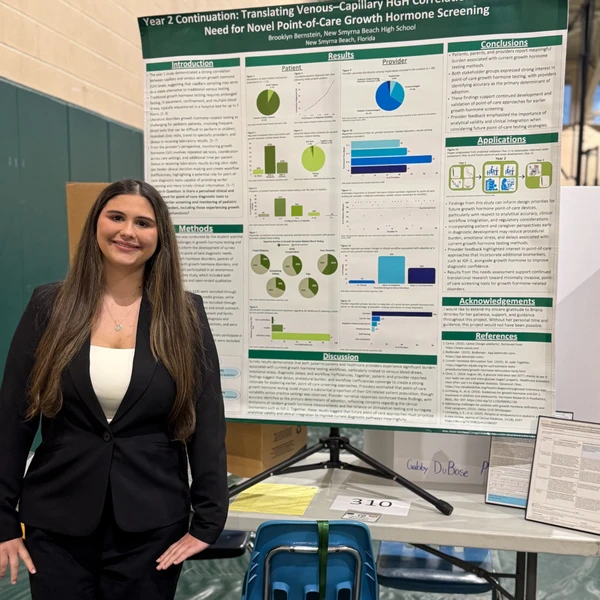
I am a high school senior in Florida and will complete my Associate of Arts degree through dual enrollment in December and will graduate with my AICE diploma in May. I plan to major in a biology field on a pre-med track and eventually become a pediatric endocrinologist. My interest in medicine is personal. After being diagnosed with growth hormone deficiency as a child and undergoing years of treatment, I became passionate about medical research and patient advocacy. I have conducted independent biomedical research, worked with university mentors, presented at scientific conferences, and competed in regional and state science fairs. I presented my research at the MAGIC Foundation Annual Convention and contribute to its monthly newsletter, helping educate and support families affected by growth disorders. I serve as the FASC Secretary for my school’s Student Government Association and am a member of National Honor Society, HOSA, Phi Theta Kappa, and the National Thespian Society. I was also selected for the Tomorrow’s Leaders program through the Volusia Futures Foundation. I have completed more than 1,600 volunteer hours, participated in the International Research Olympiad, and am working to establish an Envirothon team at my school. My interests include biomedical research, healthcare, leadership, theatre, community service, environmental science, and STEM outreach.

Education

Daytona State College

Associate's degree program

2025 – 2026

Majors:
  • Biological and Biomedical Sciences, Other
New Smyrna Beach High School

High School

2024 – 2027

Miscellaneous

Desired degree level:
Doctoral degree program (PhD, MD, JD, etc.)
Graduate schools of interest:
University of Florida, Wake Forest University, Florida Atlantic University, Emory University-Oxford College, Emory University, Stetson University
Majors of interest:
Biological and Biomedical Sciences, Other, Medicine, Biological and Physical Sciences, Human Biology, Biomedical/Medical Engineering, Clinical/Medical Laboratory Science/Research and Allied Professions
Desired degree modality:
In-Person
Medical school interest:
Yes
English as first language:
Yes
Homeschooled:
No

Career

  • Student Researcher / Principal Investigator

    Research · Stetson University (Dr. Kristine Dye Laboratory)

    Jan 2024 – Jan 2025

Miscellaneous

Dream career field:
Biomedical Engineering, Medicine, Research
Dream career goals:
Pediatric Endocrinology and Growth Hormone Research
Work experience:
0 years
Has nursing license:
No
Leadership experience:
Yes

Future Interests

  • Advocacy
  • Volunteering
Strides 4 Gianluca Scholarship
Looking back, I realize growth has defined my life in more ways than height alone. Pediatric endocrinology and science have held my heart for as long as I can remember. A painful blood test led to an intimidating diagnosis that changed the trajectory of my life and eventually inspired me to pursue a career helping children with growth disorders. When I look back at my elementary school class pictures, I do not have to search very hard to find myself. I was always the shortest. But my growth hormone deficiency affected more than my height. When I was younger, it took my body longer than my classmates' to recover when I got sick. I missed my sixth birthday celebration at school because I was sick, and I even missed my kindergarten school play. They may seem like small events now, but when you are five or six, they are not small. I remember being disappointed that everyone else was there while I was home sick. At seven years old, I sat in an exam room clutching my mother's hand as my endocrinologist explained that I had growth hormone deficiency and would need daily injections. I was terrified. I hated needles, and suddenly needles were going to become part of my everyday life. My diagnosis finally explained some of the things that had made me different from other children, but it also brought injections, doctor's appointments, blood tests, and constantly tracking my growth. Something strange happened over time, though. The doctor's office became less scary. I started asking questions. Fear gradually turned into curiosity, and I wanted to understand why my body worked the way it did. Science was already something I loved. As a child, I eagerly waited for monthly science kits to arrive. Whether I was building a pulley system or growing bacteria, I wanted to know how and why things worked. In ninth grade, that curiosity finally connected with my own experiences. For my science fair project, I researched whether growth hormone affected bacterial growth in the gut microbiome. Being in the lab and actually working with hormones ignited a flame in me that would never burn out. My sophomore year, I was able to work in the Dye Laboratory. I used ELISA kits to study correlations between growth hormone levels in venous blood, capillary blood, and saliva. My results showed a strong correlation between venous and capillary serum samples, suggesting that capillary blood could potentially offer a less invasive approach to growth hormone testing. That project became personal in a way I had not expected. I had gone from being the seven-year-old terrified of a blood test to researching whether there might be an easier way to test children like me. I realized research could be more than something I enjoyed or something that earned an award at a science fair. It could actually improve someone's experience. Junior year changed my plans again when I was unable to continue working in the lab. I was heartbroken. Research had become such a large part of what I loved, and I did not know how I was supposed to continue without a laboratory. Instead of giving it up, I had to figure out another way. I connected with the MAGIC Foundation for Children's Growth, where I found a mentor and began talking with patients, parents, and providers about their experiences with growth disorder testing. I heard about families driving hours to specialists, parents missing work, children missing school, and patients going through repeated blood draws. I knew what a blood test felt like, but I had never really considered all the other barriers surrounding that one appointment. That year changed the way I viewed research. Numbers matter, but there is always a person behind the number. I began writing for the MAGIC Foundation's newsletter and later had the opportunity to present at its annual conference. Looking around at children who were shorter than their peers and nervous about many of the same things I had once feared, I saw myself in them. My own disability has also affected the way I think about inclusion and accessibility. I know what it feels like to be physically different while still wanting to be treated like everyone else. At the same time, I have learned that treating everyone exactly the same is not always equitable. Sometimes people need different resources or accommodations to have the same opportunity to participate. I want to bring that understanding with me to college. In classrooms, laboratories, organizations, and my community, I want to pay attention to barriers that may be easy for someone without a disability to overlook. I also want to listen before assuming I know what another person needs. Growth hormone deficiency has given me experience with one disability. It has not given me the experience of someone who uses a wheelchair, is visually impaired, has a learning disability, or lives with another condition. Advocacy should not mean speaking over those people. To me, it means making sure they have the opportunity to speak and are actually heard. My intended field of study is biology, with the goal of eventually attending medical school and becoming a pediatric endocrinologist. I want to combine research with patient care because I have experienced both sides of that relationship. I understand why accuracy matters in a laboratory, but I also understand why the experience of the child sitting in the exam room matters. I hope to continue researching less invasive and more accessible methods of diagnosing and monitoring growth disorders. To an adult, reducing a blood draw or making a test easier may sound like a small improvement. To a seven-year-old clutching her mother's hand because she is terrified of a needle, it is not small at all. I know because I was that child. Growth hormone deficiency made me the shortest child in nearly every class picture, but it also gave me a perspective I never would have chosen for myself. I cannot change the birthday celebration or kindergarten play I missed, and I cannot make my seven-year-old self less afraid of that first diagnosis. What I can do is use those experiences. One day, I hope to sit on the other side of that exam room as a pediatric endocrinologist. I want to help children understand what is happening to them, continue researching ways to make their care better, and advocate for patients whose needs are too easily overlooked. I used to wonder why I was so different from everyone else. Now, that difference is one of the biggest reasons I know what I want to do with my future.
Bulkthreads.com's "Let's Aim Higher" Scholarship
When I was eight years old, I was diagnosed with growth hormone deficiency after years of monitoring, testing, blood draws, scans, and doctor’s appointments. While receiving a diagnosis finally gave my family answers, the process of getting there was long, stressful, and often overwhelming. As a child, I didn’t understand why so much testing was necessary. I only knew that I dreaded the appointments and blood draws that seemed to become a regular part of my life. As I grew older, I became curious about the science behind my condition. That curiosity eventually led me to biomedical research focused on growth hormone testing and diagnosis. Through my own research and conversations with patients, families, and healthcare providers, I learned that my experience was far from unique. Many families spend years searching for answers, travel long distances to see specialists, and endure repeated testing before receiving a diagnosis. Because of these experiences, the thing I want to build is a less invasive point-of-care screening and monitoring tool for growth hormone deficiency. My vision is to create a method that can help identify potential growth hormone disorders more easily and make monitoring more convenient for patients and families. A tool like this could reduce barriers to care, lessen the burden of testing, and help families begin the path toward answers sooner. For children, it could mean less anxiety surrounding testing. For parents, it could mean fewer obstacles between concern and diagnosis. Building something like this will require far more than a single research project. It will require years of education, scientific training, collaboration, and perseverance. That is why higher education is so important to my future. I plan to become a pediatric endocrinologist while continuing to conduct research focused on growth disorders and diagnostic methods. My education will provide the knowledge and skills necessary to transform an idea into something that can make a meaningful difference in the lives of patients. The impact of this work would extend beyond me. Communities benefit when children receive care sooner, when families have better access to information and resources, and when healthcare becomes more accessible. By improving the way growth hormone disorders are identified and monitored, I hope to help reduce delays in care and improve the experience for future patients and families. What began as my own search for answers has grown into a vision for the future. I want to build something that makes the journey to diagnosis and treatment easier for the next generation of children than it was for me.
Women in STEM Scholarship
My journey toward a career in medicine began when I was 6 years old. Long before I knew what a pediatric endocrinologist was. At my six year old annual checkup my pediatrician noticed that I was no longer growing at the rate I should have been. At first my pediatrician hoped I was just a late bloomer and that I would catch up eventually. For the next year we monitored my growth, which was easy since there was none. My seven year check up started what felt like an endless cycle of appointments, growth charts, blood draws, scans, and testing in order to figure out why I wasn’t growing. During this time, I didn’t fully understand what was happening, just that something was different. My friends were all growing taller, while I became one of the smallest kids in my class. I remember sitting in waiting rooms, asking questions, and trying to make sense of words I couldn’t even pronounce. What I remember most, though, was my pediatric endocrinologist. Dr. Daboul never treated me like I was too young to understand. Instead of talking around me and over my head, he looked me in the eye and talked to me. He explained what growth hormone deficiency was, how the endocrine system worked, what wasn’t working in my body, and why the testing was necessary. Every appointment seemed to create ten new questions in my mind, and he always took the time to answer them. Looking back, I realize that he wasn’t just treating a patient. He was inspiring a future endocrinologist. Somewhere along the way, I stopped being interested only in finding answers to my questions, and started becoming fascinated by the science behind it all. I wanted to know how growth hormone worked, why testing took so long, and if there were better ways to diagnose patients. The older I got, the more my curiosity about growth hormone disorders grew. In middle school I was introduced to the science fair world, which led to my high school self focusing on biomedical research. What started as attempts to better understand my own condition developed into my desire to research growth hormone testing and diagnosis. Through working alongside university mentors and biomedical experts, I explored ways to make testing less invasive for patients. My research led to the realization that my family’s experience was not unique, and a change is needed. I heard from families who spent years waiting for answers. Many of them travel hours to see specialists and must endure extensive testing before receiving their diagnosis. For some, the journey to diagnosis was more difficult than the condition itself. One meaningful moments in my journey was presenting my research at the MAGIC Foundation Annual Convention, then speaking with children and families who had traveled the same road I did. I also met endocrinologists who spoke to and treated me like I was one of their peers, instead of a high school student. They encouraged me to continue my research and someday become one of them. Today, I contribute to the MAGIC Foundation through its monthly newsletter, sharing information and resources with families affected by growth disorders. These experiences have shown me that medicine is about much more than diagnosing and treating patients. It is also about listening, educating, advocating, and helping families feel less alone. My hope is to become a pediatric endocrinologist, but I also hope to continue conducting research and advocating for patients throughout my career. My goal is to help improve testing, expand access to treatment, and make the diagnostic process easier for future families.
Maxwell Tuan Nguyen Memorial Scholarship
My journey toward a career in medicine began when I was 6 years old. Long before I knew what a pediatric endocrinologist was. At my six year old annual checkup my pediatrician noticed that I was no longer growing at the rate I should have been. At first my pediatrician hoped I was just a late bloomer and that I would catch up eventually. For the next year we monitored my growth, which was easy since there was none. My seven year check up started what felt like an endless cycle of appointments, growth charts, blood draws, scans, and testing in order to figure out why I wasn’t growing. During this time, I didn’t fully understand what was happening, just that something was different. My friends were all growing taller, while I became one of the smallest kids in my class. I remember sitting in waiting rooms, asking questions, and trying to make sense of words I couldn’t even pronounce. What I remember most, though, was my pediatric endocrinologist. Dr. Daboul never treated me like I was too young to understand. Instead of talking around me and over my head, he looked me in the eye and talked to me. He explained what growth hormone deficiency was, how the endocrine system worked, what wasn’t working in my body, and why the testing was necessary. Every appointment seemed to create ten new questions in my mind, and he always took the time to answer them. Looking back, I realize that he wasn’t just treating a patient. He was inspiring a future endocrinologist. Somewhere along the way, I stopped being interested only in finding answers to my questions, and started becoming fascinated by the science behind it all. I wanted to know how growth hormone worked, why testing took so long, and if there were better ways to diagnose patients. The older I got, the more my curiosity about growth hormone disorders grew. In middle school I was introduced to the science fair world, which led to my high school self focusing on biomedical research. What started as attempts to better understand my own condition developed into my desire to research growth hormone testing and diagnosis. Through working alongside university mentors and biomedical experts, I explored ways to make testing less invasive for patients. My research led to the realization that my family’s experience was not unique, and a change is needed. I heard from families who spent years waiting for answers. Many of them travel hours to see specialists and must endure extensive testing before receiving their diagnosis. For some, the journey to diagnosis was more difficult than the condition itself. One meaningful moments in my journey was presenting my research at the MAGIC Foundation Annual Convention, then speaking with children and families who had traveled the same road I did. I also met endocrinologists who spoke to and treated me like I was one of their peers, instead of a high school student. They encouraged me to continue my research and someday become one of them. Today, I contribute to the MAGIC Foundation through its monthly newsletter, sharing information and resources with families affected by growth disorders. These experiences have shown me that medicine is about much more than diagnosing and treating patients. It is also about listening, educating, advocating, and helping families feel less alone. My hope is to become a pediatric endocrinologist, but I also hope to continue conducting research and advocating for patients throughout my career. My goal is to help improve testing, expand access to treatment, and make the diagnostic process easier for future families.
Brooklyn Bernstein Student Profile | Bold.org