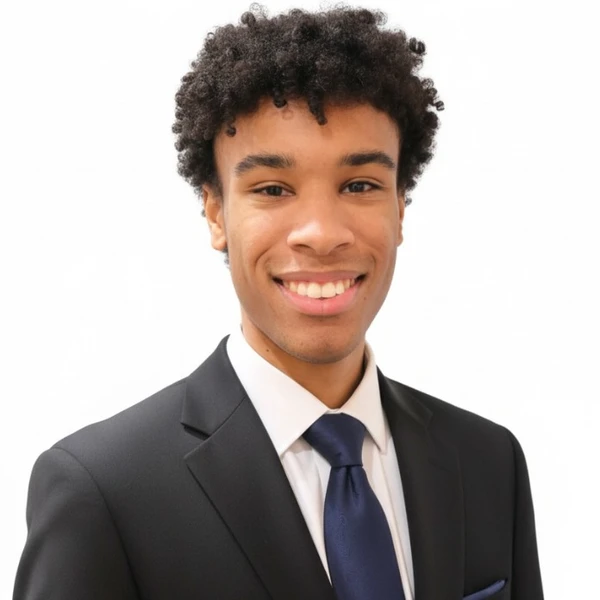
Hobbies and interests
Gaming
Research
Neuroscience
Tennis
Brenden Findlay
1x
Finalist1x
WinnerBrenden Findlay
1x
Finalist1x
WinnerBio
I’m a chemistry and neuroscience double major with research in PFAS and cancer epigenetics. I volunteer in crisis support and community service. I love solving complex problems and connecting science to real-world impact.
Education
Tulane University of Louisiana
Bachelor's degree programMajors:
- Medicine
- Neurobiology and Neurosciences
East Carolina University
Bachelor's degree programMajors:
- Neurobiology and Neurosciences
Miscellaneous
Desired degree level:
Doctoral degree program (PhD, MD, JD, etc.)
Graduate schools of interest:
Transfer schools of interest:
Majors of interest:
Career
Dream career field:
Medicine
Dream career goals:
Oncology
Publication on WALL-E and it's reflection on environmental degradation.
East Carolina University Journal2024 – 2024Team Associate
Walmart2025 – Present1 year
Sports
Tennis
Intramural2025 – Present1 year
Research
Chemistry
East Carolina University with Dr. Pajski — Research Assistant2024 – 2025Chemistry
Tulane SSEP — Research Team2025 – Present
Public services
Volunteering
Crisis Text Line — Counselor2024 – Present
Future Interests
Advocacy
Volunteering
Philanthropy
Maxwell Tuan Nguyen Memorial Scholarship
I was drawn to medicine because I grew up watching how confusing healthcare can feel for ordinary people. When someone in my family needed help, we often sat in waiting rooms without clear answers. Visits moved fast. Explanations felt rushed. We left with more questions than confidence. I did not understand the science at the time, but I understood the stress it created. I wanted to learn enough to help my family make sense of what was happening. That feeling grew stronger as I got older.
College gave me the tools to understand the biology behind disease. I studied chemistry and neuroscience to learn how the body works at the molecular level. The more I learned, the more I wanted to use that knowledge to reduce fear for people in the same position my family once faced. Cancer drew my attention early. It affects the body in complex ways. It affects families in emotional ways that do not show up on a scan. It forces people to make decisions while carrying heavy pressure. I want to work in this field because it asks for strong science and strong communication. It asks for clarity, honesty, and patience.
Being a first generation college student shaped my goal even more. I often had to figure out every step of school without guidance. I learned how to search for help. I learned how to speak up when I was confused. I learned how to stay focused when a system felt difficult to navigate. Those experiences shaped how I want to support patients. Many people enter healthcare with the same uncertainty I felt in school. They feel nervous. They feel unsure of the next step. They feel afraid to admit they do not understand something. I want to make it easier for them to speak. I want them to feel safe asking questions. I want them to walk away with clear information they can trust.
I plan to make a difference through oncology and research in cancer epigenetics. I want to study how small molecular changes can influence the development of disease. I want to contribute to treatments that improve survival and reduce harm. I want to bring research findings into clinical settings so patients receive care rooted in strong science.
My goal is simple. I want to become a physician who listens. I want to support patients with clear information and strong compassion. I want to use my training to reduce confusion and fear. My path gives me a reason to stay committed to this work. I want to give people the guidance my family once needed, and I want to do it with skill, respect, and purpose.
Phoenix Opportunity Award
I grew up in a place where college felt distant. No one in my family could tell me how to apply, how to find support, or how to plan for a career in medicine. I had to learn every step alone. I filled out forms without knowing if I was doing them right. I made decisions with limited guidance. I pushed through fear that I did not belong. Being first-generation shaped me in quiet ways that stayed with me. It taught me how to keep going in moments when quitting felt easier.
This experience sits at the center of why I want to work in medicine. I know what it feels like to move through a system that was not built with you in mind. You feel small. You feel unsure. You feel like everyone else knows something you do not. I see that same feeling in patients who face serious illness. They read words they do not understand. They sit through appointments that move fast. They try to seem strong while carrying fear. I want to be the person who helps them breathe again. I want to give them clarity when they feel lost.
My interest in oncology comes from this drive. Cancer forces people to confront uncertainty at a level most never imagine. Patients need someone who can explain the science clearly. They need someone who listens. They need someone who sees the human being behind the diagnosis. My background taught me to notice what people hide. It taught me to listen when someone feels overwhelmed. It taught me to speak in a way that brings comfort.
Being first-generation does not define me, but it has shaped my purpose. It gave me empathy rooted in lived experience. It pushed me toward a career where I can turn my own struggle into support for others. It inspired me to pursue a career in medicine to provide guidance to others, just as I once wished I had.
Anthony Belliamy Memorial Scholarship for Students in STEAM
WinnerI grew up in a rural part of North Carolina. My community had few resources, limited opportunities, and strong expectations about who you could be. I am a Black Caribbean student, and I faced a lot of pressure to adjust myself to fit the beliefs around me. People made quick assumptions about my interests, my potential, and my identity. It was hard to stay grounded. I wanted to do well in school and build a future in science, but I spent a long time trying to move through other people’s expectations instead of my own goals.
The most difficult point came during my first year of high school. My confidence dropped, my grades fell, and I struggled to see a path forward. I felt stuck. I did not know how to ask for help or who I could trust. I wanted to study medicine, but the gap between what I hoped for and what I saw around me felt huge. Many people told me to aim lower or choose something easier. I carried those comments for a long time.
I changed things step by step. I joined the National FFA Organization and started volunteering at food banks during Thanksgiving and Christmas. These experiences helped me realize that I could make a tangible contribution to my community. I also began to study more seriously. I focused on chemistry and biology because they made sense to me and gave me something steady to hold on to. I worked with my teachers, rebuilt my study habits, and pushed my GPA up. I learned how to take ownership of my path even when my environment made it hard.
During college, the challenge took a different form. I became a crisis text line volunteer. I helped people work through fear, loneliness, and emergencies. I learned how to stay calm and ask clear questions under pressure. I saw how health problems grow worse when people lack support. This experience changed my view of medicine. I no longer saw healthcare as a list of treatments. I observed the entire system and the way people navigate it during their most vulnerable moments.
I also joined research. I studied PFAS binding to human plasma in computational chemistry. Later, I began environmental and geological research at ECU, which involved collecting and analyzing water samples. Now I want to work in cancer epigenetics. My interest in oncology grew from my own experiences with limited access and resilience. Cancer care demands precision, patience, and innovation. Many communities like mine face real gaps in access to prevention and treatment. I want to close those gaps by creating better tools and helping patients navigate complex systems.
The biggest lesson I've learned from my challenges is that support truly matters. A single mentor, a clear study plan, or a small opportunity can make a significant difference. I had to learn how to build those supports on my own at first. Now I use that understanding to guide my goals. I want to become a physician who can see both the science and the lived realities of the patients in front of me. I want to work in oncology because cancer affects every part of a person’s life and demands both scientific skill and empathy.
My early challenges shaped my drive and my purpose. They taught me to set my own direction, stay consistent, and work toward a career that can improve lives through science and patient care.
Aaryn Railyn King Foundation Scholarship
Becoming a physician is not only an ambition but a response to loss, inequity, and the conviction that care should be designed to reach every patient where they live, not just where resources happen to be concentrated. The path began with a personal rupture: my grandmother’s decline unfolded in a system that could not mobilize quickly enough, in a place where distance, limited services, and understaffed clinics turned early warning signs into outcomes. That grief clarified a purpose to practice in communities like hers and to build the infrastructure that keeps families from having to choose between time, travel, and timely care.
Rural America carries a disproportionate burden of chronic illness, premature death, and care deserts. This reality is not abstract when you have watched a loved one wait while a hospital searched for a bed hours away. Nearly one in five Americans lives in rural communities. Yet, access erodes as hospitals close service lines and margins turn red, with almost half of rural hospitals operating at a loss and hundreds vulnerable to closure. These conditions widen the gap between what medicine knows how to do and what patients can actually receive on time, especially for time-critical conditions like stroke, sepsis, and complications of heart disease.
Medicine, for me, is the union of bedside presence and systems design, a commitment to both the human moment and the scaffolding that makes good outcomes repeatable. The goal is not only to save lives, but also to innovate by making specialty care routine in places where it has been exceptional, using tools that are pragmatic rather than flashy. Telehealth stroke networks, e-consults, remote monitoring for heart failure and diabetes, and audio-first outreach for patients without broadband are examples of innovation that fit the constraints of rural life and still elevate the standard of care.
Innovation must also be honest about barriers that technology alone cannot solve, including the digital divide that leaves many rural households less able to use video visits or remote devices. That is why the plan centers on blended models: micro-clinics linked to tertiary centers, nurse-led protocols with specialist backup, and palliative care access extended through secure teleconsults that keep care in the community when appropriate. Building these bridges can reduce provider isolation, improve retention, and keep local hospitals viable so families do not have to drive hours to receive chemotherapy or deliver a baby.
There are also personal obstacles, particularly financial ones, that make training feel like walking a tightrope while carrying books and bills at the same time. The median four-year cost of attendance for medical school is now well into the hundreds of thousands, and the average graduate debt hovers around $200,000. These figures can deter trainees from pursuing rural practice if repayment seems impossible on safety-net salaries. Navigating those constraints has taught disciplined triage, transparent communication, and resourcefulness that translates directly to patient care and program building in under-resourced settings.
Losing my grandmother transformed statistics into a promise, and that promise shapes the physician I intend to become: a clinician who listens closely, acts quickly, and designs care pathways that do not depend on a patient’s zip code to be effective. The measure of success will be fewer delayed transfers, fewer preventable funerals, and more families keeping their elders close because the care they need finally exists where they live.
Kim Moon Bae Underrepresented Students Scholarship
Growing up Black in Clayton, North Carolina, shaped how to move through the world with care, focus, and grit. In a town that is mostly White, it was common to be the only Black student in a class or one of a few on a team, and that meant learning to be confident without a crowd to blend into. It meant preparing twice as hard, speaking clearly, and proving credibility again and again, because first impressions did not always tilt in my favor.
Being underrepresented is not only about numbers. It changes how people hear you and how you hear them. In medicine, that matters. The AAMC uses the term "underrepresented in medicine" to describe groups whose presence in the profession is lower than in the broader population, and Black students are included in this definition. Knowing this does not discourage me. It gives direction. It reminds me that patients often open up more when they feel seen, and that lived experience can make care more honest and respectful.
My hometown has taught me practical skills that are well-suited for the clinic. It taught how to notice minor signs of discomfort and respond with patience when trust is fragile. It taught how to explain complex ideas in simple terms so that no one feels talked down to, and how to advocate for fair treatment without losing focus on the goal. These habits help with taking good histories, building shared plans, and following up in ways that people can actually follow through on.
This identity also shapes future work. First, mentorship. Representation does not grow by accident. Supporting Black and other underrepresented minority students through early outreach, steady guidance, and fair evaluation helps more talented individuals enter and stay in medicine. Second, patient care that centers on equity. That means naming racism as a health factor when it shows up, screening for social needs, and writing plans that fit real lives, not perfect ones. Third, systems change. Policies and training should reduce bias and widen access, from admissions to clinic protocols, so success is not predictable by race.
Growing up Black in a predominantly White town did not limit what is possible. It clarified what is needed. It shaped a steady voice, a clear purpose, and a practice focused on trust, access, and fairness for every patient who walks through the door. It also taught me to look people in the eye, listen without rushing, and show up every time so care feels like a promise kept.
Manny and Sylvia Weiner Medical Scholarship
Becoming a physician is not only an ambition but a response to loss, inequity, and the conviction that care should be designed to reach every patient where they live, not just where resources happen to be concentrated. The path began with a personal rupture: my grandmother’s decline unfolded in a system that could not mobilize quickly enough, in a place where distance, limited services, and understaffed clinics turned early warning signs into outcomes. That grief clarified a purpose to practice in communities like hers and to build the infrastructure that keeps families from having to choose between time, travel, and timely care.
Rural America carries a disproportionate burden of chronic illness, premature death, and care deserts. This reality is not abstract when you have watched a loved one wait while a hospital searched for a bed hours away. Nearly one in five Americans lives in rural communities. Yet, access erodes as hospitals close service lines and margins turn red, with almost half of rural hospitals operating at a loss and hundreds vulnerable to closure. These conditions widen the gap between what medicine knows how to do and what patients can actually receive on time, especially for time-critical conditions like stroke, sepsis, and complications of heart disease.
Medicine, for me, is the union of bedside presence and systems design, a commitment to both the human moment and the scaffolding that makes good outcomes repeatable. The goal is not only to save lives, but also to innovate by making specialty care routine in places where it has been exceptional, using tools that are pragmatic rather than flashy. Telehealth stroke networks, e-consults, remote monitoring for heart failure and diabetes, and audio-first outreach for patients without broadband are examples of innovation that fit the constraints of rural life and still elevate the standard of care.
Innovation must also be honest about barriers that technology alone cannot solve, including the digital divide that leaves many rural households less able to use video visits or remote devices. That is why the plan centers on blended models: micro-clinics linked to tertiary centers, nurse-led protocols with specialist backup, and palliative care access extended through secure teleconsults that keep care in the community when appropriate. Building these bridges can reduce provider isolation, improve retention, and keep local hospitals viable so families do not have to drive hours to receive chemotherapy or deliver a baby.
There are also personal obstacles, particularly financial ones, that make training feel like walking a tightrope while carrying books and bills at the same time. The median four-year cost of attendance for medical school is now well into the hundreds of thousands, and the average graduate debt hovers around $200,000. These figures can deter trainees from pursuing rural practice if repayment seems impossible on safety-net salaries. Navigating those constraints has taught disciplined triage, transparent communication, and resourcefulness that translates directly to patient care and program building in under-resourced settings.
Losing my grandmother transformed statistics into a promise, and that promise shapes the physician I intend to become: a clinician who listens closely, acts quickly, and designs care pathways that do not depend on a patient’s zip code to be effective. The measure of success will be fewer delayed transfers, fewer preventable funerals, and more families keeping their elders close because the care they need finally exists where they live.