user profile avatar

Braxton Wai

1x

Finalist

1x

Winner

Bio

I am an IB Diploma student and a cross-cultural bridge-builder navigating a global move from the US to Shanghai. My leadership style centers on "human logistics"—the art of aligning diverse talents to elevate communities. Whether managing operational sustainability at Magnet Burger, serving as Deputy Secretariat for BISSMUN, or delivering a TEDx talk on "The Ripple Effect," I focus on leaving environments stronger and more inclusive. As a sponsored competitive golfer and Red Cross lifeguard, I balance rigorous athletic discipline with a deep passion for mentorship. Pursuing Social Sciences and Public Policy is my path to bridging the gap between Western theory and global application. This scholarship directly fuels my determination to solve the complex community and policy challenges of tomorrow, ensuring financial constraints do not limit my capacity to create real, structural change.

Education

British International School of Houston

High School
2024 - 2026

Diamond Bar High

High School
2022 - 2024

Miscellaneous

  • Desired degree level:

    Master's degree program

  • Majors of interest:

    • Public Policy Analysis
    • Political Science and Government
    • Law
  • Not planning to go to medical school
  • Career

    • Dream career field:

      Public Policy

    • Dream career goals:

    • coach

      golf at diamond bar
      2024 – Present2 years
    • Lifeguard and Swim coach

      Vagaro DBHS
      2023 – 20263 years

    Sports

    Badminton

    Club
    2023 – Present3 years

    Tennis

    Club
    2024 – Present2 years

    Snowboarding

    Club
    2022 – Present4 years

    Swimming

    Varsity
    2020 – 20266 years

    Awards

    • relay medals, gold medals, varsity team member

    Golf

    Varsity
    2022 – 20264 years

    Awards

    • first place medals, varsity recognition, golf coach

    Research

    • Philosophy

      IB British International School — contributing writer
      2024 – 2026
    • Business, Management, Marketing, and Related Support Services, Other

      IB — Manager
      2024 – 2026

    Arts

    • WISS

      Drawing
      IB
      2024 – 2025
    • usa dance

      Dance
      2019 – 2024

    Public services

    • Volunteering

      NAE student summit in Houston — contributor
      2024 – 2025
    • Volunteering

      british international school — lead coach
      2024 – Present
    • Volunteering

      Nord Anglia — Group leader
      2025 – 2026

    Future Interests

    Advocacy

    Politics

    Volunteering

    Entrepreneurship

    Michael Rudometkin Memorial Scholarship
    Early in my academic career, I was defined by a narrow definition of success: GPA, race times, and efficiency. I treated my life as a series of data points to be optimized. However, I have learned that the most significant impacts are not recorded on a scoreboard, but in the quiet, often invisible moments where we choose to prioritize someone else’s journey over our own. Embodying selflessness, I have realized, is not about discarding one's own goals, but about recognizing that those goals are hollow if they aren't achieved in connection with others. My commitment to altruism found its clearest expression on the pool deck. Initially, I approached coaching with the same "fix-it" mentality I applied to my own training. I wanted to see progress markers and speed. But I soon encountered a student whose paralyzing anxiety kept them at the edge of the pool, unable to even submerge. I could have easily dismissed this as a "failure of talent," but I chose a different path—one rooted in the understanding that true leadership requires making time for those who feel left behind. I began dedicating my own downtime after practice to this student. Instead of coaching them as a "project," I coached them as a friend. I opened up about my own history, sharing the story of my near-drowning incident as a child and the lingering fear that accompanied my return to the water. By showing my own vulnerability, I dismantled the power dynamic of the "instructor" and replaced it with a partnership of mutual trust. We didn't focus on the clock. We focused on the breathing, the trust in the water, and the quiet assurance that they were safe. When that student finally swam their first lap, the joy I felt was not the satisfaction of a successful coaching drill—it was the profound fulfillment of seeing someone find their own confidence. This philosophy of selflessness extends to my work in Model United Nations and student government, where my goal is never to "win" a debate, but to ensure that the quietest voices in the room are heard. I have spent countless hours mediating conflicts, not for personal recognition, but because I believe that a community is only as strong as its most marginalized member. Perseverance, to me, is the daily decision to stay kind in a world that often rewards cold efficiency. It is easy to be a high-achiever; it is much harder to be a consistent source of support for others. I am pursuing a career in public policy not to climb a ladder, but to build a foundation where more people can succeed. I want to build a legacy that mirrors Michael Rudometkin’s: one where the value of my life is measured not by my personal accolades, but by the number of people who felt empowered and valued because I took the time to walk beside them. True success is not a solo pursuit. It is the art of lifting others as you climb, finding fulfillment in the progress of the people around you, and ensuring that no one has to navigate their challenges alone.
    STLF Memorial Pay It Forward Scholarship
    Leadership is often misunderstood as the ability to command. Through my experiences as a Model United Nations (MUN) organizer and a coach, I have learned that true leadership is actually an act of service—it is the deliberate design of systems that allow others to succeed. For me, leadership through service is the bridge between individual potential and collective impact. My most significant volunteer initiative was organizing regional MUN workshops. While many students participate in MUN as delegates, I took on the role of the lead organizer. This required far more than just "showing up"; it required months of logistical planning. I had to coordinate scheduling for over 200 student delegates, secure venues, develop conflict-resolution training modules, and manage the administrative backend of the event. I realized that if I failed to organize the logistics effectively, the students would lose their opportunity to learn and grow. In this context, my service was not just about the event itself; it was about protecting the time and ambitions of my peers. By streamlining the conference structure, I ensured that every participant could focus on the discourse rather than the chaos of an unorganized system. Similarly, my work coaching beginner swimmers has been a lesson in "servant leadership." I have spent countless hours on the pool deck helping novices overcome the same anxieties I once faced. However, I didn’t just teach them how to swim; I created a framework for them to track their own progress. By translating my own data-driven, analytical approach into simple, actionable steps for them, I empowered them to own their improvement. Watching a teammate find their rhythm—or seeing a student delegate finally grasp a complex geopolitical negotiation—is the greatest return on investment I could ask for. I believe leadership through service is essential because it dismantles the barrier of "who is in charge." When you lead by serving, you become a partner in the other person's success. You aren't just telling them what to do; you are providing the tools, the structure, and the encouragement they need to lead themselves. This philosophy is at the core of my approach to public policy and community organizing. I want to build systems—whether they are sports leagues, academic conferences, or government policies—that serve the people who participate in them, rather than expecting those people to conform to rigid, outdated models. Receiving the STLF scholarship would represent a powerful alignment with these values. It would allow me to continue focusing my energy on creating opportunities for others as I transition into my undergraduate career. I am committed to a future where leadership is defined by the impact we have on the success of those around us, and I am ready to continue building those structures of service in every community I join.
    Marcia Bick Scholarship
    Success is often viewed as a linear progression of opportunity, yet for many students from disadvantaged or complex financial backgrounds, the path is more akin to a hurdle race in the dark. Growing up navigating the logistical demands of an international family business and the intense financial realities of competitive, Olympic-track athletics, I have learned that talent is distributed equally, but access is not. Underserved students deserve opportunities—not as an act of charity, but as a strategic investment. When you provide resources to a student who has already learned to "do more with less," you are not just funding an education; you are backing a proven engine of resilience. My own path has been defined by a constant need to dismantle obstacles rather than wait for them to disappear. Living between the U.S. and China, I have had to master the complexities of international residency and self-funded athletic training. When I managed supply chains for my family’s franchise, I wasn't just learning business operations; I was learning the weight of financial stability. I realized early that there are no shortcuts to achieving a balance between high-level athletics and academic excellence. While my peers often relied on stable, localized support systems, I was forced to become my own project manager, balancing a rigorous swimming and golf schedule with the financial necessity of maintaining my family’s business. These experiences taught me that resilience is not merely the ability to "push through" pain; it is the ability to maintain intellectual focus when your resources are thin. My commitment to success is data-backed and relentlessly consistent. I have treated my athletic and academic pursuits as a laboratory, using quantitative analysis to optimize every hour of my day. I do not come from a place where success is guaranteed, and that has forced me to be more disciplined, more analytical, and more intentional with my time than any student who has always had a clear, funded path forward. Receiving the Marcia Bick Scholarship would be the critical bridge that transforms my current efforts into a sustainable future. As I transition into higher education at an elite institution, the financial burden of tuition and living expenses threatens to throttle the very focus I have worked so hard to cultivate. This grant would allow me to direct my energy away from the logistics of survival and toward the realization of my goals: bringing my analytical rigor to the field of public policy and economic development. I am not looking for an easier path; I am looking for a foundation that allows me to build at the scale I know I am capable of achieving. I have the drive, the discipline, and the track record. With this support, I have the opportunity to prove that someone from a background of uncertainty can build a life of profound, measurable impact.
    Cooper Congress Scholarship
    The architecture of public policy is often viewed as a struggle between opposing ideologies, but my experience in competitive athletics and business logistics has taught me that it is, instead, a problem of system design. Whether navigating the complexities of international residency or managing supply chains for my family’s franchise, I have learned that sustainable progress is rarely achieved through mandate; it is achieved through the objective, evidence-based optimization of a system that serves all stakeholders. My interest in public policy, specifically at the federal level, stems from the realization that we are currently operating on outdated infrastructure. I have seen, both in the classroom and on the field, how institutional rigidity leaves talented individuals—particularly in niche or emerging industries like professional swimming—at the mercy of outdated, "extractive" systems. I am deeply concerned with the policy issue of labor equity in semi-professional and Olympic-track athletics. Too often, we treat athletes as disposable products for a four-year cycle, rather than professional assets who deserve representation, financial viability, and a seat at the regulatory table. Civil discourse is the engine of effective policy. In the polarized environment of current legislative affairs, "debate" is often performative, aimed at victory rather than resolution. However, my work as a MUN organizer and a student editor has required a different approach: active listening and the synthesis of disparate viewpoints. To solve the issue of athlete equity, one cannot simply advocate for a single position. You must facilitate a dialogue between athletic governing bodies, commercial interests, and the athletes themselves. Conflict resolution, in this context, is not about finding a middle ground; it is about creating a data-backed framework that allows for mutual success. I aspire to serve in a capacity that allows me to bridge the gap between private-sector innovation and public-sector oversight. We need policymakers who understand the "supply chain" of human capital—those who can look at a sports league or an educational program and ask: "Is this system incentivizing growth, or is it merely consuming potential?" My career goal is to bring the analytical rigor of sports science into the halls of government, where policy is too often detached from the ground-level realities of those it affects. Ensuring everyone has a voice requires us to design systems where participation is not a privilege but a feature. By fostering a culture of mutual respect and leveraging empirical evidence to guide our legislation, we can move away from the current climate of division. I am not entering this field to win a debate; I am entering it to build a more equitable architecture for the next generation. Civic and Leadership Experience: Model United Nations (MUN) Organizer: Feburary 13,2026, facilitated debates and conflict resolution workshops for 200+ student delegates across international schools around the world, focusing on synthesizing disparate viewpoints. Student Sports Editor, The Bull's Eye (Diamond Bar HS): August 2022-January 2024, oversaw peer review and editorial standards, ensuring journalistic integrity and inclusive representation. Student Prefect (BISS Puxi): October 16, 2024-June 2026, mediated interpersonal conflicts and represented the student body to school administration, acting as a liaison between student needs and institutional policy. Family Franchise Operations Manager: June 2024-present. Managed logistics, supply chain, and staff operations, gaining practical experience in organizational efficiency and resource allocation.
    Tom LoCasale Developing Character Through Golf Scholarship
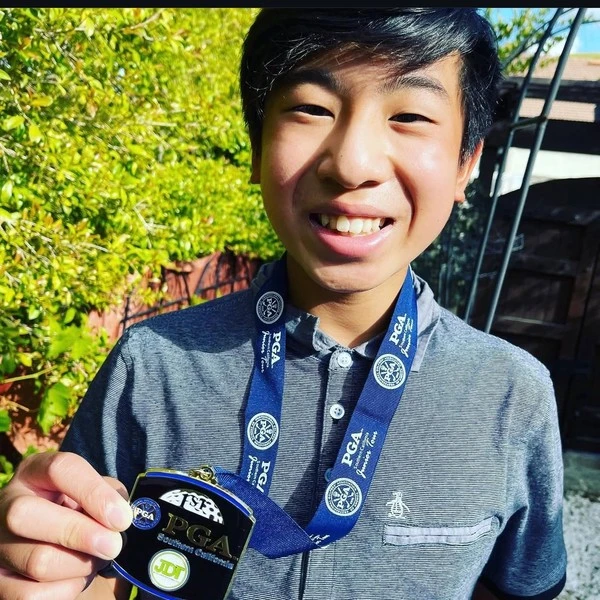
    Winner
    In golf, there's a specific sinking feeling that players must face: the walk to a ball that has landed in the rough or the fear that the ball has disappeared after a perfect swing or a hiccup during the backswing. As a competitive golfer playing in the SCPGA and AJGA, I spent years believing that my success was defined by perfection. I viewed a double bogey as a poor score and a personal failure that threatened to unravel the remaining seventeen holes. However, the most profound lesson golf has taught me is that life isn't defined by a single hiccup on a hole, but resilience to calm down, dig yourself out, and face the challenge with grit. Golf is a unique sport because it forces you to live with your mistakes in real-time. Unlike basketball, a turnover is immediately followed by a chance to play defense; a bad shot in golf leaves you with a long, solitary walk to face the consequences. Early on, I let those walks become mental traps. If I lipped out a crucial putt, I would carry frustration to the next tee box, letting a three-inch mistake dictate a five-mile game. The turning point came when I began to view each hole as a metaphor for chapters in life. I realized a round of golf is a series of isolated events connected by a single mindset. If I hit a ball into a hazard, it's merely a hiccup, not destiny. This shift in perspective, treating each shot as its own fresh start, became the foundation of my mental toughness. I learned that the ability to recover is far more valuable than being perfect. I have already begun utilizing this lesson outside the course. When I moved from the U.S. to Shanghai at the start of eleventh grade, I was met with a "shot into the rough." The language barrier and the cultural shift felt like a daunting hazard. Rather than letting the initial shock paralyze my progress, I applied my golf mindset: I assessed my lie, stayed patient, and focused on the next "stroke." This led me to leadership roles such as school Prefect and Deputy Secretariat for BISSMUN, where I managed complex logistics. When a project stalled, or a meeting didn't go as planned, I did not see it as a setback, but saw it as a difficult lie from which I could still save par. In my endeavors managing Magnet Burger, I applied this principle. When I noticed our packaging was environmentally and financially inefficient, I did not view the past waste as a failure. Instead, I focused on the next move-- researching sustainable suppliers and pitching a transition to recyclable containers. I treated the business problem like a difficult green-side chip: precision, a calm head, and the understanding that a single adjustment could change the outcome of the entire venture. In the future, I plan to utilize these lessons to pursue a career in public policy and business. The world is full of "hiccups"-- economic shifts, regulatory hurdles, and social challenges. My experience in the course has prepared me to face these not as insurmountable obstacles, but as parts of a larger game. Whether I am advocating for the UN SDGs-- as I did with my 'Uplift project-- or navigating the complexities of global markets, I will carry the golfer's control: the understanding that while I cannot control where every ball lands, I have complete control over how I play the next shot. I will remain a student of the recovery, ensuring that no single setback ever dictates the outcome of my game.