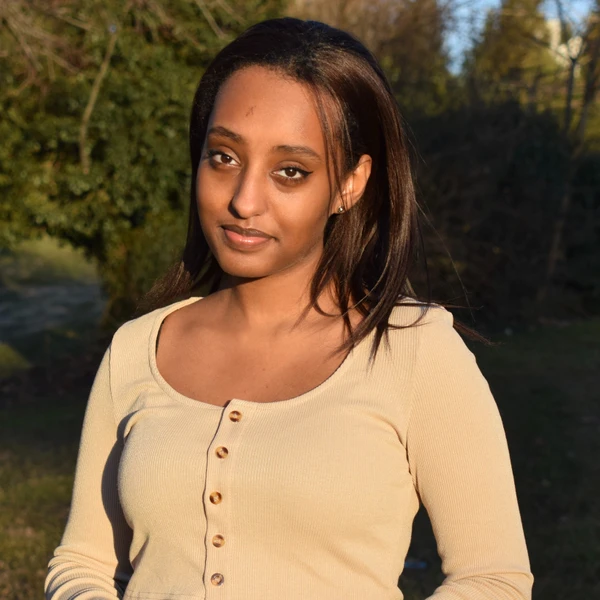
Gender
Female
Ethnicity
Black/African
Hobbies and interests
Medicine
Reading
Academic
Adult Fiction
Classics
Adventure
Contemporary
Young Adult
I read books multiple times per week
US CITIZENSHIP
US Citizen
LOW INCOME STUDENT
Yes
FIRST GENERATION STUDENT
Yes
Blen Yohannes
1x
Nominee1x
Finalist1x
WinnerBlen Yohannes
1x
Nominee1x
Finalist1x
WinnerBio
As a first-generation American and first-generation college student from a low-income background, I have navigated challenges that have shaped my determination and drive to create meaningful change. My journey began in high school, where I worked tirelessly to bridge disparities in education and address the opportunity gap within marginalized communities. That early work ignited a passion for equity and justice that continues to guide my aspirations today. Now, as a pre-medical student with a deep interest in public and global health, I am committed to addressing the systemic barriers that impact underserved populations. I aim to merge my educational experiences with my passion for advocacy to create equitable healthcare solutions, particularly for those who have historically been left behind -- both in the US and across African countries.
Education
Northeastern University
Bachelor's degree programMajors:
- Biological and Biomedical Sciences, Other
Minors:
- International/Globalization Studies
Miscellaneous
Desired degree level:
Doctoral degree program (PhD, MD, JD, etc.)
Graduate schools of interest:
Transfer schools of interest:
Majors of interest:
- Pre-Medicine/Pre-Medical Studies
Career
Dream career field:
Medical Practice
Dream career goals:
OBYGN
Research
Public Policy Analysis
Boston Medical Center — I am currently creating the study, designing the methodology, and preparing a comprehensive IRB submission.2025 – PresentHuman Biology
Boston Children's Hospital — Research Assistant2023 – 2025
Arts
Northeastern University
Videographyhttps://www.youtube.com/watch?v=86c9bNZ9J9M2025 – 2025
Public services
Public Service (Politics)
Ethiopian Federal Ministry of Health — As an intern at the Ethiopian Ministry of Health, I shadowed alongside national health officials to support maternal health policy efforts and better understand health system challenges in low-resource settings.2025 – 2025Advocacy
MCPS DCC Coalition — Leader of this Coalition2021 – 2021Public Service (Politics)
MCPS Student Member of the Board Semi-Finalist — Organizing, Campaigning, and Planning to win the election and become next student member of the board.2021 – 2021Volunteering
Sunrise Senior Living Nursing Home — General Activities Department volunteer2018 – 2019
Future Interests
Advocacy
Volunteering
Philanthropy
Entrepreneurship
Mohamed Magdi Taha Memorial Scholarship
Winner"You speak Amharic really well for someone born and raised in the US," is a sentiment I often hear whenever I return to Ethiopia. It may be easy to assume this was learned passively, perhaps through my grandparents who came to live with us, but that dismisses the reality: the weekly grammar lessons my mom enforced, my grandparents' refusal to learn the English word for "milk" until we could say it back to them in Amharic, and even now, the online Zoom classes I take to develop my professional and medical vocabulary as I continue to work and travel. It dismisses the hard work of my family and the belief that no matter where we live, our connection to our home country matters. Like Mohamed, who carried deep pride in his Sudanese heritage, I was raised to love and feel responsible for a country -- even if I didn't grow up in it.
As a child, I visited Ethiopia only once, but the trip left a permanent mark. Growing up low-income in the US, I thought I understood what it meant to be "disadvantaged," as signaled by the boxes I checked on every form I ever filled out. But standing in Ethiopia as a kid, where I saw families navigate a level of scarcity I had never seen, encountered illnesses that looked frightening on the streets, and noticed the parallels between myself and the kids my age begging on the streets, that understanding shattered.
Whether I realized it then or not, that awareness eventually followed me to Boston, where I came to Northeastern University. I started with the intention of pursuing wet-lab research and medicine, but after time in the lab recognized that I loved leading projects, but felt too far removed from the people they would benefit. Pipetting cells and contributing to "bench" science can make a difference, but I wanted to work on initiatives actively shaping communities and changing lives for and alongside the people who needed it most. That realization guided me toward global health, where I have found my purpose. Like many others drawn to public service, I believe that where someone is born should not determine whether they have the right to live. Mohamed fought for this through his advocacy for a free and fair Sudan. I fight for it by working to advance health equity.
Once I recognized how much opportunity exists to make a difference, even as an undergraduate, I took action. I partnered with GHSEN, a nonprofit connecting US health policy researchers to counterparts across Africa, and developed their first-ever learning trip, bringing ten students, most of them diaspora like me, to Ethiopia to learn about the healthcare landscape in person. Closer to home, I am working with Boston Medical Center to launch a patient narratives project, creating space for refugees and newcomer immigrants to advocate for themselves in an increasingly hostile climate. I plan to continue this work by pursuing a career at the intersection of medicine and policy.
Like Mohamed, I want to use the privilege I have recognized in myself to help those who need it most and mobilize other young people who feel powerless to create change. If I can show others that the work starts right where they are, in the communities they already belong to, then that is a job well done.
Mohamed's father said his son "didn't see himself in the equation. All he saw was how he could help." That is the kind of upstander I strive to be… someone who carries two homes in their heart and uses that duality as a bridge.
Ruth and Johnnie McCoy Memorial Scholarship
Although seemingly atypical, what started with my passion for pursuing medicine and an extensive education consists of a children’s Elmo doctor kit that I was gifted on my 6th birthday. Like so many other first-generation Americans and children of immigrants that came before me, my parents expect me to capitalize on the opportunities they never had and become highly successful. This educational focus could even be highlighted through my childhood toy box filled with a multitude of Barbie career dolls which featured the doll as a doctor, lawyer, and more. Despite my other toys, the relatively simple gift of my first doctor toy set was what truly launched me into a fervor in the not-so-simple medical field. Through my ardor pertaining to the world of medicine throughout such formative years, I have consistently learned and explored the timeless career pathway for years. Being a first-generation American in an immigrant family hailing from Ethiopia, one of the poorest nations in the entire world, the stories of medical mysteries and malpractice were innumerable in my household. There was always someone new who had died or been heavily injured through the fault of a hospital, or doctor, or wrong diagnosis, or mistreatment -- the reasons were just as endless as the stories. My own grandmother was the victim of medical misdiagnosis in an Ethiopian Hospital; The missed diagnosis of a heart attack led to doctors directing my grandmother to take the stairs to the next floor to find another department, but unfortunately, never made it there. The stress and pressure of having to walk caused her to have an early death. There is no shortage of personal horrible medical experiences and puzzling scientific questions throughout the world, especially in developing countries, but there is a severe shortage of people with the ability to answer these questions. The desire to be able to have an answer to the countless questions pertaining to those with no access to healthcare has been a motivation like no other to pursue a career in the competitive medical field. Despite my strong work ethic, I recognize the long and difficult path that is in store for me through medicine. Being a good student may not necessarily be enough to achieve my career aspirations, but the determination to make a positive difference in communities around the world surely is. Never again do I want to have a limited medical knowledge be a barrier between me and helping someone in need, whether they are an in-person patient requiring surgery or diagnosing and answering the questions of a patient 7,000 miles away.