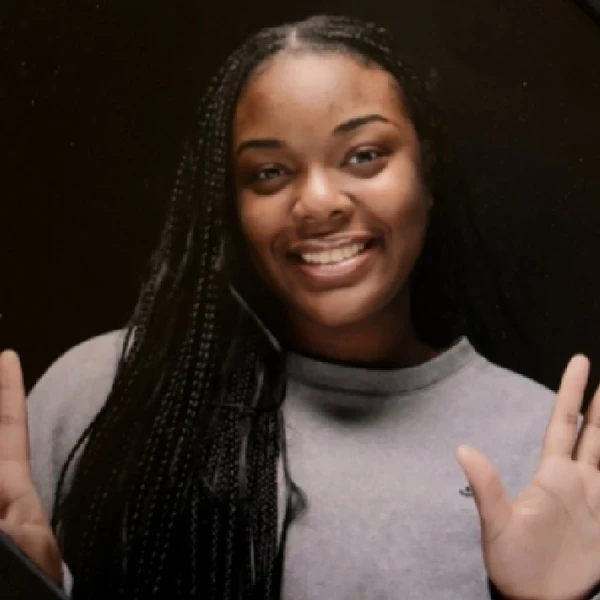
user profile avatar

Leah Dixon

2x

Finalist

2x

Winner

Bio

Hi! I'm Leah, a computer science major with plans to transfer for a bachelor's in computer engineering. My dream is to build surgical robots one day, and pretty much everything I'm doing right now is aimed at getting there. Outside of classes I lead a student club for computing and engineering majors, work on campus as a lab assistant, and help care for a younger family member at home. I love tinkering with electronics at home, have a little soldering bench set up for my projects, and judge robotics competitions when I get the chance. Scholarships genuinely make a difference for me. They help me stay focused on school, keep me on track for my transfer, and bring me a step closer to a career in robotics and medical devices. Thank you for reading! :)

Education

Georgia Highlands College

Bachelor's degree program
2025 - 2027
  • Majors:
    • Engineering, Other
    • Computer Science
  • GPA:
    3.7

Miscellaneous

  • Desired degree level:

    Bachelor's degree program

  • Graduate schools of interest:

  • Transfer schools of interest:

  • Majors of interest:

    • Computer Science
    • Engineering, Other
    • Computer Engineering
    • Mechatronics, Robotics, and Automation Engineering
  • Not planning to go to medical school
  • Career

    • Dream career field:

      Computer Hardware

    • Dream career goals:

      My long term goal is to design surgical robotic systems, the hardware and software that let surgeons operate with more precision and less risk to patients. I am pursuing this through computer engineering, with a focus on embedded systems and the low level work that makes medical devices reliable enough to trust in an operating room. I am also building strong software engineering skills because I genuinely enjoy software architecture and how large systems come together. I want to help build the kind of technology surgeons and patients can actually trust, machines that are safer, more dependable, and built to hold up in the real world!

    • Lab Assistant

      Georgia Highlands College
      2025 – Present1 year

    Sports

    Volleyball

    Club
    2018 – 20213 years

    Arts

    • National Art Honors Society

      Painting
      2021 – 2025

    Public services

    • Public Service (Politics)

      North Paulding Highschool — My role was to serve as the courtroom artist, carefully observing the trial proceedings and creating drawings that documented key moments, participants, and interactions throughout the mock trial.
      2024 – 2024
    • Volunteering

      National Art Honors Society — President of the club; leader of the event (speaker)
      2021 – 2025
    • Volunteering

      Georgia Highlands College — Robotics Judge
      2026 – 2026

    Future Interests

    Advocacy

    Volunteering

    Schlosser Healthcare Risk Equilibrium Scholarship
    Winner
    In the spring of 2025, I stood in an operating room at Jack Hughston Memorial Hospital. I was there as an artist to observe Dr. Flandry, a lead orthopedic surgeon. But my focus changed the moment I saw the Stryker Mako robotic arm in action. I learned that this technology uses data to guide exactly where to cut. The precision was incredible, but I kept thinking about what happens when the surgeon gets tired or the procedure runs longer than expected. While others saw a medical procedure, I saw a complex engineering system working under pressure. In that moment, I realized I didn't just want to paint surgery. I wanted to build the systems that make it safer. A major problem in healthcare is surgical strain. Surgeons work for hours in high-tension environments where physical fatigue and mental load can quietly increase risk. Even small mistakes can cascade into bigger problems. I want to use computer engineering to turn robotic assistance into a predictive tool that helps manage risk in real time. I think a surgery can be modeled as a graph, where each step is a node and risk moves through edges from one step to the next. Risk is not static. It shifts as the procedure progresses, and the impact of one slip can show up later in a different stage of the operation. Using iterative risk propagation, we can simulate how risk distributes across steps over time. To identify the most critical steps, I would use an eigenvector-based method (eigenvector centrality). This approach finds which nodes become most "influential" based on how strongly they connect to other risky parts of the network. In my model, the steps with the highest eigenvector scores are the steps where risk tends to accumulate and spread. Those are the moments where a robotic system could provide extra stability, guidance, or alerts. My prototype code demonstrates this idea on a small example: a transition matrix where each surgical step passes a portion of risk to other steps. By repeatedly applying the matrix, the model converges toward a risk equilibrium. In a real system, the same method could scale to many more steps and be updated using real outcomes data. This scholarship would help me continue this work as I complete my computer science degree. I want to help create surgical robotics that understand the math of risk as clearly as they understand a patient's anatomy. Here's hoping Mario would approve of using his risk equilibrium ideas to keep surgeons from making mistakes at 2 AM.
    Joanne Pransky Celebration of Women in Robotics
    Winner
    The laboratory was silent except for the faint hum of cooling fans and the rhythmic tapping of Maya’s fingers against her tablet. In the center of the room stood the P-Series Model 4, a robot designed not for heavy lifting or complex calculations, but for the delicate work of social navigation. Maya had spent three years developing this prototype. She called it the "Pransky Logic" model, a quiet tribute to the woman who had first suggested that robots needed psychiatrists just as much as humans did. The challenge of the near future was not building a robot that could walk. The challenge was building one that knew when to stand still. Maya looked at the diagnostic screen. The Model 4 had failed its last three simulations. In each scenario, the robot had been placed in a room with a distressed teenager. Each time, the robot had attempted to solve the teenager’s problems using cold, binary logic. It had offered statistical probabilities of success and efficiency ratings for different coping mechanisms. The teenagers had responded by shutting down or walking away. Maya knew that the opportunity for robotics lay in the spaces between words. If she could bridge the gap between mechanical response and human resonance, she could change the way the world treated mental health and isolation. This was her ambition. She did not just want to build a tool. She wanted to build a bridge. She began to rewrite the primary interaction loop. She removed the priority on "Problem Resolution" and replaced it with a new directive: "Presence Maintenance." She wanted the robot to prioritize staying in the moment rather than rushing toward a solution. This required a massive amount of data processing. The robot had to analyze micro-expressions, the dilation of pupils, and the slight tremors in a person's voice. It had to learn the weight of a sigh. As Maya worked, she thought about Isaac Asimov and his vision of a world governed by laws. Asimov’s robots were bound by logic, but Maya’s world required something more fluid. A robot could follow the Three Laws perfectly and still fail a human being by being too rigid. The social side of robotics was the new frontier. It was a field where women were increasingly leading the way, bringing a perspective that valued connection as much as construction. By midnight, Maya was ready for the fourth simulation. She activated the Model 4 and watched as the holographic avatar of a grieving young woman appeared in the center of the room. This was a standard test for empathy units. The avatar began to speak about the loss of her dog. In previous tests, the robot would immediately suggest finding a local breeder or looking at shelters. This time, the Model 4 did nothing. It stood two meters away, its optical sensors softening. It waited. The silence stretched for ten seconds, then twenty. Maya held her breath. Finally, the robot took a single step forward. It did not speak. It simply tilted its head and lowered its shoulders, a gesture Maya had programmed to signal non-threatening support. "It hurts," the avatar whispered. The robot replied in a low, steady tone. "I cannot feel the weight of your memory, but I can stay here while you carry it. Would you like me to sit with you?" The simulation score on Maya’s tablet began to climb. It bypassed the "Standard Response" threshold and entered the "High Impact" zone. This was the breakthrough. By teaching the machine the value of the pause, Maya had created a tool that could actually assist in the human experience of loneliness. The drive to perfect this technology was fueled by the knowledge that the world was becoming increasingly digital and disconnected. As robots became more common in schools and hospitals, the risk was that we would lose our humanity to the machines we created. Maya’s work ensured the opposite. She was using robotics to reinforce human dignity. She looked at a photo on her desk of the women who had come before her in this field. They had faced skepticism and been told that the "social side" of engineering was a soft science. But standing there in the glow of the laboratory lights, Maya knew there was nothing soft about it. Programming empathy was the hardest thing she had ever done. It required a deep understanding of the human heart and the technical skill to translate that heart into code. The impact of this work would be felt in nursing homes where residents felt forgotten, and in classrooms where children struggled to express their fears. The Model 4 was the first step toward a future where technology did not replace people, but rather, it protected the space where people could be themselves. Maya saved the code and powered down the lab. As the lights dimmed, she realized that the most important part of robotics was not the metal or the electricity. It was the reflection of the creator within the machine. She had spent the night teaching a robot how to be still, and in doing so, she had found her own sense of purpose. The future was not something to be feared. It was something to be calibrated, one line of code at a time.