
Hobbies and interests
Theater
Painting and Studio Art
Marine Biology
Ecology
Zoology
Archaeology
Architecture
Botany
Reading
Adventure
Adult Fiction
Fantasy
Design
Mystery
Suspense
Science Fiction
I read books multiple times per month
Bella Manoff
1x
Finalist
Bella Manoff
1x
FinalistBio
I’m currently a student at Chico State pursuing a degree in Ecological, Evolutionary, and Organismal Biology. I have a long-standing passion for both wildlife and creative design. I’ve always been drawn to hands-on, artistic work, from set design and backstage theatre to woodworking and building. Over time, I realized I wanted to apply those skills in a more meaningful way.
My goal is to design and manage naturalistic habitats and wildlife spaces that prioritize animal welfare, sustainability, and enrichment. Through my coursework and experiences, like volunteering in habitat restoration, building bat boxes for displaced wildlife, and working with diverse groups of people, I’ve developed a deeper understanding of ecology, animal behavior, and the importance of thoughtful, humane design. I’ve also built strong teamwork and leadership skills through theatre and community work.
While financial challenges and learning differences like dyslexia have required me to put in extra time and effort to succeed, they’ve also made me more determined and resilient. I look forward to my last year in college and being able to jump into a career in captive wildlife care and habitat restoration, where I can combine science, creativity, and compassion to improve the lives of animals.
Education
California State University-Chico
Bachelor's degree programMajors:
- Ecology, Evolution, Systematics, and Population Biology
Cabrillo College
Associate's degree programMajors:
- Liberal Arts and Sciences, General Studies and Humanities
Cabrillo College
Associate's degree programMajors:
- Fine and Studio Arts
Santa Cruz High
High SchoolMiscellaneous
Desired degree level:
Graduate schools of interest:
Transfer schools of interest:
Majors of interest:
- Zoology/Animal Biology
- Ecology, Evolution, Systematics, and Population Biology
Career
Dream career field:
Wildlife Biologist
Dream career goals:
Teacher's Assistant
Stroke and Disability Center at Cabrillo College2022 – 20242 yearsFarm Hand, Sheep Caretaker
Common Roots Farms2020 – 20244 yearsFood Prep, Cashier, Customer Service
Whitings Foods2019 – 20245 yearsBrakeman, Cashier, Ticket Salesman, Entertainer, Food/Beverage server
Roaring Camp Railroads2022 – Present4 years
Sports
Volleyball
Intramural2025 – 2025
Arts
Cabrillo College Theatre
TheatreThe Curious Incident of the Dog in the Nighttime2023 – 2024
Public services
Volunteering
Common Roots Farms — Farm Hand, Sheep Caretaker2020 – 2024
Future Interests
Advocacy
Politics
Volunteering
Entrepreneurship
FMA College Scholarship
Thank you for your consideration!
Sturz Legacy Scholarship
I remember standing in a muddy sheep pen, my hands shaking slightly as I pulled a foxtail from deep beneath the eyelid of our poor little lamb. We had spent months convincing them to trust us, and in that moment it felt like we were going right back to where we started. So much work had gone into getting them comfortable with humans, and it felt like no one really appreciated how much time and effort had been invested in these animals.
I began volunteering at Common Roots Farm in 2020, at the height of the COVID pandemic. I learned a lot being a part of the farm team, even though I didn’t always feel like anyone else saw me as a proper member of that team. There were times when my long and patient work was overlooked and credited to the farm as a whole, rather than being something my mother and I had taken on personally and worked hard to build.
When the farm decided to bring in sheep, there was no one with experience caring for larger animals. My mom and I had been volunteering as farmhands working in the crop fields, and we stepped up since we’d had experience with horses and goats. What was supposed to be three lambs quickly turned into three adult sheep, three lambs, and a Great Pyrenees that all needed to stay together. The pen had to be expanded right away, and no one really knew what to do next.
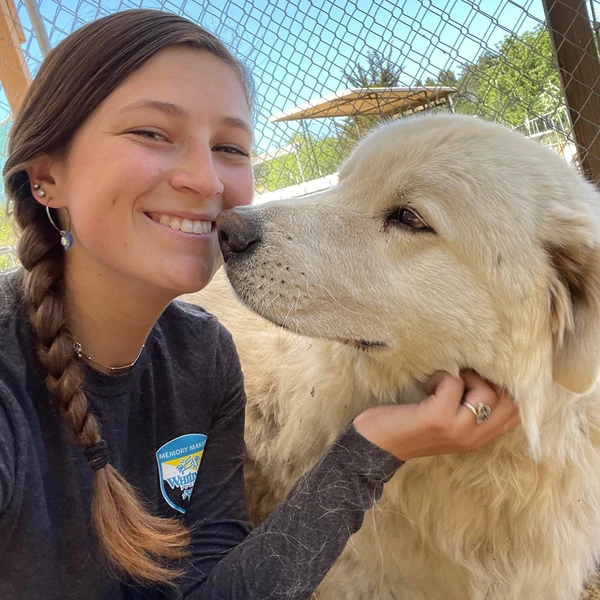
My mom and I committed to taking on their full-time care. We set up feeding and watering schedules and dedicated multiple days a week to the animals. They were extremely skittish and couldn’t leave their small chain link enclosure because there was no guarantee that anyone could wrangle them back into their pen. At first, we just sat with them and talked so they could get used to our presence. When the lambs were small enough, we would hold them in our laps, using grain and gentle voices to calm them. Over time, we started brushing them out, pulling burrs and foxtails from their wool, and slowly getting them used to being touched. It took months before they would let us put halters on them, and even longer before they could be walked safely around the farm. Common Roots is a really unique place where people of all abilities come to work and visit, so the sheep had to get used to power wheelchairs, canes, and a lot of different kinds of movement and noise. That part took a lot of time and patience, but eventually it worked. The same sheep that used to bolt at the sight of a person began approaching the fence, excited to greet people and ask for treats.
Unfortunately, we didn’t get much credit for our work with the sheep. When the farm talked about them in newsletters, events, or speeches, the credit went to the farm and its team as a whole. The sheep were featured everywhere, but the work that made them calm and safe around people was never mentioned. It was a weird situation because the manager was a family friend, so it felt wrong to bring it up. At the same time, it started to feel like the work we were doing just didn’t matter in the way other work around the farm did. For a long time, I didn’t say anything. I told myself it wasn’t a big deal and that the work itself was what mattered. But over time, it stopped being just about recognition. Because my mom and I were the only ones consistently working with the sheep, their care would slip when we weren’t there. We would come back to flooded pens or find them put into pastures full of foxtails, which we had specifically warned against. The week we spent pulling foxtails out of their ears, eyes, and noses was when it really hit me that staying quiet wasn’t helping anything.
Eventually, we did say something. We talked to the manager privately and made sure we were clear about both the lack of acknowledgment and the issues with the sheep’s care. It was uncomfortable, and I was nervous going into it, but it ended up going better than I expected. She understood, apologized, and things actually improved after that. Looking back, I don’t think staying quiet for as long as I did was the right choice. At the time, I told myself I was being respectful and avoiding unnecessary conflict, but really I was just avoiding something uncomfortable. By the time I finally said something, the situation had already grown into something that was affecting the animals, not just me.
It eventually went beyond needing recognition. I realized that by staying quiet, I was allowing something I cared about to be handled poorly. I’ve always had a hard time speaking up for myself, especially when something feels rooted in emotion instead of something concrete. It’s easy for me to convince myself that it’s not serious enough to bring up. This experience showed me how wrong that can be. If I were in the same situation again, I wouldn’t handle it the same way. I wouldn’t wait until there was a clear problem to justify saying something. I would speak up earlier, even if it felt uncomfortable and even if I wasn’t completely sure how it would be received.
Still, I don’t regret that experience. It forced me to recognize a pattern in myself that I was trying to pretend didn’t matter. It also changed how I treat other people. I’m much more conscious about making sure credit goes where it’s due, especially in group settings where it’s easy for individual effort to disappear into the background. More than anything, it shifted how I think about responsibility. Speaking up isn’t just about being recognized; it’s about making sure the work is being done right and that the people and animals depending on it are actually being supported.
Our Destiny Our Future Scholarship
I remember standing in the sheep pen, watching a young girl with cerebral palsy cautiously reach out her hand. When the sheep stepped forward and nuzzled her fingers instead of backing away, her whole demeanor changed and her face lit up with a smile. What started as hesitation turned into confidence in a matter of seconds.
At Common Roots Farm, I worked with sheep and chickens while supporting individuals with disabilities in an inclusive and accessible farm environment. My role was not just to care for the animals, but to help create an environment where both the animals and the people interacting with them felt safe and comfortable. Over time, I began to see how meaningful those interactions were. People who were hesitant at first would slowly gain confidence and build a connection that was both calming and empowering.
That experience changed the way I think about impact. I realized that making a difference is not just about large-scale change, but about creating environments where individuals feel supported, included, and capable. It also reinforced how powerful the relationship between humans and animals can be when it is built on trust and understanding.
My experience at the Cabrillo Stroke and Disability Center continued to build on this understanding. While working with individuals recovering from strokes and living with mobility challenges, I learned the importance of patience, adaptability, and meeting people where they are. Whether I was helping guide exercises or adjusting activities to fit someone’s needs, I saw how thoughtful support could improve both confidence and quality of life.
These experiences have shaped the way I approach my future career. I am pursuing a degree in Ecological, Evolutionary, and Organismal Biology at Chico State. I look forward to a career in wildlife rehabilitation and habitat design. I want to create environments that support not only animal welfare, but also meaningful human interaction. In rehabilitation centers, sanctuaries, and educational spaces, well-designed habitats can reduce stress for animals while also allowing people to safely connect with and learn from them.
I also hope to contribute to environmental restoration efforts to rebuild habitats, support biodiversity, and create more resilient ecosystems. I can’t do that all on my own, and I believe that the long-term impact will depend on people feeling connected and motivated to save the natural world. Getting the opportunity to interact with animals and understand their role in an ecosystem will encourage people to care about protecting it.
My goal is to combine science, design, and service to create spaces that are both functional and meaningful. For animals, that means environments that support natural behaviors, health, and recovery. For people, it means creating opportunities for connection, education, and inclusion, regardless of ability or background.
I want to make a positive impact on the world by building environments that allow both people and animals to thrive. Through my work, I hope to contribute to a more compassionate and connected world, where care for the environment and care for each other go hand in hand.
Future Green Leaders Scholarship
As a kindergartener, I watched a baby chick break out of its shell for the very first time. I sat in awe as something fragile transformed into a curious, active animal in less than an hour. That moment sparked my fascination with animal development and care, as well as a fierce curiosity about what environments allow animals to truly thrive.
This is the core of why sustainability must be a priority in biology and wildlife care. Animals don’t exist in isolation. Their health is directly tied to the ecosystems around them, and when those systems are disrupted by habitat loss, climate change, or human activity, the consequences ripple across entire populations. Sustainability is not just about protecting individual species; it is about maintaining the balance of the environments that support them. Without that balance, conservation efforts only work as temporary solutions.
While pursuing a degree in Ecological, Evolutionary, and Organismal Biology at Chico State, I have seen how interconnected these systems are. Through coursework and fieldwork, I have gained a deeper understanding of how ecosystems function and how easily they can be disrupted. My work along the Big Chico Creek corridor, removing invasive species and restoring native habitat, has shown me that even smaller local efforts can contribute to long-term environmental stability. Getting to build bat boxes for wildlife displaced by wildfire has also reinforced how thoughtful human intervention can help restore balance without risking further disruptions.
In my future career, I plan to work in wildlife rehabilitation and habitat design, creating naturalistic environments that prioritize both animal welfare and ecological sustainability. In captive settings, this means designing habitats that reflect natural ecosystems, reduce stress, and encourage species-specific behaviors. In the wild, it means contributing to restoration efforts that rebuild ecosystems and improve their resilience against environmental challenges. This includes restoring wetlands that support biodiversity while helping reduce flooding, promoting native pollinators in grassland habitats, and helping reestablish fish populations in aquatic systems where they have disappeared.
My background in art has also shaped how I approach this work. Before pursuing biology, I studied studio art and worked in set design, where I learned how to turn ideas into physical, functional spaces. Designing a habitat is not that different from designing a set. Both require an understanding of structure, behavior, and environment. The difference is that in wildlife care, the goal is not just appearance, but the health and sustainability of a living system. This perspective allows me to approach conservation work with both scientific understanding and creative problem-solving.
In my field, sustainability is the foundation that determines whether conservation efforts succeed or fail. My goal is to contribute to a future where wildlife is not only protected, but supported by environments that allow ecosystems to function as they were meant to. By combining scientific knowledge, hands-on restoration work, and thoughtful design, I hope to reduce environmental impact and create spaces where both animals and ecosystems can thrive.
Women in STEM Scholarship
Growing up, I always felt like the “art brain” in a room full of “math brains”. Other students seemed to have no trouble grasping new concepts, but I needed more time, sometimes twice as long, to understand the same material. In middle school, this became impossible to ignore. I struggled to keep up with assignments, couldn’t answer questions when called on, and felt completely lost during lectures. It was frustrating and discouraging, especially because I was genuinely interested in subjects like science and math. I constantly felt embarrassed and out of place in the classroom, and I often questioned whether I belonged in those subjects at all, especially as a woman in a male-dominated field of study.
Eventually, I was diagnosed with dyslexia, which felt like it changed everything. For the first time, I understood that I wasn’t falling behind because I wasn’t capable; my brain just didn’t process information the same way. I began developing strategies that worked for me instead of continuing to struggle along the same path as other students. It didn’t make things easy, but it made progress possible. Over time, I built confidence in my ability to adapt and succeed, even when things took more time and effort.
When I first started college, I leaned into what came naturally and pursued art, earning associate’s degrees in both Studio Art and Liberal Arts and Sciences. I thrived in that space, but I couldn’t ignore my long-standing passion for biology. Choosing to transfer into a biology program meant stepping back into an environment where I once felt out of place, knowing I would likely face the same challenges again. Even now, I often find myself working harder to keep up, but that feeling no longer stops me from trying.
At Chico State, I chose to pursue a degree in Ecological, Evolutionary, and Organismal Biology. I knew I’d need to fight harder for success than others, but I also knew that if I wanted to make a meaningful impact in wildlife care and conservation, I needed to push through that discomfort. My coursework has given me a deeper understanding of animal behavior, plant ecology, and environmental systems, while reinforcing how interconnected these systems are.
Outside of the classroom, I have applied what I am learning through hands-on experience. Along the Big Chico Creek corridor, I have participated in habitat restoration through invasive species removal and native plant support. I have also worked with the Butte Environmental Council to build bat boxes for wildlife displaced by wildfire. These experiences have shown me how local efforts can contribute to larger conservation goals and ecosystem stability.
Over time, I’ve come to see my learning disability as a kind of deer trail that splits off from the typical learning path. Even though the trail may be longer and less direct, it still leads to the same destination. Along the way, I’ve learned to approach problems differently by thinking visually, noticing patterns, and considering how structure and behavior interact.
As a woman in STEM, I hope to contribute to a field that is becoming more inclusive by helping create space for different ways of thinking. I know how easy it is to feel like you don’t belong, and I want to be part of changing that. Instead of trying to think like everyone else, I’ve learned to use the way I think to contribute something valuable.
Christian Fitness Association General Scholarship
Growing up, I always felt like the “art brain” in a room full of “math brains”. Other students seemed to have no trouble grasping new concepts quickly, but I needed more time, sometimes twice as long, to understand the same material. In middle school, this became impossible to ignore. I struggled to keep up with assignments, couldn’t answer questions when called on, and felt completely lost during lectures. It was frustrating and discouraging, especially because I was genuinely interested in subjects like science and math. I constantly felt embarrassed and out of place in the classroom, and I often questioned whether I belonged in those subjects at all.
Eventually, I was diagnosed with dyslexia, which felt like it changed everything. For the first time, I understood that I wasn’t falling behind because I wasn’t capable; my brain just didn’t process information the same way. I was able to develop strategies that worked for me instead of continuing to struggle along the same path as other students. It didn’t make things easy, but it made progress possible. Over time, I built confidence in my ability to adapt and succeed, even when things took more time and effort. Instead of seeing extra time as failure, I started to see it as part of the learning process.
When I first started college, I leaned into what came naturally and pursued art, earning associate’s degrees in both Studio Art and Liberal Arts and Sciences. I thrived in that space since I could succeed without constantly fighting the way my brain worked, but I couldn’t ignore my long-standing passion for biology. Choosing to transfer into a biology program wasn’t an easy decision. It meant stepping back into an environment where I once felt out of place, and knowing I would likely face the same challenges again. Even now, I am often surrounded by people who seem to process complex equations and scientific concepts with ease, and I still find myself working harder to keep up. That feeling of being the “art brain” among “math brains” hasn’t completely gone away.
When I chose to pursue a degree in Ecological, Evolutionary, and Organismal Biology at Chico State, I knew it might feel unfairly difficult. But I also knew that if I wanted to make a meaningful impact in wildlife care and conservation, I needed to push through that discomfort. My coursework has given me a deeper understanding of animal behavior, plant ecology, and environmental systems, while reinforcing how interconnected these systems are. It has also shown me that persistence matters just as much as natural ability when it comes to succeeding in a challenging field.
Outside of the classroom, I have worked to apply what I am learning through hands-on experience. Along the Big Chico Creek corridor, I have participated in habitat restoration through invasive species removal and native plant support. I have also worked with the Butte Environmental Council to build bat boxes for wildlife displaced by wildfire, helping provide safe roosting spaces for affected populations. These experiences have shown me how local, hands-on efforts can contribute to larger conservation goals and ecosystem stability. They’ve also reinforced why I chose this path in the first place, because I can see the direct impact of the work being done.
Over time, I’ve been able to shift my perspective and see my learning disability as a kind of deer trail that splits off from the typical learning path. Even though the trail may be windier, longer, and less well-trodden, it can still get me to the same destination. By the time I reach the end, I will have seen things that people on the main path might miss. My background in art allows me to approach problems differently. I notice patterns, think visually, and consider how structure, space, and behavior interact. These skills are still valuable in science-based work, especially when working with living systems that require technical understanding and creative problem-solving.
Something that used to make me feel out of place has become one of my greatest strengths. My way of thinking allows me to bridge the gap between art and science, helping me design environments that are both functional and meaningful. As I move toward a career designing naturalistic habitats for wildlife, I rely on both creative and scientific thinking. My goal is to create spaces that support animal welfare while also educating people about the importance of conservation and ecological balance. Instead of trying to think like everyone else, I have learned to value the way I see the world and use it to build something better.
Elijah's Helping Hand Scholarship Award
I’m bisexual, and for me it’s been less about who I’m attracted to and more about where I seem to fit, both within and outside the LGBTQ community.
There’s a weird level of suspicion around bisexuality, and it feels like it comes from both sides. Within the LGBTQ community, being in a long-term relationship with a man means I’m often dismissed as straight. Outside of that community, I still get flagged as different in small ways. I end up feeling like I’m constantly adjusting how much of myself I show depending on the space I’m in.
I catch myself self-censoring all the time. It can be something as simple as changing how I phrase something or stopping myself from making a joke or reference I’d normally make around my friends. Since moving from Santa Cruz to Chico, I’ve noticed this a lot more. Back home, my friend group was a mix of queer and straight people who had all grown up together, so I never really had to think about it. Chico is much more conservative, and there have been moments when I forget to filter myself and immediately feel the shift. People don’t usually say anything outright, but you can tell when the energy changes. Conversations get a little more distant, and I become very aware of how I’m being read.
So I adjust. If I keep more to myself and lean more into what people expect, interactions tend to go more smoothly. On the other side, in LGBTQ spaces, I’ve noticed I adjust in a different way. I’ll refer to my boyfriend as my “partner” because it keeps things more open-ended, and I’ve seen noticeably more positive reactions to that than when I’m more direct. It’s a small change, but it makes a difference in how people respond to me.
It’s pretty typical and often appropriate to self-censor to some degree when interacting with different groups of people. However, it started to feel inauthentic and more like I was hiding parts of myself rather than simply reminding myself not to overshare. I don’t think I realized how much this was affecting me until I started building new social circles. It’s definitely impacted my confidence. I’m more cautious about what I say and how I say it, and sometimes I just choose not to say anything at all. It’s not coming from a place of shame. I think it’s actually more akin to fear. I’ve just learned that certain versions of myself are easier for people to accept than others, and it doesn’t feel worth making myself a target in order to be myself.
This experience has made me a lot more aware of how people treat each other in these spaces. I notice now how quick people are to make assumptions, and how easy it is to unintentionally push someone out of a group. Because of that, I try to be more mindful of how I interact with others. I don’t want to be someone who makes people feel like they have to prove themselves or edit who they are just to be included.
I’m still figuring out how to balance all of this. I don’t believe the answer is to stop being aware of my surroundings, but I also don’t want to keep shrinking parts of myself just to make things easier. Moving forward, I want to be more comfortable being open about who I am without feeling like I have to explain it or soften it depending on who I’m talking to.
Dorothy Walker Dearon Scholarship
My academic goal is to earn my bachelor’s degree in Ecological, Evolutionary, and Organismal Biology at Chico State. Over the last three years, I have been developing a strong foundation in animal behavior, ecology, plant biology, and environmental systems. Through my coursework and hands-on experiences, I am working to better understand how species interact with one another and with their environments, and how those systems can be supported and restored.
My long-term career goal is to work in captive wildlife care and rehabilitation, with a focus on designing and managing naturalistic habitats that prioritize both animal welfare and ecological integrity. I am particularly interested in habitat restoration and enrichment, which would allow me to create spaces that encourage animals to express natural behaviors while also supporting conservation and recovery efforts. I want to contribute to environments where animals are not only kept safe, but given space to heal and thrive while they prepare to return to the wild.
My education has not always followed a straightforward path. I initially pursued art, earning associate’s degrees in Studio Art and Liberal Arts and Sciences, before deciding to return to biology. This transition was not easy, especially as someone with dyslexia navigating a rigorous STEM curriculum. These challenges have strengthened my ability to adapt, persist, and approach problems from multiple perspectives. My background in art has also become an advantage, allowing me to think visually and spatially when designing environments and solving complex problems.
Outside of the classroom, I have worked to apply what I am learning through volunteer and hands-on experiences. Along the Big Chico Creek corridor, I have participated in habitat restoration through invasive species removal and native plant support. I have performed studies to find the best ways to promote pollinator visitation in heavily landscaped areas. I have also worked with the Butte Environmental Council to build bat boxes for wildlife displaced by wildfire, helping provide safe roosting spaces for affected populations. These experiences have shown me how local, hands-on efforts can contribute to larger ecological and public health outcomes by supporting biodiversity and ecosystem stability.
My goal is to use my education to create environments that support both wildlife and the broader health of ecosystems. Healthy ecosystems are directly connected to public health, as they support clean water, air quality, and biodiversity. By contributing to conservation, habitat restoration, and wildlife rehabilitation, I hope to play a role in protecting these systems and the communities that depend on them.
I am driven by a long-standing commitment to animal care, environmental stewardship, and continuous learning. With the support of this scholarship, I will be able to continue pursuing my academic goals and work toward a career where I can make a meaningful impact on both wildlife and global health.
Dream BIG, Rise HIGHER Scholarship
As a kindergartener, I watched a baby chick break out of its shell for the very first time. I sat and waited in awe as it transformed from something fragile and meek into a fully aware and curious animal in less than an hour. That moment left a lasting impression on me and sparked a fascination with animal development and care that has only grown over time.
I spent my first nine years at Gateway School along the cliffs of Monterey Bay, only across the street from tide pools, kelp forests, and a monarch butterfly sanctuary. Each year, we celebrated “Ocean Week,” where each grade transformed its classroom into a different part of our aquatic ecosystems and taught one another about their part of the natural world. Exploring the coastline, studying marine life, and seeing the monarch migration firsthand gave me an early understanding of how interconnected ecosystems are and how important it is to protect them. My early education gave me the drive to pursue biology and started me down the path toward a career focused on the natural world.
My hands-on experience only deepened my commitment to this path. After hatching chicks in class, I convinced my parents to let me get my own chickens, and now I’ve had birds for nearly two decades. Over the years, I have managed injuries, deformities, illness, and the unpredictability that comes with animal care. From treating parasites to nursing birds back to health at my bedside, these experiences taught me patience, responsibility, and a lasting commitment to animal welfare.
Animals were also a constant presence in my home through my mom’s work with disabled students at Cabrillo College’s Stroke and Disability Center. I grew up alongside therapy dogs who assisted in her classes, helping people overcome mobility challenges with the added emotional support and entertainment of a Jack Russell terrier. Watching those interactions showed me how powerful the human-animal connection can be when it is built on trust, training, and understanding. It also introduced me to the importance of creating environments that support both animals and the people who interact with them.
My education has not always been a smooth road. Growing up, I often felt like the “art brain” in a room full of “math brains”. I struggled to keep up, especially in subjects like science and math, despite my interest in them. Eventually, I was diagnosed with dyslexia, which changed my perspective on everything. For the first time, I understood that I wasn’t falling behind because I wasn’t capable; my brain just didn’t process information the same way. It didn’t make things easy, but it made progress possible. Over time, I developed strategies that worked for me and built confidence in my ability to adapt and succeed.
When I started college, I leaned into what came naturally and pursued art, earning associate’s degrees in Studio Art and Liberal Arts and Sciences. However, my interest in wildlife and ecology never went away, and I eventually decided to return to a STEM path and pursue a degree in Ecological, Evolutionary, and Organismal Biology at Chico State. This meant stepping back into a much more academically challenging environment, but it gave me a much stronger sense of purpose. My coursework has deepened my understanding of animal behavior, plant ecology, and environmental systems, while reinforcing how interconnected these systems are.
Through hands-on volunteer work, including habitat restoration along the Big Chico Creek corridor, invasive species removal, and building bat boxes for wildlife displaced by wildfire, I have seen how education can turn into meaningful action. These experiences have shown me how thoughtful human intervention can help restore balance to disrupted ecosystems and support biodiversity on a local level.
My goal is to design and manage naturalistic habitats and wildlife rehabilitation spaces that prioritize animal welfare, ecological sustainability, and species-specific enrichment. I want to create environments that allow animals to express natural behaviors, reduce stress, and recover in spaces that reflect their true ecological needs. I also hope to design spaces that are accessible and educational, which can help people build meaningful connections with the natural world.
Education has shaped my goals by giving me direction and the tools to pursue them. The challenges I have faced, especially navigating dyslexia and the demands of a STEM education, have pushed me to be more adaptable, persistent, and resourceful. Moving forward, I hope to use my education to contribute to a future where animals are not only protected but given the opportunity to live healthy, enriched lives within environments that truly support them.
Dr. Howard Hochman Zoological Scholarship
As a kindergartener, I watched a baby chick break out of its shell for the very first time. I sat and waited in awe as it transformed from something fragile and meek into a fully aware and curious animal in less than an hour. That moment left a lasting impression on me and sparked a fascination with animal development and care that has only grown over time.
I spent my early education at Gateway School along the cliffs of Monterey Bay, only across the street from tide pools, kelp forests, and a monarch butterfly sanctuary. Each year, we celebrated “Ocean Week”, where each grade transformed its classroom into a different part of our aquatic ecosystems and taught one another about their part of the natural world. Exploring the coastline, studying marine life, and witnessing the monarch migration firsthand gave me an early understanding of how interconnected ecosystems are and how important it is to protect them.
Hands-on experience only deepened this connection. After hatching chicks in class, I began caring for my own chickens at home and have continued to do so for nearly two decades. Over the years, I have managed injuries, illness, and the unpredictability that comes with animal care. From treating parasites to helping birds recover from injuries, these experiences taught me patience, responsibility, and a lasting commitment to animal welfare.
Animals were a constant presence in my home through my mom’s work as a teacher of disabled students. I grew up alongside therapy dogs who assisted in her classes, helping people overcome mobility challenges with the added emotional support of a Jack Russell terrier. Watching those interactions showed me how powerful the human-animal connection can be when it is built on trust, training, and understanding. It also introduced me to the importance of creating environments that support both animals and the people who interact with them.
At Common Roots Farm, I put this into practice by caring for sheep and chickens while working directly with disabled students. We worked to ensure the animals were comfortable while creating safe, meaningful experiences for participants. This reinforced my belief that animal care is not just about meeting physical needs, but about designing environments where both animals and people can thrive.
I am currently pursuing a bachelor’s degree in Ecological, Evolutionary, and Organismal Biology at Chico State. My studies have provided a strong foundation in animal behavior, ecology, plant biology, and environmental systems. I have also gained hands-on experience through habitat restoration work, including creek cleanups, invasive species removal, and building bat boxes for wildlife displaced by wildfire. These experiences have shown me how thoughtful human intervention can help restore balance to disrupted ecosystems.
My goal is to design and manage naturalistic habitats and wildlife sanctuaries that prioritize animal welfare, ecological sustainability, and species-specific enrichment. I want to create environments that allow animals to express natural behaviors, reduce stress, and recover in spaces that reflect their true ecological needs. I also hope to design spaces that are accessible and educational, helping people build meaningful connections with the natural world.
My passion for animals is rooted in care and curiosity. It has grown through years of hands-on experience, observation, and learning. Through my education and future career, I hope to contribute to a world where animals are not only protected but given the opportunity to live healthy, enriched lives within environments that truly support them.
HeySunday Green Minds Scholarship
Standing backstage during a set change, I got to watch blank stages transform into living spaces in mere seconds. Walls flew in from the wings, furniture was placed by crewmembers dressed in shadows, and suddenly, actors were able to move through a fully realized world. That moment shaped the way I think about environments. Now, I can apply that same understanding to my work in creating spaces that don’t just look natural, but actively support life.
I am pursuing a degree in Ecological, Evolutionary, and Organismal Biology at Chico State, with the goal of designing and managing naturalistic habitats for wildlife. My work is driven by the belief that protecting the planet is not only about preserving land, but about restoring the relationships that allow ecosystems to function. As climate change, habitat destruction, and wildfire continue to disrupt natural systems, wildlife increasingly depends on human-designed environments for survival, rehabilitation, and conservation.
Through my academic and volunteer work, I have already begun contributing to this effort. I have participated in creek cleanups and invasive species removal along the Big Chico Creek corridor, helping restore native habitats and improve ecosystem health. I have also worked with the Butte Environmental Council to build bat boxes for populations displaced by wildfire, providing safe roosting spaces for species impacted by habitat loss. These experiences have shown me that meaningful environmental work often happens at a local level, where small and consistent actions can have a lasting ecological impact.
In the future, I hope to expand this work by designing habitats that prioritize both ecological integrity and animal welfare. In rehabilitation and sanctuary settings, I want to create environments that reduce stress, encourage natural behaviors, and support successful recovery and reintroduction. In restored wild spaces, I hope to contribute to rebuilding ecosystems that are resilient to environmental change. My goal is to approach habitat design not just as construction, but as a form of ecological problem-solving that considers species interactions, plant communities, and environmental conditions as a whole.
It’s very important to me that these spaces are accessible and meaningful for people as well. My experience working with individuals with disabilities at the Cabrillo Stroke and Disability Center and Common Roots Farm showed me how powerful it can be when people are able to safely interact with animals and nature. I want to design environments that foster education, connection, and a sense of responsibility toward the natural world, because long-term sustainability depends on people understanding and valuing what they are working to protect.
My path into this field has not been traditional. Coming from a background in art and design, I bring a different perspective to scientific work. I think about natural environments visually and spatially, considering how movement, structure, and behavior interact. This allows me to bridge the gap between creativity and science, designing spaces that are both functional and intuitive.
As I move towards my final year at Chico State, I am focused on turning my education into action. I hope my work will contribute to a healthier, more sustainable world by restoring habitats, supporting wildlife recovery, and creating spaces that strengthen the relationship between people and the environment. Protecting the planet requires both knowledge and intention, and I am committed to using both to build a future where ecosystems and the species within them can thrive.
Harry B. Anderson Scholarship
Standing backstage during a set change, I watched a blank stage transform into a living space in seconds. Walls flew in from the wings, furniture was set by crew dressed in shadows, and suddenly the lights came up, and actors were standing in a whole new world. That moment stuck with me and showed me how powerful an environment can be in shaping behavior, movement, and experience. Now, I carry that understanding forward to use in the context of wildlife biology. I want to build environments that don’t just look real, but allow living systems to function, heal, and thrive.
I am pursuing a degree in Ecological, Evolutionary, and Organismal Biology at Chico State because I want to design and manage naturalistic habitats for wildlife. My goal is to create spaces in sanctuaries, rehabilitation centers, and restored ecosystems that allow animals to express natural behaviors, reduce stress, and recover in environments that reflect their true ecological needs. This work isn’t just about conservation; it's about rebuilding systems that have been disrupted to give animals a real chance at survival.
My path towards STEM has not been straightforward. I come from a background in art and design, where I learned how to translate ideas into physical spaces through set design and three-dimensional construction. I struggled academically because of my dyslexia, which made science and math-based courses particularly difficult and feel out of reach for me. For a long time, I avoided fully committing to biology because I doubted my ability to succeed in a STEM environment.
My interest in wildlife never went away, and I eventually realized that if I ever wanted to make a meaningful impact, I needed to push through that fear and return to the field that had always inspired me. Since transferring into biology, I have developed a strong understanding of ecological systems, animal behavior, and environmental relationships. Through hands-on work like creek cleanups, invasive species removal, and building bat boxes for wildlife displaced by wildfire, I’ve seen how small and intentional actions can support entire ecosystems.
My background in art gives me a unique approach to wildlife biology. It allows me to think spatially and creatively, while my scientific training gives me the knowledge to design responsibly. When I think about habitat design, it’s about more than just structures. I am thinking about movement, stress, enrichment, and the relationships between species and their environments. I want to create spaces that actively improve the quality of life for animals while also educating and connecting people to the natural world.
As I prepare to take on my final year at Chico State, I am focused on turning this vision into a career. My goal is to build environments that support both wildlife and the communities that interact with them. Pursuing STEM is not just about earning a degree for me. I’m working to gain the tools to repair, restore, and redesign the spaces that animals depend on. I am committed to using my education to create environments where wildlife can truly live, not just exist.
Charles B. Brazelton Memorial Scholarship
Growing up, I always felt like the “art brain” in a room full of “math brains”. Other students seemed to have no trouble grasping new concepts quickly, but I needed more time, sometimes twice as long, to understand the same material. In middle school, this became impossible to ignore. I struggled to keep up with assignments, couldn’t answer questions when called on, and usually felt completely lost during lectures. It was frustrating and discouraging, particularly because I was so interested in subjects like science and math. I constantly felt embarrassed and out of place in the classroom.
Eventually, I was diagnosed with dyslexia, which felt like it changed everything. For the first time, I understood that I wasn’t falling behind because I wasn’t capable; my brain just didn't process information that same way. With that understanding, I was able to develop strategies that worked for me instead of continuing to struggle up the same path other students used. It didn’t make things easy, but it made progress possible. Over time, I built confidence in my ability to adapt and succeed, even when things took more effort.
When I started college, I leaned into what came naturally and pursued art, earning associate degrees in both Studio Art and Liberal Arts and Sciences. But I couldn’t ignore my long-standing interest in biology. Choosing to transfer into a biology program meant stepping back into an environment where I once felt out of place. Even now, I am often surrounded by people who seem to process complex equations and scientific concepts with ease, and I still find myself working harder to keep up. That feeling of being the “art brain” among “math brains” hasn’t completely gone away.
Over time, I’ve been able to shift my perspective and see my learning disabilities as a kind of deer trail that splits off from the typical learning path. Even though the trail may be windier, longer, and less well-trodden, it can still get me to the same destination. By the time I reach the end, I will have seen things that people on the main path might miss. My background in art allows me to approach problems differently. I notice patterns, think visually, and consider how structure, space, and behavior interact. These skills are still valuable in science-based work. As I move toward a career designing naturalistic habitats for wildlife, I rely on both creative and scientific thinking. Understanding how an animal moves, behaves, and interacts with its environment requires more than data; it relies on perspective.
Something that used to make me feel out of place has become one of my greatest strengths. My way of thinking allows me to bridge the gap between art and science, helping me design environments that are both functional and meaningful. Instead of trying to think like everyone else, I have learned to value the way I see the world and use it to build something better.
Bulkthreads.com's "Let's Aim Higher" Scholarship
Standing backstage during a set change, I watched a blank stage transform into a living space in mere seconds. Walls flew in from the wings, furniture was set by crew dressed in shadows, and suddenly the lights came up, and actors were standing in a whole new world. That was the first time I understood how powerful an environment is in shaping behavior and perception, and it’s a lesson I now carry into my work with wildlife.
I want to build naturalistic habitats that support both animal welfare and ecological function. Whether in sanctuaries, rehabilitation centers, or restored wild areas, I aim to design spaces where animals can express natural behaviors, experience less stress, and interact meaningfully with their environments. This work brings together science and design, combining ecological knowledge with creativity to create environments that meet the needs of the species within them.
At Chico State, I’ve been building the foundation for this future. Through my studies in Ecological, Evolutionary, and Organismal Biology, I’ve learned how interconnected ecosystems are and how easily they can be disrupted. Outside the classroom, I’ve contributed to creek cleanups and invasive species removal along Big Chico Creek, helping restore native habitats. I’ve also worked with the Butte Environmental Council to build bat boxes for species displaced by wildfire. These experiences have shown me that building is not always about creating something new, but more often about restoring balance, adapting design, and rebuilding what has been lost.
I hope to make an environmental and community-driven impact through my work. For animals, well-designed habitats improve health, reduce stress, and support successful rehabilitation and conservation efforts. For people, these spaces foster connection, education, and a deeper sense of responsibility toward the natural world. My experiences at the Cabrillo Stroke and Disability Center and Common Roots Farm showed me how environments can be designed with accessibility in mind. At Common Roots, I worked closely with sheep and chickens, helping care for them while guiding young adults with disabilities as they safely interacted with and learned about the animals. This taught me how to adapt both the space and my approach, ensuring the animals were comfortable while creating opportunities for people of all abilities to participate in their care. I want to help create spaces where people can not only observe wildlife, but meaningfully engage with it in ways that are safe, inclusive, and enriching.
As I prepare to begin my final year at Chico State, I am focused on turning this vision into reality. Building my future means combining science, design, and service into something tangible and long-lasting. The environments I hope to build will not only support wildlife but also strengthen the relationship between people and the ecosystems we depend on.