Hobbies and interests
Animals
Baking
Birdwatching
Chinese
Coffee
Cleaning
Piano
YouTube
Tutoring
Stargazing
Reading
Young Adult
I read books multiple times per week
Baylee Aguilar
1x
FinalistBaylee Aguilar
1x
FinalistBio
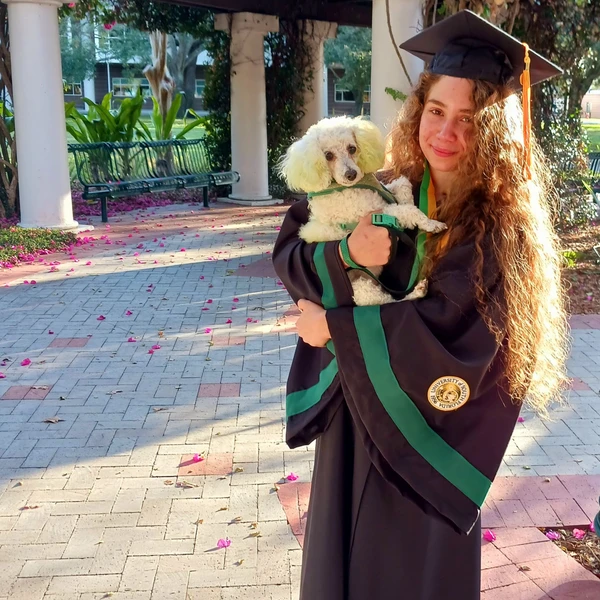
I'm a first-generation college student and aspiring mixed animal veterinarian who started college at 12 and earned my bachelor's degree by 16. I was recently accepted into the inaugural class at Utah State University College of Veterinary Medicine. Raised by a single mom, I learned to juggle school, work, and volunteering from a young age. I also assisted with day-to-day tasks in my mom’s small home-based hair studio to help support us. My dream is to open a veterinary practice that creates opportunities for people with disabilities like me and makes care more accessible in rural and underserved communities.
Education
Utah State University
Doctoral degree program (PhD, MD, JD, etc.)Majors:
- Veterinary/Animal Health Technologies/Technicians
University of South Florida-Main Campus
Bachelor's degree programMajors:
- Biology, General
Hillsborough Community College
Associate's degree programMajors:
- Biology, General
Miscellaneous
Desired degree level:
Doctoral degree program (PhD, MD, JD, etc.)
Graduate schools of interest:
Transfer schools of interest:
Majors of interest:
Career
Dream career field:
Veterinary
Dream career goals:
Veterinary Technician
Valrico Animal Clinic2025 – Present1 yearVeterinary Technician
Hyde Park Veterinary Hospital2025 – 2025
Sports
Karate
Club2012 – 202210 years
Research
Biological and Physical Sciences
Dr. Slavov Lab — Volunteer Research Assistant2024 – 2025Biotechnology
Dr. Cao Lab — Volunteer Research Assistant2025 – 2025
Public services
Volunteering
Humane Society of Tampa Bay — Volunteer2021 – 2023Volunteering
Keeping Tampa Bay Beautiful — Volunteer2022 – 2023Volunteering
Noah’s Ark Animal Hospital — Volunteer Veterinary Assistant2023 – 2024
Future Interests
Advocacy
Volunteering
Philanthropy
Entrepreneurship
Elijah's Helping Hand Scholarship Award
Bruises, scars, and blood. Belittlement, manipulation, and gaslighting. That sums up my childhood.
After experiencing abuse by my father as an infant, I was left in the care of my mother. For a few years, I attended public school where I made friends and felt supported by my teachers. But after I was diagnosed with a chronic stomach condition, my mom chose to homeschool me. That’s when everything changed.
Without a father, friends, teachers, or counselors, I was completely at the mercy of my mom. Many days were filled with her putting me down, calling me stupid, comparing me to other children she "wished were hers," pulling my hair, and hitting me with whatever she could find. I started to wonder if maybe she was right. Maybe I was innately bad, unworthy, and unlovable.
Feeling lonely and isolated, I went online looking for connection. When my mom found out, things only got worse. She started locking me in the bathroom for hours with homework. Sometimes, my little dog Daisy was in there with me. She was the only comfort I had.
Still, I loved my mom. I clung to old videos from when I was five — her laughing with me on a scooter, teaching me how to do push-ups. Not wanting to believe the person I was living with was the same person from those videos, I made up a story: maybe something happened to her soul, maybe the real her was in the star that used to sit above my bedroom window. Some days I would fall to the ground sobbing, like a thousand boulders were crushing my chest.
I used to imagine a car coming toward me and thought of just letting it hit me, ending a life I no longer wanted to remember. One day, I turned to Reddit to see if anyone else was experiencing what I was. I was shocked to find hundreds of threads from kids just like me looking for answers. I considered that a blessing from God. That was the day I realized I didn’t deserve to be beaten, taunted, or erased.
Today, I still live with my mom. But despite everything, I graduated college at 17 with a Bachelor's degree and was just accepted to veterinary school at Utah State University.
What I appreciate most about my journey is how pain can expand your heart. I don’t look at strangers the same way anymore. I don't assume a smile means someone’s okay. At work, I make sure to smile at everyone and ask about their day, because I remember how those small gestures made me feel like someone cared. When friends or coworkers cry, I hug them tightly, because I remember hugging my pillow at night pretending it was someone who loved me.
Surviving mental illness teaches you the gravity of your words and actions. I never thought I’d experience suicidal thoughts, even when I was screaming in pain to walls. And then I did. I picked at my skin until it bled, bit my nails until they hurt, and broke down completely. But I made it through.
Being a veterinarian may not seem like the most therapeutic profession, but for me, it’s deeply healing. My dog Daisy became a mother to me. Her love wasn’t based on my grades or whether I was perfect. It wasn’t even based on my heart, but on hers. She couldn’t speak, but I could look into her eyes as she followed me around, the guardian of my heart — and I knew I was loved.
Thank you for reading.
Kayla Nicole Monk Memorial Scholarship
Lucky's name was ironic. He was emaciated, covered in feces and wounds. After weeks of tireless care from veterinarians, he became a playful pup ready for a new home. Watching his transformation reminded me of my own. Growing up, I faced rejection from my father and struggled with the challenges of a learning disability, which made it hard to believe in myself. Like Lucky, I had someone helping me through the hard times too - my dog, Daisy. Her love and comfort kept me going when things felt too heavy. Seeing how Lucky and I got better with patience and care taught me that being a vet isn't just about fixing medical problems. It's also about protecting the connection people have with their animals and preserving the kind of bond that helps us get through difficult times.
Since I was ten, I've helped my mom run her home beauty salon. I book appointments, manage inventory, and accommodate clients, teaching me time management and conflict resolution. More importantly, watching her struggle as a single mom to make ends meet gave me a unique perspective that I bring to my work as a vet tech. One case that stuck with me was a single mother whose dog had an aural hematoma. While reviewing the estimate, she struggled to keep her toddler calm. As she spoke, I saw a familiar look on her face, one I'd seen on my mom's: panic. She explained that while she wanted to proceed with treatment, it wasn't financially possible. My mother, too, had encountered many situations where she had to say "no" to things we needed because it wasn't in our budget. In that moment, I wanted to be the support that my mom and I had frequently desired. After discussing the situation with the veterinarian, he suggested an affordable alternative: draining the hematoma and prescribing a few doses of prednisone. The client was able to move forward with veterinary care. Without the struggles my mom and I faced growing up, I may not have felt so compelled to advocate for that patient and her family. I hope to carry that understanding into my future as a veterinarian.
Through research, I've seen how the human-animal bond extends beyond the clinic. I contributed to developing a dementia vaccine to reverse cognitive decline in humans and animals. In addition, my work on prion disease pushed me to learn new tools, design ligands, and quickly adapt as the project evolved. My research made me want to use those skills in veterinary medicine, especially to help make treatment more affordable. Over time, I've worked with wildlife, companion pets, exotics, and now horses. Those experiences are why I want to become a mixed-animal vet who helps animals of all kinds feel safe and cared for.
My hands-on experience and research background have prepared me to grow in this field. Receiving this scholarship will enable me to focus on earning my degree rather than on financial challenges. I’ve overcome many difficulties from a young age, which have taught me to have compassion for others who face unique circumstances. I hope you will see the potential in me to be a veterinarian who, besides diagnosing, treating, performing procedures, leading in emergencies, and contributing to research, supports clients with limited resources.
Alger Memorial Scholarship
“Be the change you wish to see in the world.”
This quote means a lot to me because I’ve lived by doing what needed to be done, even when I didn’t have a perfect plan or support system. I’ve learned to keep moving forward anyway. Even if it was something small. If something needed to be done at school, work, or in my life, I found a way to do it. I believe small changes can lead to big results. It’s always been important to me to do what I can to make things better for others.
At USF, I had the opportunity to join a research project with Dr. Cao on an Alzheimer’s vaccine. One of my responsibilities was helping him find veterinary clinics willing to collaborate by providing blood samples. Because of language barriers, Dr. Cao had trouble connecting with clinics. I’d worked in my mom’s business for years, which gave me experience talking to people, answering questions, and handling different situations. I was hopeful I could help. I drafted a letter explaining our project and visited multiple clinics to present our proposal. After a lot of effort and many rejections, I finally connected him with several collaborators, including the Director of Science at Blue Pearl. This helped move the project forward.
In Genetics, we were assigned a group project that confused some classmates. Hoping to make it easier, I created a GroupMe chat and suggested dividing the work into sections. I matched each part to students based on their strengths. That helped us stay organized and submit something we felt confident about. I’ve been overwhelmed in classes before and never want someone to struggle alone.
Being one of the youngest on staff at the clinic hasn’t always been easy. At first, some people didn’t take me seriously, and I felt overlooked. Instead of letting it get to me, I focused on learning and doing my best. Later, when I saw new hires around my age being treated the same, I made it a point to make them feel welcome. I wanted to be someone they could count on the way I wish someone had been there for me when I started.
Having a learning disability has also shaped how I see things. At times, I’ve been underestimated because of it, but that’s what pushes me to make change. I want to open a practice that hires and supports people with disabilities. I’ve had to figure out how to study in ways that work for me. Having a disability doesn’t mean you’re weak. It teaches you to be creative and solve problems in your own way. Everyone deserves a chance to succeed.
On the first day of my biodiversity lab, an older man joined our table. He brought printed slides instead of a computer. Some classmates made fun of him, but I tried to include him, knowing how isolating it feels to be dismissed. Later, I saw him struggling to photograph microscope slides. Not wanting his grade to suffer, I emailed him offering to send mine. He was incredibly thankful and said he’d hoped someone would help. At our next lab, he brought me a pink rose from his garden to thank me. I was surprised something so small had meant that much. That moment reminded me that small things can mean a lot.
Whether in research, the classroom, or the clinic, I’ve learned that being the change doesn’t always mean doing something big. It means noticing what needs to be done, and being willing to step in.
Lotus Scholarship
When I hear the word "resiliency," I see my mom waking me up at 4 a.m. to teach me before heading to work in her salon. We couldn’t afford tutors, so we sat at the kitchen table with old textbooks and a laptop, using YouTube and Google to learn what we didn’t know. People told her she couldn’t homeschool me because she wasn’t educated, but we did it anyway.
I didn’t set out to graduate high school at 13 or earn my bachelor’s degree at 16. I just kept going, even when it was hard. I didn’t take summers off, and I studied through holidays. When I felt discouraged, I leaned on prayer and reminded myself why I started.
We didn’t have a safety net. When people promised to help and didn’t follow through, we did things ourselves. I once planted a butterfly garden after someone promised to help and never showed up. I read everything I could and taught myself. That’s when I realized that commitment doesn’t depend on others, it’s a choice I can make.
I have a learning disability, so I had to find creative ways to succeed. I used a whiteboard to simplify tough concepts, and I led study groups in Organic Chemistry and Genetics. Helping others learn gave me a sense of purpose.
I now work as a veterinary technician and just got accepted to veterinary school. My goal is to open a clinic that provides care to both animals and underserved families. I want to show others that even if you come from nothing, you can still become something. My experiences didn’t hold me back, they made me who I am today. And I plan to use everything I’ve learned to lift others up.
Unleashable Scholar
My interest in veterinary medicine began with a desire to help animals that, like me, had been through difficult times. One of the cases that has stuck with me the most was that of a terrier named Lucky. When he came to the Humane Society where I was volunteering at the time, he was emaciated, covered in feces, and had open wounds all over his body. I helped care for Lucky over several weeks, cleaning his wounds, bathing him with medicated shampoos, and applying ointments to treat his skin infections. As his skin began to recover, his whole personality changed. He went from a scared puppy hiding in the corner of his cage to a playful boy ready for his new home. That experience made me realize how important it is to heal animals from the outside in.
After I started working as a veterinary technician at several general practices, I realized that the number of cases involving skin diseases was particularly high, especially in Florida, where the hot and humid climate creates ideal conditions for skin problems. I saw several pets that came in with flaky, itchy skin, which was causing them considerable discomfort. After treatments with either allergy injections, such as Cytopoint or Apoquel pills, or Sebozole shampoo and cefpodoxime, some animals came in for their two-week rechecks looking fantastic and in great spirits. Sometimes, other patients weren't so lucky. Their owners would spend hundreds of dollars seeking dozens of treatment options, only to find that they would have to go to a dermatology specialist who could identify the root of the problem.
Despite the demand for this expertise, there is a shortage of veterinary dermatologists, mainly due to the extra training required and how difficult it is to secure a residency in the field. Because of this, it is a career path I am committed to. Not only do I love veterinary science as a whole, but I also believe that skin problems are not given the attention they deserve. Skin conditions appear to play a crucial role in human health, yet they are often overlooked in animals. That's something I am hoping to change.
I've learned that I enjoy the detective work involved in dermatology and the client communication that comes with managing chronic cases. It combines medicine, problem-solving, and compassion in a way that aligns with the kind of veterinarian I aspire to be. My goal is to continually build my knowledge and skills in this area, as I have learned from both personal experience and from animals like Lucky that healing the outside can be a significant part of healing the inside as well.
Online ADHD Diagnosis Mental Health Scholarship for Women
Growing up, I endured several traumatic experiences that left invisible scars. My father repeatedly assaulted me at a young age. The effects of this abuse were worsened by the fact that I was forced to continue seeing him after the incidents had been reported. The emotional turmoil I bottled up manifested in self-destructive behavior like nail-biting, overeating, and picking at my skin until it bled. These were my ways of releasing my pain without having to talk about it. I also became extremely sensitive to various noises, including chewing, tapping, whispering, and any other wet sounds. Just listening to someone eat will drive me into a rage, and cause me physical pain, making it difficult to concentrate at school or even have dinner with someone else.
After he got married, my father disappeared. While I was thankful I would never be hurt by him again, the effects of the abuse he had inflicted remained. I experienced social anxiety, sensory sensitivities, and difficulty focusing. After visits to a therapist, I was diagnosed with PTSD.
One of the hardest parts of living with PTSD is the constant and unrelenting pain caused by things that would never affect the average person. Because I also have flat affect, you would never know what I'm feeling, even in extremely stressful situations. Struggling to organize my thoughts, communicate clearly, or cope with my issues, the stress manifests itself in different ways, the most common being nausea and intense burning of my stomach. For a long time, I felt embarrassed about my symptoms, and was scared to reach out for help because I didn't want to be thought of as crazy or not good enough. But with the support of therapy, I realized I wasn't alone, and I've been learning how to manage my anxiety, set boundaries, and seek academic accommodations that have helped me succeed in school.
From this experience, I've learned how to channel my health and help others in similar situations, sometimes just by sharing in their suffering. I have stopped self-harming with the help of licensed professionals and a lot of prayer. Despite everything I've experienced along with the endless support of my mom, I was able to graduate from the University of South Florida at 16, making me one of the youngest people to do so (youtube.com+2usfznews.com+2usf.edu+2). I'm grateful that these experiences didn't define me, but rather that I was able to come out stronger because of them.
Carolina Kennel Club Veterinary Scholarship
Lucky's name was ironic. He was emaciated, covered in feces and wounds. After weeks of tireless care from veterinarians, he became a playful pup ready for a new home. Watching his transformation reminded me of my own. Growing up, I faced rejection from my father and struggled with the challenges of a learning disability, which made it hard to believe in myself. Like Lucky, I had someone helping me through the hard times, too - my dog, Daisy. Her love and comfort kept me going when things felt too heavy. Seeing how Lucky and I got better with patience and care taught me that being a vet isn't just about fixing medical problems. It's also about protecting the connection people have with their animals and preserving the kind of bond that helps us get through difficult times.
Since I was ten, I've helped my mom run her home beauty salon. I book appointments, manage inventory, and accommodate clients, teaching me time management and conflict resolution. More importantly, watching her struggle as a single mom to make ends meet gave me a unique perspective that I bring to my work as a vet tech. One case that stuck with me was a single mother whose dog had an aural hematoma. While reviewing the estimate, she struggled to keep her toddler calm. As she spoke, I saw a familiar look on her face, one I'd seen on my mom's: panic. She explained that while she wanted to proceed with treatment, it wasn't financially possible. My mother, too, had encountered many situations where she had to say "no" to things we needed because it wasn't in our budget. In that moment, I wanted to be the support that my mom and I had frequently desired. After discussing the situation with the veterinarian, he suggested an affordable alternative: draining the hematoma and prescribing a few doses of prednisone. The client was able to move forward with veterinary care. Without the struggles my mom and I faced growing up, I may not have felt so compelled to advocate for that patient and her family. I hope to carry that understanding into my future as a veterinarian.
Through research, I've seen how the human-animal bond extends beyond the clinic. I contributed to developing a dementia vaccine to reverse cognitive decline in humans and animals. In addition, my work on prion disease pushed me to learn new tools, design ligands, and quickly adapt as the project evolved. My research inspired me to utilize those skills in veterinary medicine, particularly to help make treatments more affordable. Over time, I've worked with wildlife, companion pets, exotics, and now horses. Those experiences are why I want to become a mixed-animal vet who helps animals of all kinds feel safe and cared for.
Earning a DVM will enable me to diagnose, treat, perform procedures, lead in emergencies, and contribute to research. It will also provide me with the tools to support clients with limited resources and help develop more affordable care options.
I believe that responsible breeding can be beneficial, especially when it is used to produce good working dogs, including those involved in military service, herding, or as service pets for individuals with disabilities. However, poor breeding practices lead to preventable suffering. For example, Frenchies and other brachycephalic breeds often experience difficulty breathing and suffer from aspiration as puppies, while very large dogs, such as Great Danes, often suffer from severe joint problems. I believe that regardless of breed, every animal deserves patient-focused care. With the right approach, including neutering and outreach, backyard or otherwise improper breeding can be prevented.