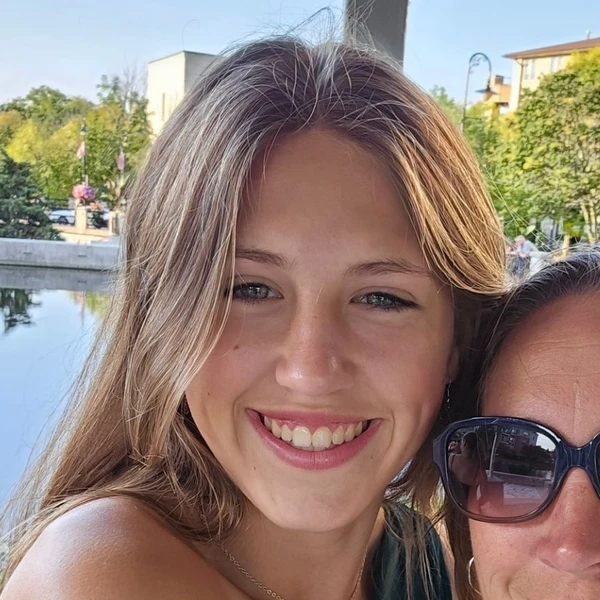
Aliana Banner
1x
Finalist
Aliana Banner
1x
FinalistBio
I would love to work with kids with disabilities when I am older as I have a younger brother (7) who has Down syndrome. I also have an older brother (19) who currently attends UW-Platville and a younger brother (5) who is in kindergarten. I love playing all kinds of sports like basketball, soccer, field hockey, and track and field. I really enjoy baking with my mother and cooking with my father in my free time. I also enjoy creative writing and being outdoors. I am currently committed to play D1 soccer at The Citadel and looking at possibly joining the military!
Education
DIVINE SAVIOR HOLY ANGELS HIGH SCHOOL
High SchoolMiscellaneous
Desired degree level:
Master's degree program
Majors of interest:
- Social Sciences, Other
Career
Dream career field:
Marketing and Advertising
Dream career goals:
Sports
Field Hockey
Varsity2022 – 20264 years
Awards
- First Team All-Conferece
- First Team All-State
Track & Field
Varsity2024 – Present2 years
Soccer
Club2010 – Present16 years
Basketball
Junior Varsity2019 – 20223 years
Artistic Gymnastics
Club2010 – 202111 years
Future Interests
Advocacy
Volunteering
Entrepreneurship
Julie Adams Memorial Scholarship – Women in STEM
The United States is often described as a nation founded on ideals rather than shared ancestry. At its core, being American is tied to values such as freedom, equality, and the belief that every person has worth. These ideals are powerful because they are aspirational: they challenge the nation to continuously grow and correct itself. However, American history also reviews persistent flaws, especially in who is fully included in these promises. One of the clearest ways to understand both America's noblest ideas and its most significant shortcomings is by examining how the country treats individuals with disabilities, particularly those with Down syndrome. Through this lens, the American story becomes 1 of contradicting struggle and gradual progress, reflecting both the nation's failures and its capacity for moral growth.
The idea that “all people are created equal” suggests that value is not earned through intelligence, productivity, or physical ability, but is something every person possesses simply by existing. This is especially meaningful in the context of individuals with Down syndrome challenging society's narrow definitions of success and ability, reminding Americans that dignity is not dependent on academic performance or economic contribution. When America lives up to its ideals, it recognizes people with Down syndrome as full citizens — capable of joy, relationships, work, creativity, and meaningful participation in community.
While opportunity does not mean everyone achieves the same outcomes, it does mean everyone deserves access to education, health care, employment, and social inclusion. For people with Down syndrome this idea has fueled movements for inclusive classrooms, supported employment programs, and legal protection under disability rights law. These advancements reflect America at its best: a society willing to expand its understanding of who belongs and who deserves support. The moral strengths of the nation lies not in uniformity, but in its willingness to adapt systems to serve people with different needs.
Additionally, the emphasis on advocacy and free expression has allowed families, individuals, and allies within the Down syndrome community to speak out against discrimination and low expectations. The ability to challenge injustice openly is a uniquely powerful tool, and it has played a critical role in shifting public perception of disability. Advocacy efforts reflect another noble American ideal — the belief that progress is possible through collective action and moral courage.
Despite these ideals, America's most prominent flaws are revealed when examining how individuals with Down syndrome have been treated historically, and in some cases, continue to be treated today. One major flaw is exclusion, which stems from fear of difference and lack of understanding. For much of American history, people with Down syndrome were segregated, institutionalized, or denied basic opportunities such as education, employment and healthcare. These practices were rooted in the false belief that disability equality equated to inability or lesser worth. Although progress has been made, remnants of these attitudes still exist in the form of social stigma and lowered expectations.
America's tendency to equate value with productivity is another significant flaw. In a culture that prioritizes efficiency, achievement, and economic output, people who learn differently are required additional support and are often seen as burdens rather than contributors. This mindset creates barriers for individuals with Down syndrome, whose strengths may not align with traditional measures of success. These flaws arise from an overemphasis on individuals without sufficient regard for community responsibility. While independence celebrates American values, it can be harmful when it leads to neglect to those who need collective support.
Systemic inequality also plays a role in perpetuating these flaws. Access to resources for people with Down syndrome varies widely based on socioeconomic status, geographic location, and educational funding. This inconsistency reveals a gap between America's promise of equal opportunity and the reality many families face. These shortcomings are not accidental; they stem from historical neglect of disability rights and ongoing discomfort with difference. However, acknowledging these flaws is an essential step towards meaningful change.
The story of Down syndrome in America mirrors the broader American narrative — one marked by struggle, resistance, and gradual expansion of rights. Over time, advocacy has transformed public understanding, shifting the conversation from limitation to capability. This reflects the nation's capacity for self-reflection and moral growth. America's flaws do not negate its ideals; rather, they expose their work still required to achieve them.
An aspect of my identity is growing up as the sibling of a brother with Down syndrome in a society that often misunderstands disability. My experience has taught me how quickly life can change and how families must adapt within systems that are not always designed for difference. Like many American stories, mine began with uncertainty and fear, followed by growth, responsibility, and a deeper understanding of what inclusion truly means.
Becoming an older sister required me to rethink my role in my family and my expectations of success and communication. As my brother grew, my family learned to meet him where he was instead of forcing him to fit narrow societal norms. Learning new ways to support and communicate with him, like using sign language, has shown me that equality does not mean sameness. This lesson reflects a broader American challenge: creating a society that values people for who they are, not how closely they resemble the majority.
My identity has been shaped by seeing how American culture often responds to disability with pity rather than understanding. Many assume a diagnosis defines a person's quality of life, but my experience has shown me otherwise, watching my brother grow and overcome challenges, reveals how flawed those assumptions are. His progress comes not from lowered expectations, but from consistent support, belief, and opportunity.
My family challenged limitations, placed them on my brother and sought resources that allowed him to thrive. This persistence is central to the American identity, confronting barriers and pushing for change. Ultimately, I want to pursue a major that aligns with the helping of people with special needs. I want to be able to change the views that America has on people with disabilities and that they are and always have been “created equal.”
Wisconsin Gymnastics Scholarship
I have learned many lessons as a leader in high school sports, but the most valuable is that there is always someone watching your leadership on and off the field. It is just as important, if not more important, to be a leader off the field as it is on it. A player may be the most skilled on the team, play nearly the entire game, and serve as an example in practice, but if they fail to support their teammates or show a negative attitude when they are not competing, they are not truly a leader. A leader is someone that anyone can look up to at any given moment, regardless of the situation.
When I was selected as a captain for my senior season after being on varsity since my sophomore year, I understood that this role came with responsibility beyond my performance. I knew I was chosen not only for my experience, but because I set an example for my teammates at all times. At practice and during games, I strive to make an impact in any way I can, whether that is making a key pass, pushing the ball forward, or stepping up in important moments. However, I have learned that leadership is not just about what happens during play, it is also about how you respond in the moments in between.
One moment that reinforced this lesson for me was during a game when I was subbed out after a tough stretch. Instead of becoming frustrated or shutting down, I made a conscious decision to stay engaged and support my team from the sideline. I cheered loudly, offered encouragement, and stayed positive, even when the game was not going in our favor. I noticed that my energy began to influence those around me, and my teammates responded with more confidence and determination. That experience showed me that leadership is not about being in the spotlight, but about lifting others up no matter your role in that moment.
Even outside of games and practices, I take initiative to bring my team together. Whether it is organizing team dinners, encouraging team bonding, or participating in community service, I believe that strong relationships off the field lead to better teamwork on it. Creating a sense of trust and unity has been one of my main goals as a leader.
Ultimately, the most important lesson I have learned is that leadership is not limited to one person. Anyone on the team can be a leader in their own way. During my senior year as a captain, I encouraged each of my teammates to step into leadership roles that made them feel confident and comfortable. By doing this, we created a more supportive and connected team environment. This lesson has shaped me not only as an athlete, but as a person, and it will continue to guide me in my future endeavors.