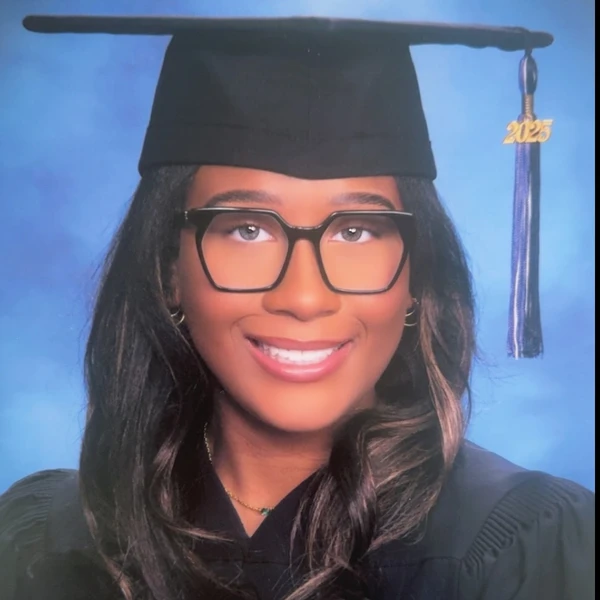
I am the daughter of two teen parents, and the youngest in the family of 4. I am the only girl and the only one afforded the opportunity to go to college. Seeing the opportunity forwarded to me only makes me hungry to succeed. Success for me is reaching my passion of continuing to learn scientifically and reaching my goal of Forensic Pathologist.
From a young age, my fascination with science, the medical field, and mysteries has shaped my aspirations and guided my career path. I was first introduced to forensic science in middle school and initially wanted to pursue a career as a crime scene investigator, but I realized in 10th grade that my calling was in the medical field. Doing research led me to what I believe to be my calling: Forensic Pathology. This profession not only allows me to engage with my passion for science but also presents a unique opportunity to serve as a voice for those who can no longer speak for themselves. My goal is to use fact-based science to accurately determine the causes of suspicious deaths, which will provide closure to my patients and their families.
Forensic pathology is a field that merges medical science with the critical need for justice. As a future pathologist, I vow to ensure that every investigation is thorough and precise, as these findings can significantly impact the lives of many. By uncovering the truth behind each death, I hope to provide clarity and solace to grieving families. I am passionate about justice and once considered law, but my desire to seek truth through undisputable fact-based science has steered me to the medical field.
In addition, I know that our community needs more compassion and support, especially within the healthcare system. There is a significant lack of representation of black medical professionals, which can create barriers for young people of color who aspire to enter the medical field. I, myself, have found it difficult to network in certain settings, but will continue to push through and be to others what I needed for myself. As I pursue my career, I hope to break down these barriers by actively engaging with my community and serving as a role model. It is essential for young people to see themselves reflected in all professions, especially in fields that significantly impact lives.
To foster this connection, I plan to participate in outreach programs and host panel discussions about my career path. By sharing my journey and the importance of forensic pathology, I hope to inspire other young people to consider careers in medicine. I strongly believe that representation matters, so it is crucial to create an environment where the next generation feels empowered to pursue their dreams, regardless of the challenges they may face. Through mentorship and community engagement, I aspire to create a supportive network to bridge the access gap between black medical professionals and the youth. By sharing my experiences and encouraging others, I hope to inspire a new wave of passionate medical professionals who will continue to uplift our communities. I am extremely passionate about creating a future where compassion and medical science intersect to bring healing and justice to those in need.
As a competitive dancer for over ten years, one of the biggest challenges I've faced hasn't been learning difficult choreography or committing to countless hours of practice; it's been learning to accept and embrace the body I dance in. Unlike many of my peers, I've never had what people consider the "typical" dancer's body. That reality brought years of self-doubt, emotional struggle, and the constant feeling that I had to prove myself before stepping on stage. While I've always worked incredibly hard and developed a strong technical skill set, I often felt that appearance-based judgments overshadowed my talent. At competitions, I theorized and sometimes sensed that judges couldn't look past the physical standards for certain styles of dance that they were used to, and it made me question whether I'd ever be truly recognized. Despite the discouragement, I kept showing up. I danced not for a score but for growth. I focused on refining my technique, deepening my emotional expression, and using each performance as an opportunity to become better. While I've been fortunate to receive several academic honors, such as being inducted into the National Honor Society, earning top grade averages, and holding leadership positions, my proudest achievement came outside of the classroom. At a regional competition, out of over 1,000 dancers, I received the highest overall score in my last ever dance competition. For the first time, I felt truly seen and respected for my ability, not measured against a narrow standard of what a dancer is supposed to look like. It was a moment for me and all dancers who have struggled to feel accepted in a space that often prioritizes aesthetics over authenticity. The experience taught me one of the most important life lessons: success is not defined by other people's opinions or whether I fit a mold; it's about staying committed, working hard, and believing in my worth regardless of outside judgment. I've realized that life, like dance, is deeply subjective, and rejection doesn't reflect a lack of talent but reflects one moment in time and one person's perspective. That mindset shift changed everything for me. I no longer dance to be accepted. I dance because it's my passion, outlet, and a space where I've grown mentally, emotionally, and creatively. Overcoming this challenge has shaped how I view myself as a dancer and a human. It has also given me the confidence to advocate for others who feel unseen. Whether in dance, school, or in leadership, I now strive to create spaces where people are valued for their dedication, effort, and heart. Being different isn't a weakness; it's a strength, and now, I carry that lesson with pride every time I step on stage.