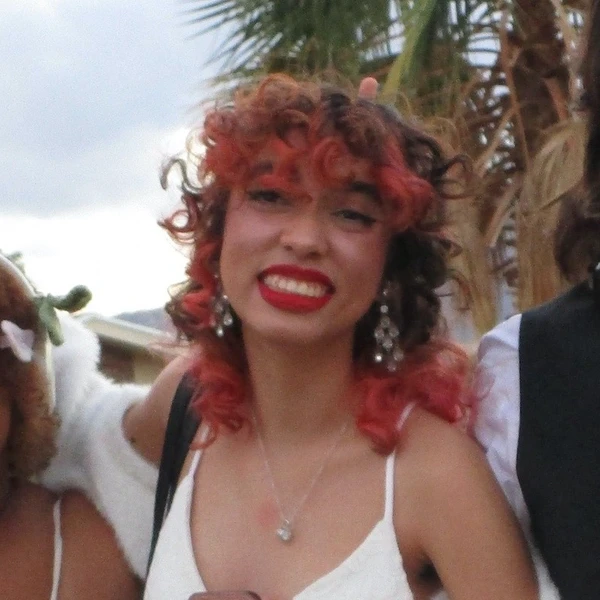
Age
18
Gender
Gender Variant/Non-conforming
Ethnicity
Hispanic/Latino, Asian, Black/African
Hobbies and interests
Animation
Art
Baking
Cinematography
Dance
Directing
Drawing And Illustration
Dungeons And Dragons
Ethics
Graphic Design
Writing
Reading
Academic
Classics
Contemporary
Horror
Magical Realism
Romance
Science Fiction
Cultural
Politics
Folklore
I read books multiple times per week
Ava Chang
1x
Nominee2x
Finalist
Ava Chang
1x
Nominee2x
FinalistBio
My name is Ava Chang, and I am a writer. I will major in creative writing and journalism in the fall of 2026. I aspire to become an educator after a career in publishing.
I plan to use my work to uplift other racialized kids like me so they know that their experiences matter, that their perspectives are acknowledged, and that they are not alone. My goal is to become an author capable of illustrating our broad experiences as multicultural citizens of this country, and that they are capable of forging their own beautiful reflections.
I am strong, bright, queer, and disabled, and I am proud to use my writing to give a voice to those like me. I believe in reflecting the human experience through art, and that literature and journalism can help change the world for the better.
I have taken AP level courses throughout high school with a focus on studying literature, and have medaled in essay writing throughout district to state level. Now, I am more than ecstatic to finally get a chance at entering programs that could change my life and the world around me.
I could not be more thankful to the people who have got me here, including but not limited to my grandparents for seeking a better life here in America, my mother for working her butt off to get my sister and I an education, and every teacher who has encouraged me to follow my potential despite my obstacles. I hope sincerely to make them proud.
Education
Irvin High School
High SchoolMiscellaneous
Desired degree level:
Bachelor's degree program
Majors of interest:
- Literature
- Education, General
- Journalism
- Film/Video and Photographic Arts
Career
Dream career field:
Writing and Editing
Dream career goals:
I am going to become an author and journalistic editor at a publishing house, then I will move into education.
Character Designer & Illustrator
Freelance2024 – Present2 yearsSensitivity Reading
Independent Creator2024 – Present2 years
Sports
Taekwondo
Club2016 – 20204 years
Research
Ethnic Studies
Freelance — Sensitivity Reading & Cultural Research2024 – Present
Arts
Center for Career & Technology Education
Graphic Art2023 – PresentIrvin High School
Dance2024 – 2025
Public services
Volunteering
Most Holy Trinity Catholic Church — Assisted in Organization of Food Drive2023 – 2023Volunteering
Irvin Highschool GSA — Booth Runner2022 – 2023Advocacy
Self Organized — Co-Organizer of Student-Led Protest2026 – 2026
Future Interests
Advocacy
Volunteering
Philanthropy
RonranGlee Literary Scholarship
“Yet hence arises a grave mischief. The sacredness which attaches to the act of creation -the act of thought- is transferred to the record… The writer was a just and wise spirit: henceforward it is settled, the book is perfect; as love of the hero corrupts into worship of his statue. Instantly, the book becomes noxious: the guide is a tyrant. The sluggish and perverted mind of the multitude, slow to open to the incursions of Reason, having once so opened, having once received this book, stands upon it, and makes an outcry, if it is disparaged. Colleges are built on it. Books are written on it by thinkers, not by Man Thinking; men of talent, that is, who start wrong, who set out from accepted dogmas, not from their own sight of principles…”
-Ralph Waldo Emerson.
Language is an imprecise mechanism engrained to each human being at birth. Within mankind’s long mammalian history, communication of ideas is one of the main evolutionary traits that has allowed the human species to survive. The mirror neurons in the primate brain enabled mankind with the ability to empathize and disseminate information based on body language, tone of voice, facial expressions, and eventually the written word. The progression of the human means of communication has been crucial to the sapience needed for agriculture, education, sciences, and advancement as a species. However, a man who has never seen a tiger may not be able to picture it in his mind purely off description alone. He may find himself only able to imagine the terror a tiger might induce when faced with its fangs head on.
Language is imprecise because of the gap between human experience and human imagination. Where the ability to readily and competently communicate ideas is praised, the actual experiences or substances behind understanding those ideas is often undercut. The challenges the everyday person might face can be described in the best, most accurate terms possible, only to fall short to someone who has not yet experienced those challenges. The words no longer contain the context behind them.
Human beings have great difficulty imagining what they have never been exposed to, so languages and arts were created to fill that void, so that one may become familiar with the unfamiliar. In education, society relies on literature and textbooks to prepare the young and inexperienced for facing the world; these tools are used as guides to fill vulnerable minds with the material they need to survive. Thus, the texts or art itself gain a pedestal, rather than the thoughts, work, and happenings put behind them. This is a common cause for the derision of modern or abstract art, in which an audience member might scoff at Klein’s Blue, in which a square canvas is painted in its entirety with a simple blue paint. The audience is devoid of the context that the mixing of the blue paint and the artist’s method to hide the brushstrokes had been revolutionary in the techniques of the art world. Often, to an audience without the experiences to appreciate the process, the product is worth more than the act of creation.
The knowledgeable scholars of society write down what they already know to warn and inform about potential dangers or sociological findings, such as the Museum of Auschwitz or the post-colonialist Braithwaite’s literature on the lasting effects of colonialism in the Caribbean islands. However, the audience’s lack of experiential knowledge means that these writings are mystified. Intelligence becomes something gifted instead of gained, and intellectualism becomes a religion rather than a practice. Each person reading works like Self Reliance, Women, Race & Class, or Great Expectations can feel as though they are only getting half of the story, like trying to imagine a color based on only its name. Thus, there is the assumption of a special talent within the understanding or writing of these literature. In order to fill these holes, a person must go out to explore and learn the context behind these books for oneself. Texts can only supplement so much knowledge when one refuses to expand their own.
The information of the text or past is not to be diminished simply because it is unable to fully communicate its existence or ideals. There is much to learn from learning what one does not understand, and much to be gained once we gain the tools to do so– as long as we forgo the assumption that procuring knowledge is a chore. The issue lies within the assumption that because it is written by a great man, the text becomes ironclad, never to be expanded upon or disproved, taken merely at face value; past information or philosophies can rather be used to guide individuals forward onto new paths that can come from challenging or recontextualizing old ideals. Knowledge becomes valuable when one puts it into action, or vice versa. The importance of pursuing thought and creativity is what led to those former breakthroughs, and there is surely more left in this world to be unearthed as life begins to expand and move past the structure of previous centuries. Plato was taught by Socrates, but he continued to create his own schools of thought long after Socrates was dead.
The transcription of thought and creativity is critical for the world to keep thinking upon and digesting new ideas or concepts than an individual might have never otherwise been exposed to, but the ability to pull back the curtain and find out where those ideas had come from in the first place is an exercise in autonomy. At certain points, when one does not question the information they are told or where it’s coming from, it can be similar to watching the shadows upon the cave wall.
Reading and writing are two important parts of language, allowing one’s thoughts and ideas to be disseminated, discussed and criticized. However, vast amounts of reading or writing about the world without supplementing one’s knowledge with tangible experiences has the potential to create a blind spot within the scholar. Writing a thousand essays does not matter if one does not do the work to understand what makes a great essayist great. Understanding ideas only in theory often leads to half-thoughts and misinterpretations of complex subjects, creating scholars who write confidently on matters they have never truly examined for themselves. A refusal to question and explore the world is a refusal to develop one’s mind. The things humanity can gain from literature is only as great as what we can gain from remaining curious.
The mystification of what makes a great writer or scholar is egregious. Any human has the ability to access thought, to examine and analyze their perspectives of the world, to study. The great injustice comes from an inability to imagine one’s own intelligence or greatness, which comes from the lack of experience that goes into understanding how greatness is made. This is the most horrid example of the impreciseness of language. When a text or scholar is praised, the inexperienced cannot imagine the work, experience, and effort that goes into it.
Justin Burnell Memorial Scholarship
The struggle to find identity is similar to having no identity at all. Brathwaite wrote that every Caribbean person holds a sort of plurality within them in being both assimilated to a foreign culture and retaining a connection to their heritage, finding belonging in both and neither, thus creating something new entirely. Something that struggled to be named. Growing up in a mixed family, my grandmother hailing from Trinidad and my biological grandfather Chinese, I felt that conflicted sense of belonging.
Growing up multiracial was a precursor to the struggle of growing up genderqueer. No one label was ever quite wrong, but there was never one that could perfectly summarize the experiences of my identity. I was both a boy and a girl, while neither all at once. I felt like both everything and nothing, but there was never a word for existing both outside the binary and within it, at least, never one that I felt fit. Like my people of the Caribbean, I was creating a new reality.
My journey to describe my culture was inhibited by my struggle to feel welcome in it. There's an unfortunate reality of Brown and Black spaces or communities being unaccommodating to this kind of multiplicity. I was always one to read, escaping my realities with book after book after book. It was one of the only places I felt seen or safe, but nothing ever felt like enough. Little resources I found ever reflected the realities of the struggle to be me, and I yearned for the chance to see myself on paper. It is one thing to be queer, it is another to be Brown, and then to be a queer Brown person is to not be seen at all. If no one had ever written it, did I even exist?
If I could not find my experiences reflected elsewhere, then I would have to create it myself. Writing, to me, is its own kind of language, one we try to use to bridge the gap between our experiences and others. It hungered deep inside me, a desperation and passion for pulling my soul out of my chest and showing it for the whole world to see. There is nothing more human than the attempt to connect with others, and to be cut off from that is stifling. Writing gave me a way to understand a world that seemed to not want me in it.
If reading was my way of hiding from the world, writing became my way of existing in it. When I began to show my art online and post my writings, I discovered friends and family who had been struggling just like me, ones who had found belonging in the things I had created. Ones who could not live within one identity. There were suddenly people in my life who could accept me and connect with me, encouraging me to write more about the experiences inherent to this kind of being. I was reaffirmed to the fact that voices like mine were worth hearing.
The rise of representation for people like me, fictional and not, has been astounding to see. To have the next generation not live with the same kind of invisibility I felt for years is something I more than want to contribute to. My degrees will hopefully help bridge the gap between language and experience, to find balance in plurality. To give other kids a chance to resonate with the world around them. There is nothing I want more than to keep on writing and create a future where we are seen.
James Lynn Baker II #BeACoffeeBean Scholarship
Growing up Blasian and Mexican, especially in the throes of rising anti-immigrant sentiment mixed with the violence against Asians during the pandemic era, was obviously not ideal.
I watched BLM protests cause waves throughout the country while my Chinese blood was gaining scrutiny, and my hometown was still recovering from getting shot up for the crime of being brown only a year prior. The violence against all of my heritages was up on an international stage, and I was only twelve years old. The news coverage was important, but it scared me. I didn't know where to look.
Then the news started platforming the people fighting. The people brave enough to get on that world stage and say, "These people are my blood. I will not abandon them, even if it is dangerous." The ones that demanded attention and disseminated information. Through those ideals, I have focused my efforts on learning every possible way to look out for my community.
Online sources and the news interviewing people like me were important resources to start with. I began helping with work around the church and gathering donations from my own closet and friends' pantries, doing my best to create a place where people could feel safe. My mother and I carried toys to the youth shelter, made boxes of our out-grown clothes to donate whenever possible, joined community events. I called my friends out when needed, and accepted my own blind-spots when they were pointed out to me. The cruelty I had learned of the world was something I vowed to not let exist in me.
This past year, the realities of that vow have become difficult. The news cycles have felt increasingly like we have been backsliding, and I have caught myself becoming lost in my angers at the world around me. The unfortunate truth is that there is no rest from activism, especially when brown, and that sometimes change requires constant fight for any ounce of justice.
I felt overwhelmed by the sheer intensity of the corruption, one problem fixed only for a thousand more to show. I felt alone upon seeing so many voices celebrating the brutality against my brothers. Every new day I felt as though the rot was deeper than I had ever thought to imagine, that there was not possibly enough I could do to ever fight back. I started to feel like a coward in the face of it all.
Sometimes I still find myself feeling hopeless. But in the news of people speaking out, waking up to and fighting against injustices in this country, I came to the conclusion that we must be able to see the problems to fight them. The love I have for my people needed to be bigger than any fear or shame inside of me. I decided to help organize a student protest, using my resources to spread the word about our demonstration, and our combined efforts lead to television coverage of our story. Not long after many similar demonstrations across the city, the city council voted against building a new detention center.
This is why I plan to study journalism. Our efforts are multiplied when they become visible. My people, every one of them, all deserve a voice within this nation, and I plan to use my degree to give them one. I will focus on issues inside our community and uplift community-led plans on fixing them, because our knowledge and struggles deserve attention. I hope that if I'm given a chance to make that plan a reality, the world will change for the better.
Ryan Stripling “Words Create Worlds” Scholarship for Young Writers
I made my first original story when I was four years old, stranding my stuffed animals on the deserted cardboard islands of my living room carpet sea. I couldn't even read yet when I was forcing my sister to play out the dramatic endings, forcing her to play with dolls and rewrite scene after scene. In the classroom where my teacher would chastise me for my chicken-scratch lettering and doodling battles in the margins, I was always more focused on getting my vision to come across cleanly than fixing my mistakes. My mind has always wandered, to many adults' dismay.
It was like an instinctual need for me. Something written in the fine print of my soul, in whatever outlet it came out in. Markers, pen, iMovie. It was the constant urge to empty out my ever-filling imagination, my brain swirling with each and every concept that passed by, latching onto any hint of a narrative that I could make out. It's like a deep pull in my chest that keeps dragging me back to making new languages, sketching out scenes, and studying each character I made with intensity, always revising.
I was obsessed with my stories. I couldn't make friends and I didn't know how to play properly or what the other kids meant when they said nasty things to me. My parents worked often, and my sister was older. I was alone, but I had my books, my movies, and my journal full of ill-paced comics made by my shaky unskilled hands, and that was enough for me. Stories were a way to get away from everything. It was somewhere I could hide. Somewhere that had room for me.
When I was nine, my aunt told me that I should publish a book I wrote. It was a joke. "Book" is a stretch, as it was more of a notebook I bought from Barnes & Nobles with a main character that was blatantly just a cooler super-powered version of me. Even so, it was the first time anyone had ever suggested that my ideas were worth reading. That my writing, as I would come to know it, meant anything but a silly way to distract myself. It went from a private indulgence to something that might be worth showing to the world. I pushed the doors to my imagination wider, and writing became everything to me. A way to show the intimate experience of how I view the world and the things I thought were worth exploring. To bridge the gaps between language and experience.
I was a young teen when I published something online for the first time. So scared to see what others thought of what I had to say, of how I bared my soul. As I kept diving deeper into my writing, reflecting experiences in my characters that I had never thought to tell anybody, I realized I had become a bridge to every other lonely kid like me. Every brown child without a perspective, every neglected kid with no one to talk to. They found themselves in my stories. They found themselves in me.
To me, writing is a language itself. It's a statement of who you are, your passions, your memories. Your ideas. And I speak to my audience through it. I learned to be brave enough to connect with the outside world, instead of hiding from it. I plan on continuing that journey in college by majoring in English and Creative Writing. I'm going to learn how to keep connecting.
Hines Scholarship
My mother is a first generation American citizen, born here in the states. Both her parents were immigrants from Mexico, neither of whom spoke English. They lived off food stamps and moved often, trying to find a place where they belonged.
My mother went to a local college, the first in her family to do so, working as a bartender at nights to fuel her dreams of something higher. We used to shower with water bottles, the water shutting on and off intermittently as child support checks went undelivered. She decided, all while supporting herself and two kids on the sole income of an elementary school teacher, to go back to school for her Master's degree.
I often watched her stay up late at night in between piles of papers and her open laptop, trying to balance grading papers and submitting her own schoolwork. She was missing my childhood milestones to give us a better life, fighting against the systemic disadvantages that being brown in America gave us, and I was proud of her.
Prejudice and poverty was engrained into my veins from birth. The mix of identities in my blood meant there was no escaping the generational trauma I was going to face, but she worked her hardest to protect me from it. She tried to connect me to the Black and Asian heritage from my father's side, even if he never did, to show me to be proud of who I am. She showed me to be proud of my skin. My mother told me to never wish to be anyone else, no matter the hardships.
I did, of course, because she couldn't shield me from the other children at school as our rights became a presidential debate, or the news stations that recounted the shooting that took place in my city because a white man decided he didn't like Mexicans. But her courage and strength has never once failed to give me some of my own.
I have never once met anyone who could persevere like my mother. She showed me that resilience is what mattered most. She taught me that through our hardships, we stayed strong and lifted others up through our strength. That is how we overcome all the hurdles put up against us.
She taught me a passion for empathy and a commitment toward empowering the people around me. When I think of college, I think of my mother pursuing a higher education so that she can build a better world not only for her children, but for her students. I think of her fighting to provide for me and my sister so that we can live proudly. I think of her fighting to keep us connected to our roots.
I think of the way she helped me find peace in my identity.
I know there are more stories like ours out there. I aspire to use my education to share those stories. I'm pursuing creative writing and journalism, to shine a light on my people so our voices are heard. I want to highlight the man-made inequalities in our communities, as well as show others who look like me that they are not alone.
My mother gave me the ability to pursue my dream and find my voice. I choose to use it to give back to our community. I will continue her fight to lift up others and use my education to expose racial injustices, as well as highlight Black and brown excellence for the world to see. College, for me, means representing my heritage with pride.
Healing Self and Community Scholarship
When I was younger, mental health was more of a threat than anything else. When my depression started to show its face in my preteen years, the thought of going to a doctor was used as a punishment. A therapist was for sick people, villains in our cartoons who shipped people off to gloomy asylums. A place where I'd end up mute and abused if I kept crying, per my daddy's words. It was hard being brown and ill, as Black and Mexican families like the ones my parents hailed from didn't discuss trauma or mental disorders that I might have inherited. Being hit as a child was a funny story and anything else was something you didn't mention.
Then, when I was thirteen, my mom brought me to a book store for my birthday, where a huge section was dedicated to POC authors. Finding stories that showed me at all were rare. The topics those stories tackled made me feel seen and comforted, things I didn't know other people went through. Those books that I found, ones that showed brown kids struggling with their queerness and health, they made me feel less broken. They stopped me from making decisions I couldn't take back. I want to spend my education learning to write those books and show kids that the options are there, that taking care of themselves doesn't have to be scary or shameful. That they're not alone. Sometimes accessibility means showing someone that help exists at all.