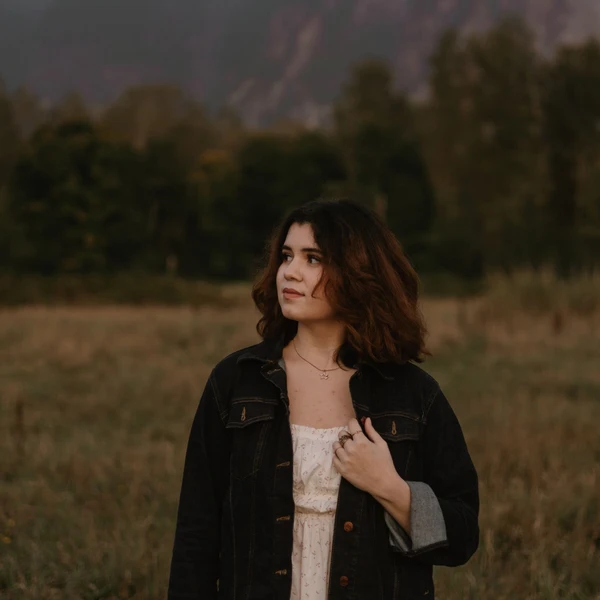
Age
20
Ethnicity
Native American/Indigenous Peoples, Caucasian, Hispanic/Latino
Hobbies and interests
Acting And Theater
Drawing And Illustration
Singing
Alpine Skiing
Hiking And Backpacking
Screenwriting
Writing
Anthropology
International Relations
Reading
Academic
Adult Fiction
Young Adult
Classics
Adventure
Fantasy
Science Fiction
I read books multiple times per month
Kendall Sullivan
1x
Finalist
Kendall Sullivan
1x
FinalistBio
Hi! My name is Kendall Sullivan, but almost everyone knows me by my middle name, Parker. I like to joke that I'm just like Peter Parker because of my name, but really, I don't think we're all that different.
While I might not have spidey-sense, I am a college student with big dreams of changing the world. I'm pursuing my bachelor's degree at the University of Washington in Indigenous Archaeology, with plans to receive my PhD--because if there is any science that desperately needs more Indigenous scientists, it's archaeology.
My culture plays an enormous role in how I live my life, and I am lucky to be surrounded by other Native students here at the UW, and this has only further inspired me to take up positions of leadership and ignited my passion for creating space for Native people in Anthropology. I strive to create change through storytelling, whether that's visually as a muralist, or in my positions at the intersection of the Anthropology and Native communities. I believe that stories are integral to human-nature, and telling the stories of the world, especially of my people, is what drives me.
Education
University of Washington-Seattle Campus
Bachelor's degree programMajors:
- American Indian/Native American Languages, Literatures, and Linguistics
- Archeology
GPA:
3.9
Bellevue College
Associate's degree programGPA:
3.7
Liberty Sr High School
High SchoolGPA:
3.8
Miscellaneous
Desired degree level:
Doctoral degree program (PhD, MD, JD, etc.)
Graduate schools of interest:
Transfer schools of interest:
Majors of interest:
- Anthropology
- American Indian/Native American Languages, Literatures, and Linguistics
- Archeology
Test scores:
1360
SAT
Career
Dream career field:
Writing and Editing
Dream career goals:
Pursue archaeology in the field of research, and be able to work directly with tribes and Indigenous communities either through Cultural Resource Management or Archaeological excavation projects and/or archiving.
Cabin Counselor
YMCA of Greater Seattle2025 – 2025Illustrator
The Daily2024 – 20262 years
Research
Archeology
Lab technician; photographing, sorting, and categorizing lithic artifacts over 7,000 years old.2024 – Present
Arts
The Daily
Illustration2024 – PresentLiberty High School Patriot Players, Troupe #3082
TheatreCinderella , A Midsummer Night's Dream, Mamma Mia, The Visit, Anything Goes2022 – 2024
Public services
Volunteering
First Nations @ UW Powwow — Art Committee Co-Chair2025 – PresentVolunteering
Maple-Hills Elementary — Teacher’s Assistant during the last ~40 minutes of the day.2019 – 2020
Future Interests
Advocacy
Volunteering
#AllKidsNeedBooks Scholarship
From a young age, I knew I loved telling stories. I grew up drawing characters of my own creation and writing fantastical tales in glittery ball-point-pen inside of my school notebooks (much to my teachers dismay). One of my life’s goals is to write and publish a novel, but my proudest piece of storytelling is a mural piece that I had the opportunity to design and paint.
The piece is titled “Currents of Care,” and is installed inside of the Renton Public Library, a facility of the King County Library system in Washington State. The mural is three panels, which tells the story of the Cedar River, indigenous connections to water, and honors four important Indigenous land and water rights activists–including my own late grandfather, who played a role in the Fish Wars of Washington State in the 1960s. Since being installed this past Fall, I’ve had community members approach me and ask me about the mural. It has not only served as a jumping off point to start conversations about the importance of water to my people, but to ask how community members can contribute their own stories to the world around them. In fact, this was one of the major aspects of “Currents of Care.” We organized community events during the process of painting the mural, and incorporated various elements created by members of the community into the mural piece. Every addition held meaning.
This sort of storytelling is not the same as writing a 300-page book, but that does not detract from its significance. I’ve grown to realize that storytelling has endless possible mediums–but this was not always my mindset. When I was younger, I used to believe I could never be a real storyteller. I was too caught up in making silly comics, or typing up fanfiction on the internet. In my head, the only way to tell meaningful stories was through writing captivating novels. So I disregarded the vivid stories that I created through my art, brushed off my high school theater performances, and did not recognize the value in telling the stories of others through my work in Journalism.
For a while, I gave up on the idea of telling stories. I abandoned my hopes of a creative writing career, and focused my sights upon anthropology. Funnily enough, it was in an anthropology class that I realized stories were everywhere. My professor explained that anthropology, and its various fields, was simply a multi-disciplinary way of telling stories of human connection. That’s when it clicked–there was more than one way to tell a story. As it turns out, I didn’t need to write an award-winning novel to make an impact–I was already making one.
While I am no longer pursuing a professional career in writing, storytelling (and my goal of writing a book) has never left my life. If anything, I have been finding ways to emphasize the importance of storytelling in my current career path. As an archaeologist, I view the human material past as physical pieces that we can use to tell stories, and most importantly, to help descendent communities rediscover their stories. Being Native, giving others the ability to bring the stories of their ancestors into a living context is of utmost importance to me. The funds from this scholarship would help to ensure I get the opportunity to continue telling stories through any means possible–whether that is painting murals, excavating artifacts, curating museums, or sharing stories with my Native community–because if there is anything that I can confidently say about myself, it is that I am a storyteller.
UPAC Native American Student Scholarship
I am a member of the Suquamish Tribe in Washington State, and am currently studying Indigenous Archaeology at the University of Washington. I am most interested in Community Based Participatory Research (CBPR), and have been seeking to implement these research strategies practically–Utah’s lush archaeological record and diverse Indigenous communities have been a subject of interest for me for quite some time, and is where I am currently looking to focus my future research. While my own tribal history is of utmost importance to me, I believe that bringing Utah’s archaeological record back into a living context through community-based work is critical. Indigenous perspectives in archaeology are imperative for interpreting and reforming our understandings of the human past as archaeologists, and also for building bridges between Tribal communities and science. Growing up, I found it difficult to imagine myself in anthropological science–after all, people who looked like me were oftentimes the ones being studied, being chained only to the past and forgotten in the present. There often was not room at the table for Indigenous peoples, let alone Indigenous women, to have conversations about science. I don’t want this to be the case for future generations. I want Native kids like myself to be able to imagine themselves as archaeologists, anthropologists, and scientists–individuals who bring invaluable perspectives to their fields. As I grow as a researcher and archaeologist, I want to utilize the perspectives of my community members and of my own positionality to guide my research. Archaeology should be mutually beneficial, and Indigenous peoples deserve the opportunity to tell their own stories and reclaim their own cultures in the present. Inviting living and descendant communities–such as the Puebloan descendants of the Anasazi, or the Great Plains descendants of Fremont peoples–into archaeological conversations should be the ultimate goal of community archaeology. Our collective past is public, and it is perhaps even more important to ensure that descendant communities have equal access to and stake in their past and present. These funds would be utilized to continue my undergraduate studies into the next Fall Quarter at the University of Washington and my subsequent graduation, and anything remaining would be utilized to pay for application fees as I prepare to apply for doctoral programs at various schools I am interested in, including the University of Utah’s Anthropology PhD program. For me, being an archaeologist and being Native are intrinsically woven together, much like the cedar baskets of my ancestors. It is my identity as a Native person that informs my interpretations of the material past, and it is this perspective that is invaluable in today’s world of anthropology. My people, the people of Utah, and all Indigenous peoples deserve a path towards cultural revitalization, and I believe archaeology is a fundamental stone in that path.
Native Heritage Scholarship
Throughout my life, storytelling has been at the very core of who I am. I grew up writing comics on scrap paper, bringing my ideas to life in crayon and pencil, and as I progressed, that love of storytelling shifted to writing, reading, and speaking. I believe that every choice I have made has stemmed from my love of storytelling, and in a way, that love is tied directly to my ancestors, and my ancestors are who I am.
I didn't have the opportunity to grow up hearing stories from my grandpa, or from any elders, due to the very real story which has shaped who I am today--that is, the story of my great-grandfather, and how he was sent to a boarding school. A story which reshaped not only my life, but the life of my mother, and the life of whoever comes after me. Sometime between the years of 1905 and 1915, my great grandfather, George Bailey, a Snohomish man, was sent to the Tulalip Boarding school on the Tulalip Reservation in Washington state. George was born in 1900, and he was sent there only as a little boy, before the school was shut down, and he got a job as a fisherman. This story, is not a happy one. In fact, it was more like a horror story. Many terrible things happened to him at that school. He would speak his language, Lushootseed, and the teachers would call it dirty, and would force soap into his mouth to 'clean' him. They beat him, and created an environment that George would carry with him well into his adulthood. I do not know what else happened to George while he was there, because he dared never speak of it, save for a few words, to his children.
But, I do know one thing. This is the story of my people. A story of violence, abuse, and anger. It is a story which tells of George cycling that violence onto his own child, of how he found solace in alcohol, passing on his coping mechanisms to his son who had to endure the damaged man who tried to raise him. It is a sad, sad story. But it also a story of resilience. A story of redemption, in the form of my mother, who promised herself she would end the cycle of abuse that had started with her grandfather, and it is my story today, as I pursue my education at a university with a dense population of native students. This story has shaped who I am in the most fundamental of ways. It has inspired me to pursue archaeology in the name of all those who had been disrespected by the science, to prove that indigenous voices matter. It has led me to positions of leadership in my community, co-chairing for the art committee at an entirely student run powwow, and as an officer in a native student organization. It is what guides me in every step of my life.
This story of my people, of my family, and of myself, is ever changing. If I cannot get back the pages that have been torn out, then I will write my own. I will re-write everything that was lost, through regaining a sense of community and of my own culture. I hope that one day, this story which has stood the test of time, is a book full of life and culture, and that the pain that George had to endure--that my people, long before him, had to--is nothing more than a distant chapter.
Little Miami Brewing Native American Scholarship Award
I am a descendant of a boarding school survivor. I carry with me three generations of trauma caused by the Tulalip Boarding school, the school which my great-grandfather attended somewhere between 1905 and 1915. It is this school which created a cycle of violence and abuse within my family, which was only broken by my mother, who tried her best to build a better life for me than the life which she had. Despite this, there is still a very heavy existence within my family, the knowledge that our culture was stripped from us by one fateful decision a hundred years in the past. My great grandfather, a Snohomish man, went to that boarding school with long hair--a picture on a bookshelf in my home would tell you that--and after his time there, his hair never reached past his shoulders. He spoke very little about his experiences there, but the ones he did stay with me through my mother's retellings. "He would speak the language," she told me, while we were watching the documentary 'Sugarcane' for the first time. "and he said, they would force soap into his mouth. He said they called it dirty."
As I grapple with the tremendous loss of my family's history, stolen away from me by a past I cannot control, I often find myself asking questions about my life: How would it look different? Would I live on the Tulalip Reservation, instead of a secluded suburb on the east-side of Western Washington? Would I know Lushootseed? Would I have attended powwows as I grew up, instead of neighborhood barbecues? I find myself trying to piece together every part of myself that seemed out of place as I grew up in a small town with nobody else around me to share my history. In fact, it wasn't until high school that I was even able to understand my own past. Today, I attend a university full of Native people, a dynamic that I never had as I grew up. I see myself in a different sort of world, one where I feel just too Native to be in non-Native spaces, but feel too non-Native to be in Native ones. Despite all of this, I have tried my very best to craft a world around me where I do fit. I've found myself surrounded by support of all kinds, from my Native community as I find my place in this strange new world, and I find myself excited to go to powwows, to dance for the first time on powwow floors, to share in making fry bread, and to be in community. Even though my culture may have been taken from me, I will never stop trying to get it back. I believe that at the very least, I owe it to my ancestors, to my mother, and to myself, and to the next generation of people after me.
Elevate Mental Health Awareness Scholarship
Like a lot of people my age, the COVID-19 pandemic was for me, a tough time. Even more than that, it was a stalling of time--in the moment, I often felt like my life would never move on. I was trapped, every day was a cycle of trudging down the stairs, opening a laptop and sitting in silence for hours on end. A cycle I could not escape from. Like a caged animal, my mental health began to deteriorate at an extreme rate. I found myself crying in bed, barely having strength to pull the sheets off my own body. Even years later, I feel as though that period of my life will never leave me. I see it every time I have to open a Zoom meeting, every time I find myself laying in bed longer than I should, when I ignore texts and 'doom scroll' on TikTok. I often get scared that one of these days I will wake back up in that reality, like waking up from a dream. I could blame a lot of my problems on the pandemic, on being locked indoors with nothing but my own thoughts. I could say "Oh, it was because of 2020," or "It was just online school," but I know that my mental health was already fragmented. I know, because some people were able to recover from the pandemic as though nothing had changed--they were able to return to their lives that they had left behind, fit back into society perfectly once the social-distancing policies were lifted. But I'm still learning how to fit back in to a world that I was never really a part of to begin with. I was diagnosed with ADHD at a young age, and prone to anxiety attacks growing up. It was no surprise that for most of my life I struggled with my mental health, with coping mechanisms, with the ability to get out of bed in the morning, and the pandemic was just the match to a spark. The thing about fires, as destructive as they may be, is that it often clears land and leaves space and nutrients for life to recover, or more accurately, to regrow. My growth had been stunted, and a forest fire is what it needed. I find myself today in a place I couldn't picture a year before the pandemic. I am in college now, and I'm not afraid to acknowledge when I need help anymore. I no longer bottle things up, and having a place in community has given me a reason to wake up every morning. I still lay in bed sometimes, staring at the ceiling, but it's no longer with a sense of dread hanging over me. Instead it's a quiet understanding that my body needed this--it needed an extra moment of rest. I don't obsess over my grades, or get mad at myself for not understanding something. The people around me have shown me that everyone learns at different paces, that not everything needs be understood the same way. I carry with me a sense of understanding, an acknowledgement that what I went through during the pandemic was one of the darkest periods of my life, but the light at the end was brighter than at the beginning. I will never be the same person I was before 2020, but that, I know, is a good thing.