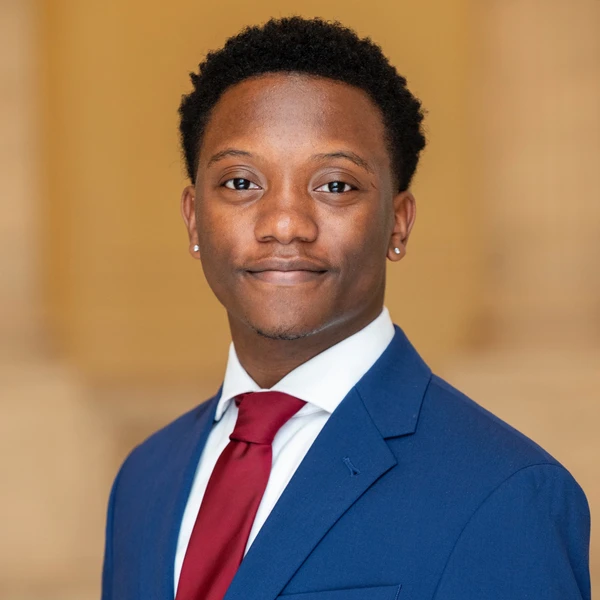
user profile avatar

Aaron Thompson

1x

Finalist

General information

Age
21
Gender
Male
Ethnicity
Black/African

Hobbies & Interests

  • Running
  • Politics and Political Science
  • Mock Trial
  • Philosophy

Reading

  • Literature
  • Adventure
  • Mystery
  • Realistic Fiction

I read books multiple times a month.

Bio

Harvard student studying Social Studies, African American Studies & Economics.

Education

Harvard College

Bachelor's degree program

2023 – 2027

Majors:
  • Ethnic Studies
  • Social Sciences, General
  • Economics
Minors:
  • Romance Languages, Literatures, and Linguistics, General
GPA3.7 GPA

Dallas County Community College District

Associate's degree program

2021 – 2022

GPA4.0 GPA

Rosie Sorrells Education and Social Services High School

High School

2020 – 2023

GPA4.0 GPA

Life High School Waxahachie

High School

2019 – 2020

GPA3.7 GPA

Navarro College

Associate's degree program

2019 – 2020

GPA4.0 GPA

Miscellaneous

Desired degree level:
Doctoral degree program (PhD, MD, JD, etc.)
Majors of interest:
Political Science and Government, Economics
Medical school interest:
No

Career

  • Intern

    Government Administration · City Attorney's Office

    Jan 2021 – Jan 2021

  • Election Clerk

    Civic & Social Organization · City of Dallas

    Jan 2021 – Jan 2021

  • Host events and entertain customers

    Entertainment · Parties with Charm/ Character Clubhouse

    Jan 2019 – Jan 2021

Miscellaneous

Dream career field:
Law Practice
Dream career goals:
Open a pro bono clinic
Has nursing license:
No

Future Interests

  • Advocacy
  • Politics
  • Volunteering
  • Philanthropy
Vincent U. Cornwall Legacy Scholarship
With a lifelong passion for social justice and community engagement, I have come to realize that financial literacy is a critical issue that affects everyone, particularly those from marginalized communities. Many people who grow up in low-income homes lack the resources and education necessary to manage their finances effectively, which can lead to a cycle of poverty that persists for generations. As a result, I have decided to use my experience in civic engagement to educate my community about financial literacy, with a particular focus on policy, resources, and marginalized communities. I believe that by empowering people with the knowledge and tools they need to manage their finances effectively, we can break the cycle of poverty and create a more equitable society. One of the main challenges I have encountered in this work is the lack of resources available to people who come from low-income homes. Many financial literacy programs are geared toward people who already have a basic understanding of personal finance, which can be overwhelming for those who are just starting. In addition, many of these programs require a significant investment of time and money, which can be a barrier for people who are already struggling to make ends meet. More often than not, our Black communities end up getting the short end of the stick. Without proper access to financial literacy resources, coupled with cultural and generational ideas of wealth and money management, it is almost impossible to create social mobility within our communities. To address this issue, I want to develop a financial literacy curriculum that is accessible and relevant to people from all backgrounds. This curriculum will be designed to be delivered in a variety of settings, including schools, community centers, and online platforms. It covers topics such as budgeting, saving, investing, and credit management, and is tailored to the specific needs and challenges faced by people from low-income communities. In addition to developing this curriculum, I also want to build partnerships with local organizations and government agencies to promote financial literacy and advocate for policy change. I believe that by working together, we can create a more supportive and equitable environment for people who are struggling to manage their finances. Having worked with my school's Student Voter Empowerment Coalition and March to the Polls, I have experience when it comes to planning, organizing, and delegating and I would leverage those skills to help benefit my community. Ultimately, my goal is to break the cycle of poverty that disproportionately affects minority students from low-income homes through financial literacy education, community empowerment, and advocacy for policy change. I believe that by empowering individuals with the knowledge and tools they need to manage their finances effectively, we can create a more just and equitable society for all.
Ethel Hayes Destigmatization of Mental Health Scholarship
I think existing as a person of color, more specifically, a Black man in society comes with its daily struggles. In the past few years, seeing the constant neglect and abuse of minorities was mentally draining. I became depressed. I no longer spoke to my parents or played with my brother because I was angry. Additionally, I was starting the school year in a new high school, unfamiliar with any of the students. I was struggling to make friends and participate in class. My parents recognized my behavior and encouraged me to join an after-school club. Little did I know, this would ignite a flame and spark my passion for public service. I joined my school's government and civic engagement club and immediately fell in love with the work they were trying to do. Instead of going to school angry, I was provided an outlet to voice my opinions and concerns with the country's current climate. Understanding how minorities usually take the brunt of poor and misguided legislation, I turned my sites to the public defender crisis. I've learned many things about the legal system and the dismal realities that exist for our public defenders. For instance, when states don't assume financial responsibility, many local governments are left to cover the cost of public defense. In most instances, that funding is not sufficient, negatively impacting our most vulnerable citizens: disenfranchised people of color who cannot afford private attorneys. Knowing such, I decided, in my heart to become an attorney and help reform statewide indigent defense commissions (IDCs). These are responsible for funding, improving, and evaluating defender services. I ask myself, "How can a public defender take on so many cases, especially with the limited resources at their disposal?" The simple answer is they cannot. That is why I want to change their story, birthing a renewal for our defense system. As an attorney, I would advocate for improved public defender resources. And I'd use my understanding of the law to advise the indigent defense commissions to consider new policy installments. In fulfilling this goal, I'd get to work in cohorts with state governments introducing policies that will incentivize and reinspire public defenders who only satisfy their job requirements because of their experiences within the broken system. Such policies would make information more readily available for appointed counsel where open-file discovery would be a requirement. Paired with several other laws, this could metamorphose the reality of public defense as it is known.
Student Memes Scholarship
Fun fact, actually, really really sad fact: @aaron_thompson_05
Aaron Thompson Student Profile | Bold.org